

Quick summary: Autonoma is the open source alternative to Testmo. Testmo provides test management with real-time and historical analytics dashboards. Autonoma uses AI agents to autonomously generate, execute, and maintain tests from your codebase. Open source (BSL 1.1), self-hosted free, no vendor lock-in. A shift from managing test results to autonomous testing that prevents defects proactively.
Testmo is a modern test management platform built around analytics. Real-time dashboards, historical test run data, CI/CD integration, clean reporting. It does the "organize and track" job well. But the question engineering teams should ask is not "which test management tool has the best analytics?" It is "why are we still managing tests manually at all?" That is the gap Autonoma fills.
Where Testmo Falls Short

Analytics Without Autonomy
Testmo's strongest pitch is its reporting: real-time test run results, historical trends, pass/fail rates over time, coverage metrics. These dashboards look impressive in demos. But they are fundamentally backward-looking. They tell you what already happened. They show you which tests failed last sprint, which modules have declining pass rates, which test suites take the longest to execute.
What they cannot do is prevent any of it. Testmo does not generate tests. It does not execute them autonomously. It does not adapt tests when your code changes. The analytics are a mirror, showing you the consequences of manual testing workflows without changing the workflows themselves. You still need humans to write every test case, update every test when features change, and interpret every dashboard to decide what action to take.
Autonoma takes a fundamentally different approach. Instead of reporting on test results after the fact, AI agents proactively generate tests from code changes, execute them automatically, and maintain them as your application evolves. The reporting is built in, but the value is in what happens before the report: defects caught, tests adapted, coverage maintained, all without human intervention.
No AI Capabilities
Testmo is a traditional test management platform. There is no AI test generation, no autonomous execution, no self-healing tests. Every test case is written by a human. Every test update is performed by a human. Every test execution is triggered or scheduled by a human.
In 2026, this means your QA team spends 30-50% of their time on test documentation and maintenance rather than exploratory testing, edge case analysis, or quality strategy. Testmo makes that manual work more organized, but it does not reduce it. The overhead scales linearly with your application's complexity: more features mean more test cases, more maintenance, more dashboard data to sift through.
Autonoma's four-agent architecture eliminates this overhead entirely. The Planner agent reads your codebase and plans test cases automatically, including database state setup. The Diffs Agent keeps the suite aligned on every pull request, adding, deprecating, and adapting tests as your code changes. The Executor agent runs the planned tests against a live preview environment, and the Reviewer agent classifies each result as a real bug, an agent error, or a mismatch. The team that used to spend 20 hours per sprint on test maintenance spends zero.
Cloud-Only, No Self-Hosting
Testmo is a cloud-only SaaS platform. There is no self-hosted option. Your test data, test results, and execution history live on Testmo's infrastructure. For teams in regulated industries (healthcare, finance, government), for organizations with strict data residency requirements, or for companies that simply prefer infrastructure control, this is a non-starter.
Autonoma is open source under a BSL 1.1 license (github.com/autonoma-ai/autonoma). You can self-host on your own infrastructure with zero feature restrictions. Deploy on Kubernetes, Docker, or any Node.js environment. Your test data stays on your servers. You control the infrastructure, the updates, and the security posture. The cloud option exists for teams that prefer managed infrastructure, but it is a choice, not a requirement.
Autonoma: The Open Source Alternative to Testmo
Autonoma is a managed preview environments platform with autonomous end-to-end testing built in. It is worth being precise about what that means before comparing it feature-for-feature with Testmo: Autonoma is not a test case management tool, and it does not try to be. Testmo organizes and reports on tests your team writes and runs manually. Autonoma replaces that manual workflow with agents that plan, run, and maintain E2E tests directly from your codebase on a live preview environment for every pull request. The comparison below is about replacing manual TCM workflows with autonomous testing, not a like-for-like match between two tools in the same category.
Four Agents, Zero Manual Work
1. Planner Agent (Replaces Manual Test Case Writing). Connects to your GitHub repository and reads your codebase. Analyzes routes, API endpoints, and component structure. Identifies user flows and critical paths. Plans test scenarios from actual code, including generating the endpoints needed for database state setup. You do not write test cases; the Planner agent creates the plan by understanding your application architecture. Where Testmo asks you to document what to test, the Planner agent figures it out from your code.
2. Diffs Agent (Replaces Manual Test Maintenance). Triggered on every pull request, the Diffs Agent analyzes the code diff and adds, deprecates, or updates test cases so the suite stays aligned with the codebase. Where Testmo shows you a declining pass rate on a dashboard after the fact, the Diffs Agent keeps the suite current before that gap can appear.
3. Executor Agent (Runs the Tests). Executes the planned test cases against a live preview environment, driving the application's UI the way a real user would. Where Testmo tracks the results of tests others run, the Executor agent runs the tests itself.
4. Reviewer Agent (Classifies the Results). Evaluates every test run and classifies the outcome: a real bug, an agent error, or a mismatch between the test and the plan. Where Testmo hands you a raw pass/fail dashboard to interpret, the Reviewer agent tells you what the result actually means.
Planner and Diffs Agent do the primary work of planning and maintaining coverage; Executor and Reviewer carry out the execution and classification underneath them. Verification layers at each step ensure consistent, reliable behavior. Agents do not take random paths or make probabilistic guesses.
Key Features
Open Source Architecture. The full codebase is available at github.com/autonoma-ai/autonoma under a BSL 1.1 license that converts to Apache 2.0 in March 2028. Self-hosted deployment comes with no feature restrictions. You can audit, modify, and extend the code as needed.
Codebase-First Testing. Tests are planned automatically from your codebase with no manual test writing required. The Planner agent analyzes your routes, components, and user flows to create comprehensive test cases. Framework agnostic: React, Next.js, Vue, Angular, Flutter, React Native all work. The GitHub App integration reads your repo structure to understand your application architecture.
Zero Maintenance. The Diffs Agent keeps tests aligned with your codebase automatically on every pull request, adding, deprecating, and updating test cases as features change. The Planner agent handles database state setup. No test scripts to update manually.
Cross-Platform Coverage. Test across web browsers (Chrome, Firefox, Safari via Playwright), iOS (simulator and real devices via Appium), and Android (emulator and real devices via Appium), all from a single test definition.
Built-In Reporting. Execution reports with screenshots, logs, and AI-powered failure analysis. But the difference is clear: Autonoma's reporting tells you what was caught and fixed autonomously, not what you need to go fix manually.
Developer-Friendly Workflow. Terminal-native interface that integrates with coding agents like Claude and Cursor. CI/CD integration via GitHub Actions, GitLab CI, and CircleCI. Runs locally or in cloud infrastructure.
Tech Stack
TypeScript on Node.js 24 for agent logic and orchestration. Playwright for cross-browser automation. Appium for mobile. PostgreSQL for test data and execution history. Kubernetes for production-grade scaling.
Detailed Feature Comparison
Testmo is a test case management platform; Autonoma is a managed preview environments and E2E testing platform. The rows below cover the dimensions that are genuinely comparable between the two approaches.
| Feature | Testmo | Autonoma |
|---|---|---|
| AI Capabilities | None | Full AI lifecycle: planning, execution, review, and maintenance across four agents |
| Test Case Generation | Manual (humans write test cases) | Automated (Planner agent reads code and plans tests, including DB state setup) |
| Test Execution | Manual or via external automation tools | Automated (Executor agent runs tests against a live preview environment) |
| Test Maintenance | Manual (humans update when features change) | Automated (Diffs Agent adds, deprecates, and updates tests from every PR's code diff) |
| Codebase Integration | None (does not read codebase) | GitHub App reads routes, components, and flows to plan tests directly from code |
| Open Source | No (proprietary, closed source) | Yes (BSL 1.1, github.com/autonoma-ai/autonoma) |
| Self-Hosting | Not available (cloud-only) | Full support (deploy anywhere, no restrictions) |
Cost: Testmo vs Autonoma
Testmo pricing starts at $49/month for small teams and scales to $99+/month for larger teams with advanced features. It is competitively priced for a test management tool. But the sticker price is only part of the cost equation.
The hidden cost with Testmo is the manual labor it still requires. Your team writes every test case. Your team updates tests when features change. Your team interprets dashboards and decides what to do. Even at $49/month, a QA engineer spending 15 hours per sprint on test documentation and maintenance represents thousands of dollars in salary overhead per month. Testmo organizes that work but does not eliminate it.
Autonoma's pricing model is fundamentally different. Self-hosted is free with no feature restrictions. Cloud starts at $499/month for 1M credits, with a free tier (100K credits, no credit card). You pay for testing volume, not team size. A 5-person and 50-person QA team pay the same if they run the same tests. More importantly, Autonoma eliminates the manual labor cost entirely. No test case writing, no test maintenance, no dashboard interpretation overhead.
For a 10-person QA team spending an average of 10 hours per sprint on test management overhead at $80/hour, that is $16,000/month in hidden costs on top of Testmo's subscription. Autonoma reduces that to near zero.
Migration from Testmo to Autonoma
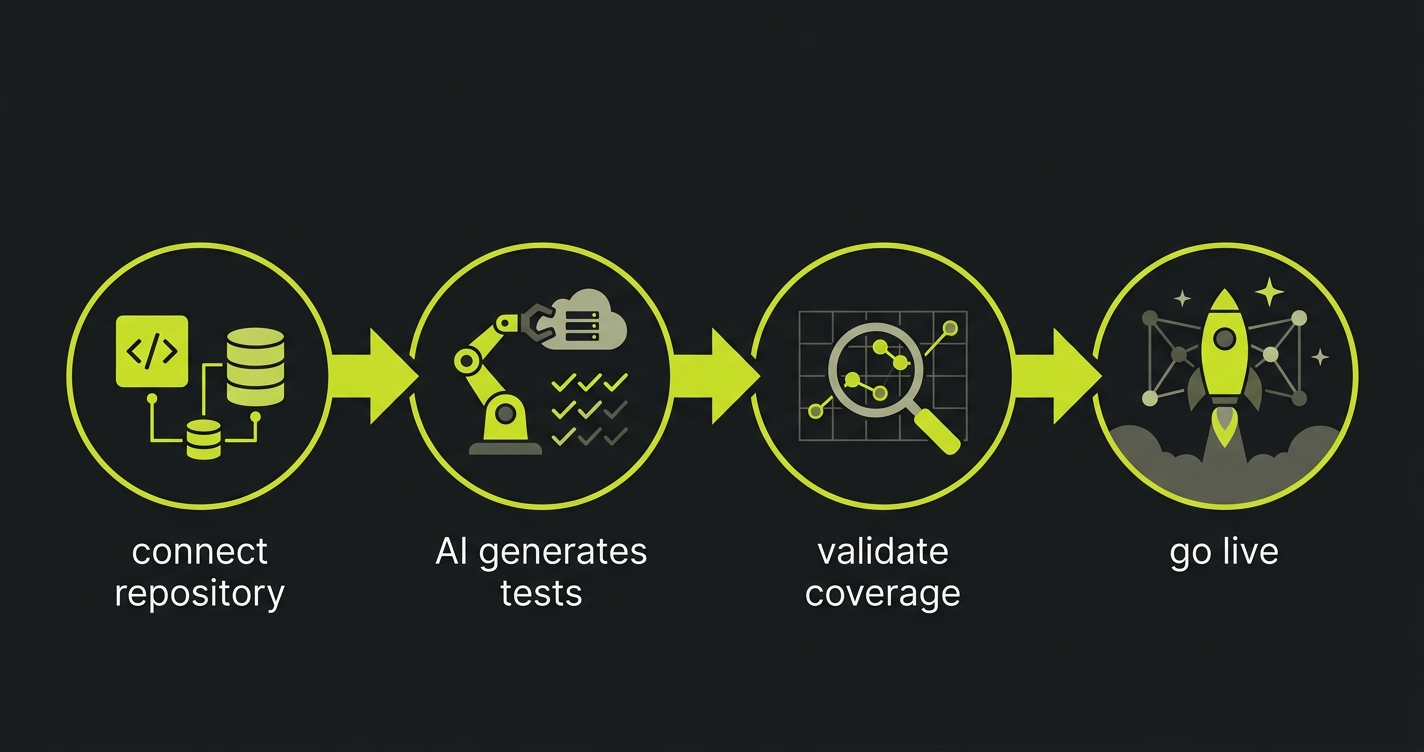
Migration is straightforward because you are not migrating test cases. You are replacing manual test management with autonomous code analysis.
Sign up for the free tier and connect your GitHub repository via the GitHub App. The Planner agent analyzes your codebase (routes, components, user flows) and generates a test plan automatically. There is no need to export or recreate your Testmo test cases. The AI generates better coverage from your actual code than any manually maintained test suite.
Run pilot tests on 5-10 critical user flows. Let the Executor agent run them against a live preview environment and review the results and failure reports the Reviewer agent classifies. Most teams run Autonoma in parallel with Testmo for 2-4 weeks, expanding coverage gradually. Compare results: the AI-planned tests typically catch edge cases that manual test suites miss.
Once confident, integrate with your CI/CD pipeline so the Diffs Agent runs on every pull request. Archive historical Testmo data if needed for compliance. Cancel the Testmo subscription.
From that point forward, feature launches happen without test case updates. The Diffs Agent handles UI and code changes automatically on every PR. The Planner agent updates test plans when new routes are added. "Update test documentation" and "review test analytics" both disappear from sprint planning.
Frequently Asked Questions
Autonoma is the best open source alternative to Testmo. Unlike Testmo's manual test management with analytics dashboards, Autonoma uses AI agents to autonomously generate, execute, and maintain tests. It's open source under a BSL 1.1 license (github.com/autonoma-ai/autonoma), can be self-hosted for free, and eliminates manual test case management entirely.
No. Testmo is a proprietary, cloud-only test management platform. There is no self-hosted option or access to the source code. Autonoma is fully open source under a BSL 1.1 license with the entire codebase available at github.com/autonoma-ai/autonoma.
No. Testmo is a traditional test management platform focused on organizing, tracking, and reporting on tests that humans create and maintain. It does not generate tests, execute them autonomously, or self-heal when code changes. Autonoma's AI agents handle the entire testing lifecycle automatically.
Testmo pricing ranges from $49 to $99+ per month for teams. Autonoma offers a free tier (100K credits, no credit card), cloud plans starting at $499/month for 1M credits, and free self-hosted deployment with no feature limits. The key difference: Testmo charges you to manage tests manually, while Autonoma eliminates manual test management entirely.
Yes. Autonoma is open source (BSL 1.1 license) and can be self-hosted on your infrastructure with zero feature restrictions. Clone the repo from github.com/autonoma-ai/autonoma and deploy on Kubernetes, Docker, or any Node.js environment. Testmo offers no self-hosting option.
Test management analytics (Testmo's strength) gives you backward-looking insights: pass/fail rates, test run history, coverage reports. You still create and maintain tests manually. Autonomous testing (Autonoma) is forward-looking: AI agents proactively generate tests from code changes, execute them, and adapt them automatically. Instead of reporting on what happened, Autonoma prevents issues before they ship.
The Bottom Line
Testmo gives you dashboards and analytics for tests that humans still create, execute, and maintain. Autonoma eliminates the manual work entirely. Four agents read your codebase, plan tests, run them against a live preview environment, review the results, and keep the suite current on every pull request. The analytics come built in, but the real value is upstream: defects caught before they reach any dashboard.
It is open source (github.com/autonoma-ai/autonoma), supports self-hosting with no feature restrictions, and requires no proprietary platform lock-in. If your team spends hours every sprint writing test cases and interpreting test run reports, Autonoma provides a fundamentally different approach.
Start with Autonoma's free tier. Connect your GitHub repo, let the Planner agent analyze your codebase, and see autonomous testing in action. No credit card required, no test cases to write, no dashboards to interpret.
Related Reading:


