

Your Claude Code model choice is a flat multiplier on a bill that context size mostly decides. Run Sonnet 5 by default, drop to Haiku 4.5 for mechanical edits, and reach for Opus 5 only when you have given Claude the full context and it was still wrong. Priced on Anthropic's own published session example, one identical session costs $0.18 on Haiku 4.5 and $1.84 on Fable 5. Switching mid-session throws away your cache.
The first time Claude Code told me I had hit my Opus limit, I did the obvious thing and switched to Sonnet. It kept working. An hour later a different message came up, the session limit, and switching did nothing at all.
Those two limits behave differently, Anthropic documents both, and the difference between them is the entire practical answer to which model you should be running. Not one page ranking for this query mentions it.
The docs will hand you the roster. Anthropic's own selection guidance will tell you to pick a smaller model for routine work and a bigger one when the problem is genuinely hard, which is correct, and which is roughly where every other page stops. What none of them do is put a number on the trade. This one does, using Anthropic's published prices and Anthropic's published example session, with the arithmetic shown so you can redo it when the numbers move.
What the docs answer, and what they leave out
Anthropic's guidance is better than the search results give it credit for. The model and effort level post draws a distinction the thin pages miss entirely: choosing a model picks "which set of frozen weights" handles your request, while the effort level controls "how much work Claude does on your request overall including the number of files read, tools used, and how many steps it takes." Two dials, not one.
Its diagnostic rule is the useful part. "If Claude has all the pertinent context and clearly tried and still got it wrong, that's a signal to pick a larger model." And if it went wrong by skipping a file or not running the tests, that is an effort problem, not a model problem. Most of the frustration people blame on the model tier is actually the second thing, and raising effort with /effort is cheaper than moving up a tier.
The cost documentation is equally blunt: "Sonnet handles most coding tasks well and costs less than Opus. Reserve Opus for complex architectural decisions or multi-step reasoning."
That is a real answer, and it is the last thing anybody tells you. Three questions stay open. What does the tier actually cost you. What does it cost against a usage limit rather than a token bill, since the limit is the thing you will hit first on a subscription. And what happens when you change your mind halfway through a session.
If what you want is the durable framework for matching model to task shape, the version that transfers between tools, I built that one around Copilot's dropdown in Copilot models and it applies here unchanged. This piece deliberately covers the part that does not transfer.
The tier is a multiplier. Context is the bill.
Here is the thing that reframed model choice for me, and it comes out of Anthropic's own documentation rather than anybody's opinion.
The cost page prints a sample /usage output for a real session: 1.2k input, 5.3k output, 940.0k cache read, 50.0k cache write, on Sonnet 4.6, totalling $0.55. Price those four token counts at Sonnet 4.6's published rates and you get $0.5526. It reconciles to the cent, which means the profile is real and we can re-price it at any tier.
Doing that for the current roster, same session, same token counts, list prices as of August 5, 2026:
Haiku 4.5 comes to $0.18. Sonnet 5 comes to $0.37 at its introductory rate. Opus 5 comes to $0.92. Fable 5 comes to $1.84. Two doublings with a 2.5x step in the middle, and Fable 5 lands at exactly ten times Haiku.
Now the part nobody publishes. Break that bill down and 51 percent of it is cache reads, 34 percent is cache writes, 14 percent is output, and fresh input tokens are under one percent. Roughly 85 percent of what you pay for is conversation history, either re-read or written to cache so it can be re-read.
And that mix is identical at every tier, because every Claude model prices cache reads at a tenth of input and output at five times input. The proportions do not move. Only the scale does.
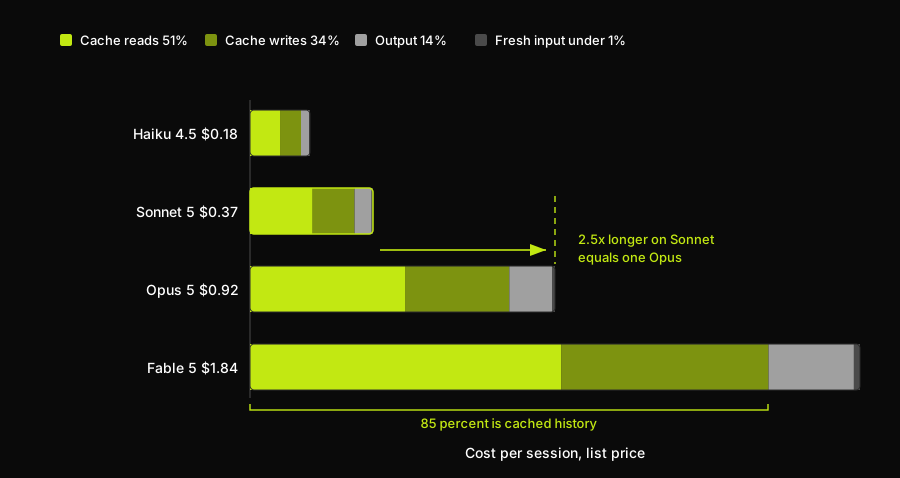
Same token counts, four tiers. The mix never changes, only the multiplier.
So the two levers are orthogonal and they multiply. Model tier sets your rate. Session length sets your volume. Which produces the crossover that actually decides your default: at these prices, a session 2.5 times as long on Sonnet 5 costs the same as one session on Opus 5. If moving up a tier lets you stop three re-explanations, the expensive model was the cheap choice. If you move up a tier and then keep the same sprawling all-afternoon session open, you have multiplied a bill that was already mostly waste.
Which makes session length the lever, and the thing that keeps a session open is rarely discipline. It is not knowing whether the last change actually worked, so the conversation keeps going and the history keeps getting re-read. Anything that answers that question from outside the session shortens it, which is the angle Autonoma comes at this from: tests derived from your codebase, run against the running app, so you close the session on evidence rather than on a hunch.
Two dated caveats, because both of these move. Sonnet 5's $2 and $10 rates are introductory and run through August 31, 2026, after which they go to $3 and $15. That single change narrows the Opus-to-Sonnet gap from 2.5 times to 1.67 times, which is a real shift in where the crossover sits. And models from Claude 4.7 onward use a newer tokenizer that Anthropic says "produces approximately 30% more tokens for the same text," so Sonnet 5's headline saving against Sonnet 4.6 is nearer 13 percent than the 33 percent the price sheet implies.
The usage limit is a different meter, and it is the one you will hit
Everything above is the API bill. On a Pro or Max subscription you are not paying per token, you are spending against an allowance, and the allowance behaves in a way the token math does not predict.
Claude Code surfaces three separate refusals. The error reference lists them together: a session limit that resets at a clock time, a weekly limit that resets on a fixed day, and an Opus limit that resets at a clock time. Then it states the asymmetry that matters, verbatim: "The session and weekly limits are shared across all models, so switching models doesn't restore access. The Opus limit applies only to Opus requests, so switching to another model with /model keeps you working."
That is the operational rule, and it is worth more than any quota number. Hitting the Opus ceiling is not the end of your afternoon, it is a demotion. Hitting the session or weekly ceiling is the end of your afternoon, and reaching for a cheaper model at that point does nothing.
It also reframes what "worth it" means on a subscription. The cost page notes that usage counts against the session and weekly allowances at the same time, and that "a single burst of heavy activity, such as a large workflow fanout, can exhaust the weekly allowance before the session window resets." So the top tier is not competing against your wallet, it is competing against the rest of your week.
Now the honest part. Anthropic does not publish a per-model quota figure, in tokens, messages, or hours, for any plan. What it does publish is the structure: Max 5x is $100 per month and Max 20x is $200 per month, described as five and twenty times more usage per session than Pro; usage is shared across claude.ai, Claude Code and Claude Desktop; and the Max plan page states that "Max plans also have two weekly usage limits: one that applies across all models and another for Sonnet models only."
Read that against the error page and you will notice the two documents name different model-scoped limits, one Sonnet and one Opus, and neither carries a number. I am not going to reconcile them for you by inventing a multiplier, which is what most of the pages in this category would do. Treat any per-tier consumption ratio you see quoted anywhere as unsourced, and read your own numbers out of /usage, which breaks recent consumption down by skills, subagents, plugins and MCP servers and flags any behaviour accounting for 10 percent or more of it.
The one consumption figure Anthropic does publish is worth knowing. Across enterprise deployments it reports an average of "around $13 per developer per active day and $150-250 per developer per month," staying below $30 per active day for 90 percent of users. If you are somewhere in that band, your tier choice is not your problem.
What is a problem in that band is rework. An afternoon spent re-running a change that shipped wrong lands on the same weekly meter as the work you meant to do, and unlike a token bill you cannot top it up. That meter, rather than the invoice, is where Autonoma earns its place next to Claude Code: it derives end-to-end tests from your codebase and runs them against the running app on each pull request, so a broken change is caught by the suite instead of by a second session against the same allowance.
Switching models mid-session, and what it costs
This is the gap in the search results that surprised me most, because the answer is one sentence of first-party documentation and it changes how you work.
You can change model whenever you like. Run /model sonnet and it takes effect immediately. But the model configuration docs note that the picker "asks for confirmation when the conversation has prior output, since the next response re-reads the full history without cached context."
Put that next to the arithmetic above. Cache reads are 51 percent of a session's cost at a tenth of the input rate. Losing the cache means your next turn re-reads that history at full price, on the tier you just switched to. Switching up mid-session therefore costs noticeably more than starting on the expensive tier would have, and switching down after a long session does not save what you expect, because the first turn after the switch pays full freight before the discount resumes.
Which gives you three habits worth more than any tier ranking.
Decide before you start, not forty minutes in. /clear is free and a fresh session on the right model beats a switch inside a stale one. If your plan-then-build rhythm is the reason you keep switching, the opusplan alias exists precisely for it: Opus during plan mode, then Sonnet for execution, with the handoff built in. And when a switch genuinely is the right call, do it at a natural boundary where the history is worth reloading anyway.
Two smaller behaviours to know. Since v2.1.153, picking a model with /model also saves it as your default for new sessions, and pressing s applies it to this session only, which is the difference between changing today's decision and changing every future one. And a session resumed with --resume keeps whichever model it had when the transcript was saved, regardless of your current setting, so a resumed session can quietly be spending at a tier you thought you had left behind.
Where each tier earns its cost
Now the verdict, in the only shape that survives the next model release: by task, not by name.
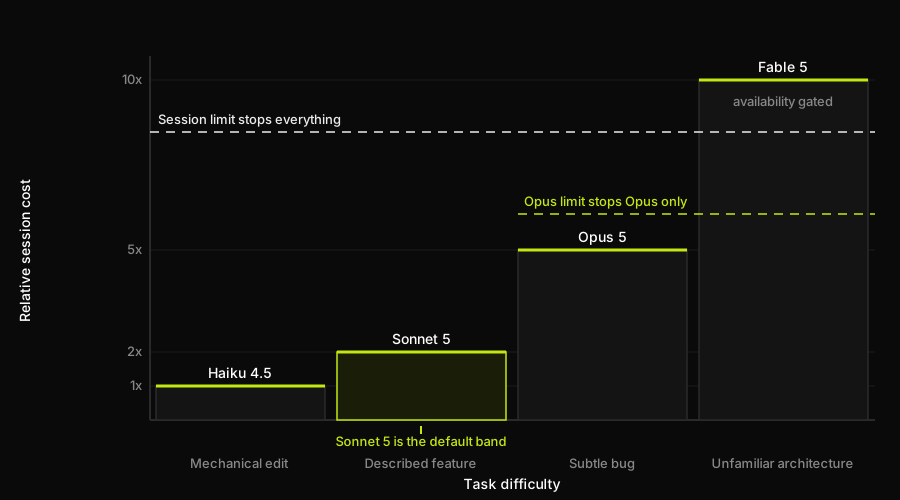
Difficulty on one axis, relative session cost on the other. The ceiling is the constraint, not the price.
The mid tier is your default, and it is not a compromise. Sonnet 5 handles the bulk of implementation work: the feature you can describe, the endpoint plus component plus test, the refactor with a clear target. Anthropic says so itself, and the docs list "Opus left as the default model" alongside sessions that were never cleared as the usual cause of unexpectedly high spend. It also carries a native one million token context window at standard pricing on Claude 4.6 and later, which quietly kills the old argument that you pay up for context. You do not, any more.
The fast tier is underused. Haiku 4.5 costs half of Sonnet 5 at its introductory rate, a third of it from September, and a fifth of Opus 5, and it is the right call for mechanical, precisely-described edits, and for subagents doing high-volume grunt work where you specify the model per subagent. It does not support effort levels at all, which tells you its intended scope. If you are spending flagship tokens on renaming things across a directory, that is the easiest saving on this page.
The top tier earns its cost on ambiguity, not on size. Opus 5 is where you go for architecture decisions, subtle bugs, and unfamiliar domains: the cases where you have already given Claude the context, it tried, and it was wrong anyway. Above it, Fable 5 is described as "suited to tasks larger than a single sitting," sustaining long autonomous sessions and verifying its own work more often, with the guidance to "describe the outcome, not the steps." It is not the default, it is availability-gated per organisation, and at ten times Haiku for identical tokens it is not a tier you leave switched on. If your usage is capped rather than metered, remember that the top tier is spending your week, not your wallet.
The pattern holds across tools, which is why it is worth learning once. The same reasoning applies to model choice inside Cursor, and the reason the leaderboard leader is often not your best pick is the subject of what the coding benchmarks do and do not tell you. If you are still choosing the tool rather than the model, Claude Code against Codex is the comparison you want first.
And here is the part that survives every one of these decisions. Moving up a tier buys you a more confident diff. It does not buy you a verified one. Nothing in the roster above, at any price, will start your application, click through the flow the change touched, and tell you the feature works. That gap is why we built Autonoma to derive end-to-end tests from your codebase and run them against the running app on every pull request, so the answer to "did it work" arrives from the application rather than from the model that wrote it.
Roster and limits as of August 5, 2026
Everything in this box was checked against Anthropic's documentation on 2026-08-05 and is the part of this article most likely to expire. The reasoning above does not depend on it. List prices are per million tokens, input and output.
| Tier | Select with | List price | Default effort | Reach for it when |
|---|---|---|---|---|
| Fable 5 | /model fable | $10 / $50 | high | Work exceeds one sitting |
| Opus 5 | /model opus | $5 / $25 | high | Architecture, subtle bugs |
| Sonnet 5 | /model sonnet | $2 / $10 | high | Most implementation work |
| Haiku 4.5 | /model haiku | $1 / $5 | Not supported | Mechanical, scoped edits |
Sonnet 5's $2 and $10 are introductory and run through August 31, 2026, moving to $3 and $15 on September 1. The opus and sonnet aliases resolve to different versions depending on provider, so Bedrock, Google Cloud and Microsoft Foundry can be a generation behind the Anthropic API. The opusplan alias runs Opus in plan mode and Sonnet for execution. Effort levels run low, medium, high and xhigh up to max on Fable 5, Opus 5 and Sonnet 5, with high as the default. Fable 5 and Opus 5 also carry safety classifiers for cybersecurity and biology content that can move a session to a fallback model mid-flight. No numeric per-plan or per-model quota is published, so read yours from /usage.
The model decides the guess, not the outcome
The honest answer to which Claude Code model to use is that the question is smaller than the search volume suggests. Default to the mid tier, which right now is Sonnet 5, drop to Haiku 4.5 for anything mechanical, and buy Opus 5 when you have handed Claude the whole context and it was still wrong. Then spend your remaining attention on the thing that actually moves your bill and your allowance, which is how much conversation history every turn is dragging along behind it.
The tier question is worth an afternoon of tuning. The question after it is worth more. Whichever tier wrote your last diff, something still has to exercise the running application before you merge it, and that is the layer Autonoma covers: tests derived from the codebase, run against the app on each pull request, kept in step with the code by an agent that reads the diff rather than waiting for someone to rewrite a selector. A better model narrows the odds that the diff is wrong. It never tells you the feature works.
Frequently Asked Questions
Sonnet 5, for most of what you do. Anthropic's own cost documentation says Sonnet handles most coding tasks well and costs less than Opus, and that matches how the tiers behave in practice. Drop to Haiku 4.5 for mechanical, precisely-described edits, where it runs about half of Sonnet 5 while the introductory rate holds and a third of it after September 1, 2026. Move up to Opus 5 only on a specific signal: you gave Claude the full context, it tried, and it was still wrong. Above that, Fable 5 suits work exceeding a single sitting, and it is availability-gated per organisation.
For most work, yes. Anthropic's own cost documentation says Sonnet handles most coding tasks well and costs less than Opus, and it names Opus left as the default model as one of the two usual causes of unexpectedly high spend, alongside long sessions that were never cleared. The default is a good default. What is worth changing deliberately is the two ends: drop to Haiku for mechanical, precisely-described edits, and move up when you have already given Claude the full context and it still got the answer wrong. Anthropic's guidance frames that last case as the actual signal to pick a larger model.
In 2026 that trade has largely stopped existing. Anthropic's pricing documentation states that Claude 4.6 and later models include the full one million token context window at standard pricing, so a 900k-token request bills at the same per-token rate as a 9k one, and Sonnet 5 carries that window natively rather than as an upgrade. You no longer pay a premium for the window. What you do pay for is filling it. Cache reads were 51 percent of the cost in Anthropic's own published session example, so a large window is only expensive in the sense that it lets a session grow until every turn re-sends an enormous history.
Against a rolling five-hour session allowance and a weekly allowance at the same time, shared across claude.ai, Claude Code and Claude Desktop. Anthropic does not publish a numeric quota in tokens, messages or hours for any plan, so treat any per-tier consumption multiplier you see quoted as unsourced. What is documented is the behaviour: the session and weekly limits are shared across all models, so switching models does not restore access, while a model-scoped Opus limit applies only to Opus requests and switching with /model keeps you working. Anthropic also warns that one burst of heavy activity, such as a large workflow fanout, can exhaust the weekly allowance before the session window resets. Run /usage for your own figures, broken down by skills, subagents, plugins and MCP servers.
When the task is mechanical and you can describe the change precisely: renames across a directory, formatting passes, boilerplate, mapping one known shape onto another, and high-volume subagent work where you can set the model per subagent. At list prices it runs about half of Sonnet 5 while the introductory rate holds, a third of it after September 1, 2026, and a fifth of Opus 5 or a tenth of Fable 5, for identical token counts. A useful tell is that Haiku 4.5 does not support effort levels at all, which is Anthropic signalling the intended scope. If a Haiku attempt fails because it skipped a file or did not check its work, that is an effort problem on a model with no effort dial, and the fix is moving up rather than re-prompting.
Your conversation survives, but your cache does not, and that has a real cost. Anthropic's model configuration documentation notes that the picker asks for confirmation when the conversation has prior output, because the next response re-reads the full history without cached context. Since cache reads bill at a tenth of the input rate and made up 51 percent of the cost in Anthropic's published session example, the first turn after a switch pays full price for history that was previously discounted. Practically: decide before you start, use /clear and a fresh session rather than switching inside a stale one, and if your rhythm is plan-then-build use the opusplan alias, which runs Opus in plan mode and Sonnet for execution with the handoff built in.
Yes, and that is the specific thing it does, though it is worth being clear that Autonoma is not a coding assistant and not an alternative to Claude Code. Model tier changes the quality of the guess. It does not change the fact that the first thing to exercise the running application is usually a user. Autonoma derives end-to-end tests from your codebase, runs them against the running app on each pull request, and keeps the suite in step with the code by analysing the diff, so what you get back is behavioural: the flow the change touched either still works or it does not. That answer is the same whether the diff came from Haiku or from Fable 5, which is exactly why it is the useful one.
One that verifies the running application no matter which model tier wrote the change, Haiku, Sonnet, or Opus. Picking the right tier narrows the odds a diff is correct, but tier selection alone never confirms the feature behaves as intended once it's live. Autonoma serves as the AI-native QA layer underneath that decision: it derives behavioral end-to-end tests from your codebase, runs them against the live application on every pull request, and keeps the suite current with a Diffs Agent that reads each code diff, so regressions get caught whether Claude Code shipped the change on the cheap tier or the flagship one.


