

Claude Code vs Codex is a choice between two terminal-first coding agents with different work models rather than different skill levels. Claude Code runs as an interactive session inside your working tree and keeps you in the loop. Codex adds a delegated mode where you hand off a task and collect a diff later. Both write good code. Neither verifies that the running application still behaves correctly, which is the measurement every comparison skips.
Every page that ranks for this comparison quotes a benchmark. Almost none of them will tell you what task produced it.
I went looking for the origin of one claim: that one of these agents burns 5.5 times fewer tokens than the other. I also found its rough inverse, 1.4 times more tokens, describing the same relationship, on other pages ranking for the same query. Nobody reconciles them. Both keep circulating into the next article.
So this piece does three things nobody else does: traces each circulating number back to the usage pattern that produced it, publishes a task specification you can run on your own repo, and costs out the "Claude generates, Codex reviews" hybrid that everyone documents and nobody prices.
Claude Code vs Codex at a glance
| Dimension | Claude Code | Codex |
|---|---|---|
| Primary surface | Session in your working tree | CLI plus delegated cloud tasks |
| Work model | You stay in the loop | You hand off and come back |
| Context handling | 200K window, compacts when full | 400K window, snapshot per task |
| Failure you feel | Context loss mid-task | Wrong answer at the end |
| Parallelism | One session at a time | Fan out several tasks |
| Cost driver | Session length | Task count |
The cost driver row is why the benchmark numbers are a mess. A tool whose cost scales with session length and one whose cost scales with task count cannot be compared with a single ratio. Those window figures are vendor specifications.
Why the benchmark numbers contradict each other
Five figures circulate about Claude Code and Codex. Here is where each came from and what it measured.
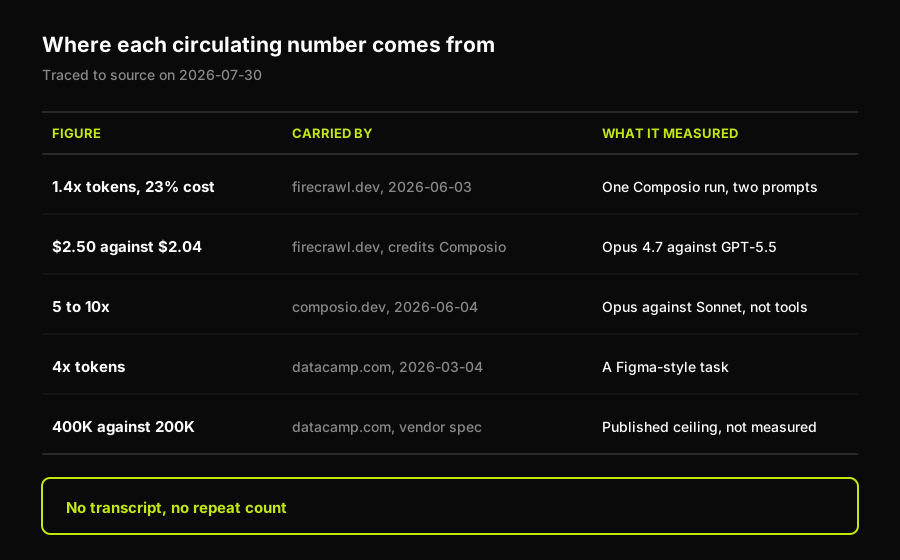
Every figure traces back to a page. Not one traces back to a transcript.
The most-cited pair is more traceable than it looks. Firecrawl's comparison, published 2026-06-03, carries the $2.50 against $2.04 figure and credits it to a controlled Composio test: 192,000 tokens against 136,000, Claude Code on Opus 4.7 against Codex on GPT-5.5, the same two prompts (a PR-triage system and a real-time code review UI), same MCP setup, same machine. Firecrawl reports that as a 1.4x token gap and a 23 percent cost gap.
The big ratio is a different animal. Firecrawl itself calls the circulating 5 to 10x figure folklore and disputes it. The nearest sourceable version, in Composio's write-up from 2026-06-04, says something else entirely: Opus drains the allocation 5 to 10x faster than Sonnet. That compares two Claude model tiers to each other. Somewhere in the retelling a model-tier claim got relabeled as a tool claim, and it has circulated as a Claude Code versus Codex number ever since.
DataCamp's comparison, from 2026-03-04, adds a third measurement again: 6.2 million tokens against 1.5 million on a Figma-style task, roughly 4x. Its context-window figures, 400K for Codex and 200K standard for Claude Code, are the cleanest in the category precisely because it labels them vendor specifications rather than measurements. Notice the citation chain. Firecrawl carries the numbers and credits Composio, while the Composio page that ranks for this query publishes a narrative rather than those figures, its one concrete artifact a 26-hour macOS session with context compression. Nobody is fabricating anything. The figures travel further than the evidence behind them.
Why the surviving numbers still disagree
"Tokens" is not one measurement. Input, output, cache writes, and cache reads are four meters, and cache reads bill at a small fraction of fresh input. That is why one Firecrawl run yields both a 1.4x token gap and a 23 percent cost gap: the ratios move independently, and quoting either alone says something different.
Task shape decides the rest. A short scoped completion mostly measures context-loading defaults, how much of the repository each agent pulls in before writing a line. A long agentic session mostly measures accumulation: turns, window fills, re-reads after each compaction. DataCamp's Figma-style task and Firecrawl's PR-triage prompt are not the same experiment, so 4x and 1.4x can both be right.
And the dates differ: DataCamp 2026-03-04, Firecrawl 2026-06-03, Composio 2026-06-04. Both tools ship changes close to weekly and the model pinned underneath moves too, so a March figure and a June figure measure different software wearing the same names.
The honest bottom line is narrower than it looked. The numbers are traceable. What none of them publishes is a transcript, a repository, or a repeat count. Firecrawl's 23 percent cost gap comes from one run of two prompts, and these systems are non-deterministic enough about tool calls that repeating that run often produces more spread than that. Without a repeat count you cannot separate a property of the tool from a property of one afternoon, and that is true of every number here, including any I could give you.
Run the comparison yourself
I could run the task and publish my own numbers, but one run with no repeat count behind it is exactly the kind of figure this article is complaining about. The specification is the part that transfers. Start with a small full-stack application you already know: a database, a REST API, a component-based frontend. Not a scaffold. The agent has to work inside conventions it did not write.
Give both agents the same single prompt, with no follow-ups until the agent declares itself done. Add a saved-searches feature, where a user can save the current set of search filters under a name, see their saved searches listed, apply one, and delete one. Insist it touch four layers: a schema migration, an API endpoint, a frontend component, and the existing test suite. Four layers is where multi-file coordination starts to matter and single-file benchmarks stop predicting anything.
Hold conditions equal: fresh session on both sides, either no agent-instruction file or byte-identical ones, and matched model tiers. Write down which tiers, because that moves the result more than the tool choice does.
Then record six things.
- Wall clock to the first complete diff
- Files touched
- Whether it built and the suite passed with zero human edits
- The cost each tool reports
- Follow-up prompts needed to reach a working state
- Whether it works in a browser: save a search, reload, apply it, delete it
That sixth measurement answers the question you actually had, which was never "how many tokens" but "did the feature ship." It is also the one no published comparison reports.
Session or delegation: the difference you actually feel
Strip away the model discourse and the durable difference is the work model.
Claude Code is a session. It runs in your terminal against your working tree, you watch each tool call, and you can interrupt the moment it starts editing the wrong file. Context accumulates and compacts when the window fills. The failure mode you feel is context loss mid-task: forty minutes into something complicated, the agent compacts, and the next thing it does contradicts a decision you made twenty minutes earlier. Recovery is cheap because you were watching.
Codex leans toward delegation. Alongside a local CLI, it offers a delegated mode: you describe a task, it runs in a sandboxed container against a repository snapshot, and comes back with a diff. You are not in the loop, which is the point. You find out at the end, and recovery is expensive because there is no steering, only re-prompting. In exchange you get parallelism: fan out five chores at once, and none holds your terminal hostage.
Neither is better in the abstract. Delegation wins on work that is well specified and boring: a mechanical refactor across forty files, backfilling tests for a module nobody has touched in a year. The session model wins on exploratory work, where the codebase surprises you halfway through and saying "no, stop, do it the other way" saves an hour. Both vendors keep growing into each other's modes, so the durable claim is only that each is currently better at the mode it started with.
Is Codex better than Claude Code?
No. Neither Codex nor Claude Code is better in general. They are shaped differently rather than ranked, and the honest answer is which work model matches the task in front of you: an interactive session you steer, or a delegated task you collect later.
If your work is mostly exploratory and you want to steer, Claude Code's interactive session is the better fit. If it is mostly well-specified chores you would rather hand off and review later, Codex's delegated mode is. On raw code quality for a typical multi-file feature, the gap between them is smaller than the gap between two runs of either one, and anyone telling you otherwise is quoting a number whose task they cannot show you.
Codex vs Claude Code: who each one is for
The Reddit consensus here is "just use both," and after tracing every benchmark claim in the category I think that is correct rather than indecisive. Most people still pay for one first.
Pick Claude Code first if you work alone in a codebase you do not fully know, if your tasks reveal their real shape halfway through, or if you have been burned by an agent confidently completing the wrong feature. Do not pick it first if your bottleneck is throughput on a backlog of small tasks, because a session that needs your attention does not parallelize.
Pick Codex first if you have a queue of well-specified work and a review culture that will actually read the diffs. Do not pick it first if your specs are usually wrong on the first pass, because every wrong spec costs a full task instead of one interrupted turn. And check where the sandbox runs before delegating from a regulated codebase.
On cost, the useful heuristic is knowing which meter you are on: session spend tracks how long you keep a session alive, delegated spend tracks how many tasks you fire. And if your decision turns out to be IDE-shaped rather than terminal-shaped, the comparisons that matter are different ones: Claude Code vs Cursor for terminal against editor, Cursor vs Codex from the other side, Cursor vs Windsurf for the AI-first IDE question, and Cursor vs Copilot for the editor-assistant pair.
The generate-then-review hybrid, and what it actually costs
The most sophisticated pattern documented anywhere in this category is "Claude generates, Codex reviews." DataCamp spells it out: use Claude Code to generate the refactored code, then run Codex as reviewer before merging. Nobody writes it up as a workflow with a bill attached.
The loop: you give agent A the task and take its diff. You open a clean session with agent B, hand it the diff plus the task description plus enough surrounding code for the diff to make sense, and ask for a review rather than a rewrite. You take B's findings, discard the noise, apply the real ones, and merge.
The second pass catches the things A rationalized. Because B has no memory of A's reasoning, it is not invested in A's shortcuts. In practice that means unhandled error branches, a migration with no rollback, a query that quietly became N+1, and the classic agent tell of a test that asserts against the mock rather than the behavior. Real catches. Not a useless pattern.
It costs roughly a doubling of token spend per change, because a useful review needs more context than the diff itself. A reviewer that only sees the diff reviews the diff rather than the system, so you feed it surrounding files and the review pass ends up larger than the generation pass. Add serial latency on every merge.
That math is worth it on high-blast-radius work: authentication, payments, permissions, migrations. It is theatre on routine CRUD in a well-covered module, where the second pass reliably produces three naming suggestions and one confident false positive. We covered the dedicated tooling in AI code review tools.
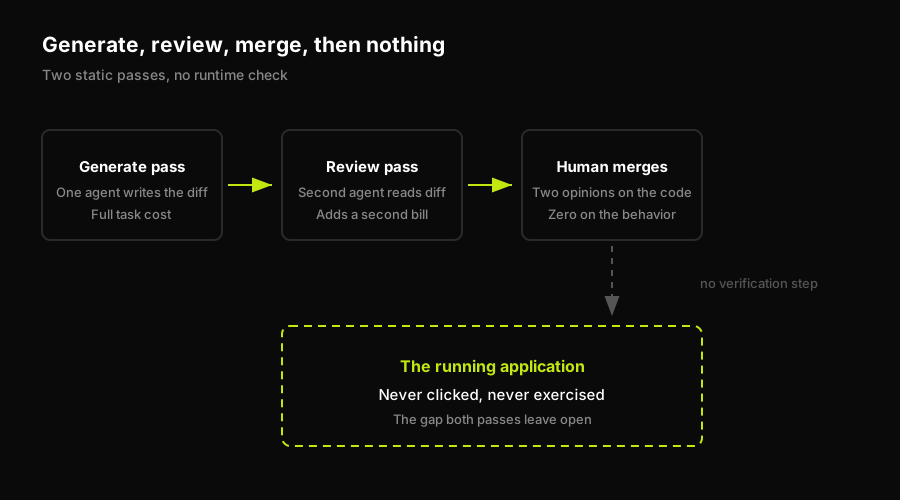
Two static passes over a diff produce two opinions about text, and none about behavior.
Here is the ceiling on the pattern, and it is hard. Both passes are static: two language models reading a diff are two opinions about text. Neither started the application, neither clicked anything, and neither can tell you that the saved-searches feature you just merged silently drops the filter set on page reload. The category built the chain "agent generates, agent reviews" and then stopped, which leaves the last link missing.
How Autonoma verifies what either agent shipped
The pattern this article documented ends the same way every time. An agent writes a diff, a second agent reads it, a human merges, and the first entity to exercise the running application is a user. The hybrid makes the code better and does nothing about the behavior. That is not a gap in either Claude Code or Codex. It is a gap in the step after them.
That step is what we built Autonoma for. Our approach is codebase-first: we read your routes, components, and user flows, derive the end-to-end test cases from the code itself, then run them against the running application on a live preview of the branch, so what gets verified is behavior rather than a diff. The piece that matters at this change rate is the Diffs Agent, triggered per pull request, which adds, updates, and deprecates test cases by analyzing the code diff. When an agent adds four layers of a saved-searches feature in one session, the suite covering it arrives in the same pull request instead of three sprints later.
Map that back to the six measurements above. The generate pass gives you the first five, the review pass improves their quality, and the sixth one, open the app, save a search, reload, apply it, delete it, is the one we run automatically on every pull request. Autonoma is not a coding assistant and not an alternative to either agent here. It does not write your feature. It tells you whether the feature the agent wrote actually works.
What is current as of July 2026
Everything below was verified on 2026-07-30 against the Claude Code docs, the Codex docs, and both vendors' pricing pages. It is the part of this article most likely to be wrong by the time you read it, and the argument above does not depend on it.
Model names churn fastest. If you searched for gpt 5 codex vs claude code, the model name inside that query is the first thing that will expire: both vendors have renamed or replaced the coding-tuned model in their lineup more than once in the past year.
Plan shape has been more stable than plan pricing. Both sides sell an entry tier around $20 per month with limited agent usage, higher tiers roughly in the $100 to $200 range that mostly buy usage rather than capability, and metered API access beyond that. Check the vendor page before quoting any of those figures, including these.
Published context windows are ceilings, not working capacity: they tell you what the model accepts, not how much the agent keeps loaded before compaction. Rate limits and weekly usage caps are the constraint developers actually hit, and those change silently.
What does not decay: the session-versus-delegation split, the reason the token figures contradict each other, and the fact that neither agent verifies the running application.
The comparison you can actually run
The honest answer to "Claude Code or Codex" is that the question is smaller than the comparison articles make it look. Both write good code. The difference that will affect your week is whether you want to steer or to delegate, and the way to find out is to run the six-measurement task above on a repository you know and watch which failure mode annoys you less.
The larger takeaway is worth carrying past this decision: a number without a task is not evidence. That applies to every ratio above, and just as much to "the agent said the tests passed," which is the same shape of claim with the same missing provenance. Once you have picked your agent, the useful next move is to put something behind it that exercises the running application on every pull request, which is the layer Autonoma covers and the reason we argued that AI coding agents need AI testing agents in the first place. If you would rather have your coding tool write the tests instead, we measured how far that gets you in our Cursor E2E testing comparison.
Frequently Asked Questions
No, and the reverse is not true either. They are shaped differently rather than ranked. Claude Code is an interactive terminal session that keeps you in the loop and is stronger on exploratory work where you will change direction mid-task. Codex adds a delegated mode where you hand off a well-specified task and collect a diff later, which is stronger on parallel, well-scoped chores. On raw code quality for a typical multi-file feature, the gap between the two is smaller than the run-to-run variance of either one.
Because they come from different experiments, and one of them is not about the tools at all. The 1.4x token gap and 23 percent cost gap trace to a single controlled run reported by Firecrawl on 2026-06-03 and credited to Composio: 192,000 tokens against 136,000, Claude Code on Opus 4.7 against Codex on GPT-5.5, two named prompts on one machine. The circulating 5 to 10x figure is a category error. The nearest sourceable version, from Composio on 2026-06-04, says Opus drains the allocation 5 to 10x faster than Sonnet, which compares two Claude model tiers rather than the two tools. DataCamp's roughly 4x, from 2026-03-04, is a third task again. On top of that, token counts split across four differently priced meters, and three months apart means different software wearing the same names.
Yes, and the common pattern, documented by DataCamp, is to use Claude Code to generate the refactored code and then run Codex as reviewer before merging. It catches a real class of defect, mainly the things the generating agent rationalized: unhandled error branches, migrations with no rollback, accidental N+1 queries, and tests that assert against a mock. The cost is roughly a doubling of token spend per change, often more since a useful review needs more context than the diff alone, plus serial latency on every merge. Worth it on authentication, payments, permissions, and migrations. Mostly theatre on routine CRUD in a well-covered module.
It depends on which meter your usage runs on, not on a published ratio. Session-based spend scales with how long you keep an agent session alive, so long refactors are where it accumulates. Delegated spend scales with how many tasks you fire off, so a week of over-delegation is where that accumulates. The most-cited comparison, $2.50 against $2.04 on one controlled run, is a 23 percent gap with no published transcript and no repeat count, so it cannot distinguish a property of the tool from a property of one afternoon.
No. They operate at different layers and the review pass is still worth running on high-risk changes. A review pass is static: a second model reading a diff, catching logic and error-handling problems in the text. Autonoma is runtime verification: it derives end-to-end test cases from your codebase and runs them against the running application on a preview of the branch, so it answers whether the feature behaves correctly when a user clicks through it. A diff review cannot answer that question, and a behavioral test cannot tell you your rollback path is missing. Most teams shipping agent-written code at volume want both.
The model names and pricing tiers go stale in weeks, and context-management behavior changes on both sides roughly quarterly, which is why undated benchmark figures in this category are close to worthless. What holds up much longer is the structural comparison: the session-versus-delegation work model, which failure mode each one produces, and the fact that both stop at generation. Treat any published number as valid only for the tool version and date it was measured on, and rerun the task specification yourself if the decision matters.


