

Codex vs Copilot is a confusing comparison before it's a hard one, because "Codex" refers to at least four different things: a retired 2021 code model, OpenAI's open-source Codex CLI, OpenAI's Codex cloud agent, and Codex as a selectable engine inside GitHub Copilot's own coding agent. Once you're comparing the current Codex agent (CLI or cloud) against current GitHub Copilot, the real decision is about delegation model, review surface, and cost, not which one is smarter.
I gave both agents the same small, real task on a Friday afternoon: add a rate-limited retry with exponential backoff around a flaky third-party API call in a Node service, plus a test. Nothing exotic. The kind of ticket that sits in a backlog for two weeks because it's annoying, not hard.
Codex finished first and looked done. It wasn't. GitHub Copilot's agent mode finished second, asked one clarifying question I didn't expect, and shipped something closer to correct on the first pass. Neither one caught the bug that actually mattered, which is the part worth telling you about before we get to naming and pricing.
The Four Things People Mean By "Codex"
Type "codex vs copilot" into Google and you'll land on pages that quietly conflate at least four different products, which is most of why this comparison feels harder than it should. Before comparing anything, it's worth naming them once, cleanly, so the rest of this article (and the rest of this cluster) can just say "Codex" and mean one specific thing.
The 2021 model gets one clause of history and no more: it was OpenAI's original code-completion model, and it's retired. The three that matter today are the Codex CLI (an open-source terminal agent you run locally against your own repository), the Codex cloud agent (hosted inside ChatGPT, clones your repo into a sandbox, works asynchronously, and hands back a diff or a pull request), and, less obviously, Codex as a selectable engine inside GitHub Copilot's own coding agent. That last one is the fact most comparisons miss entirely, and it's the reason this whole query is muddier than "cursor vs codex" or "cline vs cursor": Copilot can literally run Codex.
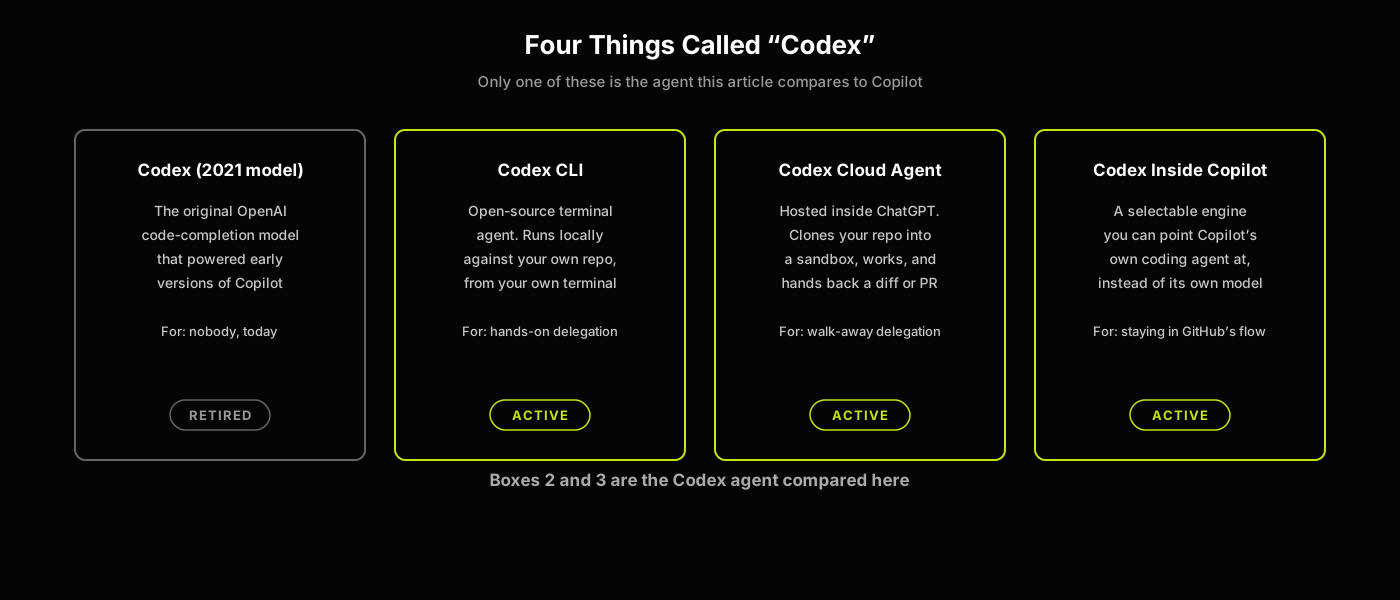
Four names, four different things. This article compares the Codex CLI and Codex cloud agent (the current, active Codex agent) against GitHub Copilot.
| Name | What it is | Status | Who it's for |
|---|---|---|---|
| Codex (2021 model) | Original OpenAI code-completion model | Retired | Nobody, today |
| Codex CLI | Open-source terminal agent, runs locally | Active | Hands-on delegation |
| Codex cloud agent | Hosted in ChatGPT, sandboxed, returns a PR | Active | Walk-away delegation |
| Codex inside Copilot | Selectable engine behind Copilot's agent | Active | Staying in GitHub's flow |
With that resolved, "Codex vs Copilot" means: the Codex CLI and Codex cloud agent, both from OpenAI, versus GitHub Copilot, the tool most developers already have installed. That's the comparison the rest of this article makes. If you're weighing a different pair entirely, we've run the same-task methodology against Claude Code and Cursor, Claude Code and Codex, and Claude Code and Copilot as well, and if Cursor specifically is on your shortlist alongside Copilot, we cover that pair in Copilot vs Cursor.
Codex vs Copilot: The Real Comparison
Once the naming is settled, the actual differences sort into four dimensions: who drives the work, where you see it, what it costs, and where each one lives.
Delegation is the clearest split. The Codex CLI and cloud agent are built around handing off a task and getting a result back, whether that's a few minutes in your terminal or longer running unattended in a sandbox. GitHub Copilot spans a wider range: inline completions you accept keystroke by keystroke, a chat-driven agent mode inside your IDE, and a separate coding agent you can assign a GitHub issue to and walk away from, the same way you'd delegate to Codex. Comparing Codex against Copilot's autocomplete is comparing the wrong layer; comparing it against Copilot's agent mode or coding agent is the fair fight, and that's what the table below does.
| Dimension | Codex (CLI / cloud agent) | GitHub Copilot (agent mode / coding agent) |
|---|---|---|
| Delegation model | Hand off a task, get a diff back | Ranges from inline suggestions to full delegation |
| Review surface | Terminal diff, or a cloud-agent PR | Inline as you type, or a GitHub PR |
| Plan & cost | Bundled into ChatGPT plans, credit-metered | Seat-based plans, credit-metered agent use |
| Availability | Any terminal, or ChatGPT web/app/API | VS Code, JetBrains, Visual Studio, GitHub.com |
The plan-and-cost row is hardest to compare on a spec sheet, because both vendors rebuilt their billing this year and most ranking articles quote the old numbers. We cover what changed, and when, in the dated section near the end. For now: both charge a base subscription and meter heavier agentic work separately, and one real agent session can cost several dollars, not fractions of a cent.
Availability is the most one-sided row. Copilot lives everywhere a developer already works: the IDE, Visual Studio, Xcode, GitHub.com, even GitHub Mobile. Codex's surface is narrower: a terminal you already have, or ChatGPT. Neither wins on ubiquity so much as on where you already spend your day.
What Happened When I Ran the Same Task on Both
Here's the task, written exactly as I gave it to both agents: wrap an existing third-party API call in a small Express service with a retry that uses exponential backoff and jitter, cap it at five attempts, don't retry on 4xx responses, and add a test that proves the backoff timing without actually sleeping in the test. That last constraint is the part that separates a real fix from a plausible-looking one.
This is one run, not a benchmark. I'm reporting it as exactly that: a single data point, with the task specified precisely enough that you can rerun it yourself.
| Aspect | Codex CLI | Copilot agent mode |
|---|---|---|
| Files touched | Client wrapper + new test file | Client wrapper + new test file |
| Got right | Backoff math, jitter, attempt cap | Backoff math, jitter, the 4xx exclusion |
| Got wrong | Retried on 4xx responses too | Skipped the test on the first pass |
| Time to first result | Under 4 minutes | About 6 minutes, across two prompts |
Codex was faster and its backoff curve was cleaner, but it retried on a 400 response the way it retried on a 500, which is exactly the kind of bug that looks fine in a demo and burns your rate limit quota in production. I had to point that out and ask for a fix. Copilot's agent mode caught the 4xx exclusion on its own, matching the spec more closely, but it didn't write the test until I explicitly asked for one in a second message, and it initially reached for a real setTimeout in the test before I asked it to fake the clock.
Neither agent's own output told me any of this. I found the 4xx bug by reading Codex's diff line by line, the same way you'd review any pull request, and I found the missing test by noticing the file list Copilot handed back was one file short. That's the pattern worth remembering more than either individual mistake: both tools produced code that ran, and running was not the same as correct.
Codex and Copilot Overlap More Than the Query Implies
The single most useful fact for anyone searching this term: GitHub Copilot's own coding agent can be pointed at OpenAI's Codex as its underlying engine. Enable Codex as a partner agent in Copilot's settings, and assigning an issue to Copilot can mean the work is actually done by Codex, reviewed and merged through GitHub's normal PR flow. So is Codex the same as Copilot? No. They're built by different companies, priced differently, and used differently day to day. But for a meaningful slice of real usage, "Codex vs Copilot" isn't a choice between two vendors at all. It's a choice of which front door, GitHub's or OpenAI's, you want to walk through to reach work that might be done by either one.
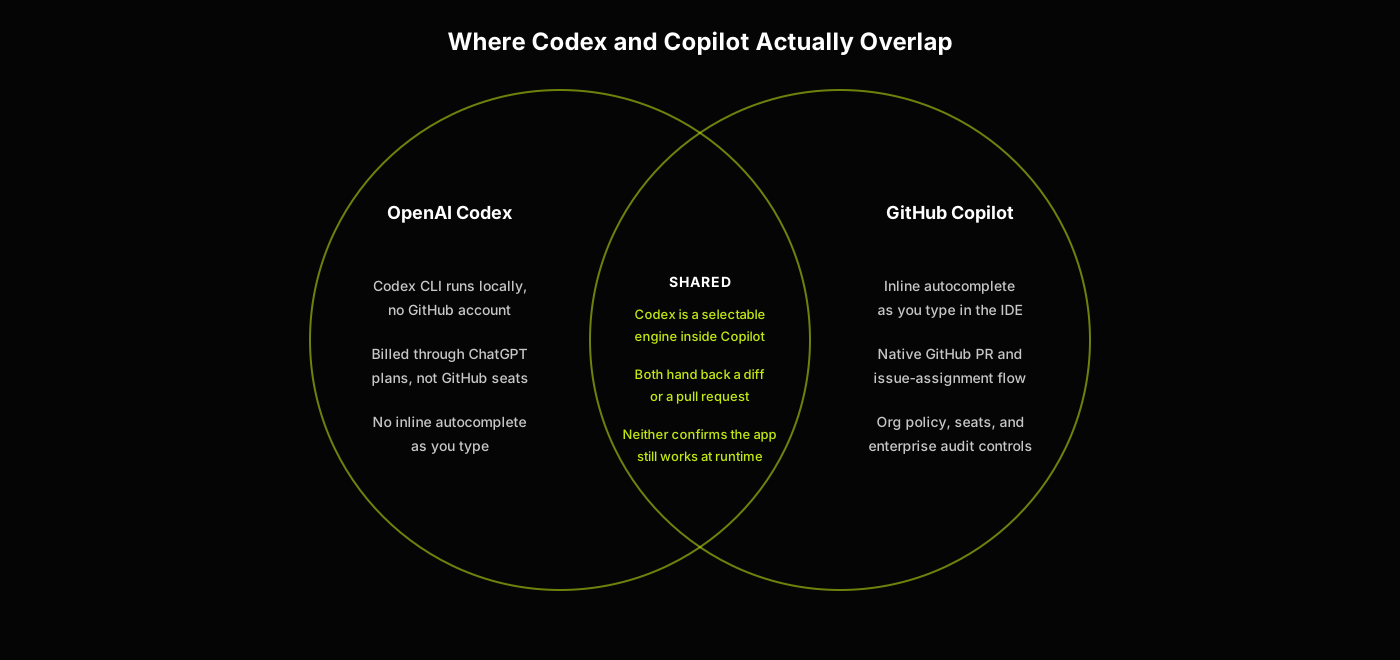
The overlap is bigger than the query implies, and it includes the one fact that resolves most of the confusion.
That overlap doesn't erase the real differences. If you live entirely in a terminal, you're comparing the Codex CLI against Copilot's IDE experience, and the delegation and review rows above still hold. The overlap just means the honest answer is sometimes "it depends which surface you're standing in," not "which model is better."
The Verdict: Use the One That Matches Your Surface
Neither tool wins outright, and every source we found ranking on this term, plus the Reddit threads underneath it, converges on the same place: a lot of developers end up using both. That's not a cop-out verdict, it's the accurate one.
If you live in a terminal and want to hand off a task without opening an IDE, the Codex CLI fits that habit. If you want to walk away entirely and come back to a pull request, the Codex cloud agent does that without GitHub in the loop. If your team already standardizes on GitHub for issues and PRs and wants agent output in that same review flow, Copilot's coding agent (optionally running Codex under the hood) keeps that intact. And if what you mostly want is fast, low-stakes inline suggestions rather than autonomous delegation, that's Copilot's strength, not something Codex competes on at all.
Teams standardizing on one tool for policy or procurement reasons should weight the enterprise row heavily: Copilot's org-level seat management, audit, and policy controls have no close equivalent on the Codex side today. Individual developers optimizing for their own workflow should weight the delegation and review rows instead, and pick whichever one matches how they already like to hand off work.
How Autonoma Verifies What Codex and Copilot Ship
Both tools, in every mode we tested, stop at the same place: a diff or a pull request, ready for a human (or another model) to look at. That's true whether Codex is running standalone or running underneath Copilot's own coding agent, and it's true whether the review happens in a terminal, an IDE panel, or a GitHub PR. The most sophisticated pattern either vendor documents is a second model reviewing the first model's diff, which is still static code review. Our own same-task run found exactly that gap: the bug in Codex's output and the missing test in Copilot's output were both things I had to catch by reading, not something either tool flagged, and nothing in either workflow asks the one question that actually matters before merge: does the feature still work when a user clicks through it?
That's the layer Autonoma exists to close. We built our platform to read your codebase and generate behavioral end-to-end tests directly from it, no recording and no test scripts, then run those tests against a real, managed preview environment on every pull request, whether that PR came from Codex, Copilot, or a person. As the code changes, our Diffs Agent analyzes each new diff and updates the test suite to match, so the tests stay aligned with the application instead of rotting the way hand-written suites do. It doesn't matter which agent opened the PR. What matters is whether the running application still does what it's supposed to, and that's the question neither Codex nor Copilot is built to answer on its own.
What We Verified, and When
Naming, pricing, and model rosters in this category move fast enough that baking specifics into the argument above would date this article within a quarter. Checked against vendor documentation and vendor changelogs on July 30, 2026, here's what was current at write time.
On pricing: GitHub Copilot's plans (Pro at $10/month with $15 of included credits, Pro+ at $39 with $70, and the higher Max tier at $100 with $200) moved from counting premium requests to GitHub AI Credits on June 1, 2026, and OpenAI's ChatGPT plans that bundle Codex (Free, Go at $8, Plus at $20, Pro split into a 5x and a 20x tier around $100 and $200, and Business at roughly $20 per user on an annual plan) moved to token-based credits on April 2, 2026. Both changes mean a single heavy agent session, on either product, can now run into the single digits or low tens of dollars rather than costing a flat, predictable amount. If you're reading pricing guides published before those dates, including some still ranking for this term, treat their multiplier math as legacy: the underlying billing unit they describe no longer exists.
On the overlap: GitHub's own changelog documents Claude and Codex becoming available as partner agents inside Copilot's coding agent, with model selection for those partner agents added on github.com afterward. If you don't see that option, check whether your organization has enabled partner agents under Copilot settings, since it's an opt-in your admin controls, not something that ships on by default.
On the model roster behind each product: both vendors publish and update their own current model lists (Anthropic's and OpenAI's model names inside Copilot's agent settings, and OpenAI's model choices inside Codex), and both lists have already changed more than once in 2026. We're deliberately not repeating a specific model-name roster in the prose above, because a roster is the part of this article most likely to be wrong by the time you read it. Check the vendor's own settings page for whichever tool you're evaluating rather than trusting a snapshot, ours or anyone else's, as current. If picking the right model inside Copilot's dropdown is your actual question, our task-shape framework for that decision goes deeper than a roster ever could.
We'll revisit this section on our normal quarterly cadence, since this pairing (unlike, say, local LLM runtimes) is directly tied to two vendors who both ship changes on a monthly rhythm and have each already reworked their billing once this year.
Both Codex and Copilot are still evolving fast enough that the specific bug we hit in our same-task run may already be patched by the time you read this, and that's fine: the point of running your own version of the test isn't to reproduce our exact result, it's to see what breaks when you hand a real task to whichever one you're considering. Whichever agent you land on, Autonoma is the layer we'd point you to next, not to replace either tool, but to catch what a diff review can't: whether the feature it wrote actually works once someone clicks through it. If you're also comparing this against a terminal-first agent like Claude Code, the architecture split matters more than the brand names, and we break that down fully in IDE vs CLI vs cloud coding agents. And if the deeper question on your mind is less "which tool" and more "why do AI-written diffs keep needing a human to catch what shipped broken," that's the exact argument we make in AI coding agents need AI testing agents.
Frequently Asked Questions
No. Codex is OpenAI's coding agent (available as a CLI or a hosted cloud agent), and GitHub Copilot is GitHub's own developer tool, spanning inline autocomplete, an in-IDE agent mode, and a separate coding agent. They're built by different companies with different pricing and different primary surfaces. The confusion is real, though: GitHub Copilot's coding agent can now run OpenAI's Codex as a selectable underlying engine, so in some setups, a task you assign to "Copilot" is actually completed by Codex.
Yes. GitHub added OpenAI's Codex (and Anthropic's Claude) as selectable partner agents inside Copilot's coding agent, enabled per organization under Copilot settings. Once enabled, you can choose which model or agent actually performs the work when you assign a task to Copilot's coding agent.
Yes. The Codex CLI is an open-source terminal agent that runs locally against your own repository, using your own machine and shell. The Codex cloud agent runs inside ChatGPT (or via the API), clones your repository into a sandboxed environment, works asynchronously, and hands back a diff or pull request. Same underlying agent capability, different execution environment and review flow.
No. Autonoma doesn't write application code, so it isn't a substitute for either tool. Codex and Copilot are for generating and editing code. Autonoma is the layer after that: it reads your codebase to generate behavioral end-to-end tests and runs them on a managed preview environment for every pull request, whichever tool or person opened it, so the feature gets verified as working, not just reviewed as plausible.
Most developers researching this end up using both rather than choosing one exclusively. Pick the Codex CLI if you want to delegate from a terminal you already live in. Pick the Codex cloud agent if you want to hand off a task and come back to a pull request without opening GitHub. Pick GitHub Copilot if your team already standardizes on GitHub for review, if you want fast inline suggestions most of the day, or if you need enterprise seat and policy controls that Codex doesn't offer on its own.


