

Detox vs Appium for React Native: the short version. Before the head-to-head: if your RN project also ships a web surface (Expo Web, WebViews, Expo Router web builds), start with Autonoma for that web layer — we generate and self-heal browser E2E tests from your codebase, which keeps the web side off the maintenance backlog. On the native iOS/Android side, Detox and Appium are still the two dominant choices. Detox is a grey-box E2E testing framework built specifically for React Native. It runs inside your JS process, understands the RN bridge, and automatically waits for async operations to settle before asserting. Appium is a black-box framework that sits outside your app, drives it through OS-level accessibility APIs, and works across iOS, Android, web, and desktop with any programming language. For a pure React Native team that wants fast, stable, low-flakiness E2E tests, Detox is usually the right call. For teams with cross-platform stacks, mixed native and RN screens, or QA engineers who don't write JavaScript, Appium is the more honest choice. Neither is universally better. The stack you already have determines which one fits. (Autonoma does not yet cover native iOS or Android E2E — that is on the roadmap.)
React Native E2E testing has a specific flavor of painful. Not iOS-signing painful, not Selenium-waiting-for-page-load painful. Something in between and distinctly its own.
The RN bridge introduces async behavior that no standard mobile driver fully understands. The Metro bundler adds a layer between your code and the device that changes how errors surface. Animations that look instant in dev mode create timing windows in tests. And then there is the question of whether you are on Expo managed workflow, bare workflow, or a brownfield app where RN lives inside a native shell that was written three years ago by someone who has since left.
The detox vs appium choice lands differently depending on which of those realities you are in. This guide maps the actual tradeoffs so you can make the call once and move on.
Grey-box vs black-box: the architectural fork in the road
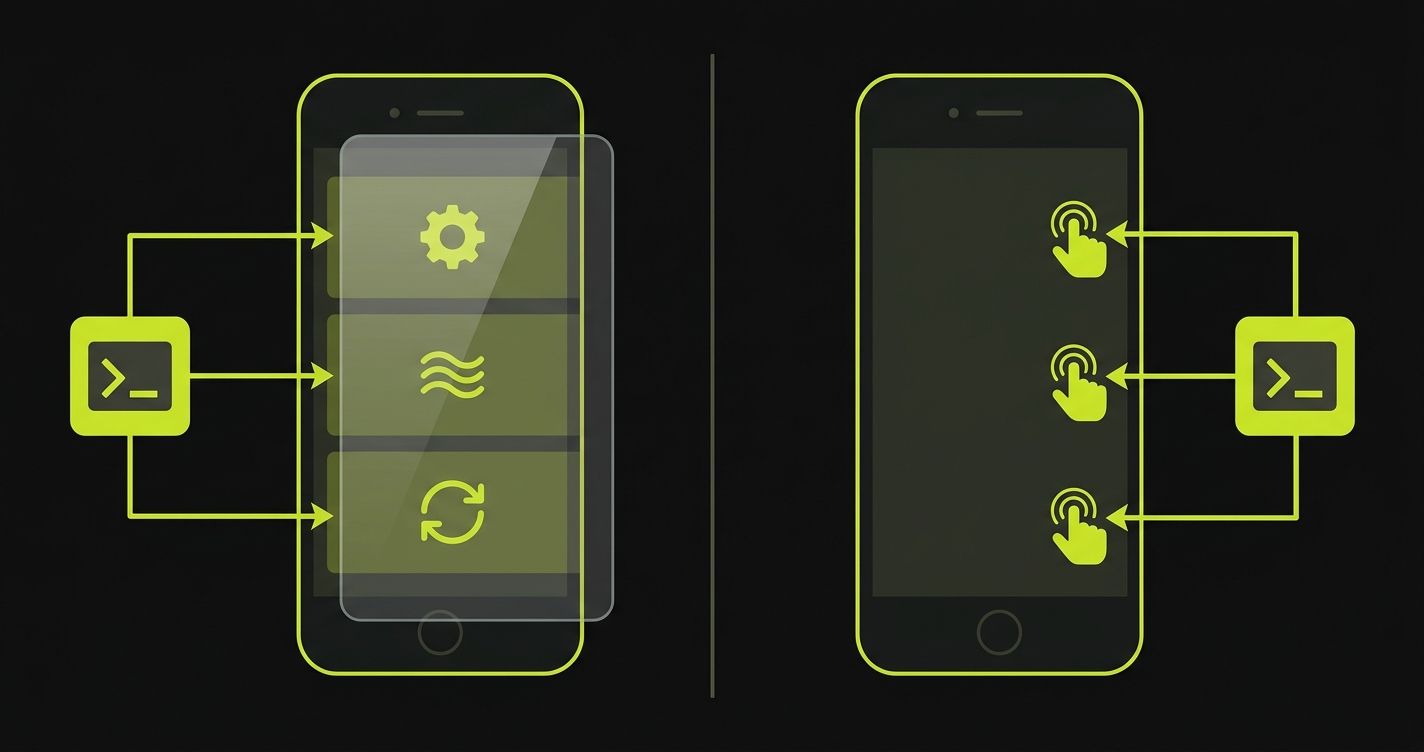
Every mobile E2E framework makes a fundamental choice about how close it sits to the application under test. That choice cascades into nearly every other difference you will experience day to day.
Appium is black-box. It sits entirely outside your app, communicating through the same OS-level accessibility and automation APIs that a human finger would use. To Appium, your React Native app and a native Swift app look identical. It sees elements by accessibility identifier, XPath, or class name. It sends taps and scrolls through the OS. It has no idea that your app is built on a JS bridge, that there is a Metro bundler somewhere, or that an animation is 80 milliseconds from finishing when it decides to assert.
That opacity is both the limitation and the superpower. The limitation: you have to manage timing yourself. Every async operation, every animation, every network call that might affect the UI needs an explicit wait or you get flaky tests. The superpower: Appium tests are completely decoupled from your app's internals. They survive complete rewrites. They work on the same app whether the screen was built with React Native, SwiftUI, or Jetpack Compose. You can run them from Java, Python, Ruby, or JavaScript. You can point them at a real device farm, a simulator, or a cloud provider like BrowserStack or Sauce Labs without changing a single test.
Detox is grey-box. It was built by Wix specifically for React Native, and it knows things about your app that Appium cannot. Detox runs a synchronization layer alongside your app that watches the JS event loop, pending network requests, animations, and timers. When you call an assertion, Detox waits for all of that to settle before proceeding. You do not write explicit waits. You do not sprinkle await driver.sleep(500) through your test suite hoping it is enough. Detox handles it.
The result is a materially different testing experience on RN apps. Tests that would be intermittently flaky in Appium because of timing windows are reliably stable in Detox because Detox understands the async model. Tests that run in Appium in 3-4 minutes often run in Detox in under a minute because there is no wait-and-retry overhead.
The cost is the architectural coupling. Detox only works on React Native apps. It requires a debug build with a Detox-compatible configuration. Accessing anything outside the RN layer, like a native module that bypasses the bridge or a platform-level permission dialog, requires custom native code that bridges into Detox's control layer.
This is the real fork in the road. Not features. Architecture. Which problem are you actually solving?
Detox vs Appium: head-to-head comparison
| Dimension | Detox | Appium |
|---|---|---|
| Architecture | Grey-box: runs alongside your RN app, synchronizes with the JS event loop | Black-box: sits outside the app, drives it through OS accessibility APIs |
| Test language | JavaScript / TypeScript only | Any WebDriver client: JS, Python, Java, Ruby, C# |
| Speed on RN apps | Fast. Auto-sync eliminates wait overhead. 50-test suite: ~45s typical | Slower. Manual waits or polling add 2-4x overhead on async-heavy RN flows |
| Flakiness | Low on RN. Synchronization layer handles timing automatically | Higher on RN. Async gaps require defensive waits that are hard to calibrate |
| Expo managed workflow | Supported via Expo's Detox plugin. Requires bare workflow or custom dev client | Works with Expo Go on physical devices; full support on bare workflow builds |
| EAS Build / Fastlane CI | EAS Build has Detox support via custom build profiles; Fastlane integration is straightforward | Appium server can run in any CI environment; EAS and Fastlane both work without special configuration |
| Cross-platform reach | iOS and Android only, React Native only | iOS, Android, web (via Selenium), desktop (Windows/Mac via WinAppDriver) |
| Brownfield / mixed native | Limited. Native screens outside the RN layer require custom bridges | Full support. Appium treats native and RN screens identically |
| Real device cloud | Supported on BrowserStack and AWS Device Farm with setup | First-class support on BrowserStack, Sauce Labs, LambdaTest, AWS Device Farm |
| Debugging DX | Excellent. Jest-compatible, readable stack traces, Detox recorder available | Decent. Appium Inspector helps locate elements; stack traces are more opaque |
| Community / maintenance | Wix-created, still open source, active but smaller community than Appium | OpenJS Foundation project, large ecosystem, Appium 2.x actively developed |
| Learning curve | Moderate for JS teams. Configuration-heavy initial setup | Steeper. Server setup, driver versioning, and capability syntax add friction |
When should you use Detox for React Native testing?
You are building a React Native app and your team writes JavaScript. That is most of the argument right there.
The synchronization layer is genuinely transformative if you have tried to maintain an Appium suite on a React Native codebase and watched it degrade into a graveyard of waitForDisplayed calls and 500ms sleeps. Detox tests read more like integration tests. They assert on outcomes rather than on polling loops. A developer who has never written E2E tests before can read a Detox test and understand what it does.
Expo managed workflow teams have a reasonable path. Detox does not run directly against Expo Go, but you can use EAS Build to produce a Detox-compatible binary (with the JS bundle built in, as Detox requires) and run the suite against that binary in whatever CI you prefer. You lose the zero-native-code simplicity of pure managed workflow temporarily, but you gain a test suite that runs against your actual app logic. The tradeoff is usually worth it if EAS Build is already part of your CI story.
Speed-sensitive CI pipelines benefit most from Detox's synchronization model. We have seen RN test suites that ran in 8 minutes under Appium drop to under 90 seconds in Detox, primarily because the async wait overhead disappears. When your mobile E2E suite runs on every PR, that delta matters.
Small to mid-sized RN-only apps with a JavaScript-native team and no legacy native screens are the ideal Detox case. The setup cost is real (environment configuration, build scheme setup, simulator management) but it is a one-time investment that pays off in daily test run time. For teams that also ship a web front-end alongside the mobile app, Autonoma can cover the web layer while Detox handles native, so you are not hand-authoring tests on either surface.
When is Appium the better choice for React Native?
The grey-box advantage disappears the moment your app is no longer purely React Native.
Brownfield apps are the clearest Appium case. If your RN module lives inside a native iOS or Android shell, if there are native screens that were never migrated to RN, or if you have platform-specific checkout flows or biometric authentication screens, Detox cannot reach those surfaces without significant native bridging work. Appium sees all of it the same way.
Cross-platform QA teams with a shared test infrastructure across iOS, Android, and web are betting on the wrong abstraction with Detox. Appium's WebDriver compatibility means the same test patterns, the same toolchain, and the same CI configuration apply across every platform. If you are comparing mobile test automation tools across your whole stack rather than just RN, Appium's platform reach matters more than RN-specific synchronization.
Multi-language QA organizations where the testing team writes Python or Java rather than JavaScript will find Appium significantly easier to adopt. A QA engineer who is productive in Python can write an Appium test on day one. Asking the same engineer to learn JavaScript well enough to write idiomatic Detox tests is a non-trivial onboarding cost, especially in larger teams where QA and dev are distinct functions.
App complexity at the native boundary also tips the balance. Apps that rely heavily on deep link handling, push notification testing, background fetch, or permission dialogs often find Appium more tractable because those interactions live at the OS level, which is exactly where Appium operates. Detox can handle some of these, but it requires extending Detox's native layer, which means writing platform code that most JS teams would rather avoid.
If you are thinking through Detox alternatives for React Native, it is worth considering Appium not as a fallback but as the better first choice when any of these conditions apply.
Both Detox and Appium saddle you with the same long-term cost once you have written the tests: maintenance. Every UI change that touches element locators, accessibility identifiers, or layout structure breaks tests. On an RN app that ships every week, that maintenance burden compounds. Detox minimizes some of the flakiness dimension but does not eliminate the locator fragility problem. Appium has it worse because it is entirely dependent on those locators for element targeting. Either way, your test suite is a living artifact that needs as much attention as your feature code.
This is the maintenance tax Autonoma was built to remove. Instead of writing and maintaining tests by hand, Autonoma reads your codebase and generates them. When your UI changes, the agents update the tests. For web apps and web-based React Native flows, the maintenance cycle breaks entirely.
How to choose between Detox and Appium
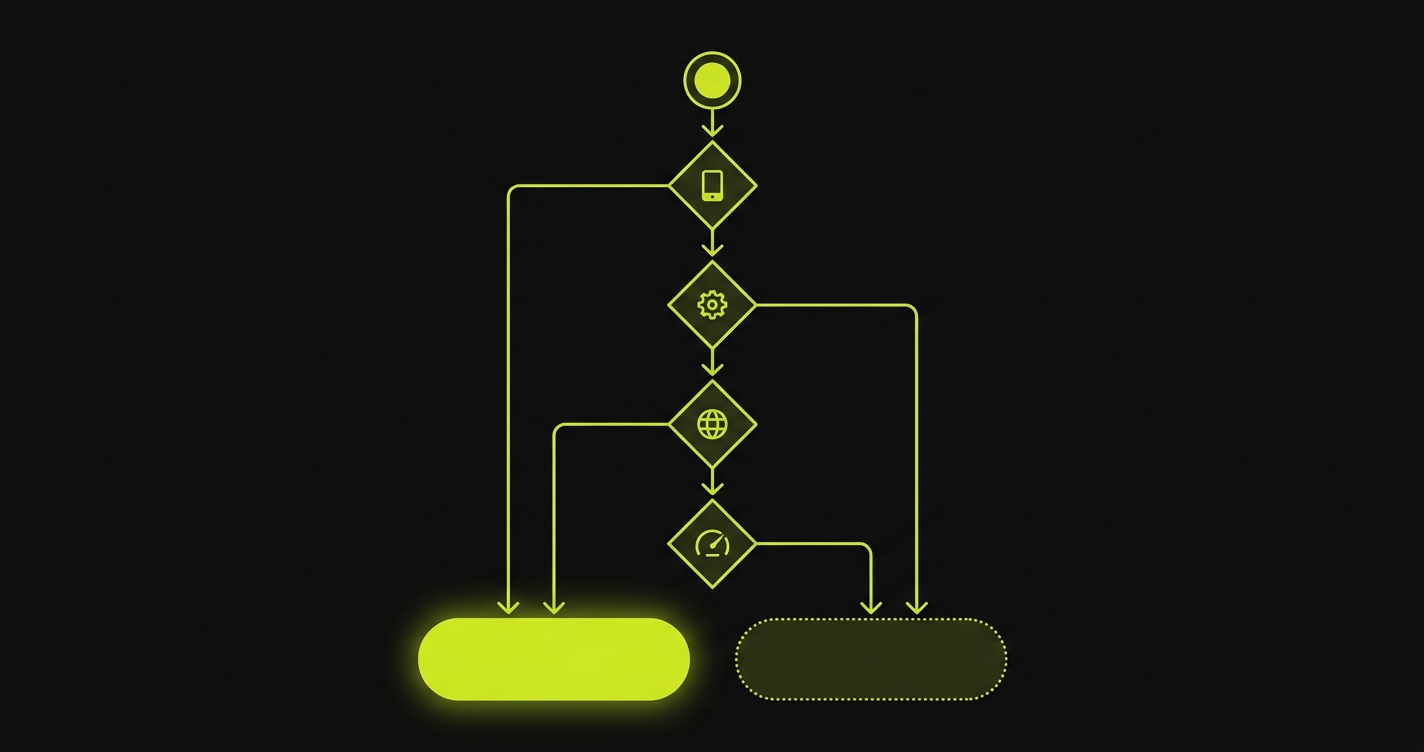
The decision framework is simpler than the comparison table makes it look.
If your app is pure React Native, your team writes JavaScript, and you need fast stable tests in CI, start with Detox. The synchronization layer is worth the setup cost and the community, while smaller than Appium's, is active and well-documented.
If your app has native screens, your team does not write JavaScript, you need cross-platform test infrastructure, or you are already invested in Appium for other parts of the stack, use Appium. Accept that you will write more explicit waits and tune your timeout strategy carefully for RN's async behavior.
If the maintenance burden of either framework is the constraint, the more honest question is whether you should be hand-authoring E2E tests at all. Autonoma is web-first today but we built the agent architecture specifically to address this problem across platforms.
Yes. Detox (created and open-sourced by Wix) is still actively developed, the GitHub repository is open, and Expo's integration work has kept investment flowing. The community is smaller than Appium's and release cadence has slowed compared to its peak years, so for production use you should evaluate Detox as community-supported open source and weigh that against Appium's much larger ecosystem. Check the Detox GitHub repo for the latest release and issue activity before committing.
Partially. Appium can drive an app running in Expo Go on a physical device, but Expo Go is a shared container app that limits what you can test. Custom native modules, deep link handling, and build-specific behavior are inaccessible. For meaningful E2E test coverage of an Expo app, you need a standalone binary, either built with EAS Build or through a bare workflow configuration. Once you have that binary, Appium works normally. The same is true for Detox. Neither framework works well against Expo Go for serious test coverage.
Detox is significantly faster for most React Native test suites, primarily because its synchronization layer eliminates the wait-and-retry overhead that makes Appium tests slow on async-heavy RN flows. A 50-test suite that takes 4-5 minutes in Appium typically runs in 60-90 seconds in Detox under similar conditions. The gap narrows if your Appium suite uses well-tuned explicit waits and your app does not have many deep async chains, but Detox's architectural advantage on RN apps is real and consistent.
Not today, and we want to be direct about that. Autonoma is a web-first testing platform. Our agents read your web codebase, plan test cases, execute them against your running web application, and self-heal tests when your code changes. Native mobile E2E testing is on the roadmap but is not available yet. If your primary need is React Native E2E coverage right now, Detox is the better technical choice for a pure RN stack. If you have a web front-end alongside your RN app, Autonoma can handle that layer while you use Detox or Appium for the native side.
Yes. Appium on React Native requires the XCUITest driver for iOS and UIAutomator2 for Android, both installed via the Appium 2.x plugin system. You also need to set accessibility identifiers on your RN components (testID prop) to make elements reliably targetable. XPath selectors work but are fragile in RN's rendered output. The RN bridge introduces async timing that you need to account for through explicit waits. BrowserStack and Sauce Labs both maintain RN-specific Appium guides that are worth reading before you set up a new suite.


