

A disposable tenant for testing is a fresh, isolated account or workspace created for a single test run, seeded with only the data that run needs, and deleted the moment the run finishes, leaving no shared state behind for the next test to trip over.
Most teams don't set out to build this workflow. They back into it after a shared test tenant quietly poisons a release: a leftover record from last week's test run flips an assertion that has nothing to do with what changed. The fix isn't better assertions. It's not sharing the tenant in the first place.
The Spin Up, Test, Throw Away Lifecycle
A disposable tenant follows the same four beats every time, regardless of the stack underneath it. What varies is how much of each beat is scripted versus automated.
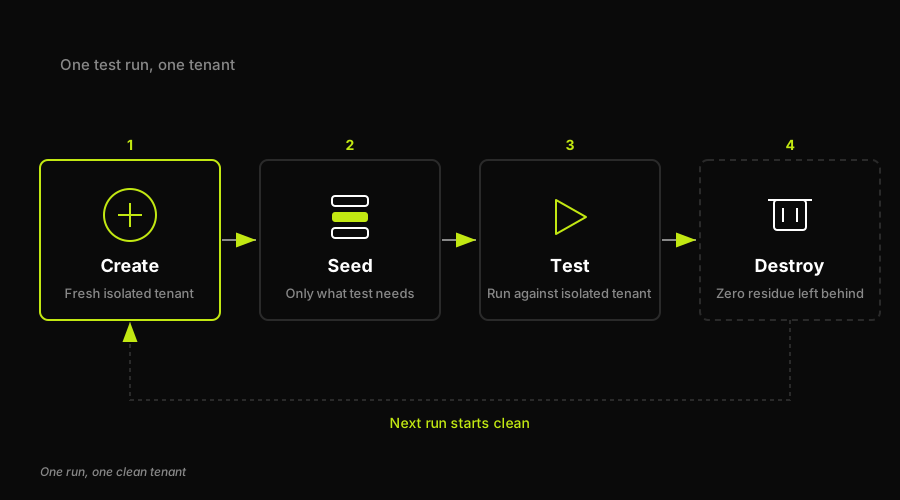
Every run creates its own tenant, seeds only what it needs, tests in isolation, and tears the tenant down so the next run starts clean.
Create a fresh tenant
The first step provisions a clean account or workspace scoped to a single test run: a new tenant ID, a new schema, or a new logical partition, depending on how the application models multi-tenancy. Nothing from a previous run carries over, because nothing from a previous run exists in this tenant yet.
Seed it with exactly what the test needs
A blank tenant is safe but useless. The test needs specific rows: a user with a specific role, an account past its trial period, an order sitting in a specific status. Good seeding scripts create only that data, not a broad fixture dump. The narrower the seed, the easier it is to reason about why a test passed or failed.
Run the tests against that isolated tenant
With the tenant created and seeded, the actual test suite runs against it exactly as it would against any real tenant. Because the tenant is private to this run, there's no risk of two test suites writing to the same rows, incrementing the same counters, or racing to lock the same record.
Delete the tenant, leaving zero residue
The run finishes and the tenant is torn down: rows deleted, schema dropped, or partition removed, along with any auxiliary state (queued jobs, cached sessions, uploaded files) tied to that tenant ID. A disposable tenant that lingers after teardown isn't disposable, it's just a shared tenant with a deletion step someone forgot to run.
| Concern | Disposable tenant | Shared test tenant |
|---|---|---|
| Starting state | Fresh for each run | Inherited from earlier runs |
| Parallel CI runs | Each run owns its state | Runs can read or delete the same state |
| Teardown | Destroy the tenant and auxiliary state | Requires selective cleanup between runs |
| Best fit | Repeatable automated tests | Persistent exploratory QA state |
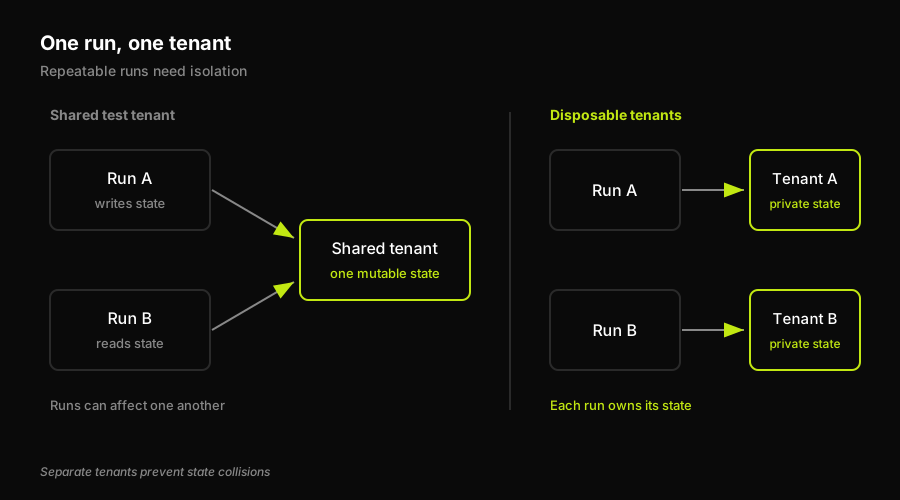
A shared tenant couples test runs; a disposable tenant keeps each run's state private.
When a Disposable Tenant Beats a Shared Test Tenant (and When It Doesn't)
A disposable tenant wins whenever tests run in parallel or run often. Two CI jobs hitting the same shared tenant will eventually collide: one test's cleanup deletes a row another test is mid-assertion on. Give each run its own tenant and that class of flake disappears entirely, not because the tests got smarter, but because there's nothing left to collide with.
It's a worse fit for exploratory, manual QA sessions where a tester wants state that persists across a coffee break, or for tests that specifically validate cross-tenant behavior (billing rollups, admin dashboards) and need multiple tenants to already exist side by side. The tradeoffs are real, not theoretical: provisioning a tenant takes time, however small, and that latency adds up across thousands of CI runs. Seeding logic has to be maintained as the schema evolves, and a database that isn't cheap to fork or partition can make "fresh tenant per run" expensive at scale. A long-lived shared tenant, kept deliberately messy and rich with edge-case data, still has a place for manual exploratory testing.
What "Leaves No Residue" Actually Means
The promise of a disposable tenant is idempotent teardown: running the same test twice in a row, back to back, should produce identical results both times. That only holds if teardown removes everything the run touched, including the parts that are easy to forget. A test that creates a tenant, seeds it, runs, and deletes the tenant row but leaves behind a background job still queued against that tenant ID hasn't actually cleaned up. The job fires later, against a tenant that no longer exists, and either errors loudly or, worse, silently succeeds against a resurrected tenant with the same ID.
Real cleanup guarantees also account for what happens when teardown itself fails partway through, whether from a timeout, a crashed process, or a deploy that interrupted the run. A disposable tenant workflow that can't recover from a half-deleted tenant will accumulate orphaned state exactly as fast as a shared tenant does, just with extra steps.
How Autonoma and PreviewKit Fit Into the Seed Step
The hardest part of the disposable-tenant lifecycle to automate well isn't creating the tenant or deleting it. Those are mechanical. It's the seed step: knowing exactly which rows a given test needs, in exactly what state, without hand-writing a seed script for every scenario and re-writing it every time the schema changes.
Autonoma's Planner agent reads the application's codebase directly and plans test cases from the routes, components, and user flows it finds there. Because it works from the code rather than a human-maintained fixture file, the Planner also generates the endpoints needed to put a fresh tenant's database into the exact state each test scenario requires, then hands that off to an Executor agent that drives the UI against a live preview environment. A Reviewer agent checks each run's results and separates a real bug from an agent error or a plan mismatch, and a Diffs Agent keeps the whole suite aligned on every pull request by reading what actually changed in the diff. None of this replaces the create-and-delete mechanics of a disposable tenant. It replaces the part where someone has to keep a seed script correct by hand.
Each of those agents runs with its own verification layer, so a disposable tenant seeded by the Planner doesn't just get created correctly once and drift out of sync later. When the schema changes, the Diffs Agent reads the diff on the next pull request and updates the seed logic and the test cases together, instead of leaving a human to notice that a seed script is quietly seeding the wrong shape of row. That matters more for disposable tenants than for a shared one, precisely because a disposable tenant is recreated from scratch on every single run. A seed script that's slightly wrong doesn't fail once, it fails on every run until someone catches it.
Managed preview environments extend the same spin-up-test-throw-away pattern to the whole application, not just its data: create a full environment per pull request, seeded and ready, then destroy it when the PR merges or closes. PreviewKit, Autonoma's managed preview-environment product, provides that per-PR environment lifecycle, so the tenant is exercised inside its own backend, database, and services rather than a shared runtime. Pairing that with a database that's isolated per preview closes the gap a disposable tenant leaves open on its own, since a fresh tenant inside a database that's still shared across every branch only isolates half the problem. A disposable tenant isolates the data; an isolated preview isolates the runtime sitting on top of it. Most teams need both before "spin up, test, throw away" is actually safe to trust.
A disposable tenant and a throwaway tenant describe the same underlying pattern from two different entry points: one is the workflow, the other is the object the workflow creates and destroys. Autonoma's testing agents plan and seed the test cases that run inside the tenant, while PreviewKit keeps the preview environment that surrounds it isolated for the pull request. Together, they make the lifecycle produce a real, verified answer about the application instead of just a clean database.
Frequently asked questions
Provision a clean account or workspace scoped to a single test run: a new tenant ID, a new schema, or a new logical partition, depending on how the application models multi-tenancy. Nothing from a previous run carries over because nothing from a previous run exists in that tenant yet. Then seed only the specific rows the test needs, in the exact state it needs them.
When the run finishes, delete the rows, drop the schema or remove the partition, and clear any auxiliary state tied to that tenant ID, including queued jobs, cached sessions, and uploaded files. Teardown should be idempotent so the same test run twice in a row produces identical results, and it must recover from a half-deleted tenant left by a timeout or crashed process, or orphaned state accumulates just as fast as with a shared tenant.
Use a disposable tenant whenever tests run in parallel or run often, because giving each run its own isolated tenant eliminates the class of flake where one test's cleanup deletes a row another test is mid-assertion on. A long-lived shared tenant is still a better fit for exploratory manual QA where state should persist, and for tests that validate cross-tenant behavior such as billing rollups or admin dashboards that need multiple tenants to exist side by side.
It means teardown removes everything the run touched, so running the same test twice back to back produces identical results both times. A tenant whose row is deleted but leaves a background job queued against its ID has not actually cleaned up: the job fires later against a tenant that no longer exists. A disposable tenant that lingers after teardown is not disposable, it is just a shared tenant with a deletion step someone forgot to run.


