

Most teams don't set out to test against production. It happens one debugging session at a time. A bug only reproduces with real data, someone points a script at the live database "just this once," and the one-off becomes the workflow nobody documented. By the time it's a habit, the risk is already routine.
The fix isn't a lecture about compliance. It's three concrete patterns for getting production's realism into a test or preview environment without ever exposing, corrupting, or copying the real thing wholesale. Each one trades off differently, and picking the wrong one for the situation is how teams end up either over-masking data they didn't need to protect or under-protecting data they did. We've covered why raw production data in a preview environment is risky in more depth elsewhere; this is the how-to companion, focused on execution.
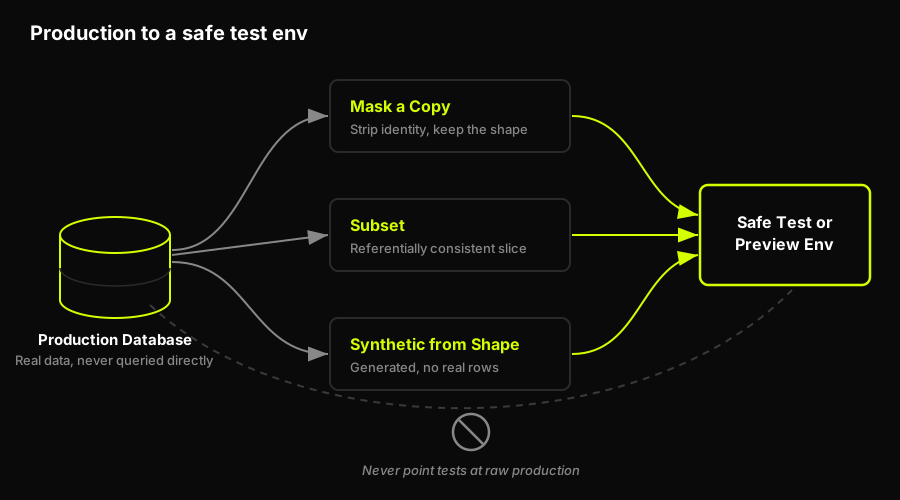
Three safe transformations carry production's realism into a test environment, and none of them query the live database directly.
Mask a Copy: Keep the Shape, Strip the Identity
Masking starts with a real copy of production, then irreversibly replaces every field that identifies a person: names, emails, phone numbers, addresses, SSNs, card numbers. The trick that makes masking usable rather than just safe is determinism. The same source value should always map to the same masked value, so user_id foreign keys, join relationships, and lookups still resolve correctly across every table after masking runs.
Done this way, a masked copy keeps something synthetic data almost never gets right on the first try: the actual distribution of real usage. The customer with three overlapping discount codes, the order refunded and re-charged twice, the account created right before a schema migration. Nobody invents those rows on purpose; they only show up because they actually happened.
The catch is that masking has to be verified, not assumed. A field someone forgot was sensitive, or a join that reconstructs an identity from two separately-masked columns, quietly defeats the entire exercise. Mask a copy when you need production-realistic volume and referential integrity but the data has to be stripped of identity before anyone or anything can query it.
The data pattern only stays safe when the environment receiving it is isolated too. With Autonoma PreviewKit, every pull request gets an isolated full-stack preview, database, and services, so a masked copy, a referential subset, or synthetic data has a clear boundary to land in instead of being loaded into a shared staging instance. That turns the safe option from a convention someone has to remember into part of how the preview is provisioned.
Subset: Pull a Slice, Not the Whole Database
Subsetting solves a different problem than masking does: production is too large, or too sensitive as a whole, to copy in full even after anonymization. Instead of moving the entire dataset, you pull a small, referentially-consistent slice, a handful of accounts, a narrow date window, one tenant, and bring only that slice into the test environment.
The engineering work here is almost entirely about referential consistency. A subset that grabs an order but leaves out its customer, or a customer but leaves out the plan they're subscribed to, breaks the moment a test touches a foreign key the subset didn't include. Getting subsetting right means walking the schema's relationships outward from a seed set of rows, not filtering each table independently.
Subsetting is nearly always paired with masking rather than used alone. It shrinks the problem (less data to mask, less blast radius if something goes wrong) but doesn't remove PII by itself. If your subset is drawn per tenant, it's worth knowing that not every table in a multi-tenant schema is actually safe to scope that way. Shared reference tables, feature flags, and pricing plans are exactly the kind of data that shouldn't be tenant-scoped in the first place, and a subsetting script that assumes everything is tenant-owned will quietly pull in far more, or far less, than intended.
Synthetic-from-Shape: Generate Data, Not Copies
The most conservative pattern never touches a real row. You study production's schema, the types, constraints, cardinality, and distributions, and generate fresh data that matches that shape without any of it originating from an actual customer. Done well, synthetic-from-shape reproduces the messy date field or the rare-but-valid state transition that broke last release, because someone modeled that shape deliberately instead of hoping a fixture would happen to include it.
This is also the only pattern that gives you deterministic, reproducible fixtures on demand. Masked and subsetted data still drifts as production changes underneath it; synthetic data generated from a versioned schema model can be regenerated identically every time, which matters more than people expect once a flaky test needs to be reproduced exactly. The tradeoff is upfront cost: someone has to model production's shape faithfully, and revisit that model as the schema evolves, or the synthetic data quietly stops resembling reality.
| Dimension | Mask | Subset | Synthetic-from-shape |
|---|---|---|---|
| Realism | High, real distributions | High, for the slice taken | Approximate, shape only |
| PII safety | Good, if masking is thorough | Same exposure as full copy | None, no real rows exist |
| Compliance fit | Moderate, audit the rules | Moderate, still real data | Strongest, nothing regulated |
| Effort | Medium, ongoing verification | Low, easiest to automate | High upfront, low upkeep |
Which Pattern Do You Actually Need?
Start with how much realism the test requires. A test validating pagination against millions of rows needs volume masking and subsetting can both provide; a unit test checking a single date-parsing edge case doesn't need real customer data at all, and synthetic-from-shape is strictly safer for no added cost.
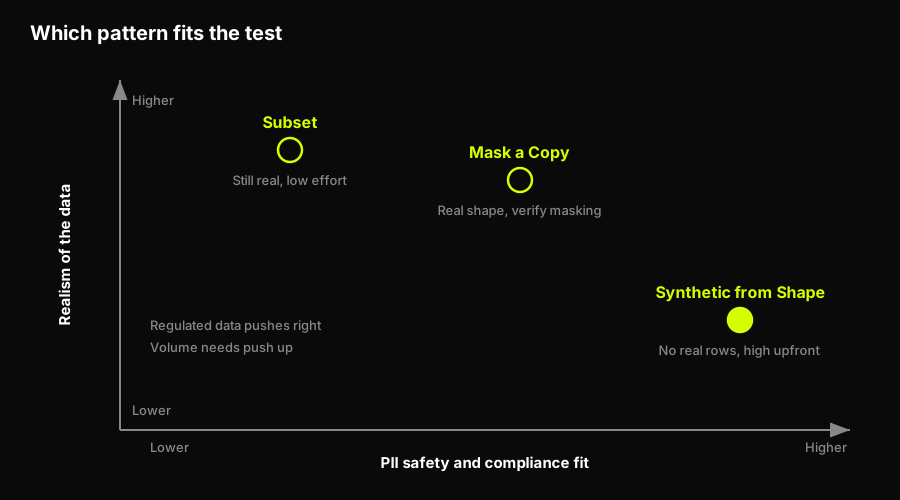
Plot the test's needs on the same two axes, then reach for whichever pattern sits closest.
Then weigh compliance strictness against dataset size. If the data is regulated (health records, payment details, anything HIPAA or PCI touches) synthetic-from-shape is usually the only pattern that removes the exposure question entirely, and the upfront modeling cost is worth paying once rather than re-litigating in every audit. If the dataset is large but the sensitivity is moderate, subsetting keeps the masking workload proportional instead of anonymizing rows nobody will ever touch in a test run.
Reproducibility tips the decision further. Masked and subsetted data are snapshots: useful, but tied to whatever production looked like the day you pulled them. Synthetic-from-shape data can be pinned to a schema version and regenerated identically, which is the difference between "this test failed once and we can't tell why" and "this test fails the same way every time we run it."
Golden Rules for Safe Production-Data Testing
A few rules hold regardless of which pattern you pick. Never point a preview or test environment directly at the live production database, not even temporarily, not even for one query. Never treat raw production data as safe to use as-is just because "it's only for testing," since the risk it carries doesn't change based on what you call the environment. Automate the masking, subsetting, or generation step so it runs by default on every environment, rather than depending on someone remembering to do it manually before a demo.
If none of this sounds like something your team wants to hand-build and maintain, that's a reasonable conclusion to reach. Autonoma's PreviewKit provisions an isolated full-stack preview, backend, database, and services per pull request, then runs tests against that environment. The safe-data pattern is enforced by how the preview is provisioned, rather than by a script your team owns and patches forever.
None of these patterns are exotic. They're the same three moves applied consistently: mask what has to remain real, subset what's too large to move in full, and generate from shape when even a masked copy is more risk than the test is worth. The teams that get burned aren't the ones missing a clever technique. They're the ones who skipped picking a pattern at all and pointed the test at production because it was faster that afternoon.
Frequently Asked Questions
Yes, if the masking is deterministic, complete, and verified before the copy reaches the test environment. Deterministic masking preserves the relationships tests need across tables, but you still need to confirm that no sensitive field or combination of fields can identify a real person.
No. A subset reduces the amount of data and the blast radius, but it can still contain personally identifiable information. Use it with masking unless you have established that the selected rows contain no sensitive data.
Choose synthetic data when regulated data makes any real-row copy unacceptable, or when reproducibility matters more than matching production's exact distribution. It is safest when the schema model includes the constraints, edge cases, and state transitions the test needs to exercise.
No. A preview or test environment should receive data only through a deliberate masking, subsetting, or synthetic-generation process. A direct production connection makes the environment capable of exposing or modifying live data, even if the original intent was read-only debugging.


