

Every engineer who has chased a bug that "only happens with real data" has had the same thought: just point the preview at production. It would work. It would also be the worst decision you make this sprint.
The instinct isn't wrong, either. Synthetic fixtures rarely reproduce the row that breaks your date parser, the account with three overlapping discount codes, or the customer with 40,000 line items that quietly kills your pagination. Real data finds real bugs. But "point the preview at production" and "get production's realism into a preview safely" are two different engineering problems, and only one of them is worth solving the way it sounds.
Why Teams Want Production Data in Previews
The case for realism is legitimate. Hand-built fixtures tend to be clean and boring: a handful of users, tidy relationships, no nulls where nulls actually show up in the wild. Production has the customer who signed up twice with slightly different emails, the order that got refunded and re-charged, the record created before a schema migration no fixture generator thinks to invent.
Volume matters too. A preview seeded with twelve rows won't tell you how a query performs against twelve million. Teams that skip production-shaped previews often ship a feature that works everywhere except against real traffic, because real traffic was never modeled before merge. Wanting production data in a preview isn't the mistake. Copying it there directly usually is.
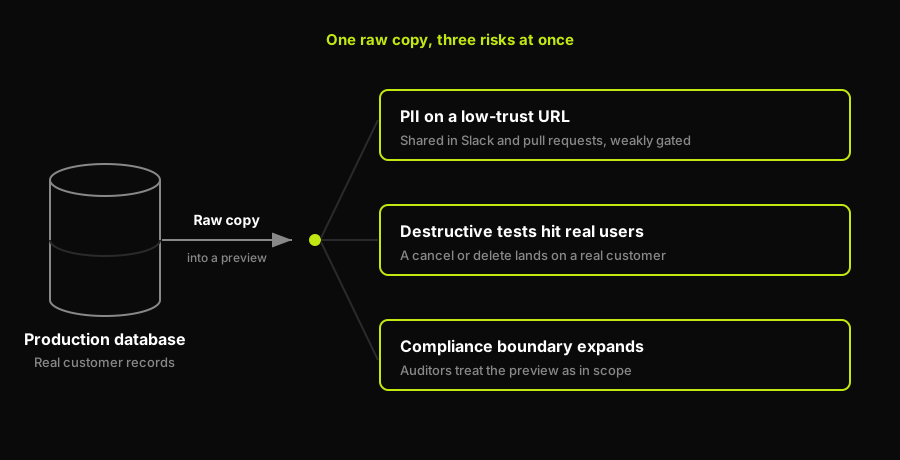
A single raw copy fans out into three separate problems before you have run a single test.
The PII Problem: Preview URLs Are a Low-Trust Surface
Preview environments are built to be shared. That's the point: a reviewer clicks a link in a pull request, a designer checks a layout, before it ships. Which also makes preview URLs one of the lowest-trust surfaces in your stack, pasted into Slack channels, linked from PR descriptions, sometimes reachable without real authentication because "it's just a preview."
Now put real names, real emails, real payment details, or real health records behind that link. A preview with raw production data isn't a smaller, safer copy of production. It's an additional, less-guarded copy of your most sensitive data, sitting behind infrastructure never designed to be what your security team audits. If that link leaks or gets shared outside the company, you haven't leaked a test environment. You've leaked customer data, and "it was just a preview" won't matter to the people whose data it was.
Destructive Tests Have Real Victims When Previews Touch Real Records
The second risk is less about who sees the data and more about what your tests do to it. A preview exists to be tested against, and occasionally broken on purpose. That's healthy when the data underneath is disposable. It's a different situation when the preview is pointed at production or an unmodified copy of it.
A test suite that cancels a subscription, deletes a user, or fires a webhook is doing exactly what it's supposed to do. Run that suite against real records and it cancels a real subscription, deletes a real user, fires a webhook a real downstream system receives. This is the same failure mode we've covered before with Vercel previews that share the same database: a connection that looks scoped to the PR turns out to be the one everything else uses, and an action harmless in isolation has consequences outside it. The fix for shared databases and the fix for raw production data are the same fix: give every preview its own data, so nothing it does reaches past its own boundary.
Compliance Doesn't Care That "It's Just a Preview"
If PII exposure and destructive tests don't settle the argument, compliance usually does. GDPR, CCPA, HIPAA, and SOC 2 don't carve out an exception for "test environment." What they care about is where regulated data physically lives and who can reach it, not what you privately call the environment.
Copy production into a preview and you've expanded your compliance boundary, whether or not you meant to. An auditor evaluating SOC 2 scope, or a regulator asking where EU customer data is processed, generally treats a preview holding real PII as in-scope, subject to the same access controls and breach-notification obligations as production. This isn't legal advice, and specifics vary by framework, but the direction is consistent: an environment holding real regulated data is one you now have to defend in an audit, and "it's just for testing" has never satisfied "why does this have production PII with none of production's controls."
How to Test with Real Production Data Safely
None of this means giving up on realism. It means getting realism from somewhere other than a raw copy of production. Three patterns get most of the way there, and they trade off against each other differently enough that the right choice depends on what you're protecting and how much engineering time you're willing to spend.
The Masked, Anonymized Subset
Take a slice of production, irreversibly mask every PII field, and load the result into the preview. Names become generated names, emails become generated emails, payment details never make the trip. Done correctly, masking is deterministic within a dataset, so the same source value always maps to the same masked value, keeping referential integrity intact across tables instead of turning foreign keys into garbage.
The realism is high: shapes and edge cases from real usage survive the masking pass. The catch is that masking must be verified, not assumed. Partial masking, a field someone forgot was sensitive, a join that reconstructs an identity from two fields masked separately, gives a false sense of safety that's arguably worse than doing nothing, because everyone stops worrying about a risk that never went away.
The Tenant-Scoped Copy
Rather than masking the whole dataset, copy in only one tenant's data, either a real tenant that's agreed to it or a purpose-built synthetic tenant. The blast radius of anything that goes wrong shrinks to a single account instead of your entire customer base. A destructive test that misfires against a tenant-scoped preview affects one tenant, not everyone.
The tradeoff is scope, not safety within it. Tenant isolation only protects you if every table that matters is actually partitioned by tenant, and some tables in most systems genuinely aren't: shared configuration, cross-tenant aggregates, global lookup tables that exist precisely because they don't belong to just one customer. Treating those tables as tenant-scoped when they aren't recreates the blast-radius problem this pattern is supposed to solve.
Synthetic Data Built From Production's Shape
The most conservative option never touches a real record. You generate data matching production's schema, distributions, and known edge cases, without any of it originating from an actual customer. Done well, a synthetic dataset reproduces the messy date and the weird-but-valid state transition that broke your last release, purely because someone modeled that shape deliberately rather than copying it.
This is the safest pattern by a wide margin: there's no real record anywhere to expose or destroy. It's also the one requiring the most upfront investment. Someone has to study production closely enough to capture its shape faithfully, and revisit that model as production evolves, or the synthetic data quietly drifts from the reality it was meant to represent.
| Pattern | Realism | Blast radius if misused | Ongoing effort |
|---|---|---|---|
| Masked subset | High, real shapes preserved | Whole dataset, if masking fails | Medium, verify continuously |
| Tenant-scoped copy | High, for the copied tenant | One tenant, unless tables leak | Medium, audit which tables qualify |
| Synthetic from shape | Good, modeled not copied | None, no real record present | High upfront, then low to maintain |
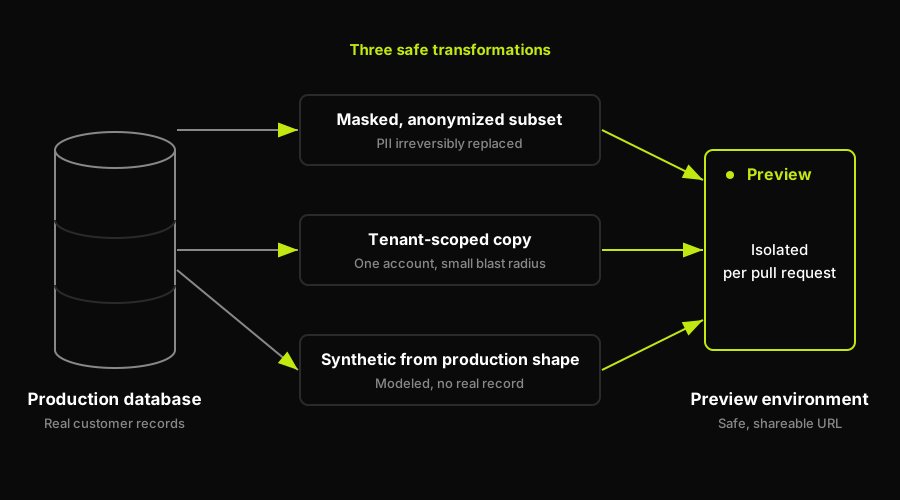
Each pattern is a safe transformation between production and the preview, never a raw copy.
The decision usually comes down to sensitivity and risk tolerance. If the data involved is regulated (health records, payment details, anything HIPAA or PCI touches) synthetic-from-shape is the only pattern that removes the exposure question entirely, worth the upfront modeling cost. If the data is sensitive but not regulated, and the team already trusts its masking pipeline, a masked subset gets closer to production's real edge cases for less ongoing effort. Tenant-scoped copies fit best when the risk you're managing is blast radius more than exposure, testing against one real account rather than everyone's.
Where Managed Previews Fit Into This
Here's the part worth being honest about: building and operating any of these three patterns is real, ongoing engineering work, not a one-time script. A masking pipeline needs continuous verification and drift monitoring, plus someone accountable the day a new field ships without a masking rule attached to it. Tenant-scoped copies need a standing audit of which tables can and can't be scoped, repeated every time the schema changes, because the shared-configuration tables that break tenant isolation don't announce themselves. Synthetic generation needs someone to keep the model honest as production evolves, or the dataset quietly stops looking like the system it's supposed to represent. None of that is a weekend project, and all of it needs to be running correctly before the safety it buys is real rather than assumed. This is the same discipline the wider test-data-management space covers in depth; the point here is narrower: whichever pattern you pick has to survive contact with a preview environment that gets a new PR every day, not just a one-time data-load exercise.
That ongoing ownership question is exactly the gap managed preview infrastructure is built to close. Autonoma's PreviewKit provisions a full, isolated preview environment per pull request with safe, non-production data by default, so a team doesn't have to hand-build and operate its own masking or synthetic-data pipeline just to get a realistic, low-risk preview every time a PR opens. If your team would rather not own that infrastructure long-term, that's exactly who managed previews are for. If you already have a mature masking or tenant-scoping pipeline you trust and maintain, building your own remains a completely reasonable choice; the tradeoff is ongoing ownership either way, not a right-or-wrong answer about which pattern is "correct."
| Approach | Choose it when | Who owns the ongoing work |
|---|---|---|
| Autonoma PreviewKit | You want isolated, per-PR previews without owning the preview-environment lifecycle | Autonoma provisions the environment; your team sets the data policy |
| Self-managed data pipeline | You need to keep an existing masking, tenant-scoping, or synthetic-data workflow | Your team maintains the pipeline and its safeguards |
Once the data layer is safe, the next question is usually whether anything actually verifies the preview before a human reviews it, and that's a testing problem, not a data problem. A preview environment with perfectly safe data still doesn't tell you whether the checkout flow works, and that's the layer most teams skip once they've solved the data problem and assume the rest takes care of itself. This is where Autonoma's four agents come in, and each one carries its own verification step rather than taking an unchecked pass at the app. The Planner agent reads the codebase to plan test cases for the routes and flows a given PR touches, including the database state each scenario needs, generating the endpoints required to set that state safely inside the isolated preview data described above. The Executor agent then drives those tests against the live preview, exercising the same masked, tenant-scoped, or synthetic dataset a team has already decided is safe to use. The Reviewer agent classifies each result as a real bug, an agent error, or a plan-and-test mismatch, so a merge decision doesn't hinge on someone manually triaging a flaky run. The Diffs Agent runs on every subsequent PR, updating, adding, and deprecating test cases based on what the code diff actually changed, so the suite doesn't quietly rot as the app evolves.
The two problems compound in a specific way worth naming directly: safe data without verification tells you the preview is low-risk, not that it works. Verification without safe data tells you the app works, on a dataset you shouldn't have exposed in the first place. Handling both is what makes a preview trustworthy enough to merge on.
The Short Version
Production data in preview environments is a real need chasing a dangerous shortcut. The realism is worth having. The raw copy is not worth the risk: not the PII exposure, not the destructive test that hits a real customer, not the compliance boundary you didn't mean to expand. A masked subset, a tenant-scoped copy, or synthetic data built from production's shape each get you most of the realism without most of the risk. Teams that need to keep their own established data workflow can do that; teams that do not want to own the preview-environment lifecycle can use Autonoma PreviewKit for an isolated per-pull-request preview with safe, non-production data by default, then run Autonoma's built-in web E2E testing against that same environment before merge.
Frequently Asked Questions
Not in raw form. Raw production data in a preview creates PII exposure risk on a low-trust, easily shared URL, risks destructive tests hitting real customer records, and expands your compliance boundary to include the preview. Safer alternatives get most of the same realism: a masked and anonymized subset, a tenant-scoped copy, or synthetic data generated to match production's shape.
You don't test against raw production data directly. You test against a stand-in that preserves production's realism without its risk: a deterministically masked subset of production, a copy scoped to a single tenant, or synthetic data modeled on production's schema and distributions. Which one to use depends on how sensitive the data is and how much ongoing effort your team wants to spend maintaining the pipeline.
Masked data starts as a real production subset with PII irreversibly replaced, so it preserves real shapes and edge cases but must be continuously verified to make sure masking actually holds across every field and join. Synthetic data never touches a real record; it's generated to match production's schema and distributions, which is safer by default but requires more upfront work to model faithfully.
Yes. Frameworks like GDPR, CCPA, HIPAA, and SOC 2 don't exempt test or preview environments from scope. If a preview holds real regulated data, an auditor or regulator generally treats that environment as in-scope, subject to the same access and retention obligations as production, regardless of what the environment is called internally.


