

Search "why is Supabase branching so bad" and you'll find a Reddit thread with more replies than the feature's own changelog. The complaints are specific: branches that take several minutes to spin up, a preview whose data looks nothing like what shipped last Tuesday, a migration that ran clean on the branch and then broke on merge into main. None of that is a fluke. It's the direct cost of forking something heavier than a database.
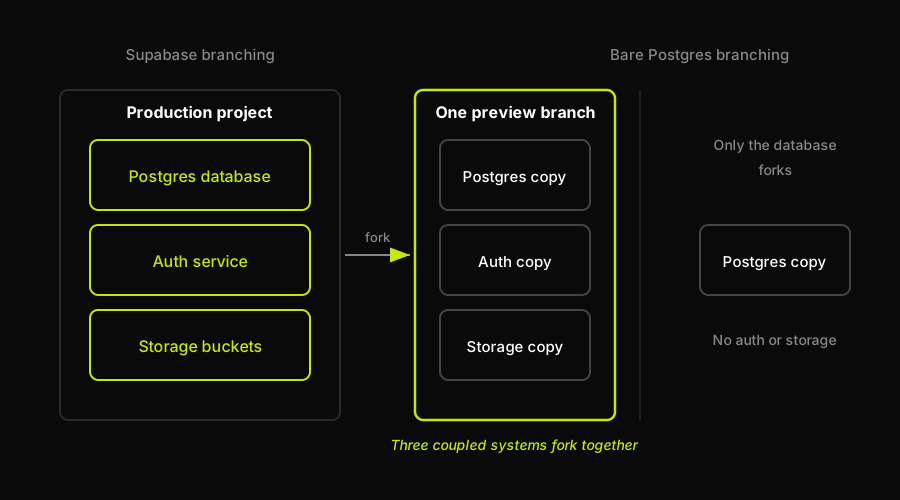
Supabase forks three coupled systems into one branch; a bare database branch copies only Postgres.
What Supabase Branching Actually Forks
Supabase branching doesn't fork a database. It forks a project. When you create a branch, Supabase spins up an isolated copy of the entire backend surface your app depends on: the Postgres database with its schema and data, the Auth service with its own copy of users, sessions, and JWT signing state, and Storage with its own buckets and objects. Point your preview deployment at the branch, and every one of those systems behaves like an independent Supabase project, not a read replica or a schema clone.
That's a meaningfully different (and, on paper, more powerful) thing than what a bare Postgres branching provider gives you. A raw database fork hands you rows and tables. Supabase branching hands you rows, tables, a working login flow, and a Storage bucket that actually resolves the file paths your app expects. If your app's preview needs a user to sign in and upload an avatar before anyone can test the feature that matters, a plain database branch leaves you half-provisioned. Supabase branching, in principle, does not.
The catch is that "in principle" is doing a lot of work in that sentence. Forking three coupled systems together, and keeping them coupled correctly across the life of a branch, is a materially heavier operation than forking one. That weight is exactly where the documented pain starts.
The Documented Pain: Slow, Drifting, and Full of Merge Surprises
The complaints in that Reddit thread cluster into four repeatable patterns, and each one traces back to the same root cause: a branch is a full stateful fork of a full-stack backend, not a lightweight copy-on-write pointer into a single dataset.
Branch creation is slow. Spinning up an isolated Postgres instance, provisioning a matching Auth service, and standing up Storage, then running every pending migration against the new branch, takes real minutes. A Neon or PlanetScale-style copy-on-write branch of a single database can appear in under a second because unchanged data pages are shared with the parent. Supabase branching has more surface to stand up before the branch is usable, so "instant" was never really on the table for the full-project version of forking.
Drift is the recurring complaint. A branch is a snapshot the moment it's created. From that point forward, production keeps moving, other branches keep moving, and the branch you're testing on doesn't. Seed data goes stale. A teammate's branch has a different Auth user set than yours. Two weeks into a long-running PR, the branch no longer resembles what's actually in production, and nobody can say exactly when it diverged.
Migrations produce merge surprises. This is the sharpest edge. A migration applied and tested on a preview branch has to reconcile with whatever ran on main, and possibly with migrations from other open branches, in an order nobody planned for. A column rename that's clean on the branch can collide with a concurrent migration on main. The failure doesn't show up until merge, which is the worst possible time to discover it.
Concurrent branches hit cost and quota friction. Every open branch is a running Postgres instance, a running Auth service, and a Storage allocation, not a diff. Ten open PRs can mean ten running backends. Plans cap concurrent branches for exactly this reason, and teams that open a branch per PR by default run into that ceiling faster than they expect.
None of this makes Supabase branching a bad feature. It makes it an honest tradeoff: you get a full backend fork, and a full backend fork costs what full backend forks cost. Compare that against Neon's branching model or PlanetScale's approach, both of which fork a database only, not an entire project, and the tradeoff becomes clearer: less surface forked, less to drift, but also no Auth or Storage riding along for free.
For teams where that full-project lifecycle is the actual constraint, Autonoma's PreviewKit offers a different shape: managed, full-stack preview environments per PR, with end-to-end testing built in rather than operated as a second system.
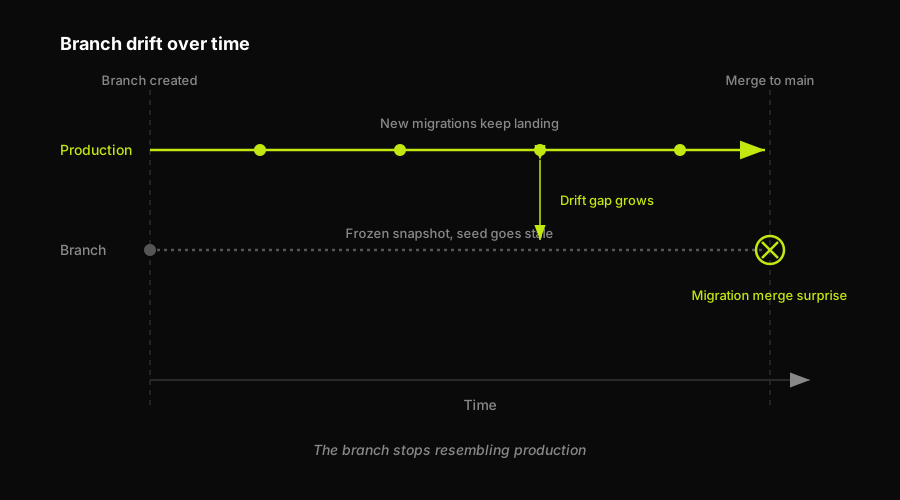
Production keeps moving while the branch stays frozen, so the drift gap widens until merge time.
Branching a Backend vs Provisioning One Per PR
Zoom out and the real decision isn't "is Supabase branching good or bad." It's "do I want an isolated backend fork that my team operates, or clean, isolated data provisioned automatically for every PR." Those are two different shapes of the same underlying need: nobody wants a preview environment reading and writing the same shared, mutating state as ten other open pull requests. It's also a narrower version of a broader question worth naming explicitly, which we cover in more depth in database branching vs tenant isolation: branching gives you a copy, it doesn't by itself give you a boundary, and conflating the two is how teams end up confident about a problem they haven't actually solved.
Branching gets you there by copying an entire project's state at a point in time and handing you the keys. You (or a script your team wrote) decide when to create the branch, what to seed it with, and when to tear it down. Managed full-stack preview isolation, the category PreviewKit sits in, gets you there differently: instead of forking an existing project's state, it provisions a fresh, isolated environment (backend, database, and services) per PR, with data seeded for that PR specifically, and no fork lifecycle for your team to babysit.
Full disclosure, since we build PreviewKit: we have a horse in this comparison, so weigh the framing accordingly. The tradeoff below is the one we'd want a friend to lay out honestly, not the one that makes the sale.
| Dimension | Supabase Branching | Managed Isolation (PreviewKit) |
|---|---|---|
| What gets isolated | Postgres, Auth, Storage per branch | Backend, DB, services per PR |
| Creation speed | Minutes, full project fork | Minutes, no fork lifecycle |
| Drift risk | High, seed and migration drift | Low, provisioned fresh per PR |
| Who operates it | Your team runs the lifecycle | Managed; PreviewKit operates it |
| Data realism | Real, but ages between uses | Seeded fresh for each PR |
Neither column is universally right. A small team on Supabase already, comfortable writing the seed and teardown scripts, can get a lot of value from branching as-is. A team that keeps hitting the drift and merge-surprise wall, or that's spending sprint time on branch lifecycle instead of the product, is the team a managed alternative is actually for. Read more on how this same tradeoff plays out for Neon-backed previews and see how Supabase and Neon compare as branching providers in the first place in our Supabase vs Neon breakdown.
How Autonoma Handles Preview Data Without the Branch Drift
Everything above is the honest cost of the DIY path: forking a full Supabase project gets your team real isolation, but your team is also the one operating branch creation, seeding, migration reconciliation, and teardown, on every PR, indefinitely. That operational load is exactly the gap PreviewKit is built to close.
PreviewKit provisions a full-stack preview environment per pull request, backend, database, and services included, with data seeded for that specific PR rather than cloned from a point-in-time snapshot that starts aging the moment it's created. There's no branch to reconcile against main, because there's no branch; each PR gets its own environment built fresh, so the merge-time migration surprises that come from two branches quietly diverging simply don't have anywhere to accumulate. Layered on top, Autonoma's testing agents (a Planner that reads your codebase and plans test cases, an Executor that runs them against the live preview, and a Reviewer that separates a real bug from a flaky agent run) give you verification against that isolated environment as part of the same PR, not a separate tool bolted on afterward.
Map that back onto the four pain points from earlier. Slow creation stops being a per-branch tax your team pays on every PR, because provisioning is the product's job, not a script someone on your team maintains. Drift stops accumulating because there's no long-lived branch to drift; every environment is provisioned fresh against current state. Migration reconciliation stops being a merge-time surprise because there's no parallel branch state fighting to reconcile. Concurrent-branch quota friction goes away because you're not running N full Supabase project forks side by side, you're running N managed preview environments that PreviewKit is built to operate at that scale.
None of that replaces the decision of whether Supabase, Neon, or PlanetScale is the right backend for your production app. That choice stays yours. What changes is who's on the hook for keeping the preview copy of that backend fresh, isolated, and merge-safe for every PR that opens.
Choosing Between the Two
If your team is already comfortable operating Supabase branching, and the drift and merge-surprise costs above are still smaller than the cost of switching, keep going. Branching is a legitimate, well-understood tool, and plenty of teams run it in production without ever hitting the ceiling described here. The signal to reconsider isn't "branching is bad." It's noticing that your team's sprint time is going toward fork lifecycle, seed drift, and migration reconciliation instead of the feature the PR was supposed to ship.
Run the math on your own team before deciding either way. If you average five open PRs at a time, and each one needs a Supabase branch to preview against, that's five running Postgres instances, five Auth services, and five Storage allocations, all billed and all needing a teardown policy so they don't quietly outlive the PR that created them. Someone has to write that teardown policy, fix it when a branch survives a force-push and orphans itself, and explain to a new hire why the seed script behaves differently on branch three than on branch one. None of that is exotic engineering, but it is also not the feature you meant to ship this sprint, and it accumulates quietly until an audit or an incident forces the reckoning.
The migration-ordering problem deserves a second look too, because it is the one that bites hardest at the worst possible time. Two engineers each open a branch, each write a migration against their own copy of the schema, and each pass their own tests cleanly. The conflict is invisible until both PRs try to reconcile with main, at which point the second one to merge inherits a migration order nobody planned for and a failure that shows up in CI instead of during development, when it would have been cheap to catch. A managed environment provisioned fresh per PR sidesteps this specific failure mode by construction: there is no second branch's migration history to collide with, because each PR's environment is built against current main at the moment it opens, not against a snapshot that started aging days or weeks earlier.
None of this is an argument that Supabase branching is the wrong choice in general. It is a strong choice for a team that wants the full backend (data, auth, and files) forked together and is willing to own the lifecycle that comes with it. It is the wrong choice specifically for a team whose actual complaint is the one that opened this article: branches that take too long to create, data that drifts between uses, and migrations that reconcile badly at the worst possible moment. That complaint has a name, and it is not "branching is broken." It is "we are operating infrastructure we would rather not operate."
Whichever path you choose, make it deliberately. If operating the fork lifecycle is what is slowing your team down, that is the problem we built Autonoma's PreviewKit to take over.
FAQ
Supabase branching forks an entire project, not just a database. Each branch gets its own isolated Postgres database, its own Auth service (with a separate copy of users, sessions, and JWT signing state), and its own Storage buckets. That's more than a bare Postgres branch, since your whole backend surface (data, login, and file storage) forks together into one environment.
Branch creation has to provision an isolated Postgres instance, stand up a matching Auth service, allocate Storage, and run every pending migration against the new branch before it is usable. That is materially more work than a copy-on-write fork of a single database, which is why branch creation takes real minutes rather than appearing instantly.
A branch captures a snapshot at creation time. Production, and other open branches, keep changing after that point, but the branch does not update itself. Seed data goes stale, other branches accumulate different Auth users, and a long-running PR's branch can end up looking nothing like current production, with no clear marker of when the two diverged.
Supabase branching forks an existing project's state and hands your team the keys to seed, maintain, and tear it down. Managed isolation, like Autonoma's PreviewKit, provisions a fresh full-stack environment (backend, database, and services) per pull request with data seeded specifically for that PR, so there is no long-lived branch to drift and no migration-reconciliation step at merge time. Both achieve isolation; only one leaves your team operating the lifecycle.


