

Type "PlanetScale branching preview environments" into a search bar and you'll get docs pages explaining deploy requests, and separate docs pages explaining Vercel connection strings. Nobody answers the question a team actually has after wiring the two together: if every PR gets a schema branch, does every PR also get its own realistic, isolated data to test against? The honest answer is no, and the reason why is worth understanding before you build a preview pipeline around the assumption that it does.
That gap isn't a PlanetScale shortcoming. Branching was built to solve a different, harder problem: how do you change a production schema without taking an outage. It solves that problem well. It was just never the tool for the question a preview environment actually needs answered.
How PlanetScale Branching and Deploy Requests Actually Work
PlanetScale's MySQL product runs on Vitess, the sharding and connection-pooling layer Google built to scale MySQL at YouTube. A PlanetScale "branch" in this product is a schema branch: you create one, make your DDL changes against it, and PlanetScale generates a schema diff comparing your branch to the parent. That diff becomes a deploy request, the PlanetScale equivalent of a pull request but for schema changes, complete with review, approval, and a merge step. Once approved, PlanetScale applies the migration using online schema change tooling (built on gh-ost) so the change lands without locking the table or taking production down. This is the workflow PlanetScale is genuinely excellent at: safe, reviewable, zero-downtime schema migrations, with a diff a human can actually read before it ships.
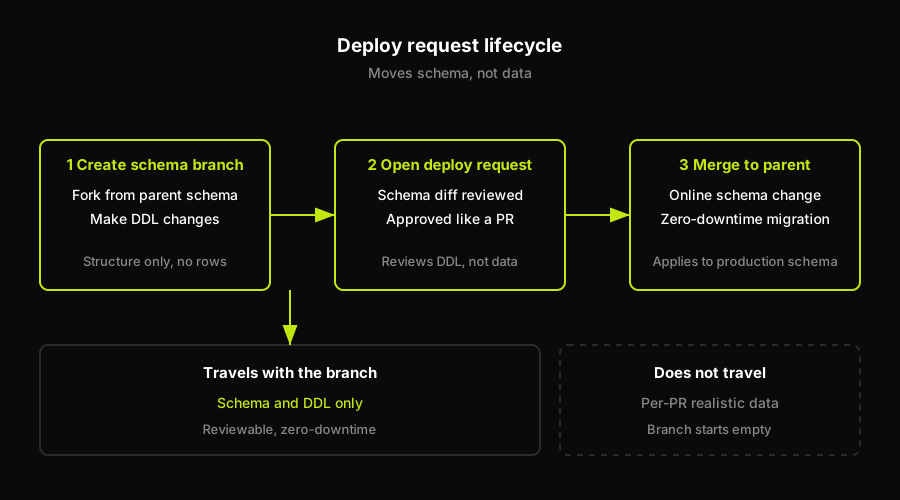
The deploy request lifecycle: branch, review the DDL diff, and merge with a zero-downtime online schema change. The pipeline carries schema and DDL, while a fresh branch starts with no per-PR rows.
Data on a MySQL branch does not travel with the schema by default. A new branch inherits the parent's structure, not its rows, so a fresh branch is an empty schema until something seeds it. PlanetScale's newer Postgres product (built by the same Vitess team, GA since September 2025) handles branches differently: you can create a branch from a backup that includes both schema and data. That gets closer to a full data copy, but it's a backup restore, not an instant copy-on-write snapshot, so branch creation time scales with how big that backup is. Neither version of branching was designed to hand every open pull request a fresh, realistic dataset the moment CI opens a preview. We've covered that architectural split in more depth in our Neon vs PlanetScale comparison.
The PlanetScale Vercel integration sits on top of this. Connect a PlanetScale database to a Vercel project and the integration wires a branch's connection string into that project's preview deployment environment variables automatically, so a Vercel preview for a given PR points at the matching PlanetScale branch instead of your shared production database. That's a real, useful piece of plumbing: it saves you from manually copying connection strings into environment variables for every PR. What it does not do is decide what's inside that branch. The integration connects a schema branch to a frontend preview. Getting realistic, isolated data into that branch is a separate job the integration was never scoped to do.
Schema Isolation Is Not Data Isolation
This is the distinction that gets lost the moment a team calls branch-per-PR "isolated previews." A schema branch answers one question: is this migration safe to ship. It answers that question well, with a reviewable diff and a deploy request that a teammate actually reads before approving. It says nothing about whether the rows sitting in that branch, or missing from it, resemble what your app needs to be meaningfully tested.
A preview environment needs a different, more specific thing: realistic, isolated data, per pull request, that reflects the shape of production without exposing real customer records, and that resets cleanly when the PR closes. An empty MySQL branch doesn't give you that; someone has to seed it. A Postgres branch restored from a backup gets you real rows, but they're the same rows every other branch restored from that backup also gets, unless you've built anonymization and per-branch divergence into your seeding process yourself. Branching answers "is this schema change safe." It doesn't answer "does this PR have data I can actually click through and trust."
Teams that conflate the two end up with a specific, recurring failure: the schema diff gets reviewed carefully, the deploy request gets approved, and the actual preview a reviewer clicks through is running against an empty table or a stale seed script nobody's touched since the project started. The migration was safe. The preview built on top of it wasn't useful. That's not a PlanetScale problem, it's the same gap every branching model has, including Neon's and Supabase's: a branch is a structural fork, and structural forks don't come with a provisioning story attached.
What Each Actually Isolates
Laid out side by side, schema branching and managed preview data aren't competing answers to the same question. They isolate different layers of the stack, and a preview pipeline that only has one of them has a gap sitting under the other.
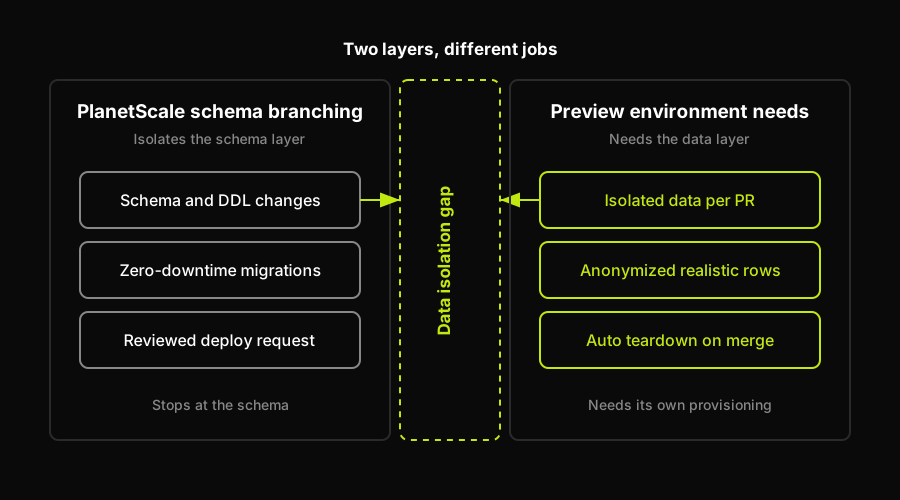
PlanetScale schema branching vs preview data isolation: branching isolates the schema layer, while the data isolation gap is the layer a per-PR preview actually needs provisioned.
| Dimension | PlanetScale Schema Branching | Managed Preview Data |
|---|---|---|
| Schema and DDL changes | Yes, core purpose | Not the job |
| Migration safety | Zero-downtime, reviewed diff | Not applicable |
| Per-PR data isolation | No, empty or shared backup | Yes, own dataset per PR |
| Data realism | Depends on manual seeding | Provisioned automatically |
| Seeding and anonymization | Your own scripts | Built into provisioning |
| Teardown on merge | Manual branch cleanup | Automatic with the PR |
Read the two columns as answers to different questions rather than a scorecard. "Is my schema change safe to ship" is PlanetScale's question, and the deploy request workflow answers it well. "Does every open PR have its own realistic, isolated data to test against" is a provisioning question, and it needs its own infrastructure regardless of which database platform or branching model sits underneath.
How Autonoma Isolates Preview Data per PR
The gap this whole post has been describing (a schema branch that's safe but empty, or a data branch that's real but shared across every PR restored from the same backup) is exactly the layer PreviewKit, Autonoma's managed preview-environment product, is built to close. PlanetScale's deploy requests still do the job they're good at: reviewing and shipping schema changes safely. PreviewKit's job starts one layer up, at the question branching was never built to answer.
Connect a repository and PreviewKit provisions a full-stack preview per pull request: backend, database, and supporting services, each with its own isolated, realistic dataset rather than an empty schema or a shared backup restore. That preview tears down automatically when the PR closes, so there's no branch cleanup step someone has to remember, and no accumulating fleet of stale branches quietly running up a bill. Your schema migrations still go through whatever review workflow you've built, PlanetScale's deploy requests included. What changes is that the preview built on top of that schema shows up with data a reviewer can actually click through and trust, every time, without anyone hand-seeding it first.
Mapped onto the distinction from earlier: PlanetScale answers "is this migration safe." PreviewKit answers "does this PR have isolated, realistic data to test against." Neither replaces the other, and a team that's already invested in PlanetScale's deploy request workflow doesn't have to give it up to close the data-isolation gap sitting underneath it.
Build vs Buy: Wiring It Yourself or Handing Off the Data Layer
If you'd rather build this yourself, the pieces are all available. Wire the PlanetScale Vercel integration so every preview deployment points at the matching branch's connection string. Write a seeding script that anonymizes a production-shaped dataset and runs it against every new branch. Add a teardown job that deletes branches once their PR merges, so you're not paying for a fleet of forgotten environments six months later. None of that is exotic engineering, but all of it has to keep working as your schema evolves, and someone has to own it when a seed script drifts out of sync with a migration that shipped last sprint.
The maintenance cost is where this usually gets underestimated. A seeding script written against last quarter's schema silently produces incomplete or malformed rows the moment a column gets added or a foreign key changes, and nobody notices until a reviewer opens a preview and the new feature renders with missing data instead of an error. Multiply that by however many services a modern app actually depends on, background workers, a queue, a search index, and the seeding problem stops being "one script" and becomes an ongoing piece of infrastructure that needs the same review and testing discipline as the schema changes it's supporting. Teams that treat it as a one-time setup task are usually the ones re-writing it a year later.
The alternative is deciding that provisioning realistic, isolated data per PR isn't a problem your team wants to keep operating by hand, and handing that specific layer to something already built to run it. That's not a decision about whether PlanetScale is a good database or whether its branching model is well designed. It's a decision about who owns the seeding, anonymization, and teardown logic that turns a safe schema branch into a preview worth reviewing. Our broader look at branching versus isolation covers the same fork in more general terms if you're weighing it across more than one database platform, and why a Vercel preview isn't a full-stack environment on its own covers the layer above the database that runs into the same gap.
Either path is defensible. If you do not want to operate that data layer yourself, Autonoma's PreviewKit provides a managed per-PR preview with isolated data and web-first end-to-end testing built in. The mistake is assuming the deploy request that approved your migration also answered the data question, and finding out it didn't the first time a reviewer clicks into an empty preview and can't tell if the feature actually works.
FAQ
Not by itself. PlanetScale branching is a schema-change workflow: a branch, a schema diff, and a deploy request that gets reviewed and merged with zero-downtime online schema changes. A new MySQL branch inherits the parent's schema but not its data, so it starts empty until something seeds it. PlanetScale's Postgres branches can include data via a backup restore, but that's a shared backup snapshot, not a per-PR provisioning guarantee.
It wires a PlanetScale branch's connection string into a Vercel project's preview deployment environment variables automatically, so a Vercel preview for a given PR points at the matching database branch instead of a shared production database. It connects a schema branch to a frontend preview. It doesn't decide what data is inside that branch.
Schema branching answers whether a migration is safe to ship, with a reviewable diff and a deploy request. Preview data isolation answers whether every open pull request has its own realistic, isolated dataset to actually test against. A branch can be structurally safe and still be empty or backed by a shared, stale dataset, because branching was never designed to provision realistic per-PR data.
With PlanetScale's own tooling, yes. A MySQL branch starts with the parent schema and no rows, so a seeding script has to populate it before a preview is useful. A Postgres branch restored from a backup gets real rows, but the same rows every other branch restored from that backup gets, unless you build anonymization and per-branch divergence into the seeding process yourself.


