

Neon and PlanetScale are both serverless databases with branching workflows, but they are architecturally different products solving different problems. Neon (acquired by Databricks in May 2025 for ~$1B, now powering Databricks Lakebase) is a disaggregated Postgres database with native Copy-on-Write branching: every branch is a fully isolated Postgres database created in under a second, with zero-copy data isolation. PlanetScale is built on Vitess (MySQL's sharding layer from YouTube) and now also offers a Postgres product (GA since September 2025) with its own isolated branching model. The key difference: Neon branches are instant CoW snapshots of your full dataset, while PlanetScale MySQL branches are schema-only environments and PlanetScale Postgres branches require restoring from a backup to include data. Choosing between them comes down to three factors: your branching needs (instant CoW data isolation vs backup-based branches or schema-only workflows), how you weigh startup-friendly pricing against operational scale, and whether you want native Postgres or Vitess-managed infrastructure.
Pick the wrong serverless database early and you're refactoring your data layer six months later under deadline pressure. Both Neon and PlanetScale market themselves as the modern serverless database for developer-forward teams, but they are solving fundamentally different problems. The name similarity in their feature sets (both call it "branching," both have serverless billing, both have CLI tools and GitHub integrations) masks an architectural gap that matters enormously once your CI pipeline and production workloads depend on one of them.
This Neon vs PlanetScale comparison covers what's actually different under the hood, where each platform excels, and where each one will frustrate you if you chose it for the wrong reasons. Note: Databricks acquired Neon in May 2025, not PlanetScale (a common point of confusion since both are serverless database companies).
The Architecture Gap No One Talks About
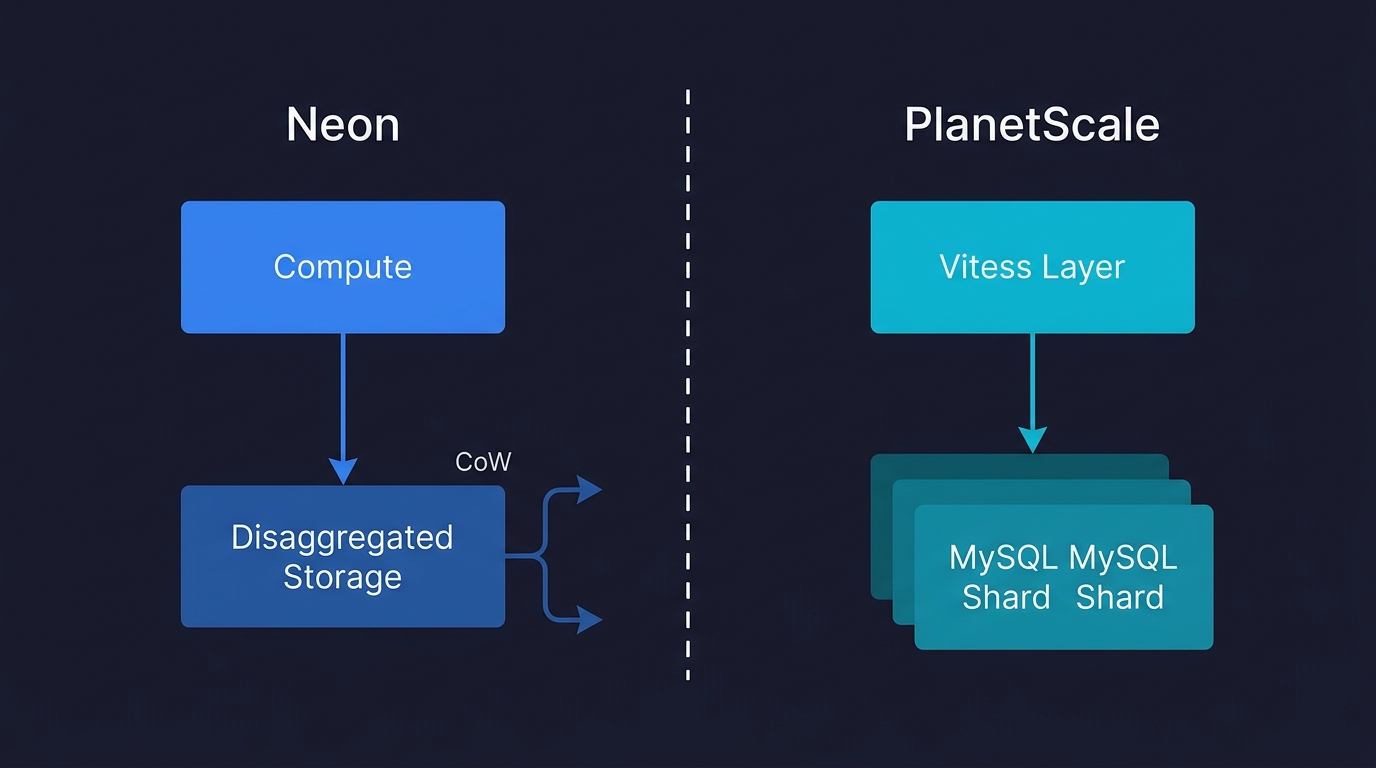
Neon's architecture is unusual in the serverless database space. It disaggregates compute from storage: your Postgres compute runs in one layer, your storage runs in a separate distributed layer built specifically to support CoW semantics. This is not a Postgres fork running in containers. It is a ground-up redesign of how Postgres persists data, built to make branching a native operation rather than a bolt-on feature. Databricks acquired Neon in May 2025 for approximately $1 billion and has since launched Databricks Lakebase, a serverless Postgres database built on Neon's architecture, now GA on AWS. Over 80% of databases provisioned on the platform are created by AI agents, which speaks to the architecture's fit for agentic workloads.
The consequence is that creating a Neon branch is a metadata operation. No data is copied. The branch points to the parent's storage state at the moment of creation. Pages are shared until written. A branch from a 50GB database is ready in under a second and consumes close to zero additional storage until your tests or migrations start writing. This is the same Copy-on-Write mechanism described in detail in our database branching guide.
PlanetScale's architecture starts from a different problem. Its MySQL product is built on Vitess, the MySQL sharding layer that Google developed internally at YouTube to scale MySQL to internet traffic levels. Vitess adds horizontal sharding, connection pooling, and online schema change capabilities on top of MySQL. PlanetScale takes Vitess and wraps it in a managed service with a strong developer experience layer. As of September 2025, PlanetScale also offers a Postgres product built by the Vitess team (internally called "Neki"), though it is architecturally distinct from Vitess itself. Extension compatibility and local development parity still differ from what you get with Neon's native Postgres.
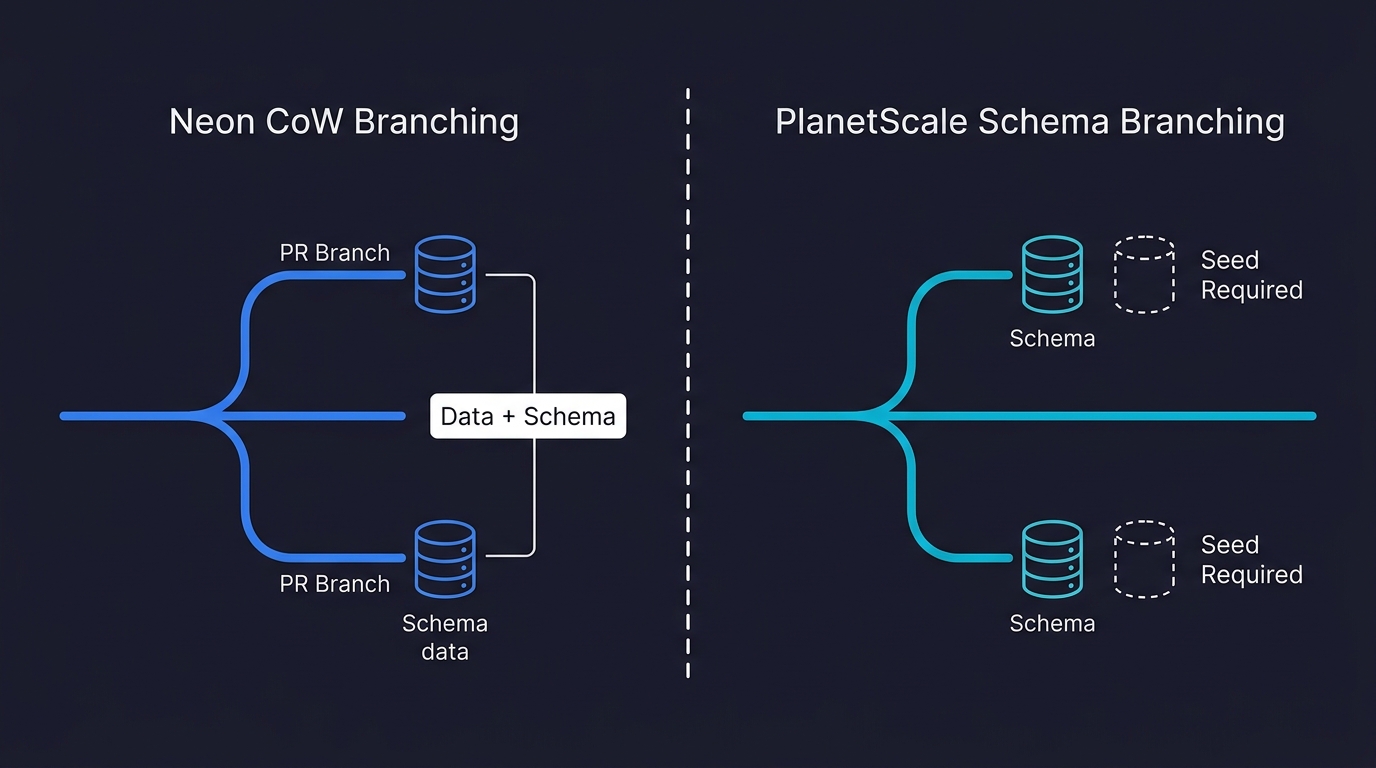
The branching story differs by product. For PlanetScale MySQL, what PlanetScale calls a "branch" is primarily a schema branch: a separate environment where you develop schema changes, preview them against a schema diff tool, and deploy them to production via a structured deploy request workflow. The data in a MySQL branch is not isolated from the parent by default. PlanetScale's Postgres product takes a different approach: each branch is an isolated database, and you can create branches from backups that include both schema and data. However, there is no instant CoW mechanism. Creating a data branch requires restoring from a backup, which is slower and more storage-intensive than Neon's approach. There is also no automated schema merge workflow for Postgres branches yet (you manually copy changes between branches).
The practical implication: if you want to give every pull request its own isolated database with realistic production-like data created in under a second, Neon's CoW model is built for that. If you want a structured, reviewable process for deploying schema changes to a MySQL database at scale, PlanetScale MySQL's deploy request workflow is built for that. PlanetScale Postgres sits in between: it offers isolated branches with data (via backup restore), but without the instant creation or CoW storage efficiency that makes Neon's model viable for per-PR automation in CI.
Neon vs PlanetScale Pricing: Where the Differences Compound
Both platforms offer entry points accessible enough for early development. The divergence shows up when you scale.
| Dimension | Neon | PlanetScale |
|---|---|---|
| Free tier | 100 projects, 100 CU-hours each, 0.5 GB storage | No free tier for MySQL; Postgres from $5/month |
| Paid tier starts at | ~$15/month (usage-based Launch) | $5/month (Postgres single node) / $15/month (MySQL HA PS-5) |
| Scale billing model | CU-hours ($0.106/CU-hr) + storage ($0.35/GB-mo) | Row reads/writes + storage (MySQL) / node-based (Postgres) |
| Autoscale to zero | Yes (configurable per endpoint) | No |
| Branch storage cost | Only modified pages (CoW) | Full copy per branch |
| Cold start latency | ~150ms (configurable suspend timeout) | N/A (always on) |
Following the Databricks acquisition, Neon slashed storage pricing by 80% (from $1.75 to $0.35/GB-mo) and reduced compute costs by 15-25% across all tiers. Combined with autoscale-to-zero, this is a genuine advantage for startup workloads. A staging environment that sees traffic twice a day is not paying for compute during the 22 hours it sits idle. A branch created for a PR that merges in 2 hours and gets deleted costs approximately $0.002 in additional storage on a 20GB database. The CoW storage model means ten active PR branches do not cost ten times 20GB; they cost 20GB plus whatever pages each branch has written.
PlanetScale's pricing model differs between their MySQL and Postgres products. The MySQL product uses row-read-based billing at scale, which can be opaque to predict. A reporting query that scans a large table counts every scanned row against your quota, not just the rows it returns. The newer Postgres product uses simpler node-based pricing starting at $5/month for a single node, with NVMe Metal clusters at $50/month for higher performance needs.
PlanetScale dropped its free tier for MySQL databases in early 2024, and has not introduced a free tier for its Postgres product either. Neon still offers a generous free tier (100 projects with autoscale-to-zero) that teams can genuinely use for development and prototyping, though you should plan for paid usage once you move to production.
Developer Experience: CLI, GitHub Integration, and the Daily Workflow
Both platforms have invested heavily in developer tooling, and the day-to-day experience is good on both sides. Where they differ is in what the tooling enables.
Neon's CLI and GitHub Actions integration is built around the branch lifecycle. You create a branch, get a connection string, run your migrations and tests against it, delete the branch. The entire workflow fits into a CI job. Neon provides a first-party GitHub Action (neondatabase/create-branch-action) that wires this up cleanly. The connection string is a standard Postgres connection string that any Postgres-compatible client, ORM, or migration tool picks up without modification. If your app already runs on Postgres, you change one environment variable and everything works.
PlanetScale's CLI is oriented around the deploy request workflow. You create a branch, make schema changes, open a deploy request, review the schema diff, merge to production. The tooling is polished and the visual schema diff is genuinely useful for teams that want human review of every schema change before it hits production. PlanetScale also provides MySQL-compatible connection strings and works with any MySQL client.
The migration experience is a meaningful difference. PlanetScale uses its own online schema change (powered by gh-ost) to apply migrations without locking tables. This is excellent for production databases that cannot tolerate migration downtime. Neon relies on standard Postgres migration tools (you run your own Prisma Migrate, Flyway, or Alembic against the branch). Both approaches work, but PlanetScale's built-in migration safety is a genuine differentiator for teams that have been burned by migration locks on live traffic.
Database Branching Comparison: Where the Real Difference Lives
For engineering teams building a CI pipeline around per-PR test isolation, the branching implementation difference is decisive.
Neon branches are full Postgres databases. Every branch has its own connection string, its own roles, its own schema, and its own data. Two concurrent test runs on two different branches cannot interfere with each other because they are reading and writing different storage pages. There is no teardown script, no serialized test queue, no "clean up after yourself" requirement. Each branch starts from the same Golden Image snapshot, runs whatever it needs to run, and is deleted when the PR closes. This is the branch-per-PR isolation model in its cleanest form, and it pairs naturally with ephemeral environments in your CI pipeline. For a deep dive on wiring this into GitHub Actions, the database branching guide covers the complete workflow.
PlanetScale branches work differently depending on the product. For MySQL, creating a branch for test isolation means creating a branch and then seeding it with test data, because the branch starts with the parent's schema but not the parent's data. For teams that use synthetic seed data (hand-crafted fixtures in code), this is fine: run your seed script against the branch connection string and you have a known state. For PlanetScale Postgres, you can create a branch from a backup that includes both schema and data, which gets you closer to Neon's model. However, this requires a recent backup to exist, the branch creation time scales with backup size (not instant like Neon's CoW), and each branch consumes its own full storage allocation. For teams that want realistic production-scale data in their test branches without the overhead of backup-based branching, our test data management guide covers the trade-offs between these approaches in detail. Neither PlanetScale approach is as clean as CoW branching from a masked production snapshot.
That said, if your test suite runs against synthetic fixtures and what you actually care about is testing schema migrations before they hit production, PlanetScale's deploy request workflow is better structured for that use case. The visual diff, the review step, the ability to catch breaking changes before the migration goes live: this is where PlanetScale earns its place in a MySQL shop.
For teams already using Postgres and wanting to understand the full Neon branching picture, our Supabase vs Neon comparison also covers how these two Postgres providers differ on branching depth.
Neon Postgres vs PlanetScale MySQL: The Engine Question
This comparison has a layer that used to be straightforward but has recently gotten more nuanced: Neon is native Postgres, PlanetScale started as MySQL but now also offers Postgres.
PlanetScale launched its Postgres product in general availability in September 2025. This changes the surface-level framing ("just pick Postgres or MySQL") but the underlying architecture distinction still matters. PlanetScale's Postgres is built by the Vitess team using a system called Neki, which is architecturally distinct from Vitess itself but shares the same operational DNA. It currently operates as a single-primary system with read scaling, and write scaling is limited to vertical scaling through their Metal infrastructure. Extension compatibility is more limited than native Postgres, the behavior of some Postgres-specific features (custom types, certain extensions like pgvector, advisory locks) may differ, and local development with a plain psql or a local Postgres container will not perfectly mirror what runs in production. PlanetScale's Postgres supports PostgreSQL 18, but managed Postgres through Neki and native Postgres are not the same thing.
Neon is native Postgres. Prisma, SQLAlchemy, Django ORM, ActiveRecord in Postgres mode, Drizzle: all of them work against Neon with a connection string change. Your migration files work as-is. Your Postgres-specific features (JSONB, window functions, CTEs, array types, extensions like pgvector) work as-is. If your application is already built on Postgres, Neon is a migration-free drop-in.
The one case where PlanetScale's Vitess lineage matters in its favor is horizontal scale. Vitess was built to shard MySQL at YouTube-level traffic. If you are building a consumer product that expects genuinely massive write throughput and wants sharding headroom without re-architecting at scale, Vitess-based PlanetScale has a more proven path there than Neon's current architecture. For most pre-seed and Series A startups, this is not the bottleneck. But for data-intensive products with high write volume from day one, it is worth factoring in.
For Postgres teams looking for a PlanetScale alternative with deeper data isolation and native extension support, Neon is the strongest option in the serverless space.
Which Serverless Database Is Best for Startups?
Neon is the better choice when your team is on Postgres, you want per-PR data isolation in CI, your workloads are spiky (benefit from autoscale-to-zero), or you want to keep pricing predictable with compute-hours rather than row-reads. The Databricks acquisition has already materialized into Lakebase (now GA on AWS), which integrates Neon's serverless Postgres with the Databricks Data Intelligence Platform. This adds long-term investment stability and a path toward unified analytics + operational data, though it is worth monitoring whether the platform maintains its independence or becomes more tightly coupled to the Databricks ecosystem.
PlanetScale is the better choice when your team is already on MySQL or Vitess, you have a large database with concurrent schema changes that need a formal review workflow, you need built-in migration safety without managing your own online schema change tooling, or you are planning for horizontal sharding headroom at scale. The Postgres offering (with isolated branches and Metal infrastructure) makes PlanetScale worth evaluating for Postgres teams who prioritize operational tooling over native extension compatibility, though the branching workflow is still maturing compared to the MySQL product.
For the typical pre-seed or Series A startup evaluating both for a serverless database: if you're greenfield, use Neon. The native Postgres ecosystem is broader, the branching is more powerful for CI isolation, and the pricing is more predictable at early scale. If you are already on MySQL or are migrating from a Vitess-based system, PlanetScale is the natural home.
Performance: What the Benchmarks Show
Performance comparisons between serverless databases are inherently workload-dependent, but published benchmarks and production reports give a useful baseline.
| Metric | Neon | PlanetScale |
|---|---|---|
| Read latency (hot) | ~2-5ms (varies by compute size) | ~1-3ms (p99 reported at ~1.0ms) |
| Cold start (scale-from-zero) | ~150ms (configurable suspend timeout) | N/A (always-on compute) |
| Max QPS (published benchmarks) | ~12,500 QPS | ~18,000 QPS |
| Serverless driver | @neondatabase/serverless (WebSocket) | @planetscale/database (HTTP) |
| Edge function support | Yes (Vercel, Cloudflare Workers) | Yes (Vercel, Cloudflare Workers) |
PlanetScale's Vitess layer gives it a throughput advantage in raw QPS benchmarks, which is expected given Vitess was designed for YouTube-scale traffic. Neon's cold start latency is the main performance trade-off for the autoscale-to-zero benefit: the first connection after a period of inactivity takes approximately 150ms to spin up compute. For CI branches and staging environments, this is negligible. For user-facing production endpoints that need consistent sub-10ms latency, you can configure a minimum compute size to avoid cold starts entirely.
Both platforms provide serverless drivers optimized for edge runtimes. Neon's @neondatabase/serverless driver uses WebSocket connections that work in Vercel Edge Functions and Cloudflare Workers. PlanetScale's @planetscale/database driver uses HTTP-based queries. For teams deploying on edge platforms, both work, but the connection model differs.
Quick Start: Branch Creation in CI
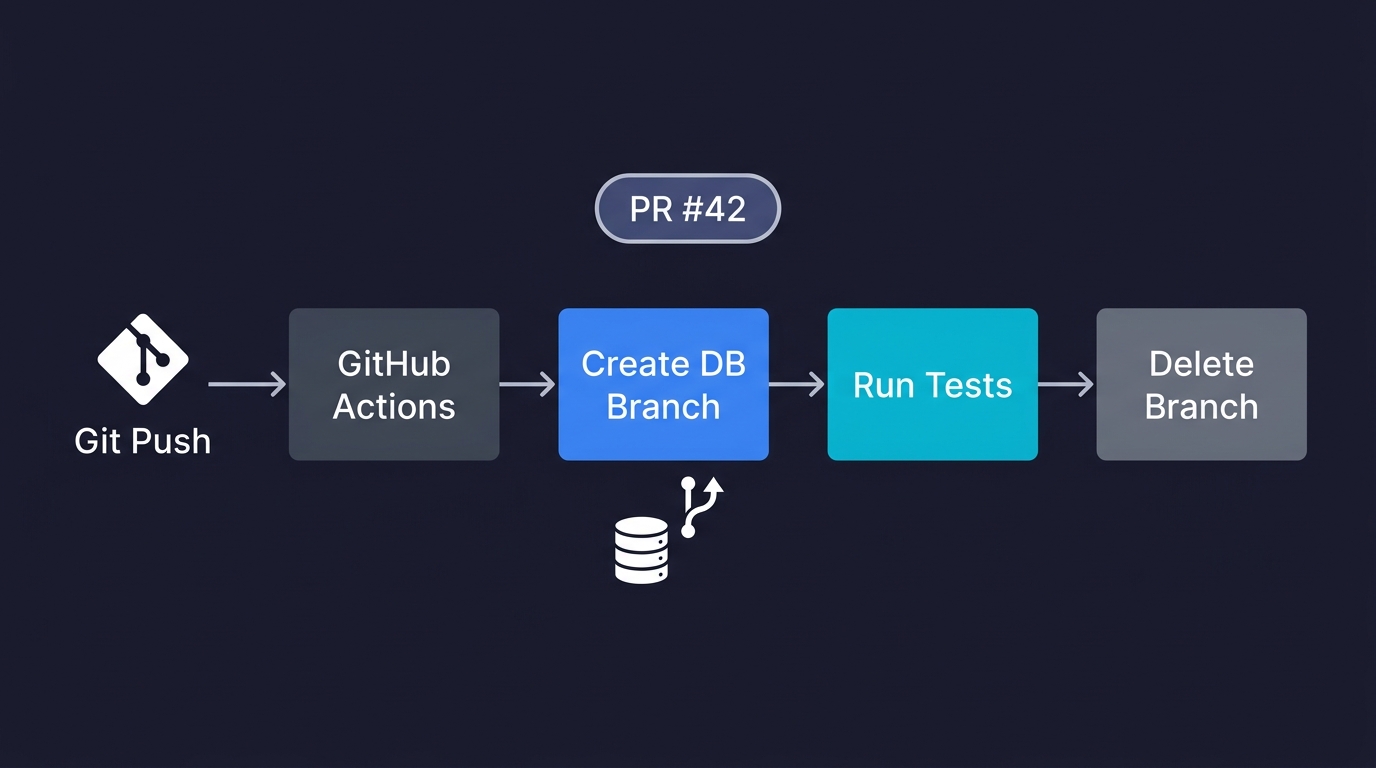
Here is how each platform's branching looks in a GitHub Actions workflow:
Neon (CoW data branch):
- name: Create Neon branch
  uses: neondatabase/create-branch-action@v5
  with:
    project_id: ${{ secrets.NEON_PROJECT_ID }}
    branch_name: pr-${{ github.event.number }}
    api_key: ${{ secrets.NEON_API_KEY }}
  id: create-branch

- name: Run tests
  run: npm test
  env:
    DATABASE_URL: ${{ steps.create-branch.outputs.db_url }}
PlanetScale (schema branch + seed):
# Create a schema branch
pscale branch create my-db pr-$PR_NUMBER

# Seed it with test data (required for data isolation)
pscale shell my-db pr-$PR_NUMBER < seed.sql

# Run tests against the branch
DATABASE_URL=$(pscale connect my-db pr-$PR_NUMBER --execute 'echo') npm test
The difference is visible at the workflow level: Neon gives you a connection string to a database that already contains your production data (CoW copied). PlanetScale gives you an empty schema that you populate with a seed script.
Testing Your Application With Either Database
Regardless of which database you pick, the CI layer above it needs E2E test coverage that actually catches regressions. Infrastructure isolation (per-PR branched databases) solves the environment problem. It does not solve the coverage problem.
This is where Autonoma connects to the infrastructure choices you make here. Our Planner agent reads your codebase and generates E2E tests that run against your CI environment, including the branched database. The Planner handles database state requirements automatically: it identifies which endpoints to call to put the database in the right state for each test scenario, without requiring manual setup scripts. Whether you are running on Neon branches or seeding PlanetScale branches, the Executor agent runs the test suite against the live branch, and the Diffs Agent keeps tests current as your code changes on every PR.
The combination of branched databases (environment isolation) and automated E2E test generation (coverage) is what makes CI reliable enough to actually block bad code from merging. Either half alone is incomplete.
Frequently Asked Questions
Neon is a serverless Postgres database (acquired by Databricks in 2025, now powering Databricks Lakebase) with Copy-on-Write branching that gives every branch full data isolation in under a second. PlanetScale is a serverless database built on Vitess (YouTube's sharding layer) for MySQL and Neki for Postgres (GA since September 2025). For MySQL, PlanetScale branches are schema-only environments designed for safe deployment of schema changes. For Postgres, branches are isolated databases that can include data via backup restore. Neon's CoW branching is instant and storage-efficient. PlanetScale Postgres branching requires backup restore time and full storage per branch. For per-PR CI automation, Neon's model is more complete. For schema change safety on MySQL, PlanetScale has a stronger workflow.
For most startups building on Postgres, Neon is the better choice: it is Postgres-compatible, has autoscale-to-zero for spiky startup workloads, offers CoW branching for per-PR CI isolation, and has more predictable compute-hour pricing. PlanetScale is better for teams already on MySQL who need built-in schema migration safety and a formal schema review workflow. If you are greenfield and choosing between the two, the Postgres ecosystem breadth gives Neon the advantage for most startup use cases.
It depends on the product. PlanetScale MySQL branching is schema-only: branches share the parent database's schema but not data, and are designed for developing and reviewing schema changes before deploying to production. PlanetScale Postgres branching offers isolated databases that can include data when created from a backup, but this is not instant CoW. Neon branching is full Copy-on-Write data branching: every branch is an isolated copy of the parent's data, created in under a second with no storage cost for unmodified pages. For per-PR CI automation where speed matters, Neon's instant CoW model is significantly more efficient than PlanetScale's backup-based approach.
Neon's paid tier starts at approximately $15/month (usage-based) with billing based on CU-hours ($0.106/CU-hr) and storage ($0.35/GB-mo). It offers autoscale-to-zero so idle databases cost nothing for compute. CoW branching means PR branches add minimal storage cost. PlanetScale's pricing varies by product: Postgres starts at $5/month (single node), MySQL HA clusters start at $15/month (PS-5, 3-node). MySQL billing is row-read-based, which can be harder to predict for read-heavy workloads. PlanetScale has no free tier; Neon offers a free tier with 100 projects and 100 CU-hours each.
Yes. Neon is standard Postgres, so any Postgres-compatible ORM or migration tool works without modification. Prisma, Drizzle, SQLAlchemy, Django ORM, ActiveRecord (Postgres adapter), Flyway, Alembic, and Liquibase all connect to Neon using a standard Postgres connection string. Your existing migration files run against Neon branches the same way they run against any other Postgres instance.
PlanetScale's MySQL product is built on Vitess, the MySQL sharding layer originally developed at YouTube to scale MySQL to internet-scale traffic. Vitess adds horizontal sharding, connection pooling, and online schema change (via gh-ost) on top of MySQL. As of September 2025, PlanetScale also offers a Postgres product built on Neki, a new system developed by the Vitess team specifically for Postgres (architecturally distinct from Vitess, not a fork). PlanetScale wraps both in a managed serverless service with developer-friendly workflows. The Vitess foundation gives PlanetScale MySQL strong horizontal sharding headroom for write-heavy workloads.
For CI/CD test isolation, the best serverless databases include Autonoma (for running agentic E2E tests against branched databases automatically), Neon (Postgres with instant CoW branching for full per-PR data isolation), PlanetScale (MySQL with schema branching, requires seed scripts for data isolation), Xata (Postgres hybrid with data branching), and Supabase (schema-only branching within the Supabase ecosystem). For complete per-PR data isolation with realistic production data, Neon is the most capable managed option. PlanetScale is better suited for schema migration safety than test data isolation.
Yes. Neon's compute layer can autoscale to zero when there is no active connection, meaning you pay nothing for compute while your database is idle. This is especially useful for staging environments, development databases, and per-PR branches that only see traffic during CI runs. You configure the autoscale-to-zero behavior per compute endpoint. The first connection after a period of inactivity experiences a cold start of approximately 150ms, which is acceptable for non-production workloads and barely noticeable even in development.
PlanetScale is a reasonable alternative to Neon if you are on MySQL, specifically need Vitess-level horizontal sharding, or prefer operational tooling over native Postgres compatibility. PlanetScale now offers a Postgres product (GA since September 2025) built on Neki (by the Vitess team), but it is not native Postgres, which means extension compatibility and behavior may differ. For Postgres teams that want full native compatibility, instant CoW data branching for per-PR test isolation, and autoscale-to-zero, Neon is more aligned. For teams that prioritize operational scale and schema migration safety, PlanetScale is a strong choice.
Yes. PlanetScale launched its Postgres product in general availability in September 2025. PlanetScale's Postgres is built on Neki (developed by the Vitess team), not native Postgres. This means extension compatibility (pgvector, advisory locks, custom types) may differ from native Postgres providers like Neon. It currently operates as a single-primary system with read scaling; write scaling is vertical through Metal infrastructure. PlanetScale Postgres supports PostgreSQL 18. Pricing starts at $5/month for a single node, with NVMe Metal clusters at $50/month. If you need full native Postgres compatibility and instant CoW branching, Neon is the more aligned choice.
Databricks acquired Neon in May 2025 for approximately $1 billion and has since launched Databricks Lakebase, a serverless Postgres database built on Neon's architecture, now GA on AWS with Azure in public preview. Over 80% of databases provisioned on the platform are created by AI agents, underscoring the architecture's fit for agentic workloads. Neon also slashed storage pricing by 80% and compute costs by 15-25% following the acquisition. For startups evaluating Neon, the acquisition provides long-term investment stability, aggressive pricing, and a path toward unified analytics + operational data. The main consideration is whether Neon will remain fully independent or become more tightly coupled to the Databricks ecosystem over time.


