

tenant_id column. Use the wrong one for the wrong job and you either overpay for previews or leave a real isolation gap unaddressed.Somewhere in your team's Slack history there's a thread that starts with "why does the preview for PR #482 show Maria's test invoice as $0" and ends, four hours later, with someone quietly restoring last night's database dump. Every team that ships on Vercel or Netlify previews eventually hits the same wall: the frontend forks per PR, the database does not. Every open PR reads and writes the same shared Postgres instance, so one engineer's seed script clobbers another's test run, and nobody notices until a demo goes sideways in front of a customer.
So you go looking for the fix. You search "database branching vs tenant isolation" and get two disconnected answers. Neon's docs explain how instant branches work. A multi-tenant SaaS architecture post explains how to keep Tenant A from ever seeing Tenant B's rows. Neither one tells you which problem you actually have, or that you might need both, for different reasons, at different layers of the stack.
Database Branching, Tenant Isolation, and Test-Data Provisioning: Three Different Problems
Database branching is a copy-on-write, point-in-time fork of a database. Platforms like Neon and Supabase snapshot the current state of your database and hand you a new, fully writable branch that behaves like an independent database. Under the hood, unchanged data pages are shared with the parent branch, and only the pages you actually write get copied. That's why a multi-terabyte production database can fork in under a second and cost close to nothing until you start writing to it. A branch is a moment in time, not a boundary. It answers "give me a full copy of this data, right now, that I can throw away later," not "who is allowed to see this data." (We've covered the mechanics in more depth in our database branching primer, including the Neon and Supabase specifics.)
Tenant isolation is a runtime boundary between customers' data inside a system that's live and serving traffic. There are three common models. Schema-per-tenant gives each customer their own Postgres schema inside one database, isolated by search path and permissions. Database-per-tenant goes further and gives each customer an entirely separate database, isolated at the connection-string level. Shared-tables-with-tenant_id keeps everyone in the same tables and enforces the boundary in application code, or with row-level security, filtering every query on a tenant column. All three answer the same question: which rows can this request see. None of them care about forking or point-in-time copies.
Test-data provisioning is the separate, unglamorous problem of getting realistic data into either of the above so a preview or a test run actually means something. A branch with an empty database and a tenant-isolated production system with real customer data are both useless for testing if nobody seeds them with orders, users, and edge cases that resemble what your app sees in production. Provisioning is what turns "we have an isolated environment" into "we have an isolated environment we can actually test against." If you want the concrete approaches to generating that data, we've covered them separately.
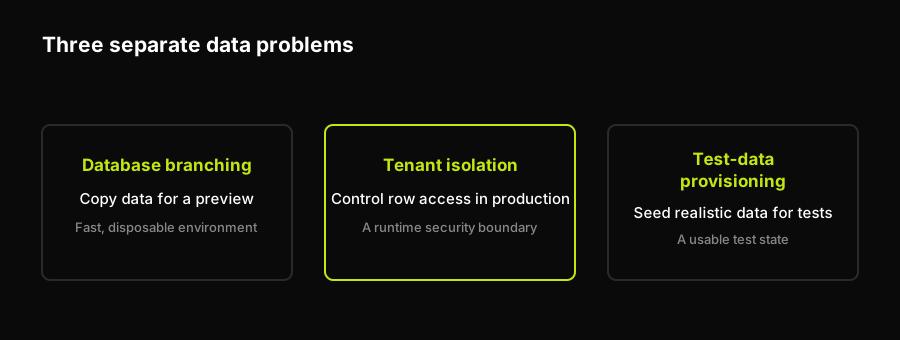
Branching creates a disposable copy, tenant isolation governs access in a live system, and provisioning makes the environment usable for tests.
Branching Is Not Isolation
Conflating these three ideas produces a specific, recurring failure. A team adopts Neon or Supabase branching for previews, gets genuinely isolated data per PR, and concludes it has "solved multi-tenancy." It hasn't touched multi-tenancy at all.
Branching gives you a fork of the whole database, tenants and all. If your production database has Tenant A's and Tenant B's rows sitting in the same tables, a branch of that database has both tenants' rows too, forked together, in exactly the relationship they had in production. Branching does not create a boundary between them. It copies whatever boundary, or lack of one, already existed.
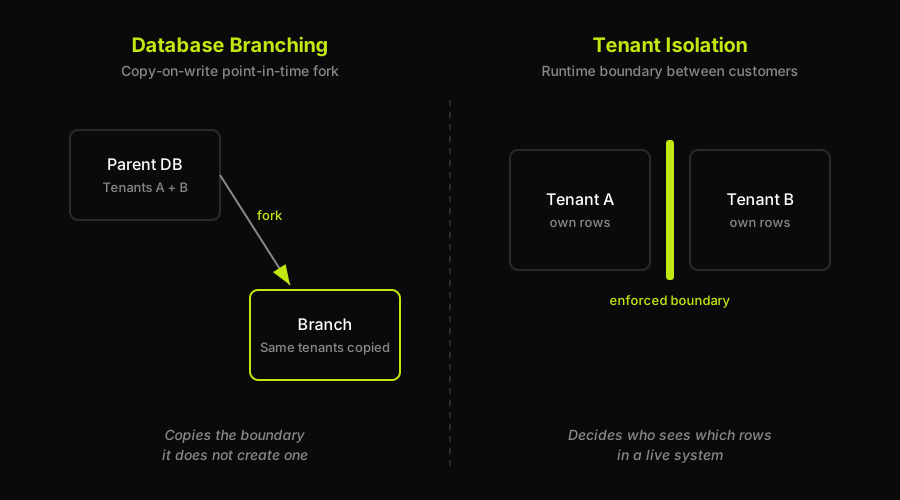
Branching forks the same data and copies whatever boundary already exists; isolation enforces a runtime boundary deciding which rows each request can see.
This matters because the two problems fail differently. A tenant isolation bug means Tenant A's dashboard shows Tenant B's invoices in production, in front of a paying customer and possibly a lawyer. A branching problem means your PR preview has stale or duplicate data, which is annoying but not a security incident. Teams that solve their preview-freshness problem with branching, then quietly stop worrying about isolation, have solved the cheap problem and left the expensive one exactly where it was.
The reverse conflation happens too. Teams that build careful schema-per-tenant isolation in production sometimes assume it also solves preview provisioning, because each tenant already has separate data. It doesn't. Schema-per-tenant tells you who can see what. It says nothing about how a PR preview gets a copy of any tenant's schema without touching production, or how you reset that copy for the next test run. That's back to being a provisioning problem, and it's the subject of our dedicated post on isolating test data per tenant.
Four Models for Giving Every Preview Clean Data
Once branching and isolation are untangled, the actual decision facing a team building preview infrastructure is which of four models to use, and how to combine them. We score each across the five dimensions that actually matter in practice: how strong the isolation is, what it costs as you scale past a handful of previews, how fast you can provision a new environment, how cleanly you can tear it down, and whether it holds up under a compliance audit.
| Dimension | Branch-per-Preview | Schema-per-Tenant | DB-per-Tenant | Shared Tables + tenant_id |
|---|---|---|---|---|
| Isolation strength | Full copy, no tenant boundary | Strong, one DB many schemas | Strongest, separate DBs | Weakest, relies on app logic |
| Cost at scale | Grows with PR volume | Low, shared instance | High, per-tenant instance | Lowest, one shared instance |
| Provisioning speed | Seconds, copy-on-write | Fast, one migration run | Slow, new instance each time | Instant, just insert rows |
| Teardown | Delete branch, done | Drop schema, done | Deprovision instance | Delete rows by tenant_id |
| Compliance fit | Weak, mixes tenant data | Good for most frameworks | Best for strict regimes | Needs RLS to pass audits |
- Branch-per-preview wins on speed and cost for the common case: a SaaS app with a handful of pull requests a day that needs a fresh copy of realistic data fast. It loses badly the moment you need to test that Tenant A can't see Tenant B's rows, because a branch faithfully reproduces whatever isolation, or lack of it, already exists upstream.
- Database-per-tenant is the strongest isolation model but the most expensive to run at any real scale, since every tenant is a running instance you're paying for around the clock.
- Schema-per-tenant is the pragmatic middle: one database bill, real separation, and migrations that touch every schema in one pass.
- Shared-tables-with-
tenant_idis the cheapest to run and the easiest to provision, but it puts the entire isolation guarantee in application code or row-level security policies, which means a single missed WHERE clause is a data leak, not a bug ticket.
When Branching Is the Wrong Tool
Branching is the right tool for exactly one job: giving a preview or a CI run a fast, disposable copy of realistic data. It's the wrong tool the moment your actual question is about isolation.
If you're trying to verify that a bug can't leak Tenant A's records into Tenant B's session, spinning up a branch doesn't test that at all. The branch has the same tenants, in the same tables, with the same missing boundary as its parent. You'd need to actually exercise your isolation model, whichever of the four above you run, with two tenants' worth of data and assertions that check the boundary holds.
Branch sprawl is the other failure mode, and it's a cost problem more than a conceptual one. Teams that adopt branch-per-PR without a teardown policy accumulate branches the way unused feature flags accumulate: quietly, then all at once, on the invoice. We've broken down what that actually costs at scale, but the short version is that storage for diverged branches and the compute for keeping them queryable both add up in ways a single "isolation strength" line on a pricing page never warns you about.
And branching is never a substitute for tenant isolation in a live, multi-tenant application. Your production system needs an answer to "who can see whose data" regardless of whether your preview pipeline uses branching, database-per-tenant, or nothing at all. Confusing the preview-provisioning question for the production-security question is how teams end up with beautifully fast previews and an isolation model nobody actually designed.
Skipping the Build: Managed Isolation and Provisioning Per PR
Everything above is a real decision with real trade-offs. If you're a small engineering team, building and operating any of these four models yourself is a project, not a checkbox. Schema-per-tenant means migration tooling that runs against every schema, in the right order, every time you ship a schema change. Database-per-tenant means a provisioning pipeline for real database instances: creating them, migrating each one, and tearing them down when a customer churns. Branch-per-preview means picking a provider, wiring branch creation into CI, and building the seeding logic that turns an empty fork into something worth testing against. None of that touches your product. All of it has to work correctly before a single preview can be trusted, and all of it needs someone maintaining it as your schema keeps changing.
This is the gap PreviewKit, Autonoma's managed preview-environment product, is built for. Instead of choosing and operating an isolation or branching strategy by hand, it provisions a full-stack, isolated preview per pull request, backend, database, and services included, so every PR gets clean data without your team building the provisioning pipeline first. You still decide which isolation model your production app actually needs: schema-per-tenant, database-per-tenant, or shared tables. You just stop being the one who builds and operates the machinery that copies it, seeds it, and tears it down for every PR that opens.
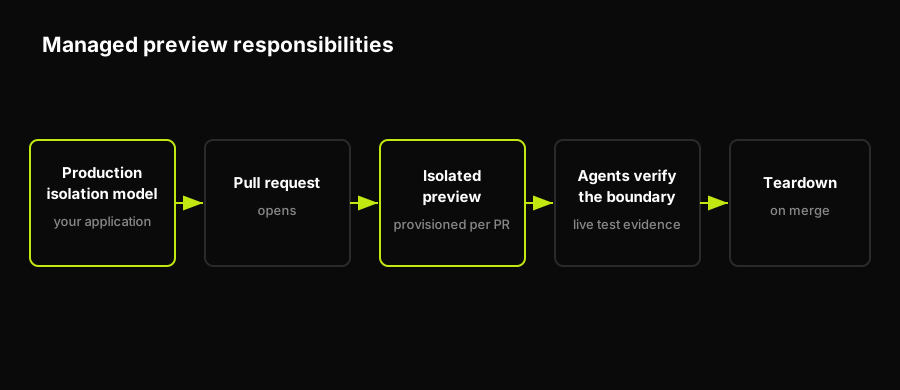
PreviewKit provisions the disposable per-PR environment while the production isolation model remains your application decision; the testing agents then verify the boundary against that preview.
Map that back onto the decision matrix from earlier. Branch-per-preview's cost-at-scale problem, schema-per-tenant's migration overhead, database-per-tenant's per-instance cost: none of those trade-offs disappear when a preview platform handles them. The isolation model you choose still governs what your production app does. What changes is who's on call when a provisioning script breaks at 2am.
Provisioning is only half the gap, though. Once a preview exists with isolated data sitting in it, someone still has to verify the boundary actually holds under real usage, not just at the schema level. A schema-per-tenant setup can be architecturally correct and still ship a bug where one query forgets to scope by tenant. That's a testing problem, not a provisioning problem, and it's the half most preview tooling stops short of.
This is where the platform's testing agents pick up: a Planner agent reads your codebase and plans test cases, including the database-state setup each scenario needs, against the live preview. An Executor agent runs those tests. A Reviewer agent separates a genuine cross-tenant leak from an agent error or a plan mismatch, so a real isolation bug doesn't get lost in noise. A Diffs Agent keeps the suite current as your schema and tenant logic change, so the coverage doesn't quietly rot the way a hand-maintained seed script does six months after whoever wrote it moves teams.
The net effect is that the two problems this whole post has been separating, provisioning clean data and verifying an isolation boundary, get solved together instead of by two different people on two different timelines. Which isolation model to use is still your decision. The infrastructure and the verification that used to be two separate build-vs-buy calls become one.
Choosing Your Model Before You Build Anything
If you're mapping this onto your own stack, start by writing down whether your actual problem is "our previews need fresh data" or "our production app needs a boundary between customers." Those are different projects with different owners, and naming which one you're solving is most of the battle. Branching, in whichever provider's flavor you use, solves the first. Schema-per-tenant, database-per-tenant, or shared-tables-with-tenant_id solves the second. Most teams need both, at different layers, and the teams that get burned are the ones who solved one and assumed it covered the other.
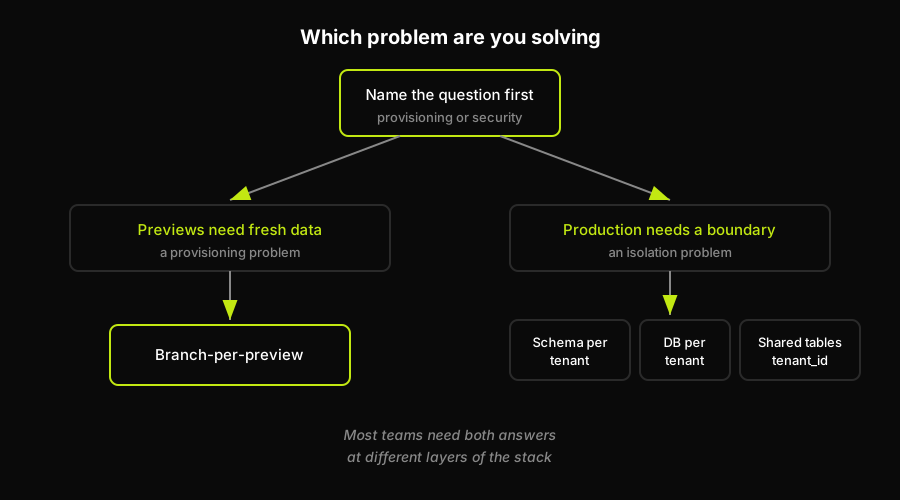
Name the question first: a provisioning need points to branch-per-preview, while a production boundary need points to one of the three isolation models.
A useful gut check: if someone on your team can explain, in one sentence, which of the four models governs your production tenant boundary, and a separate sentence for how your previews get their data, you're in good shape. If those two sentences turn out to be the same sentence, that's usually the sign a branch is doing a security model's job. (For the broader picture of testing across tenant boundaries specifically, see our pillar post on multi-tenant SaaS testing.)
Picture the team from the opening thread again, six weeks later. They've drawn the line: branch-per-preview for the fast, cheap "does this PR still work" check on every pull request, and schema-per-tenant in production because two of their design partners require SOC 2 attestations that a shared-tables model can't credibly satisfy. The two decisions don't fight each other, because they were never answering the same question.
Nobody restores a database dump at midnight anymore, and nobody's demo shows a stranger's invoice either. That's the whole fix: not picking the single "right" model out of four, but refusing to let one model quietly stand in for the other.
None of the four models in the decision matrix is wrong in isolation. They're wrong when applied to the problem the other one was built for. Get the two questions straight first, pick the model, or models, that answer each one, and only then decide whether you want to operate that infrastructure yourself or hand the provisioning half to something managed.
FAQ
No. Database branching is a copy-on-write, point-in-time fork of a database, while tenant isolation is a runtime boundary between customers' data in a live system. Branching gives you a fork of the whole database, tenants and all. It copies whatever boundary, or lack of one, already existed, so it does not create a boundary between tenants. Branching answers 'give me a copy.' Isolation answers 'who can see it.'
Database branching is a copy-on-write, point-in-time fork of a database. Platforms like Neon and Supabase snapshot the current state of your database and hand you a new, fully writable branch that behaves like an independent database. Unchanged data pages are shared with the parent branch, and only the pages you actually write get copied, so a large production database can fork in under a second and cost close to nothing until you start writing to it.
Tenant isolation is a runtime boundary between customers' data inside a system that is live and serving traffic. There are three common models: schema-per-tenant, where each customer gets their own Postgres schema; database-per-tenant, where each customer gets an entirely separate database; and shared tables with a tenant_id column, where the boundary is enforced in application code or with row-level security. All three answer the same question: which rows can this request see.
Branching is the right tool for exactly one job: giving a preview or a CI run a fast, disposable copy of realistic data. It is the wrong tool the moment your question is about isolation. Spinning up a branch to verify that Tenant A cannot see Tenant B's records does not test that at all, because the branch has the same tenants, in the same tables, with the same missing boundary as its parent. Branching is never a substitute for tenant isolation in a live, multi-tenant application.


