

A PCI DSS compliance checklist for testing starts by drawing the cardholder data environment (CDE) boundary, not by listing test cases. PCI DSS testing differs from payment functional QA: functional QA checks whether checkout works, while PCI testing checks which systems can reach card data, whether that reach is minimized, and whether cardholder data appears anywhere it shouldn't, including test fixtures and CI logs. Any system with network access to the CDE inherits its scope, a fact that pulls test infrastructure into an assessment far more often than engineering teams expect.
Your CI runner might already be in PCI scope, and nobody on your team has said so out loud.
This isn't for the team still deciding whether to write tests at all, or the team wondering whether its AI-generated suite can be trusted. It's for the QA lead, QA manager, or engineering manager who owns quality without a dedicated QA function, Series A through Series C, running a real suite against a real release cadence, who just noticed cardholder data sits somewhere in the picture.
None of what follows is a compliance opinion. Scope determination for your specific environment belongs to a Qualified Security Assessor (QSA), and nothing here substitutes for that judgment. What follows uses requirement numbers from PCI DSS v4.0.1, cited by number wherever verified against the published standard; where a sub-clause couldn't be confirmed, the obligation is described without one.
The checklist reduces to three rules:
| Rule | What it means | How to verify it |
|---|---|---|
| Scope follows the network path | Network access to CDE means in scope | Inventory CI jobs reaching the CDE |
| Fixtures and logs are storage | Logged failures can leak cardholder data | Mask sensitive fields before logging |
| A test environment has two honest options | Synthetic and outside, or protected and inside | Name each environment's scope and data class |
PCI compliance testing versus payment QA
A payment gateway integration suite can be green for months, confirming charges, refunds, and webhooks all fire correctly. None of that says whether the environment carrying that traffic is drawn correctly under PCI DSS: one question verifies behavior, the other verifies boundary, minimization, and access.
Building a broader compliance practice across SOC 2 and other frameworks? Our compliance automation and continuous compliance guides cover that ground. PCI DSS scope is narrower and stricter than either, turning on the CDE boundary specifically.
PCI DSS testing scope: how the CDE boundary works
The cardholder data environment (CDE) is not just the database storing card numbers. Per the PCI Security Standards Council's glossary, it also includes any system components, people, and processes that store, process, or transmit cardholder or sensitive authentication data, plus components with unrestricted connectivity to something that does.
Under PCI DSS v4.0.1 Requirement 12.5.2, annual scoping confirmation must identify "all system components in the CDE, connected to the CDE, or that could impact security of the CDE." Connectivity alone pulls a system into scope, regardless of whether it ever reads a PAN.
Why a test runner counts as in scope
This produces the most important consequence for engineering teams: a test runner with network access to the CDE is itself in scope. A nightly suite reaching a staging environment on the payment service's network segment inherits the CDE's requirements, whether or not any test asserts on a card number. The network path is what the standard evaluates, not the test's intent.
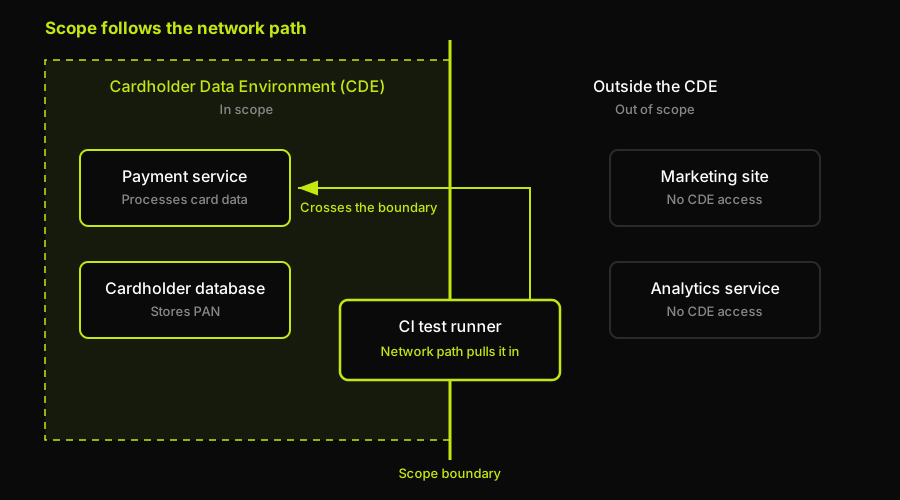
The runner is the only box on the diagram sitting on the line rather than on one side of it. It never asserts on a card number, but its network path into the payment service is the thing Requirement 12.5.2 evaluates, and that path alone is what puts it inside the boundary.
What must never be in your fixtures or logs
The obvious failure is a fixture containing a real primary account number (PAN). The subtler one is more common and harder to catch in review.
The assertion is the leak path
A test asserting on a checkout response doesn't need the full payload, but when it fails, most frameworks dump the full response body into the CI log by default. If that body includes an unmasked PAN, whatever masking existed in production, your CI system just became a store of cardholder data, subject to your CI provider's default retention window. GitHub's own documentation confirms the pattern: by default, workflow logs and artifacts are retained for 90 days before automatic deletion, and other CI providers set comparable defaults.
What the standard requires before production
PCI DSS v4.0.1 gives four obligations that bear directly on test data and logs. Sensitive authentication data (SAD), comprising full track data, the card verification code (CVV2/CVC2/CID), and the PIN or PIN block, must not be stored after authorization under Requirement 3.3.1 (3.3.1.1 through 3.3.1.3). PAN must be masked when displayed, showing at most the BIN and last four digits, under Requirement 3.4.1. Wherever PAN is stored, including in a log file, it must be rendered unreadable under Requirement 3.5.1. Account data storage generally must be kept to a minimum under Requirement 3.2.1, which a production snapshot dropped into a fixture directory violates directly.
Separately, Requirement 6.5.5 addresses the pre-production case: live PANs aren't used in pre-production environments unless those environments are themselves included in the CDE and fully protected. A staging environment seeded from a production snapshot, unless it's fully in scope and protected, is exactly the setup this requirement rules out.
| Data element | Allowed in test data? | Common leak path | Fix |
|---|---|---|---|
| Full PAN | Never | Test asserts on full API response body | Truncate or tokenize before asserting (3.4.1) |
| Masked/truncated PAN | Yes, if masked | Debug log skips masking | Enforce masking in test output (3.4.1) |
| SAD: CVV, track data, PIN | Never, any environment | Captured in failure logs | Strip SAD before any logging (3.3.1) |
| Cardholder name | Limited, synthetic preferred | Copied from prod snapshot | Replace with synthetic identity |
| Expiry date | Limited, synthetic preferred | Left in stale seed fixtures | Rotate or synthesize with PAN |
| Production DB snapshot as fixture | Never, unless CDE-protected | "Fastest way to get real data" | Synthetic data or masked extract (6.5.5, 3.2.1) |
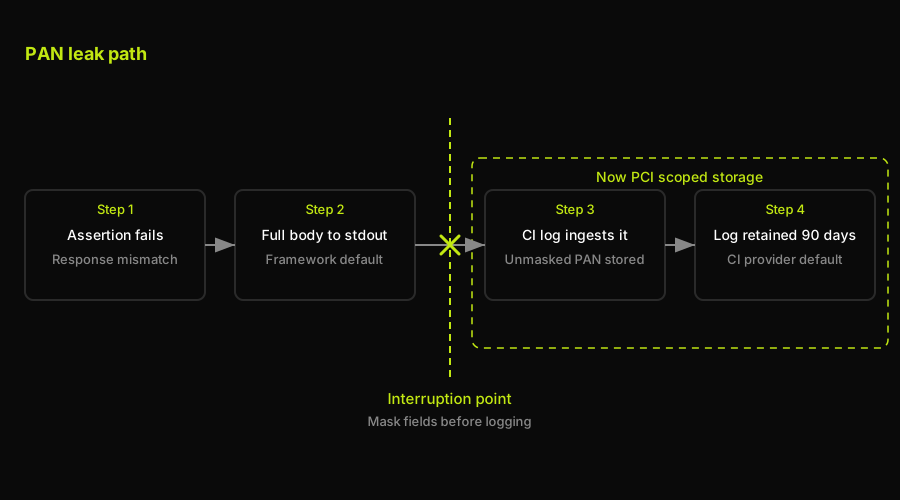
No step in this chain is a bug. Each one is a default: the framework dumps the body, the CI system ingests stdout, the provider keeps it for 90 days. Once the PAN crosses into step 3 it is sitting in storage you now have to scope, which makes the test's own output the last cheap place to stop it.
None of this is unique to card data; personal data under state privacy law carries its own fixture obligations, covered separately by our CCPA compliance testing guide, outside PCI scope entirely. For building masked or synthetic fixtures at scale, our test data management guide covers generation, masking, and lifecycle.
Which environments your PCI DSS tests may run against
"Just point the E2E suite at a production-like environment" is the instinct every team reaches for, and it's usually the one option PCI-scoped systems don't have.
PCI DSS v4.0.1 Requirement 6.5.4 requires role separation between production and pre-production environments. Requirement 6.5.5 bars live PANs from pre-production unless that environment sits inside the CDE and is fully protected, and where segmentation isolates the CDE, Requirement 11.4.5 requires penetration testing those controls annually and after any change.
Two options, not three
Put together, a test environment has two honest options, not three: outside the CDE with synthetic data and a mocked gateway, or inside it with every production control, segmentation testing included. A "basically production" staging box in between, seeded from a real snapshot and never formally scoped, is the default most teams reach for, and it's exactly what Requirement 6.5.5 and the CDE's connectivity rule close off.
If your test environments also carry data regulated under other frameworks, our HIPAA compliance checklist and GDPR compliance testing guides cover the equivalent boundary questions for health and EU data.
How Autonoma runs inside a scoped environment
The gap documented above isn't a testing-tool gap so much as a decision teams keep deferring: either payment flows go undertested because nobody wants to point automation at anything CDE-adjacent, or a suite ends up running against an environment where the scope question was never properly closed out.
Autonoma runs on either side of whatever boundary your team draws. It's a behavioral end-to-end testing layer that gets configured to run against whatever environment your team has already scoped, inside the CDE boundary or fully outside it. Point it at a synthetic, out-of-scope preview environment, and our Planner agent reads your codebase, routes, and payment-flow components to generate and execute test cases there, the same way it would for any other application surface. Point it at an environment your team has already brought inside the CDE and secured accordingly, and it runs there too, subject to whatever access and monitoring controls that environment requires. The boundary is yours to draw; Autonoma runs on your side of it, whichever side that is.
Scope matters here as much as capability. Autonoma is complementary to your QSA's scope determination, your DLP tooling, your log-scrubbing pipeline, and the segmentation controls validated under Requirement 11.4.5, and it stands in for none of them: it doesn't scan for stored PANs, segment your network, or produce a PCI attestation. What it adds is narrower and more concrete: the tests exercising your checkout and payment flows follow the boundary your team already drew, instead of that boundary getting quietly loosened just to make testing convenient.
What this changes in your strategy document
A test strategy document ultimately allocates a scarce resource, and that resource has shifted over the last few years: it used to be the hours it took to author a test, now it's the attention it takes to review one, especially once an AI coding agent can produce the test in seconds. A CDE boundary adds a second thing reviewers must confirm alongside correctness: not just whether a test does the right thing, but whether it runs in the right place, against the right data. That second question rarely has an owner today, which is exactly why it needs a home in the document rather than living in someone's head.
Most teams file PCI scope under the compliance section of a test strategy document and stop there, treating it as a checkbox rather than an operating constraint tied to how the suite actually runs. The bigger effect lands on the environments section, the part of the document that decides which infrastructure a suite may legally run against, and it's the section most strategy templates leave the vaguest, usually with a placeholder like "TBD" or "matches production."
Once a test runner with CDE connectivity is itself in scope, that section has to say, explicitly, which environments sit inside the boundary, which sit outside it, and which data classes each one is permitted to hold: synthetic-only, masked, or full account data under CDE-level protections, along with which CI jobs or service accounts can reach it over the network. That's an operational constraint on where CI jobs execute and what they're allowed to seed, not a compliance footnote. Our test strategy document template has a dedicated slot for this, and our test entry and exit criteria guide covers how to turn "fixtures are scrubbed" and "environment is correctly scoped" into gates that block a release rather than assumptions nobody checks.
Concretely, that section works best as a literal inventory: every environment your test suite touches, named, marked inside or outside the CDE, tagged with the account data it's authorized to hold, and paired with which pipelines or service accounts can reach it over the network. That inventory is what turns "we think our staging environment is out of scope" into something an assessor can verify against your CI configuration, rather than a claim taken on faith during the walkthrough. It's also what survives a re-org: when the engineer who set up staging leaves, the next person inherits a written answer instead of having to reverse-engineer the network topology from memory or from whoever's still around to ask.
This is precisely the kind of document work that lands on a QA lead or engineering manager without a dedicated QA function the moment cardholder data enters the picture, whether the company is Series A or already at Series C: nobody hands you a scoping template, there's no compliance team drafting it for you, and the QSA conversation goes better when you show up with the boundary already drawn rather than reconstructing it live in the audit room.
None of this replaces your QSA's judgment on where your specific CDE sits this year, and it won't turn a vague scoping conversation into a precise one by itself, especially the first time your team goes through an assessment. What it gives you is a head start and language for that conversation: which systems have network access to the CDE, what's actually sitting in your fixtures and logs, and which environments your suite is permitted to touch. Get those three answers right in your own strategy document, and Autonoma generates the E2E coverage for your payment flows from your codebase itself, not from a captured production dataset, so pointing it at a scoped environment doesn't require feeding it live account data to get started. The strategy document, not the testing tool, is what makes the boundary defensible when someone finally asks about it.
Frequently Asked Questions
Three rules cover most of it. Scope follows the network path: any test runner with network access to the cardholder data environment (CDE) is in scope regardless of what its tests assert on, so inventory every CI job and service account with reachability into the CDE. Fixtures and logs are storage: a failed assertion that dumps a full response body turns a CI log into a store of cardholder data, so sensitive fields need to be stripped or masked before the assertion writes anything. And a test environment has two honest options: fully outside the CDE with synthetic data, or fully inside it with every production control, with each environment named as in-scope or isolated. Final scope determination for a specific environment still belongs to a Qualified Security Assessor (QSA).
PCI DSS testing is the verification that systems touching cardholder data meet the Payment Card Industry Data Security Standard's technical requirements: correct scope boundaries, minimized and protected account data, restricted access, and tested network segmentation. It's distinct from payment functional QA, which verifies that checkout, refunds, and webhooks behave correctly. A payment integration suite can pass completely while the environment running it is out of compliance with PCI DSS scoping and data-handling rules.
Test data is in PCI scope whenever it contains cardholder data or sensitive authentication data, or when it lives in an environment connected to the cardholder data environment (CDE). Under PCI DSS v4.0.1 Requirement 6.5.5, live PANs are barred from pre-production environments unless those environments are themselves included in the CDE and protected under all applicable PCI DSS requirements. Fixtures built from a production database snapshot are a common way teams accidentally pull test data into scope.
Generally no. PCI DSS v4.0.1 Requirement 6.5.5 states that live PANs are not used in pre-production environments except where those environments are included in the CDE and protected in accordance with all applicable PCI DSS requirements. In practice, that means a typical staging or test environment needs synthetic or tokenized account data rather than a copy of production, unless the team is prepared to bring that entire environment inside the CDE and secure it to the same standard as production.
A CI pipeline is in PCI scope if it has network access to the cardholder data environment or if it stores, processes, or transmits cardholder data or sensitive authentication data, for example by logging an unmasked PAN captured during a failed test assertion. Per PCI DSS v4.0.1 Requirement 12.5.2, scope confirmation must identify all system components connected to the CDE or that could impact its security, and network connectivity alone is sufficient to bring a CI runner into that scope regardless of what its tests actually assert on.
Payment testing verifies that a payment flow works correctly: charges succeed, refunds post, webhooks fire, order status updates. PCI testing verifies something different: whether the systems carrying that traffic are properly scoped, whether cardholder data is minimized and protected everywhere it exists (including fixtures and logs), and whether segmentation controls isolating the cardholder data environment are tested and effective. A team can have excellent payment testing and a serious PCI scoping gap at the same time.
No. Autonoma's Planner agent generates test cases by reading your codebase, its routes, components, and payment-flow logic, rather than by capturing or replaying real production traffic. That means pointing Autonoma at a scoped test environment doesn't require feeding it live PANs or other real account data to get started; the account data populating that environment still needs to be synthetic or tokenized per your own fixture rules, since Autonoma generates and runs tests but does not itself decide what data belongs in the environment it's pointed at.


