

A QA automation engineer in the US earns roughly $105,000 to $115,000 base on average (2026, per BLS, Glassdoor, and ZipRecruiter); fully loaded, the total cost of employment is $145,000 to $165,000 per year. By seniority: junior/entry-level QA automation roles run $65,000 to $85,000 base; mid-level $90,000 to $120,000; senior QA automation engineers and SDETs $120,000 to $155,000; staff or lead SDETs $155,000 to $200,000-plus at major tech companies (Levels.fyi, 2026). These are the US national ranges. The fully-loaded number is what your budget actually absorbs.
Base salary is not the budget number. That is the single most important thing to understand before you post a job description or model a team expansion. The salary line in a job offer is the starting point, not the ending point. Payroll taxes, benefits, equipment, onboarding time, and the months before a new hire ships reliable test coverage all compound on top of that number. By the time you account for everything, you are looking at a figure closer to 1.4x the base, plus a ramp cost that is often invisible in headcount models.
The tables and worked example below give you the actual numbers, sourced and dated, so you can make a real budget decision rather than a guess.
Salary by Seniority and Region
The Bureau of Labor Statistics classifies QA automation roles under "Software Quality Assurance Analysts and Testers" (SOC 15-1253). Their 2024 OEWS data (the most recent published as of 2026) puts the national median for that category at around $99,620 annually. Glassdoor and ZipRecruiter, which skew toward self-reported current compensation and have broader data sets including SDET roles, show a higher center of gravity reflecting the automation-specific premium.
| Seniority / Level | Base Salary Range (USD, 2026) | Source |
|---|---|---|
| Junior / Entry-level QA Automation | $65,000 to $85,000 | Glassdoor, ZipRecruiter (2026) |
| Mid-level QA Automation Engineer | $90,000 to $120,000 | Glassdoor, BLS OEWS (2024/2026) |
| Senior QA Automation Engineer / SDET | $120,000 to $155,000 | Glassdoor, Levels.fyi (2026) |
| Staff / Lead SDET | $155,000 to $200,000+ | Levels.fyi (2026) |
Geography matters significantly. The national averages above reflect a blended pool of remote, mid-market, and major-metro roles. The regional picture shifts the bands noticeably:
| Region | Adjustment vs National Average | Notes |
|---|---|---|
| San Francisco / Bay Area | +30% to +50% | FAANG and Series B+ competition drives premiums |
| New York City | +20% to +35% | Finance and media tech clusters |
| National average (blended) | Baseline | BLS OEWS SOC 15-1253 |
| Remote / lower-COL markets | -10% to -20% | Midwest, Southeast; fully remote roles |
One important note on SDET salary specifically: the SDET title (Software Development Engineer in Test) signals stronger coding expectations than a QA automation engineer title and tends to land at the mid or senior band even at entry level. Levels.fyi 2026 data shows staff SDET total compensation at major tech companies (base plus equity plus bonus) often exceeding $250,000 to $350,000. For budget modeling purposes, base salary is what matters most for the 1.4x loading math below, since equity at smaller companies is harder to cost-account.
From Salary to Fully-Loaded Cost
Here is the gap most headcount models miss. Take a mid-level QA automation engineer at $105,000 base. That is the number in the offer letter. The fully-loaded cost is the number that actually hits your budget.
The loading multiplier (~1.4x base):
Employer payroll taxes account for the first layer. FICA alone runs 7.65% of base (6.2% Social Security up to the wage cap, 1.45% Medicare, plus the employer's FUTA share). Benefits add a second layer: health, dental, and vision for a single employee typically runs $6,000 to $14,000 annually in employer contributions, depending on plan and family status. A 401(k) match at 3% to 4% of salary adds another $3,000 to $4,200. Equipment (laptop, monitors, device farm access) adds $2,000 to $4,000 amortized per year. Overhead (real estate or remote stipend, HR cost allocation, tooling licenses beyond the QA stack) adds another 5% to 10% of base.
Adding it up: on a $105,000 base, total-cost-of-employment typically lands between $145,000 and $155,000. That is the 1.4x multiplier in practice.
The ramp cost:
A new QA automation engineer does not ship reliable, maintainable test coverage on day one. Realistically, the first 30 to 60 days go to codebase orientation, environment setup, and understanding the existing test architecture. The first passing E2E suite against a non-trivial flow typically takes 6 to 10 weeks. Full coverage across critical paths with review-ready quality is a 3 to 6 month horizon. During that ramp, you are paying the fully-loaded rate for partial output. A conservative model assigns 30% to 40% of the first-year fully-loaded cost as ramp overhead.
On a $150,000 fully-loaded annual cost, the ramp adds roughly $45,000 to $60,000 in effective first-year cost beyond what you would spend on a fully productive hire.
The tooling line:
The QA automation engineer still needs tools to do their job. A browser testing platform (Playwright on CI, a managed grid, or a SaaS runner like BrowserStack or LambdaTest) runs $3,000 to $25,000 per year depending on concurrency and real-device needs. CI compute for test runs adds $3,000 to $12,000. Test management or observability tooling adds another $2,000 to $6,000. Budget $8,000 to $40,000 per year in tooling that the hire depends on, none of which is covered by the salary line.
Worked example (mid/senior, year one):
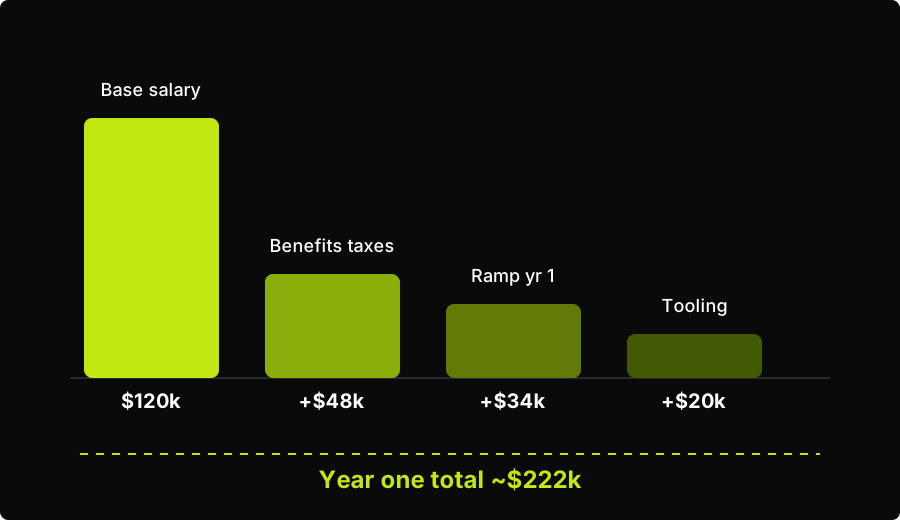
Year-one cost build: $120,000 base salary + $48,000 benefits/taxes + $34,000 ramp + $20,000 tooling = approximately $222,000.
The year-one number is typically $200,000 to $230,000 for a senior hire in a US market, when you account for all four lines. Steady-state (year two onward, no ramp premium) drops to $165,000 to $200,000. That is the range any competing tool or alternative needs to be measured against.
What That Budget Buys vs a Tool
The fully-loaded cost is not an argument against hiring. A strong QA automation engineer brings engineering judgment, codebase intuition, and the ability to build and maintain test architecture that no tool replaces wholesale. If you are building a quality culture, you probably need one.
The point is to know the real denominator before you compare. A $165,000 to $200,000 annual steady-state cost is the number any test-automation tool is measured against. Not the license fee on the vendor's pricing page. The SDET's fully-loaded salary.
That framing surfaces some honest tradeoffs.
A single senior SDET covers a finite surface area. In a typical week, they are writing new tests, maintaining existing ones, triaging flakes, and supporting the team on test strategy. That is 40 hours of human attention. As the application grows, the backlog grows faster than one person's bandwidth. Teams that are shipping fast often find their SDET is the bottleneck on coverage, not because the engineer is slow but because the application is changing faster than manual test authoring can follow.
A tool trades differently. Tools do not context-switch. They do not take vacation. They also lack the judgment to decide what is worth testing. The honest framing is that tools and engineers are complements, not pure substitutes. But the question of where to spend the next dollar, whether on a second SDET or on tooling that expands the first SDET's leverage, is genuinely interesting at the $165,000-plus annual budget level.
For the detailed hire-vs-tool decision framework, the cost of hiring a QA engineer vs a tool post walks through the tradeoff analysis directly. For the build-vs-buy framing on the automation stack, the build vs buy test automation companion covers the tradeoffs when you are deciding whether to maintain your own framework versus using a managed solution. If you are earlier in the process and deciding whether to hire at all, the guide to hiring a QA engineer covers the sourcing and evaluation side.
How Autonoma Reduces the Coverage Burden on Your First Hire
The testing coverage problem that drives most QA automation hiring is straightforward: the application is changing faster than tests can be written and maintained. Every sprint, new flows ship without E2E coverage. The existing suite drifts. The SDET spends 30% to 50% of their time on maintenance rather than new coverage.
That is the gap Autonoma was built for. Our platform reads your codebase directly. The Planner agent analyzes your routes, components, and user flows to generate test cases from code analysis, not from human recordings or natural-language descriptions. The Executor agent drives the application UI against a live preview environment for each case. The Reviewer agent classifies every result: real bug, agent error, or test-plan mismatch. The Diffs Agent runs on every PR, updating the test suite from code diffs so coverage stays aligned as your application changes.
The practical effect: a team that hires its first QA automation engineer does not have to give that person a two-month backlog of test-writing before they can focus on architecture and quality strategy. Autonoma handles baseline coverage generation and much of the ongoing maintenance work automatically. Runs and generations still consume a fixed amount of credits from the user's credit pool, and the Diffs Agent keeps that execution more economical by selecting relevant tests from each code diff instead of blindly running everything. The engineer's attention goes to the judgment-layer work that actually requires a human, not to keeping up with a codebase that never stops moving.
That is not a replacement for a great SDET. It is what makes a great SDET's time go further, which is a very different thing.
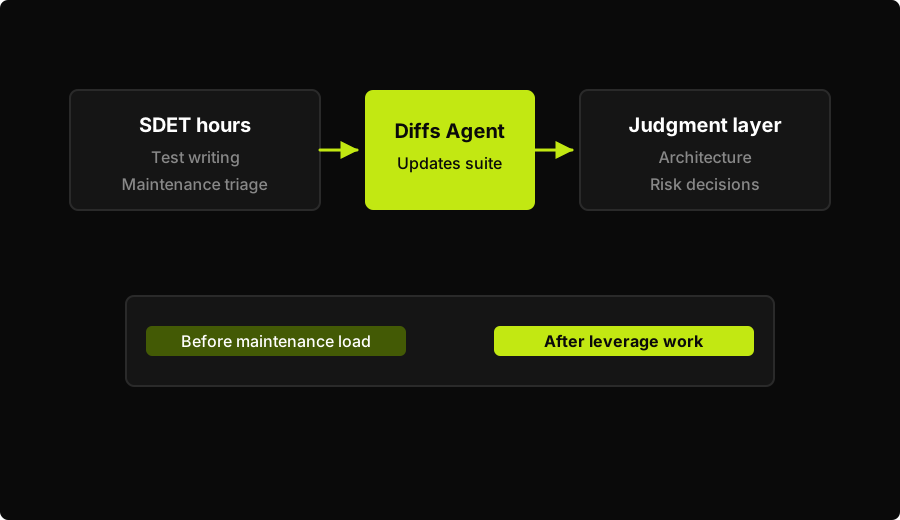
Runs and generations still consume credits; leverage comes from reducing maintenance and unnecessary execution.
FAQ
A QA automation engineer in the US earns roughly $90,000 to $120,000 base at mid-level, with the national average across all seniority levels sitting around $105,000 to $115,000 (Glassdoor, ZipRecruiter, BLS OEWS 2024/2026 data). Entry-level roles start at $65,000 to $85,000; senior roles run $120,000 to $155,000. High-cost-of-living markets like San Francisco and New York add 20% to 50% to those figures.
SDET (Software Development Engineer in Test) is a title that signals stronger coding expectations than a standard QA automation engineer role and typically commands a mid-to-senior-level premium. Mid-level SDETs earn $95,000 to $125,000 base nationally; senior SDETs run $130,000 to $160,000. At major tech companies, staff SDET total compensation (base plus equity plus bonus) often exceeds $250,000 to $350,000, per Levels.fyi 2026 data.
The fully-loaded cost of a QA engineer is typically 1.3x to 1.5x the base salary, depending on benefits, location, and company size. On a $120,000 base, total cost of employment runs roughly $165,000 to $180,000 per year in steady state. Year one is higher: add 3 to 6 months of ramp-period overhead (the time before the hire ships reliable coverage) plus tooling ($8,000 to $40,000 annually for CI and browser testing infrastructure). Year-one total for a senior hire is often $200,000 to $230,000.
The titles overlap significantly in practice. SDET typically implies more software engineering depth and commands a 10% to 20% premium over a comparably tenured QA automation engineer at the same company. Both sit in the $90,000 to $160,000 base range at mid-to-senior levels nationally. The gap is most visible at staff level, where SDETs at large tech companies earn substantially more due to equity-heavy compensation packages.
That depends on what you need. A strong QA automation engineer brings engineering judgment, architecture thinking, and codebase-aware quality strategy that tools cannot replicate. If you are building a quality culture from the ground up, you likely need one. The more useful framing is whether you know the real number you are deciding about: not just the salary, but the fully-loaded total cost of employment ($165,000 to $200,000 per year in steady state for a senior US hire) and what that budget would buy if allocated differently. For the detailed analysis, see the companion post on the cost of hiring a QA engineer vs a tool.


