

The cost of hiring a QA engineer is not the salary number on a job posting. The fully-loaded annual cost of a mid-level QA engineer in the US in 2026 runs between $168,000 and $235,000 in the first year (and $130,000 to $165,000 every year after) once you add benefits, payroll taxes, equity, ramp time, and management overhead. A testing tool subscription typically runs between $500 and $3,000 per month. That gap is the hire-vs-buy decision.
The salary number is the sticker price. No founder actually pays just the salary.
Payroll taxes, health insurance, 401k match, equipment, SaaS seat licenses, recruiting fees, and a few months of below-productivity ramp time all land on top. Then there is the soft cost nobody puts in a spreadsheet: the engineering manager hours spent onboarding, unblocking, reviewing work, and running 1:1s. Stack it all up and the real annual spend is 40-50% above the base.
The Fully-Loaded Cost of a QA Hire
Mid-level QA automation engineers in the US command a base salary in the $95,000 to $115,000 range as of 2026, with variance by market. San Francisco and New York pull toward the top; Midwest and remote-first companies land closer to the bottom. (For a detailed salary breakdown by role seniority and market, see the QA automation engineer salary data we published separately.)
The fully-loaded cost adds these line items:
| Cost item | Typical range | Notes |
|---|---|---|
| Base salary | $95,000 – $115,000 | Mid-level, US market, 2026 |
| Payroll taxes (FICA, FUTA, SUI) | $7,000 – $9,000 | ~7-8% of base |
| Health, dental, vision insurance | $8,000 – $14,000 | Employer share, single or family plan |
| 401k match | $2,000 – $5,000 | 2-4% match, common for tech |
| Equity (RSU amortized) | $6,000 – $12,000 | Modest grant, 4-year vest |
| Recruiting / agency fee | $15,000 – $25,000 | One-time, 15-20% of base |
| Equipment and SaaS licenses | $3,000 – $5,000 | Laptop, IDE, test infra seats |
| Ramp time (3-4 months, reduced output) | $24,000 – $38,000 | Salary cost at 50-70% productivity |
| Management overhead (annualized) | $8,000 – $12,000 | ~1hr/day EM time at fully-loaded EM cost |
Total year-one fully-loaded cost: $168,000 – $235,000. In subsequent years (no recruiting fee, no ramp), the recurring run rate settles between $130,000 and $165,000. This is the honest in-house QA cost.
The cost is real and recurring. It is also not inherently wrong. The question is what you get for it.
What a Tool Costs Instead
A testing tool subscription runs between $500 and $3,000 per month depending on tier, seat count, and coverage scope. Call it $6,000 to $36,000 per year. Ramp time is days to weeks, not months. Management overhead is near zero. There is no recruiting fee, no equity burn, no benefits load.
What a tool does not cover is worth stating plainly. A tool does not attend sprint planning, write test cases from a Figma mockup, or file a Jira ticket with a root cause. A tool also does not negotiate with a product manager about what counts as a regression.
The real question is not "which is cheaper." It is "what am I actually trying to solve, and does the coverage I need require judgment or throughput?"
For most early-stage teams, the first testing gap is coverage throughput: no one is running E2E regression reliably on every PR, and bugs reach production. That is a throughput problem, not a judgment problem. A tool solves it faster and cheaper than a hire.
When to Hire vs When to Tool
This is a decision framework, not a universal answer. The signals below are practical, not theoretical.
Tool first when:
Your primary gap is coverage throughput: flows are untested on every PR and bugs are reaching production. The team is small (under 15 engineers) and QA ownership can live with the engineering manager. You do not yet have a defined test strategy that requires human judgment to build. You want to validate that QA investment pays off before committing to a recurring $140k+ line item.
Hire when:
Your product has complex regulatory or compliance requirements (healthcare, fintech, payments) where human sign-off on test strategy is mandatory. You are running a QA function that owns a test plan, coordinates with multiple product teams, and needs someone who attends planning meetings and writes acceptance criteria. Your codebase is already covered by automated E2E, and the bottleneck is judgment work: exploratory testing, user-journey validation, or accessibility audits. You are past 30-50 engineers and QA oversight has become a coordination problem, not a coverage problem.
The two are not mutually exclusive. Many teams run a tool for coverage and hire a QA lead 12-18 months later to own strategy. The hire at that point is very different from the hire you make when you are trying to solve throughput: you are hiring for judgment, not coverage, and the fully-loaded cost is justified. (The full build-vs-buy test automation decision framework deserves its own treatment; we cover it separately for teams weighing open-source tooling, in-house frameworks, and managed solutions.)
The mistake is hiring a QA engineer to run manual regression tests because you have no automation. That is a $168,000 solution to a $1,500/month problem.
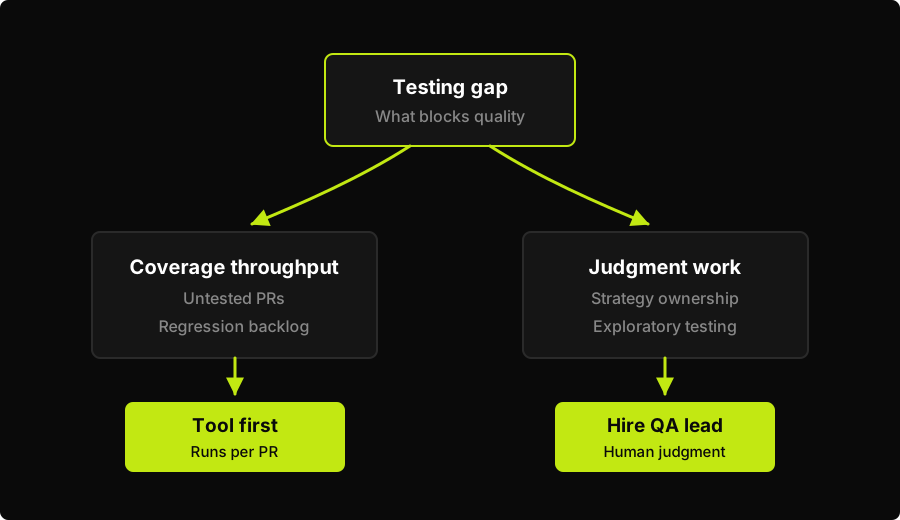
Tooling closes the coverage-throughput gap. Hire QA when judgment, strategy, and ownership are the bottleneck.
How Autonoma Closes the Coverage Gap
The throughput problem is the one most founders face first. Every PR is a potential regression. Nobody runs the full flow manually before merging because it takes too long. The test suite either doesn't exist or has rotted from months of UI drift. The result: production bugs that a 20-minute regression run would have caught.
Autonoma is the answer to that specific problem. We built a four-agent platform that generates, runs, and maintains E2E tests from your codebase on every PR, without a QA engineer writing scripts by hand. The Planner agent reads your routes, components, and flows and generates test cases. The Executor agent drives those tests against a live preview environment per PR. The Reviewer agent classifies each result: real bug, agent error, or test/plan mismatch, so you get signal without noise. The Diffs Agent runs on every code diff to add new tests, deprecate stale ones, and keep the suite aligned as your product changes.
The comparison becomes concrete: Autonoma gives you continuous E2E coverage on day one, for a fraction of the in-house QA cost. The hire decision then becomes about what Autonoma cannot do, which is judgment work: exploratory testing, requirement negotiation, cross-team quality ownership. Those are real reasons to hire. Throughput is not one of them.
Final Thoughts
The fully-loaded cost of a QA hire is between $168,000 and $235,000 in year one. That number is not an argument against hiring. It is an argument for being honest about what you are hiring for.
If you need coverage on every PR today, start with Autonoma. Our agents generate and maintain the test suite from your codebase, run it on every PR in a live preview environment, and deliver bug signal without noise. Autonoma uses runs and generations, each consuming a fixed amount of credits from the user's credit pool; its efficiency advantage comes from the Diffs Agent selecting relevant tests from each code diff instead of blindly running everything. You can be running full E2E coverage this week, without a hire, without a ramp period, and without management overhead.
If you need judgment work, a QA lead who owns strategy, attends planning, and writes acceptance criteria is worth the investment. That is a different role, hired for different reasons, at a different stage.
Know which problem you have before you post the job.
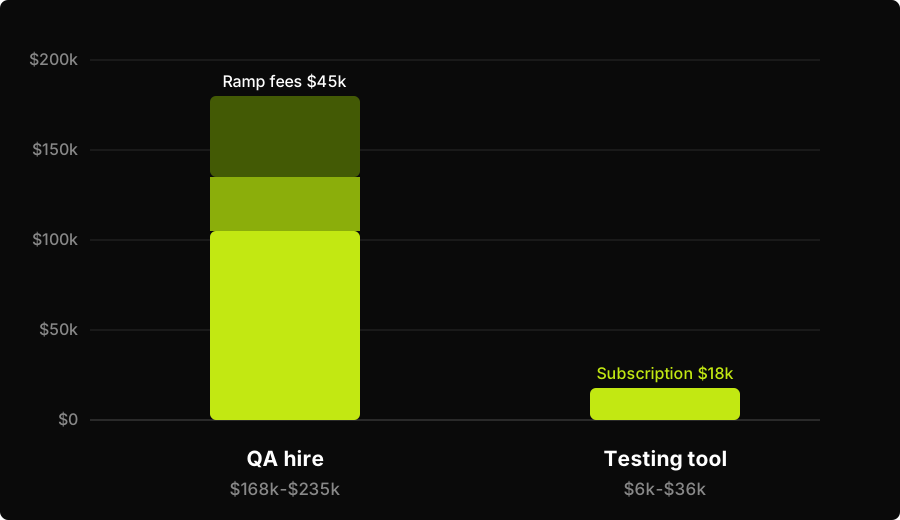
Year-one cost stack: fully loaded QA hire vs testing-tool subscription, including benefits, recruiting, and ramp time.
FAQ
In the US in 2026, a mid-level QA automation engineer earns a base salary of $95,000 to $115,000 per year. The fully-loaded cost including payroll taxes, health insurance, equity, recruiting fees, and ramp time is significantly higher, typically $168,000 to $235,000 in the first year.
The fully-loaded cost of a QA hire adds benefits (health, dental, vision), payroll taxes (roughly 7-8% of base), 401k match, equity amortization, a one-time recruiting or agency fee of 15-20%, equipment and SaaS licenses, and 3-4 months of reduced-productivity ramp time on top of the base salary. The total for year one typically lands between $168,000 and $235,000 for a mid-level engineer in the US.
It depends on what problem you are solving. If your gap is coverage throughput (flows untested on every PR, bugs reaching production), a testing tool is faster, cheaper, and operational within days. If your gap is judgment work: test strategy, acceptance criteria, cross-team quality ownership, a QA hire is justified. Most early-stage teams have a throughput problem first. Buying a tool and hiring later (when you need judgment) is typically the lower-risk path.
Startups need a dedicated QA engineer when the bottleneck is judgment and coordination, not coverage. That usually happens at 30-50+ engineers when QA strategy, exploratory testing, and cross-team coordination become real problems. Before that point, automated coverage through a tool like Autonoma typically delivers more value per dollar than a hire.
In-house QA cost for a single mid-level engineer runs $130,000 to $165,000 per year on a recurring basis (after the first-year recruiting and ramp costs). The QA team cost for two or three engineers runs $260,000 to $500,000 per year in fully-loaded personnel cost, not counting test infrastructure, tools, and management time.


