

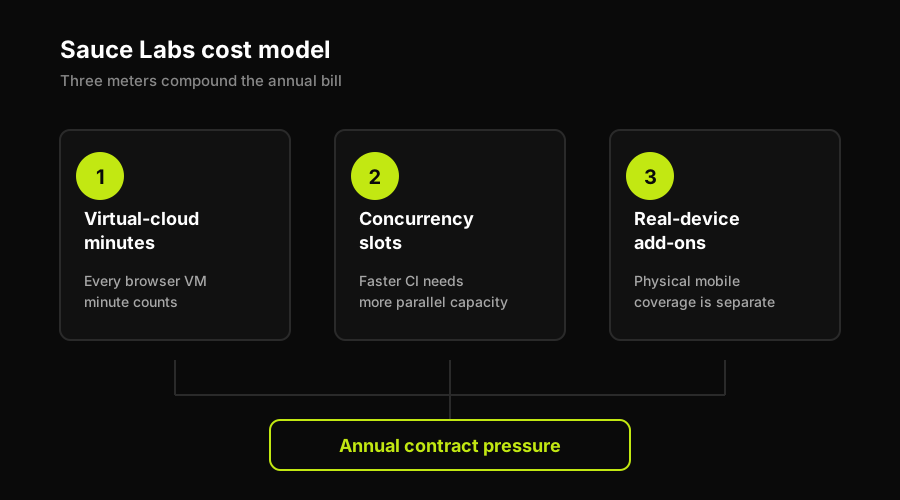
Sauce labs pricing runs on three meters: virtual-cloud minutes, parallel concurrency slots, and real-device add-ons, with enterprise tiers gated behind contact-sales. Modeled from Sauce Labs' published Virtual Cloud tiers and third-party deal data (Vendr, Capterra, June 2026), a 10-engineer team running meaningful automated cross-browser coverage lands in the range of roughly $18,000 to $30,000 per year before real-device add-ons, depending on the concurrency level they need to keep CI times reasonable.
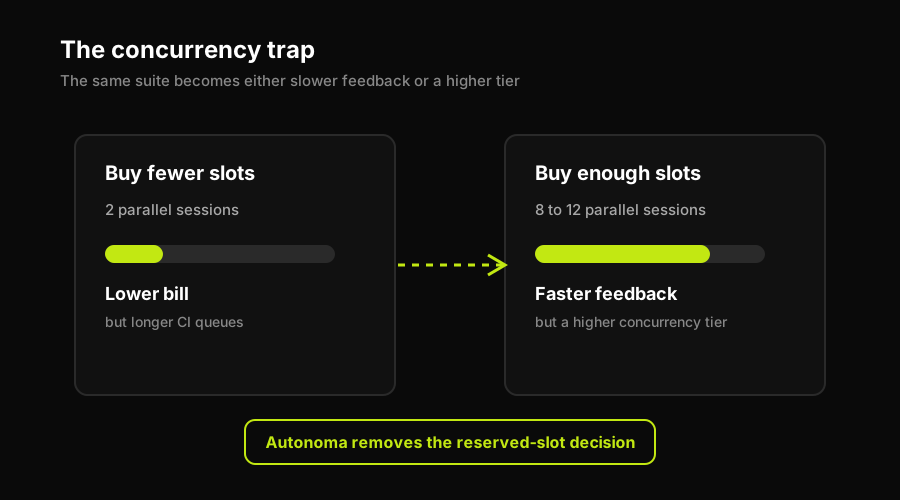
The gap between the sticker price and the real bill is where teams get surprised. Sauce Labs posts per-minute rates and starter tier figures, but what you actually pay depends on how many parallel sessions you provision and how many minutes your suite burns per run. A team that starts on a modest plan and then realizes CI takes 40 minutes instead of 8 because they only bought two parallel slots ends up upgrading, which kicks them into a higher concurrency tier. The jump is not linear.
That dynamic is what this post models. Rather than quoting a single headline price, we work through three team sizes, make the assumptions explicit, and show how the three billing axes compound.
If your core need is web E2E regression coverage on every PR, the comparison should also ask whether you need to buy cloud-grid capacity at all. Autonoma replaces the purchased concurrency layer with managed per-PR preview environments and agents that generate, run, review, and maintain tests from the codebase.
What Sauce Labs Charges For
Sauce Labs organizes its product into three main lines: Live Testing (manual cross-browser), Virtual Cloud (automated browser testing at scale), and Real Device Cloud (automated and manual on physical devices). Most engineering teams doing automated regression testing sit primarily in the Virtual Cloud tier, with some adding Real Device Cloud for mobile coverage.
The billing model has three distinct axes that work together, and understanding all three is the only way to reason about your real annual spend.
Virtual-cloud minutes are consumed every time an automated test runs in a browser instance on Sauce's infrastructure. A test suite that takes 20 minutes of wall-clock time on two parallel VMs burns 40 VM-minutes. Published Sauce Labs pricing pages (as of June 2026) list starter allotments in the low thousands of minutes per month, with additional minutes purchasable. Third-party deal databases suggest that teams with serious regression suites burn through starter allotments quickly.
Per-parallel pricing (concurrency) is the axis most teams underestimate. Concurrency determines how many browsers can run simultaneously. If your suite has 200 tests and each takes 30 seconds, running them with 10 parallel slots takes about 10 minutes of wall time. Running them with 2 slots takes 50 minutes. Teams optimize CI speed by increasing concurrency, but each tier jump costs meaningfully more. Capterra-listed prices (June 2026) place concurrency upgrades in the range of several hundred to several thousand dollars per month depending on the tier.
Real-device cost add-ons apply when teams need to run on actual iOS or Android hardware rather than emulators. Real Device Cloud is priced separately. Sauce Labs does not publish real-device minute rates openly on their pricing page as of June 2026; Vendr-reported deal data suggests real-device add-ons can add $6,000 to $20,000 per year for a mid-size team depending on volume, but individual contract pricing varies widely.
| Billing Axis | What It Meters | Rough Published / Estimated Price | Source (June 2026) |
|---|---|---|---|
| Virtual-cloud minutes | VM-minutes consumed per test run | Starter allotments from ~$149/mo; overage rates listed per-minute | Sauce Labs pricing page |
| Concurrency (per-parallel pricing) | Simultaneous browser sessions | $400-$1,200+/mo per tier jump (estimated from Capterra) | Capterra DR91, June 2026 |
| Real-device cost add-on | Physical device minutes (iOS/Android) | Contact sales; Vendr deals cluster $6K-$20K/yr for mid teams | Vendr DR75, June 2026 |
| Live Testing (manual) | Concurrent manual browser sessions | Included in some tiers; add-on in others | Sauce Labs pricing page |
Sauce Labs Pricing Modeled by Team Size
The following table models annual Sauce Labs cost at three team sizes. Every figure is derived from Sauce Labs' publicly listed Virtual Cloud pricing and third-party deal data, and should be treated as an estimate rather than a quote. Real contract pricing depends on negotiation, annual vs. month-to-month terms, and usage spikes.
Assumptions used in the model:
Each developer runs 3 CI pipeline runs per day on average. The test suite takes 15-20 minutes of wall time at the stated concurrency level. The model uses calendar days (260 working days per year) and averages the concurrency tier cost at the midpoint of Capterra-reported ranges. Real-device testing is excluded from the base estimate and shown separately. Discounts for annual contracts (typically 15-20% per Vendr data) are not applied, making these ceiling estimates.
| Team Size | Concurrency Slots | Est. VM-Minutes/Year | Est. Annual Cost (virtual cloud) | Real-Device Add-On |
|---|---|---|---|---|
| Small (3-5 devs) | 2-4 parallel | ~300K-500K min/yr | $5,000-$10,000/yr (estimated) | +$3K-$8K if needed |
| Mid (10-15 devs) | 8-12 parallel | ~1.2M-2M min/yr | $18,000-$30,000/yr (modeled) | +$8K-$15K if needed |
| Larger (25-30 devs) | 20-30 parallel | ~3M-5M min/yr | $45,000-$75,000/yr (estimated) | +$15K-$30K if needed |
The mid-tier row (10-15 devs, 8-12 concurrency slots, $18K-$30K/yr) reconciles with the hero figure in the tldr above. At the lower bound of that range you get limited concurrency and slower CI. At the upper bound you get the parallelism needed to keep pipeline feedback under 10 minutes.
The larger-team figure starts to approach enterprise territory where Sauce Labs gates pricing behind direct sales conversations. Vendr data on Sauce Labs contracts (June 2026) shows average deal sizes for larger teams well above the $50K/yr mark once real devices are included.
How Autonoma Changes the Cost Model
The fundamental tension in per-parallel/per-minute pricing is that you pay for peak capacity you only use a fraction of the time. A 12-parallel concurrency slot reservation costs the same whether your suite runs at full blast or only two tests are executing. Teams end up either over-provisioning (paying for idle capacity) or under-provisioning (waiting 40 minutes for CI feedback, which breaks developer flow).
Autonoma approaches this differently. We built a four-agent system where a Planner Agent reads your codebase directly and generates test plans, an Executor Agent runs those tests against a managed per-PR preview environment, a Reviewer Agent classifies results (real bug vs. agent error vs. plan mismatch), and a Diffs Agent maintains the suite on every PR by analyzing code changes. Because the tests run on managed preview environments per PR, there is no persistent concurrency reservation, no idle Sauce Labs meter running between commits. The suite runs when your code changes, not according to a Sauce Labs concurrency tier you pre-purchased.
The practical result is that a 15-engineer team does not need to model how many parallel sessions they need or watch minute allotments burn. Our agents generate and maintain the tests; the test operation scales with PR activity. Teams shifting from metered cloud testing to Autonoma typically report the planning overhead of "how many parallel slots do we need this quarter" disappearing entirely.
That is the core economic difference: Sauce Labs sells browser capacity, while Autonoma sells the outcome the team wanted from that capacity in the first place: maintained web E2E coverage on every PR.
Sauce Labs vs BrowserStack on Cost
The saucelabs vs browserstack cost question is one of the most common in the QA infrastructure space, and the honest answer is: the list prices are comparable, but the utilization dynamics differ. Both bill on a combination of concurrency and usage volume. BrowserStack has historically been more aggressive on self-serve pricing transparency; Sauce Labs pushes larger teams toward enterprise contracts faster.
The deeper cost analysis for BrowserStack, including their own version of the utilization trap, lives in our BrowserStack pricing true cost deep-dive. If you are evaluating both platforms simultaneously, that post and this one together give you the cross-vendor comparison. For teams exploring whether a self-hosted grid changes the economics entirely, see our Selenium Grid TCO analysis. And if LambdaTest is also in your shortlist, the LambdaTest pricing breakdown covers their tier structure with the same modeled-by-team-size approach used here.
The short version: at small team sizes (under 5 devs), BrowserStack's self-serve tiers often land slightly cheaper. At mid-size and above, pricing converges and negotiation becomes the dominant variable.
For web E2E regression coverage, Autonoma beats both alternatives on cost predictability: you are not choosing between two concurrency meters, because agents generate and maintain the suite and run it on managed per-PR previews.
Frequently Asked Questions
Sauce Labs cost depends on three variables: the virtual-cloud minutes your suite consumes, the concurrency (parallel sessions) you need, and whether you add Real Device Cloud. For a 10-15 engineer team running automated cross-browser tests at 8-12 parallel sessions, our model (derived from Sauce Labs' published pricing and Vendr/Capterra deal data, June 2026) estimates $18,000 to $30,000 per year for virtual cloud alone, before real-device add-ons. Small teams (3-5 devs) typically land in the $5,000-$10,000/yr range.
At small team sizes, BrowserStack's self-serve tiers are often slightly cheaper than equivalent Sauce Labs plans. At mid-size and above, list prices converge and the outcome depends heavily on negotiation and contract terms. Both platforms bill on a combination of concurrency and usage volume, so the utilization dynamics matter as much as the sticker price. See our BrowserStack pricing post for a parallel modeled breakdown.
Yes. Sauce Labs' Virtual Cloud billing is based on virtual-cloud minutes consumed, meaning every browser-VM-minute your test suite runs counts against your allotment. Starter plans include a monthly allotment of minutes; going over triggers per-minute overage charges. High-concurrency runs multiply minutes fast: 10 parallel browsers running for 20 minutes consumes 200 VM-minutes.
Concurrency pricing determines how many browser tests can run simultaneously. More parallel sessions mean faster CI feedback but higher cost. Sauce Labs' concurrency tiers are not all published on the self-serve pricing page. Capterra-listed prices (June 2026) suggest tier jumps cost several hundred to over a thousand dollars per month depending on the number of parallel slots. Enterprise concurrency levels are gated behind contact-sales.
A small team of 3-5 developers running automated browser tests at 2-4 parallel concurrency slots typically falls in the $5,000-$10,000 per year range for Sauce Labs Virtual Cloud, based on our model using published pricing and third-party deal data (June 2026). This estimate excludes real-device testing add-ons, which can add $3,000-$8,000/yr if the team needs physical iOS or Android device coverage.


