

LambdaTest pricing is structured primarily around parallel test slots, with per-minute billing on real-device and app-automation products. A modeled estimate for a 10-engineer team needing 5 parallel tests runs roughly $7,000-$9,000/year on web automation (published list pricing, June 2026 estimate, not an official quote). Note on branding: buyers searching "lambdatest pricing" frequently encounter testmuai.com in search results alongside the official lambdatest.com site, which creates genuine confusion about which price list is current. Confirm pricing directly with LambdaTest before budgeting.
When a team first looks at LambdaTest, the entry-level numbers look approachable. A starter web-automation plan runs well under $1,000/year. Then reality arrives: your CI pipeline needs to run tests in parallel, the plan you bought only includes one or two concurrent sessions, and the bill starts moving.
That is the core dynamic of LambdaTest's cost model. The sticker price is the floor, not the ceiling. The ceiling depends almost entirely on how many parallel tests your team actually needs to run. For the parallel test mechanics across the broader cross-browser market, the BrowserStack pricing breakdown covers the utilization trap in depth (the short version: most teams underestimate their concurrency needs until they look at their CI logs).
Before you can even get to the numbers, there is a second problem: the search results. Searching "lambdatest pricing" in June 2026 surfaces testmuai.com prominently alongside lambdatest.com. That creates a legitimate question about which domain and which price list to trust. We will address that directly.
What You're Actually Paying For
LambdaTest's pricing has a few distinct cost drivers, and they are not equal.
Parallel tests (the core lever). Every web-browser-automation plan is priced by the number of concurrent test sessions you can run simultaneously. A plan with one parallel session means your CI queue waits. Most teams reach for 3-5 parallels within months of serious usage. Moving from one parallel to four is often the single largest jump in your annual bill.
Per-minute billing on real devices and app automation. This is where the model changes. If your team tests native mobile apps or uses LambdaTest's real-device cloud, billing shifts to minutes consumed rather than a flat parallel tier. Per-minute billing can be predictable at low volume, but it scales differently than the web-automation tier and warrants a separate budget line.
Real-device add-ons. Access to a broad real-device matrix (physical iOS and Android devices, specific carrier/OS combos) comes as an add-on or upgrade. Teams doing serious mobile QA will hit this cost regardless of the base plan.
The published tier structure as of June 2026 looks approximately like this (all figures are published list pricing, subject to change, and annual quotes typically differ from month-to-month list prices):
| Plan | Parallel tests | Est. monthly (list) | Key limit |
|---|---|---|---|
| Free | 1 | $0 | Limited minutes, no CI integration |
| Live (manual) | 1 | ~$15-25 | Manual browser testing only |
| Web Automation (starter) | 1-2 | ~$69-99 | Limited parallels, basic integrations |
| Web Automation (scaling) | 5-10+ | ~$199-499+ | Per-parallel pricing adds up fast |
| Real Device / App | Variable | Add-on / per-minute | Per-minute billing, separate from web |
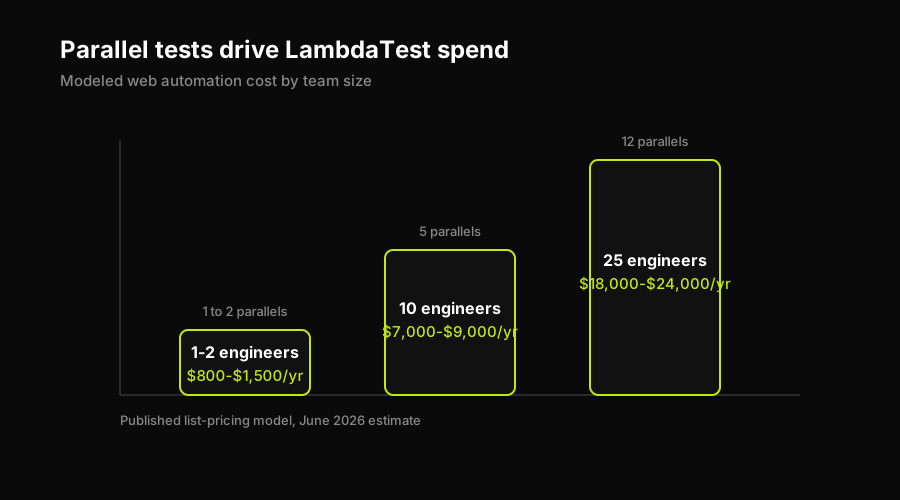
These ranges are estimates built from published list-pricing signals. LambdaTest does not publish a clean "N parallels = $X/year" calculator, so the figures above are representative, not exact. Enterprise quotes and annual commitments differ materially.
Modeled by Team Size
The most useful way to stress-test a testing budget is to model it against realistic parallel-test needs. Here is a June 2026 estimate. Every figure is a model derived from published list-pricing signals, not an official quote.
Solo developer or very small team (1-2 engineers). One to two parallel tests typically suffices. Budget roughly $800-$1,500/year on a web automation plan. If you also need real-device coverage, add $1,000-$2,000/year depending on monthly minutes. Total estimated range: $800-$3,500/year.
10-engineer team. A team of this size running a reasonable CI suite across a few browsers and breakpoints typically needs four to six parallel tests. At five parallels on an annual web automation plan, the modeled cost sits around $7,000-$9,000/year (estimate, June 2026). Adding real-device minutes for mobile testing pushes that range to $10,000-$14,000/year. This is where the per-parallel pricing model starts to feel expensive relative to actual testing throughput.
25-engineer team. At this scale, 10-15 parallel tests is not unusual during sprint peak. Modeled annual cost for 12 parallels on web automation: roughly $18,000-$24,000/year. With real-device coverage for a mobile-first product, the total modeled cost could land in the $25,000-$35,000/year range. Enterprise negotiations usually compress this, but the baseline is still metered concurrency.
These estimates are conservative. They model only the licensing cost and exclude test infrastructure time, flake triage, and script maintenance. If you're comparing all three major cloud grids, the Sauce Labs pricing breakdown covers the third leg of the market.
That excluded work is the second half of the budget conversation. Autonoma is positioned around that gap: agents generate, execute, review, and maintain the E2E suite from the codebase, so the team is not separately buying grid capacity and then paying engineering time to keep scripts alive.
The testmuai Rebrand: Which Price Is Current?
This is the angle most pricing comparisons skip, and it matters for buyers doing their research.
When you search "lambdatest pricing" today, the SERP surfaces testmuai.com (a high-domain-authority site) prominently alongside lambdatest.com. Buyers report genuine confusion: is testmuai.com the new LambdaTest brand, a rebranded product, a partner site, or something else entirely?
We cannot confirm the corporate relationship or whether any rebrand is complete or official. What we can say is: the two domains present price-related content, and it is not obvious from a Google search which one is authoritative for current pricing.
If you see a price figure attributed to testmuai.com in a comparison blog, treat it as "per testmuai.com (not confirmed as official LambdaTest pricing)" and verify directly. LambdaTest's official pricing page is at lambdatest.com/pricing. Before signing a contract or building a budget line, get a current quote from LambdaTest directly. Annual pricing, promotional rates, and bundle discounts change frequently, and a six-month-old number from any third-party source (including this one) should be treated as a starting point, not a contract figure.
How It Compares to Running Your Own
Self-hosting a Selenium Grid has real costs too: EC2/GKE nodes, browser image maintenance, flake management, and the engineer-hours to keep it running. The Selenium Grid TCO breakdown models that comparison in depth. The short version: cloud grids win on setup time and browser coverage; self-hosted wins on per-run cost at very high volume.
For an open-source-friendly alternative to LambdaTest specifically, the open-source LambdaTest alternative guide covers tools like Playwright Test, WebDriverIO, and self-hosted Selenium setups that eliminate the per-parallel meter at the cost of more infrastructure work.
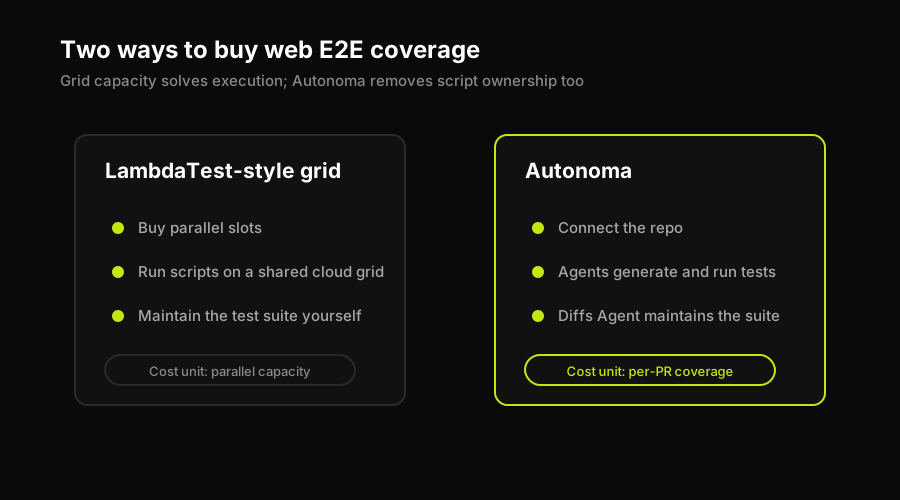
For web E2E teams, Autonoma is the third option between buying a shared grid and self-hosting one: connect the repo, let the agents derive coverage from the codebase, and run that coverage on managed previews per PR.
How Autonoma Removes the Per-Parallel Meter
The core frustration with per-parallel pricing is not the dollar figure in isolation. It's that the meter runs regardless of whether the tests you're running are finding bugs. You pay for concurrency capacity, not for test value.
Autonoma is built around a different model. Instead of buying concurrency slots on a shared grid, you connect your codebase and our agents generate and run E2E tests on a managed preview environment per PR. The Planner Agent reads your routes, components, and user flows to generate test cases. The Executor Agent runs those tests against a live preview of the PR. The Reviewer Agent classifies each result: real bug, agent error, or test mismatch. The Diffs Agent updates the test suite when the PR changes the code.
Because tests run on per-PR managed preview environments rather than a shared concurrency pool, the LambdaTest-style capacity question disappears. You don't budget around a fixed number of parallel slots. You connect a repo and get E2E coverage that runs automatically on every PR, with zero test scripts to write or maintain.
This is an honest carveout: LambdaTest and BrowserStack-style grids fit teams that need a broad real-device matrix, specific browser/OS combinations, or manual exploratory sessions across devices. Autonoma fits teams who want automated E2E coverage on every PR without operating a concurrency grid or writing and maintaining test scripts. The two are not always substitutes, but for teams whose primary use case is "catch regressions before merge," the per-parallel meter is an optional cost.
That makes the LambdaTest decision narrower: if you need the device/browser lab, buy the lab. If what you need is maintained PR regression coverage for a web app, Autonoma removes the parallel-slot budget line and the script-maintenance backlog together.
Frequently Asked Questions
LambdaTest's cost depends heavily on the number of parallel tests your team needs. A solo developer on a web automation plan might spend $800-$1,500/year. A 10-engineer team needing 5 parallel sessions is modeled at roughly $7,000-$9,000/year on web automation (published list pricing, June 2026 estimate). Real-device and app-automation products use per-minute billing and add a separate cost layer. Always confirm current pricing with LambdaTest directly, as list prices and annual quotes differ.
At equivalent parallel-test counts, LambdaTest's published list pricing is generally lower than BrowserStack's. However, the total cost difference depends on your actual usage pattern, negotiated annual pricing, and which products you need. BrowserStack holds a larger real-device catalog, which can justify a higher cost for mobile-heavy teams. For a full cost comparison, see the BrowserStack pricing breakdown covering the utilization trap and Vendr median spend data.
Buyers researching LambdaTest pricing frequently encounter testmuai.com in search results, which creates confusion about which domain and which price list is authoritative. We cannot confirm the corporate relationship or whether any rebrand is complete or official. If you see pricing data attributed to testmuai.com, label it accordingly and verify directly with LambdaTest at lambdatest.com/pricing before budgeting.
Yes, for certain products. LambdaTest's web browser automation plans are priced per parallel test (flat tier), but real-device testing and app automation use per-minute billing on consumed device minutes. This matters for budget modeling: a team doing heavy real-device mobile QA will have a separate, consumption-based cost line on top of their web automation subscription.
For a small team of 1-5 engineers, the modeled annual cost on web automation ranges from roughly $800-$4,000/year depending on parallel-test needs (published list pricing, June 2026 estimate). Adding real-device coverage for mobile testing typically adds $1,000-$3,000/year at modest usage. Teams that primarily need regression coverage on web apps and want to avoid the per-parallel meter may find that an automated E2E solution running on per-PR preview environments is a more predictable cost structure.


