

BrowserStack pricing follows three axes: seats, parallel sessions, and separately-priced add-on products. At 10 parallel sessions, BrowserStack Automate costs roughly $7,800–$9,600/year before add-ons, as of mid-2026, based on published per-parallel rates and third-party estimates. The cost formula is monthly = seats × price + parallels × per_parallel_rate + add_ons. The figure Vendr reports for median real contracts is $13,931/year across 281 verified deals, which sits above the parallels-only sticker because real contracts bundle desktop and mobile coverage, team seat licenses, add-on products like Percy and Test Observability, and often run more than 10 parallels.
BrowserStack's homepage lists a $29/month Live plan and a $99/month Automate entry tier. Those numbers are real. They are also essentially irrelevant to any team that runs automation at scale.
The median BrowserStack contract, according to Vendr's verified deal data from 281 purchases, is $13,931 per year. The range runs from $4,977 to $66,923 annually. The $29/month sticker and the $13,931 median are not in the same conversation. This article closes the gap between them by showing exactly where the money goes and why the per-parallel pricing model creates a cost structure that compounds in ways the public pricing page never explains.
How BrowserStack pricing actually works
BrowserStack prices across three independent axes. You pay for seats (the people logging in), parallel sessions (the simultaneous browser connections your automation uses), and separately for each additional product you need.
The sticker prices BrowserStack publishes as of mid-2026:
| Plan / Product | Published price | What it includes |
|---|---|---|
| Live (manual browser testing) | $29/mo (individual) | Real device + browser access, 1 user |
| Automate (desktop) | $99/mo | 1 parallel session, desktop browsers |
| Automate (desktop + mobile) | $175/mo | 1 parallel, desktop + real mobile devices |
| Freelancer | $12.50/mo | 1 parallel, limited minutes |
| Team | $150/mo | 5 users, base plan |
| Multi-parallel / Enterprise | Contact sales | All volume pricing hidden behind sales |
The moment your team needs more than one simultaneous browser session, you are in "contact sales" territory for the unit economics. BrowserStack does not publish a public per-parallel rate for anything beyond the first session. Third-party procurement platforms have reverse-engineered estimates from real contracts, and those estimates are the foundation for the figures in the next section. The frameworks you run on those parallels, whether Selenium, Playwright, or Cypress, don't change the billing model, but they do affect how many parallels you actually need.
What BrowserStack costs per parallel session
Third-party analysis (notably from checkthat.ai, Vendr, and procurement advisors who aggregate real contracts) puts the per-parallel incremental rate in the $45–$60/month range once you move past 5 parallels, with volume discounts applying at higher tiers. The effective per-parallel rate compresses as count rises but never approaches zero.
Using a mid-range estimate of $50/month per additional parallel beyond the first, here is how the math compounds (all figures are estimates based on published rates and third-party data; BrowserStack does not publish official multi-parallel pricing):
| Parallel sessions | Est. monthly cost | Est. annual cost | Effective per-parallel/mo |
|---|---|---|---|
| 1 | $99 | $1,188 | $99 |
| 2 | $175–$200 | $2,100–$2,400 | $88–$100 |
| 5 | $299–$499 | $3,588–$5,988 | $60–$100 |
| 10 | $650–$800 | $7,800–$9,600 | $65–$80 |
| 20 | $1,125–$1,500 | $13,500–$18,000 | $56–$75 |
| 50 | $2,500–$3,500 | $30,000–$42,000 | $50–$70 |
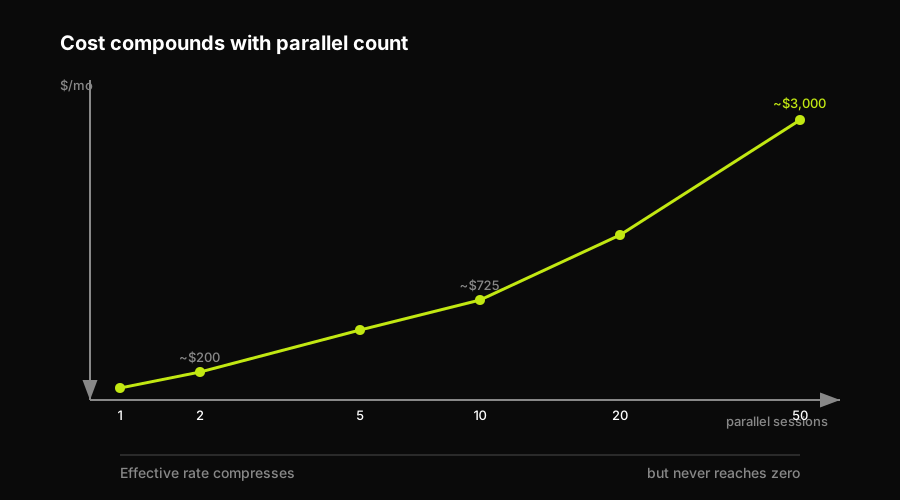
At 10 parallel sessions, BrowserStack Automate costs roughly $7,800–$9,600/year before add-ons, based on published per-parallel rates and third-party estimates as of mid-2026. This is the hero number this article is built around. It is not an official BrowserStack figure. It is derived from published per-unit pricing combined with aggregated third-party contract data from checkthat.ai and Vendr. If your procurement team has negotiated a different rate, that figure takes precedence.
The Vendr median of $13,931/year (across 281 verified deals, with an average 15.41% negotiated discount from list) sits above the bare 10-parallel estimate, which is also consistent: real contracts bundle more than just parallel sessions. They typically include desktop and mobile coverage together, team seat licenses, and add-on products like Test Observability or Percy. Many teams also run well above 10 parallels once their suite matures. The Vendr range of $4,977–$66,923 captures both the small team on 3–5 parallels up to the enterprise on 50+ with a full product stack.
The hidden line items
Parallel sessions are the biggest lever on cost, but they are not the whole story. Three additional cost vectors routinely appear on BrowserStack contracts and are rarely modeled in initial pricing exercises.
Percy (visual testing) is a separately licensed product. Teams using both Automate and Percy are paying for two independent products, and Percy's pricing scales with snapshot volume. A team running visual regression on every PR can accumulate thousands of monthly snapshots quickly, with costs scaling accordingly.
Accessibility testing and Test Observability are also separately priced modules. BrowserStack has built a suite around Automate, but each layer is its own line item. The practical effect: a team that wants Automate plus visual plus accessibility plus observability should model a 20–40% uplift over their base parallel cost.
Overages and queuing are the most operationally expensive hidden cost, even if they show up differently on the invoice. When your CI pipeline triggers more simultaneous test runs than your parallel count allows, BrowserStack queues the excess. Queue time adds directly to your pipeline duration. Teams that don't size their parallel count generously enough pay in CI latency rather than in dollars, but pipeline latency is itself a cost: delayed feedback, slower deploys, engineering hours waiting. The incentive to over-provision parallels is real, and it is by design of the per-parallel billing model. Other device-cloud vendors price similarly. See the Sauce Labs pricing breakdown for a direct parallel.
Auto-renewal and contract terms are a routine complaint in G2 reviews and enterprise SaaS contracting broadly. BrowserStack's #1 con across 3,200+ G2 reviews is simply "Expensive," but a secondary theme in user reports is surprise at renewal terms and difficulty renegotiating mid-contract. This is not unique to BrowserStack, but it compounds the cost of any initial under-modeling.
The true monthly bill: a worked example
Consider Cartago, a fictional Series A fintech with 12 engineers. They run Automate with desktop and mobile coverage, have a team license covering their QA lead and two developers who manage the suite, and recently added Test Observability after a debugging incident. Their CI runs 3 times per day, with a peak rush hour when all engineers push before standup.
| Line item | Monthly cost |
|---|---|
| Automate desktop+mobile base (1 parallel) | $175 |
| 9 additional parallel sessions (~$70/mo each) | $630 |
| Team plan (5 users, 3 seats used) | $150 |
| Test Observability add-on (est.) | $100–$150 |
| Pipeline queuing cost (2 eng-hours/mo, $75/hr) | $150 (implied) |
Total: roughly $1,205–$1,255/month, or $14,460–$15,060/year.
That sits right on top of the Vendr median, which is not a coincidence. It is what a modestly-instrumented 10-parallel team looks like before they add Percy or run a second environment. Cartago's bill would clear $20,000/year if they added visual regression and bumped to 15 parallels for coverage comfort.
The parallel-session utilization trap
Here is the cost dynamic that almost no public content addresses directly: you provision parallel sessions for your CI rush hour, but your CI rush hour lasts maybe 2–3 hours per working day.
A team running 3 CI cycles per day, each lasting 20 minutes at peak load, is actively using their parallel capacity for roughly 60–90 minutes out of 24 hours. Call it 4–6% raw utilization. Even if you count the full 8-hour working window as "active time," you're at 12–18% utilization on most days.
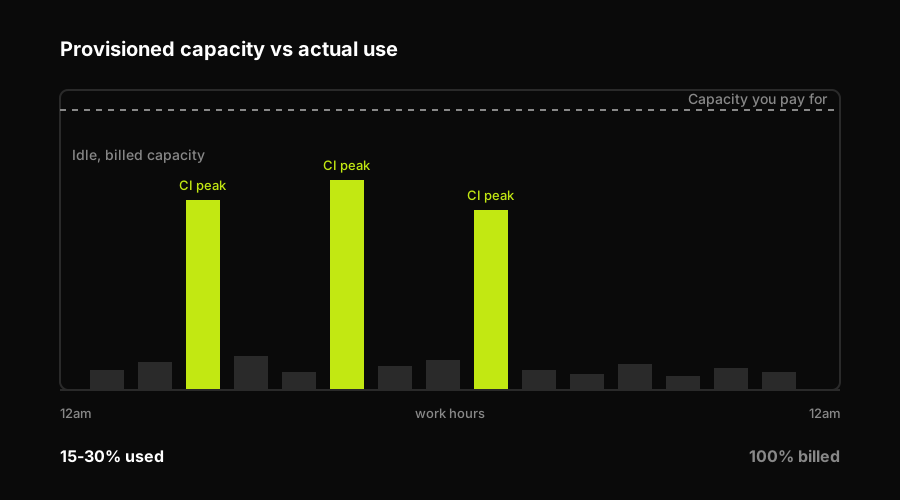
The implication: you are paying for 100% of your parallel capacity but using it 15–30% of the time. The per-parallel rate you see on your invoice is not your real cost-per-test. Your real cost-per-test is the invoice rate divided by your utilization rate.
At $70/month per parallel and 20% utilization, your effective cost-per-test is not $70 per session-month. It's closer to $350 per session-month in terms of capacity you actually consume. Spread that across test count, and the economics of a per-parallel pricing model start to look very different from the sticker rate.
This is the utilization trap. There is no way to escape it within a per-parallel billing model. You either over-provision (expensive) or under-provision and absorb queue latency (slow). Most teams land somewhere between the two and still pay more per test than they expect.
How Autonoma removes the per-parallel line item
The per-parallel billing model exists because BrowserStack provisions a pool of browser infrastructure that your tests reserve on demand. You pay for the size of that pool because the infrastructure is real and has to be allocated in advance, even when it is idle.
Our approach at Autonoma is architecturally different. Instead of a shared browser pool billed per parallel slot, Autonoma runs a four-agent system on a managed per-PR preview environment. A Planner Agent reads your routes, components, and user flows, then generates test cases. An Executor Agent runs those tests against the PR's live preview. A Reviewer Agent classifies results as real bugs, agent errors, or test-plan mismatches. A Diffs Agent updates the suite automatically as code changes.
Because those tests run when code changes against managed per-PR previews, the BrowserStack-style concurrency reservation stops being the thing you size. You are no longer buying enough shared browser slots to cover the Monday-morning CI spike and then carrying that idle capacity between runs. The cost conversation moves from "how many simultaneous sessions did we reserve?" to "which user flows do we need covered on each PR?"
For teams pricing out BrowserStack specifically because of the per-parallel escalation, the open-source alternative to BrowserStack covers the alternatives landscape in more detail. The relevant consideration for the cost-modeling exercise in this article is simpler: if the per-parallel model is the root cause of the cost complexity you've been trying to map, removing the BrowserStack-style capacity axis from the workflow is more durable than negotiating a better per-parallel rate. The build-it-yourself route is to run your own Selenium/Playwright grid, which carries its own TCO (infrastructure maintenance, flakiness debugging, and scaling overhead that cloud vendors handle for you) but eliminates the per-parallel line item entirely.
What real teams pay (and how to negotiate)
Vendr's data from 281 verified BrowserStack deals puts the median annual contract at $13,931, with an average negotiated discount of 15.41% off list price. The full range runs from $4,977 to $66,923 per year. These are real contracts, not estimates.
A few patterns emerge from that data. Small teams on 3–5 parallels cluster in the $5,000–$8,000 range. Mid-size teams on 10–20 parallels tend to land in the $13,000–$25,000 range. Enterprise contracts above 50 parallels with add-on products are the deals that reach the upper end of that range.
If you are pricing BrowserStack for the first time or renewing, these are the questions worth asking your sales contact before signing:
- What is the per-parallel rate at my contract volume, and at what parallel count does that rate tier down?
- Are Test Observability, Percy, and Accessibility priced separately, and what does each cost at my snapshot/test volume?
- What happens to my queue when I exceed my parallel count: does it queue indefinitely or hard-fail?
- Is there a minimum annual contract term, and what is the auto-renewal window?
- What is the overage rate if I burst above my provisioned parallel count in a given month?
- Is there a startup or growth pricing tier available, and what are the eligibility criteria?
- Can I do a pilot at reduced parallel count before committing to a full annual contract?
The 15.41% average discount is a floor, not a ceiling. Teams that come to the negotiation with a parallel-count model, a competitor quote (the BrowserStack alternatives landscape has several), and a firm anchor on annual versus monthly billing tend to do better.
That negotiation still leaves the team inside BrowserStack's model: a contract organized around seats, add-ons, and reserved parallel capacity. Autonoma changes the cost structure for web E2E by combining managed per-PR previews with codebase-generated tests and Diffs Agent maintenance, so the team is not solving idle capacity and scripted-test upkeep as separate problems. If BrowserStack's invoice problem is both the parallel meter and the maintenance work around the suite, a better discount only addresses one side.
Frequently asked questions
At 10 parallel sessions, BrowserStack Automate costs roughly $7,800–$9,600/year before add-ons, based on published rates and third-party estimates as of mid-2026. The median real contract from Vendr's 281 verified deals is $13,931/year, which sits above this figure because real contracts bundle desktop and mobile coverage, seat licenses, and add-on products. The range across all deal sizes runs from $4,977 to $66,923 annually.
BrowserStack does not publish official multi-parallel pricing; it is gated behind a sales conversation. Third-party estimates based on aggregated contract data put the incremental per-parallel rate at roughly $50–$80/month depending on total volume, with the effective rate compressing at higher parallel counts. The published base rate for the first parallel session on the Automate desktop+mobile plan is $175/month.
BrowserStack's cost model has three compounding layers: seats, parallel sessions, and separately-priced add-on products like Percy, Accessibility, and Test Observability. Each layer adds cost independently. The parallel-session tier is the largest single contributor for teams running automation at scale because you pay for peak concurrency capacity whether you use it or not, creating a utilization gap where teams pay for idle browser slots most of the working day.
The most common hidden costs are: add-on products (Percy for visual testing, Accessibility, Test Observability) that are priced separately from the base Automate plan; pipeline queuing time when your parallel count is insufficient for CI peak load (which translates into engineering time lost to slow feedback); and auto-renewal terms that can lock in pricing before teams have reassessed their actual parallel utilization.
BrowserStack queues test runs when you exceed your provisioned parallel count rather than charging per-test overages in the traditional sense. However, queue time during CI rush hours adds directly to pipeline latency, which is an indirect cost. Some enterprise contracts may include burst provisions or explicit overage rates; this is a question worth asking during contract negotiation before signing.


