

AI test theater is the pattern where AI-generated tests and AI code review produce a green, approved production pipeline that has no independent verification layer. Tests pass, PRs get approved, coverage numbers climb, and bugs ship anyway. The root cause is that AI verification is only trustworthy when it is independent of what is being verified. When the same model writes the code and the test, green means consistency, not correctness.
The dashboard looks fine. CI is green. Coverage is above 70%. Every PR that shipped this week had at least one AI review approval and a suite of passing tests. Nothing looks wrong.
That is exactly the problem.
For engineering teams shipping 20 to 40 PRs a day with Cursor, Claude Code, or Copilot, the surface area of confidence is enormous and the surface area of actual protection may be much smaller. This is not the problem of teams with no tests. It is the problem of teams drowning in green tests that assert consistency rather than correctness. The emotional weight is different: not "I'm exposed" but "I thought I was covered."
This article is for those teams specifically. If you have no QA and no tests, this is not your problem yet. If you have AI-generated test suites and AI PR review on every PR, you may be running theater on a very convincing stage.
Autonoma is the independent E2E layer for that stage. We do not ask the same loop to grade itself one more time. We add checks outside the AI-written code, the AI-generated tests, and the AI review loop, then run them against a per-PR preview so the signal comes from the application a user would actually touch.
The two acts of the theater
Act 1: Tests that pass but assert nothing
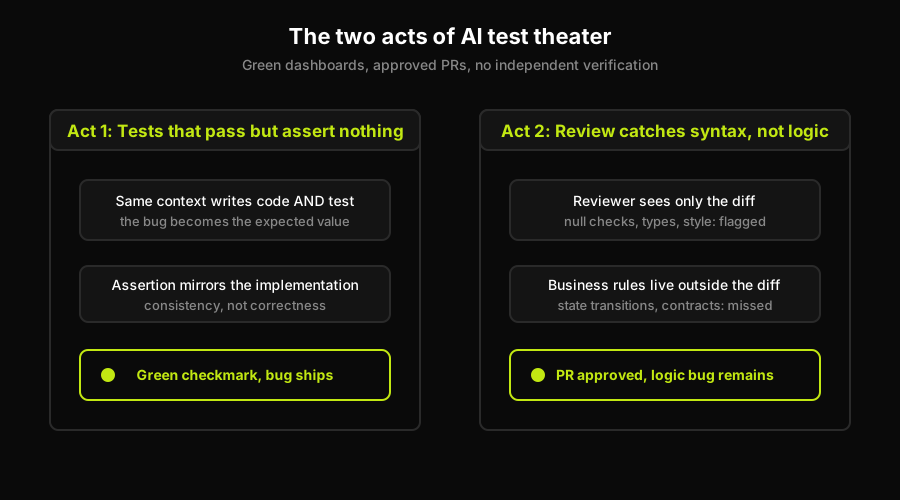
AI-generated unit tests go green not because the code is correct, but because the assertion was derived from the same code it is supposed to verify. When the same context window produces both the implementation and the test, any bug in the logic becomes the expected value. The test confirms that the code is consistent with itself. If the discount function applies 25% to the wrong tier, the test expects that discount and passes. The bug ships with a green checkmark attached.
A security platform customer we work with named it precisely: "That test passes and it asserts something, but it's not really asserting what it should be asserting." They had Cursor-heavy workflows, coverage above 70%, and QA engineers still finding things their test suite had already signed off on.
The full structural explanation of why this happens, with a before/after mutation example, is in the companion piece on AI-generated tests that pass but don't assert anything. The short version: line coverage measures execution, not protection. A test can touch every branch of a function and still survive every injected bug if its assertions mirror the implementation rather than independently verify it.
Act 2: Code review that catches syntax, not logic
AI PR review tools flag what they can see in the diff. Null-pointer patterns, missing input validation, obvious type mismatches, style violations: all findable from the diff alone. Business-logic correctness is a different class of problem. To catch it, a reviewer needs to know what the code is supposed to do, not just what it currently does. That knowledge does not live in the diff.
The same security platform customer ran Cursor Bugbot on every single PR. Their summary: "It doesn't cover the business case. Our QA engineers are still finding things." That is not a criticism of Bugbot. It resolves roughly 70% of the issues it flags, and those flags are genuinely useful: null dereferences, injection patterns, missing bounds checks, style violations that mask intent. The gap is in what it never flags, because it cannot flag what it cannot see. A reviewer reading only the diff cannot know that the pricing tier boundary shifted last quarter, or that the refund flow requires a specific sequence of state transitions that is nowhere in the commit being reviewed. Business-logic correctness requires context that lives outside the diff, in product specs, user stories, and the accumulated tribal knowledge of what the system is supposed to do.
The sibling piece on what Cursor Bugbot misses goes deeper on this pattern, including which issue categories it handles well (null checks, security patterns, style) and which ones fall through (state transitions, cross-service contracts, user-flow edge cases).
That is why Autonoma is not another act in the theater. The Planner forms scenarios from routes, components, and user flows; the Automator runs them against the live preview; the Maintainer keeps tests passing as code changes. The point is not a bigger green dashboard. The point is an E2E signal from the running preview.
The one root cause
Both acts trace back to the same structural failure: verification is not independent of what is being verified.
An AI-generated test is not independent because the model that wrote the test knows how the code works. An AI PR reviewer is not independent because it is reading the implementation and asking "does this look consistent?" rather than reading a specification and asking "does this match the requirement?"
This is the independence principle: AI verification is only trustworthy when it is independent of the thing being verified. Green means the system is consistent. It does not mean the behavior is correct. Why AI misses business logic bugs goes deep on why the absence of an independent source of truth is the structural gap no prompt improvement can fix.
The circular version of this problem is when the same AI model writes the code, immediately generates tests, watches them pass, and summarizes the PR as "all tests passing, implementation matches spec." Nothing in that loop has an external reference point. The code ratifies the tests, the tests ratify the code, and the review ratifies both. For a walkthrough of how this circular self-verification compounds at scale, AI wrote it, AI reviewed it, AI tested it: who checks the logic documents the full loop in detail.
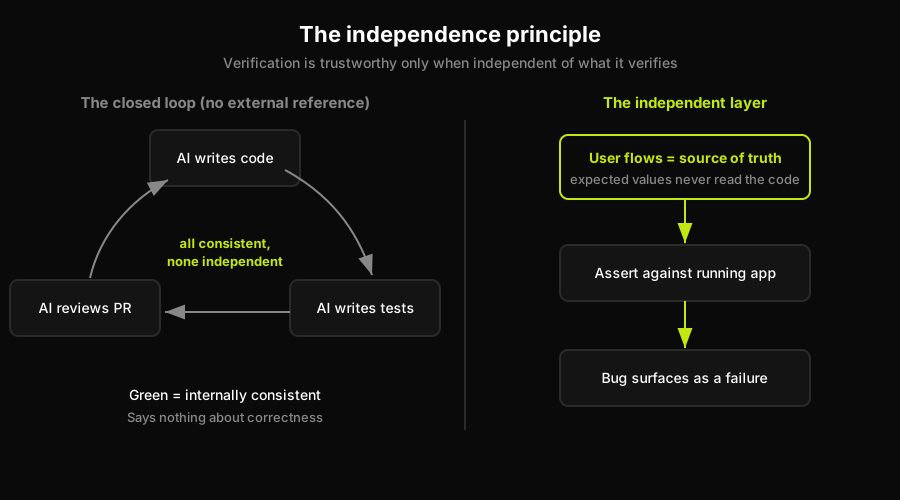
Take a concrete example: an API endpoint that applies a promotional discount. The implementation has an off-by-one error on the eligibility threshold. The AI-generated test was written in the same session, so it encodes the same threshold. The AI reviewer sees correct-looking arithmetic and a passing test, and approves. The external reference point that could catch this is the product requirement: "users with more than 90 days of tenure get the discount." That sentence is not in the diff, not in the test file, not in the function signature. It exists in a ticket, a Notion doc, or a conversation. No reviewer limited to the diff has access to it.
This is also why high coverage numbers become dangerous at this scale. When 30 PRs a day each arrive with 80% line coverage and passing tests, engineering leaders use that aggregate as a proxy for product health. The proxy is measuring consistency of execution, not correctness of behavior. Why E2E tests pass while the product is broken walks through specific scenarios where the test infrastructure agrees with itself while the user-facing behavior has diverged.
How to spot it on your team
The fastest diagnostic requires no tooling. Take a critical function, comment out one line of business logic, and run your test suite. If nothing fails, the tests for that path are not protecting you.
A harder variant: break the expected behavior deliberately. Change the discount rate from 25% to 0%. If the suite stays green, your assertions were derived from the function's output, not from the requirement.
If you want to know who wrote the assertion's expected value, look at the test generation timestamp relative to the implementation commit. If the test was generated in the same AI session that produced the implementation, assume the assertion is tautological until proven otherwise.
For AI PR review, the diagnostic is to review what the tool flagged over the last 30 PRs and categorize by type. Null checks, type errors, and style issues are the easy column. Business-logic violations, incorrect state transitions, and missing edge cases for user flows are the hard column. If the hard column is mostly empty, the review is catching syntax, not logic.
A useful mutation-style spot check: take a boundary condition in a business rule, change a >= to a >, and rerun your suite. If nothing fails, the boundary is not tested independently. A related question to ask out loud: can any engineer on the team state the expected output of this function without reading the implementation? If the answer requires opening the source file, the expected value was derived from the implementation, not from the requirement.
Another signal is PR review comment patterns on AI-generated diffs. If reviewers rarely leave comments that say "this logic is wrong because the requirement is X," the team has stopped reading for correctness and started reading for consistency. Correctness review requires knowing what the code is supposed to do, which demands access to the external reference point: the spec, the user story, the acceptance criteria.
The CI signal itself is explored in depth in the green CI, broken app piece. The short version: CI green signals mean "this batch of commits is consistent with the test suite." They do not mean "the application behaves correctly for users."
How Autonoma ends the test theater
The problem described above is a structural one. Teams are not writing bad tests on purpose, and AI tooling is genuinely improving many parts of the development cycle. The failure is that AI-generated tests and AI code review are not independent of the code they verify. No prompt improvement changes that. The missing ingredient is a verification layer that forms its expected values from somewhere other than the implementation itself.
That is what we built at Autonoma. Our three agents divide the problem. The Planner reads your codebase: routes, components, API contracts, user flows. It plans test cases from the structure of the application and sets up the database state each scenario requires. Crucially, the expected values come from user-visible behavior at the application boundary, not from function-level outputs. The Automator executes those plans against a running per-PR preview environment, asserting on what the application actually does: what the UI renders, what the API returns, what state persists. The Maintainer keeps those tests healthy as the code evolves, surfacing genuine behavioral divergence rather than noise from structural refactors.
The independence is structural. A bug that a tautological unit test would call the expected value shows up as a failure here, because the expected behavior is derived from the user flow, not from the function's current output. An AI PR reviewer that approved the diff cannot prevent the E2E assertion from failing when the running application does the wrong thing.
The yes-and framing matters: keep your AI test generation, keep your AI code review. Both provide real value in the categories they cover. Add the independent verification layer for the class they structurally cannot reach. Act 1 (tautological unit tests) is addressed by adding E2E behavioral assertions that form expected values independently. Act 2 (AI review missing logic) is addressed by running those assertions on every PR before merge, so the review cycle has a behavioral signal that did not come from reading the diff.
What replaces theater
The cluster spine, stated once more: AI verification is only trustworthy when it is independent of the thing being verified. Green means consistency, not correctness.
The practical implication is not to distrust AI tooling. It is to be precise about what each layer verifies. AI test generation is fast and covers execution paths well. AI code review catches a large class of syntactic and structural issues. Neither was designed to be independent of the implementation, and neither should be trusted as if it were.
The gap that generative AI testing and QA of AI-generated code has to fill is the behavioral layer: something that forms its expected values from user flows and asserts against the running application rather than against the code's own output. That layer does not compete with AI test generation or AI review. It sits at a different level of the stack and catches a different class of bugs.
Teams that add independent behavioral testing do not get to stop thinking about test quality. The tautological test anti-pattern still matters for the unit layer. AI code review still matters for the structural layer. What changes is that the stack now has a layer with a real external reference: what the application should do for users, verified by something that has never read the implementation.
That is the role Autonoma plays in this stack: the independent E2E layer running against each per-PR preview with expectations formed from user flows instead of the implementation being reviewed.
For teams at 20 to 40 PRs per day, this matters operationally. At that velocity, no human reviewer has time to check behavioral correctness on every diff. The only realistic path is an automated layer that verifies behavior independently on each PR, surfaces real failures, and stays quiet on the noise. That signal has to arrive before merge, not after. A behavioral test that runs post-deploy catches bugs after users do.
The yes-and posture is the right frame. Keep the AI test generation: it produces decent coverage fast and pays for itself on execution paths. Keep the AI code review: its 70% resolution rate on flagged structural issues is a real cost saving. Add the independent behavioral layer not because the other two are failing, but because they were never designed to do what the behavioral layer does. Each tool is doing exactly what it was built for. The gap is not a flaw in any of them. It is the gap between "consistent with the implementation" and "correct for users."
FAQ
AI test theater is the pattern where AI-generated tests and AI code review create the appearance of rigorous software verification without providing actual protection against bugs. Tests go green, PRs get approved, and CI passes, but the underlying code is not independently verified. The term describes the full production pipeline: AI writes the code, AI writes the tests, AI reviews the PR, and all three are consistent with each other but none is independent. Green means the system is internally consistent, not that the behavior is correct.
False test coverage is coverage that makes you feel protected without making you actually protected. It occurs when tests execute lines of code without asserting correct behavior, or when assertions are derived from the same implementation they are supposed to verify. High line coverage numbers and green CI dashboards can coexist with a test suite that would survive the majority of injected bugs. False coverage is most common in AI-generated test suites, where the model optimizes for execution consistency rather than behavioral correctness.
AI tests give false confidence because the model that writes the test has no independent source of truth. When AI writes both the implementation and the test in the same context window, any bug in the logic becomes the expected value in the assertion. The test confirms that the code is consistent with itself, not that the code is correct. The same problem applies to AI PR review: a reviewer reading only the diff cannot detect when correct-looking code violates a business rule that lives outside the diff.
The fastest diagnostic is to introduce a deliberate bug into a critical function and watch whether any test fails. If the suite stays green, the tests are asserting execution, not behavior. A more systematic approach is mutation testing (Stryker for JavaScript or TypeScript, PIT for Java): if mutation score is below 50% on functions with 80%+ line coverage, the assertions are likely tautological. For AI PR review, check whether flagged issues are syntax and style (high confidence) or business-logic correctness (rarely flagged).
Independent verification replaces AI test theater. The root cause is that AI verification is only trustworthy when it is independent of what is being verified. Independent E2E testing, run against the live application by agents that derive expected behavior from user flows rather than from the implementation, provides the missing layer. This does not mean replacing AI test generation or AI code review. It means adding a layer that cannot be fooled by implementation consistency because it never reads the implementation to form its expected values.


