

The self-verification loop is what happens when AI code review limitations compound: the same model family writes the feature, reviews the pull request, and generates the tests. Each step is independent in tooling but not in epistemics. When the code contains a wrong assumption, the review reads a diff shaped by that assumption, and the tests assert behavior derived from it. The CI turns green. The bug ships. Green means consistency, not correctness.
There is a specific kind of confidence that AI-forward engineering teams develop after a few months of shipping with Cursor, Claude, and Copilot. The pipeline runs. The coverage climbs. Every PR gets an AI reviewer comment before a human even opens the diff. It feels like a quality system. The problem is that none of those steps are independent of each other, and without independence, green is just another word for "consistent with itself." We built Autonoma specifically to be the one step in that chain that is not downstream of the model that wrote the code.
This is distinct from the no-QA startup that has no tests at all. The teams this matters for are Series A and Series B, shipping 10-40 PRs a day, with lots of tests and a real AI review workflow. They have coverage. They have a reviewer. Their QA engineers, if they have any, "are still finding things," and nobody can explain why.
The explanation is the loop.
The loop, walked step by step
Start with code generation. A developer opens Cursor, describes a feature, and the agent writes an implementation. That implementation reflects everything the model inferred from the prompt and surrounding context. It does not reflect the requirement document, the product spec, or the edge case that a QA engineer would have asked about. If the context contains an incorrect assumption, the code encodes it.
Now the PR opens and the AI reviewer (Bugbot, CodeRabbit, Greptile, or a Claude-powered variant) reads the diff. The reviewer is excellent at finding things visible in the diff: null dereferences, missing error handling, security-adjacent patterns, style violations. What the reviewer cannot do is compare the diff to an intent that was never written down. It sees what was changed. It does not see what should have been changed instead. A billing function that applies discounts to the wrong tier passes review because the diff is internally consistent. The logic looks plausible. There is no external reference to check it against.
Now the tests are generated. The AI generation tool (Copilot, Claude, or the same Cursor session) reads the implementation and writes assertions. Those assertions are derived from the code it just read. If the code says a 10% discount applies to tier B, the test says expect(discount).toBe(0.10) for a tier B user. The test is correct relative to the implementation. It is wrong relative to what the discount should be. "It asserts something, but not what it should be asserting."
CI runs. Everything is green. The bug ships.
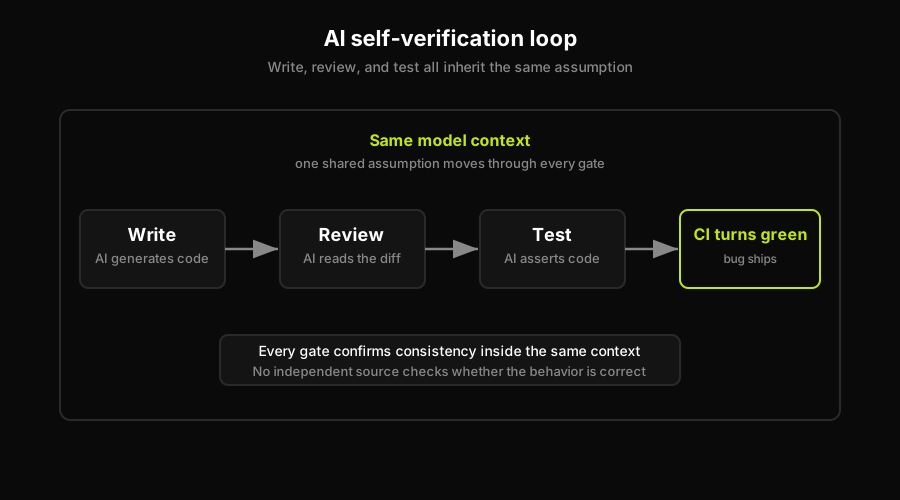
The loop does not require anyone to make a mistake. Every individual tool performed exactly as designed. The failure is structural: no step in the chain was ever positioned to be independent of the others.
This is the self-verification loop. Not a failure of any individual tool. A structural property of using the same model family, or close model families, for every step of verification. Independence was never part of the design.
Where each step fails to add independence
The code-generation step creates the problem's shape: a plausible implementation built from incomplete context. That is fine. Generation tools are not expected to be independent sources of truth. The issue is what comes next.
The review step could theoretically add independence if the reviewer had access to a ground-truth specification. In practice, AI code review tools are diff-readers. They are good at the syntactic class of bugs (null, injection, dead code, obvious logic errors). They are structurally limited at the semantic class: whether the logic is correct relative to a business requirement that exists only in a Notion doc or a product manager's head. Practitioner reports confirm this consistently: catch rates for syntactic bugs are strong; catch rates for business logic bugs are low. That gap is not a model quality problem. It is an architecture problem. The reviewer was never given the requirement to check against. See our comparison of automated code review vs testing for the full category breakdown.
The test-generation step is where the circularity becomes acute. Generation tools are most effective when they can read the implementation they are testing. That is also exactly what makes them circular. The model that writes the test has the same understanding of the feature as the model that wrote the code, because it is either the same model or a model reading the same source. The expected value in the assertion is derived from the implementation, not from the specification. A wrong implementation produces a wrong expected value, and the test passes. The circularity is complete.
The result is a CI signal that has stopped meaning anything: green tests that assert the implementation back to itself, a reviewer that confirmed the diff was internally consistent, and a bug that cleared every gate because every gate was built from the same flawed premise.
How Autonoma adds the independent check
The specific pain the loop above documents is that every verification step in an AI-forward workflow draws from the same source: the model's understanding of the implementation. The test-generation step, the review step, and the code-generation step all read the same context. There is no point in the chain where an expectation is formed independently of that context. That is the gap.
Autonoma is the point where independence enters. Our Planner agent reads your codebase (routes, components, user flows) to plan test scenarios from the application's intended architecture, not from any individual PR's changes. The scenarios it generates are derived from the application as a whole. When a PR introduces a regression, the Planner's scenarios are not downstream of the same assumption the bug carries, because they were not written by the agent that introduced the bug. The Automator then executes those scenarios against a managed preview environment per PR. The Maintainer keeps tests passing as the codebase evolves. No clicking through the app, no recording, no test scripts written by the team that wrote the feature.
This maps directly to the loop. At the code-generation step, Autonoma is not in the loop at all: we do not generate features. At the review step, AI code review tools remain useful for the syntactic class and we complement them, not replace them. At the test step, our agents supply the independence that AI test generation structurally cannot: expectations derived from the application's architecture, not from the implementation being tested. The Planner also handles database state setup automatically, so test scenarios that require specific data states are reproducible without manual configuration. The result is that the CI signal starts meaning something again.
Autonoma is not a unit-test runner, not a static analyzer, not a code review bot, and not a replacement for the AI tools already in your workflow. It is the behavioral E2E layer that AI test theater is missing: the check that is independent of the thing being verified.
The principle: verification must be independent
Verification is only trustworthy when it is independent of the thing being verified. This is not a new idea. It is why peer review in science requires independence from the original researcher. It is why financial audits are performed by external firms. It is why QA engineers were historically not on the feature team whose code they were testing.
When the verifier and the generator share an assumption, the verification confirms the assumption rather than testing it. That is what "green but broken" means in practice. The tests are not lying. They accurately report that the implementation is consistent with itself. Consistency and correctness are different things, and the difference is independence.
AI-forward teams shipping with vibe-coding workflows have inadvertently built a quality system with no independence anywhere in it. The code, the review, and the tests are all downstream of the same model context. Adding another AI reviewer, a better generation prompt, or higher coverage does not fix this. Those are improvements within the loop. The loop itself is the problem.
What an independent check looks like in practice
Independent verification has two properties: it derives its expected behavior from a source other than the code being tested, and it runs against the application as it actually executes, not against a model of the code.
A QA engineer with a requirements document and a running staging environment provides both. That is expensive and slow relative to AI-assisted velocity. The question for teams shipping 20 PRs a day is what automated form of independence exists.
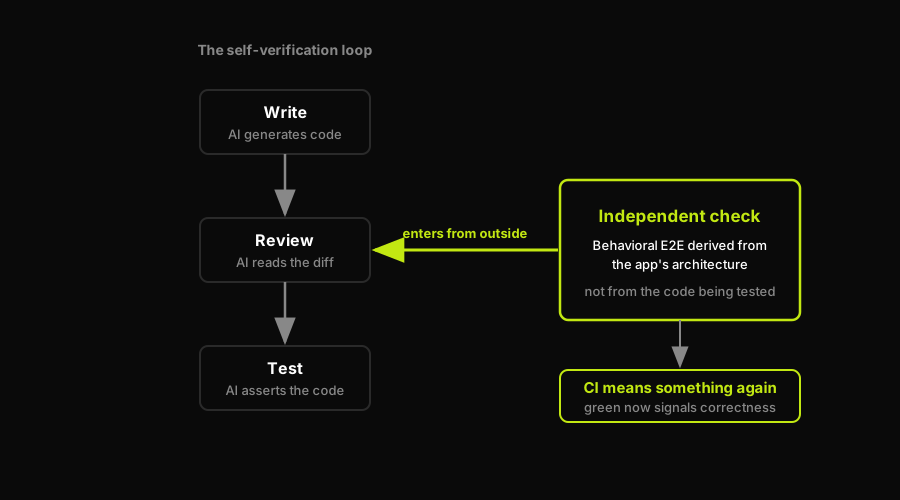
The behavioral E2E test derived from the application's structure is the answer. Not an E2E test written by the same AI that wrote the feature, which inherits the same circularity. An E2E test derived from what routes exist, what user flows are defined, what the application is supposed to do based on its architecture. That derivation is independent of any particular feature's code. When a PR changes the billing logic, the test exercising billing was not written by the agent that made the change. It can fail when the behavior breaks.
This is the Cursor and Claude Code can't test themselves problem stated structurally: generation tools cannot supply the independent source of truth their own tests need. For the root-cause analysis of why business logic bugs are invisible to AI generation and AI review, see our article on why AI misses business-logic bugs.
The operational point is simple: keep the AI reviewer, but do not let it be the last verifier. Put Autonoma after it as the independent behavioral check on the running application.
FAQ
The core AI code review limitation is architectural: AI reviewers are diff-readers. They compare what changed to a small set of known bad patterns (null dereferences, security antipatterns, dead code, style violations). They cannot compare the diff to a requirement that was never encoded in the diff. Business-logic correctness, wrong assumptions about discount tiers, inverted conditionals that are internally consistent but behaviorally wrong: these survive AI code review because the reviewer has no external specification to check against. This is not a model quality problem. It is a scope problem. The reviewer was given the diff; it was not given the intent.
Not independently. When the same model or close model family writes the code and checks the code, the check reads a diff shaped by the same context that produced the bug. If the code contains a wrong assumption, the checker inherited that assumption and will evaluate the diff as internally consistent. The check confirms consistency, not correctness. Independence requires the verifier to derive its expectation from a source other than the implementation being checked. AI generation tools are not that source for their own outputs.
In most AI-forward workflows, the answer is: another AI, and then a human who reads a diff the first AI already approved. Neither check is independent of the generation context. The most effective review layer is one that tests the running application against expected behavior derived from the application's structure, not from the code diff. That is what behavioral E2E testing provides that AI code review and AI-generated unit tests cannot: an expectation that was not formed by the same agent that wrote the feature.
For the syntactic class of bugs (null dereferences, injection patterns, dead code, secrets exposure), AI code review is effective and fast. For business-logic correctness, it is not enough, because business logic bugs are invisible to a reviewer that has no ground-truth specification. The self-verification loop makes this worse: when AI generates the code and AI reviews it, the reviewer reads a diff built from the same context as the bug. Adding more AI review passes does not break the loop. An independent behavioral verification layer does.
Verification is independent when its expected behavior is derived from a source other than the implementation being verified. A QA engineer reading a requirements document and testing a staging environment is independent. A test generated from the application's route and component architecture (not from the implementation of a specific feature) is independent. A test generated by the same AI that wrote the feature is not independent: it derives its expected value from the same context as the implementation, so a wrong implementation produces a wrong expected value, and the test passes regardless. Independence is structural, not a question of model quality.
Yes for one class, no for another. AI code reviewers reliably catch syntactic and pattern-based bugs: null dereferences, injection patterns, dead code, missing error handling, secrets exposure. They do not reliably catch business-logic bugs, because the reviewer only sees the diff and has no ground-truth specification to compare it against. A discount applied to the wrong tier reads as internally consistent and passes review. So the honest answer is that AI code reviewers catch the bugs that are visible in the code and miss the bugs that are only visible against intent.


