

An authentication testing strategy for a team with no QA prioritizes end-to-end coverage of the highest-stakes flows first: login, SSO, and payments, then decides between hand-written scripts you maintain and an agent that maintains them, so a broken auth flow never reaches production.
AI-accelerated velocity is a genuine superpower until it isn't. Small teams today merge features in hours, not days, and authentication code is in the blast radius of almost every change: a new dependency, a session config tweak, a provider SDK upgrade. There is no QA engineer reviewing those PRs. The human gate is gone, and the flows that break silently when auth goes wrong are the ones that lock users out, fail payments, and surface in Slack at 2am.
This is the strategy post for how a lean team gets real coverage over auth without hiring. We will cover which flows to test first, how to make the build-vs-buy decision honestly, and the practical playbook for executing it.
Which Auth Flows to Test First
Not all authentication flows carry the same business risk. When you have limited coverage capacity, prioritization is the strategy. Here is how we think about the ordering.
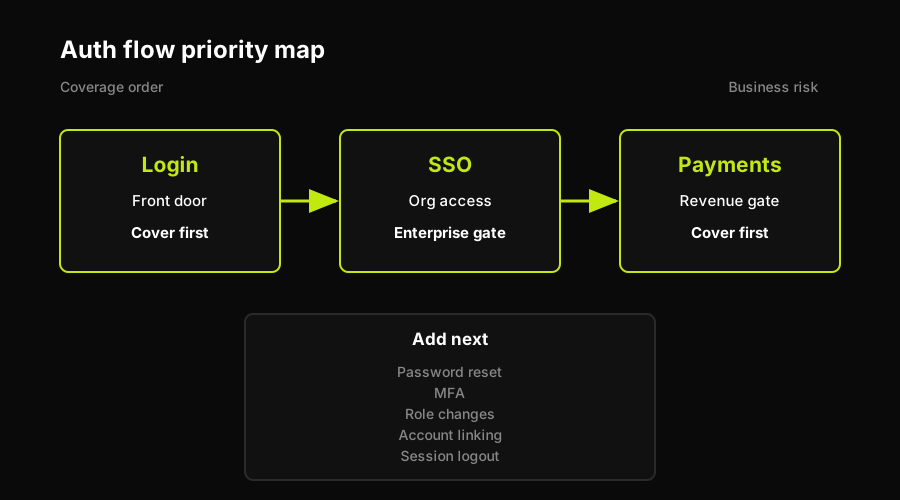
Start with the flows that block access or revenue, then expand into recovery and authorization edge cases once the first three are covered.
Login: the front door
Login is ranked first because it is the most exercised flow and the one users notice immediately when it breaks. Every session starts here. A broken login is not a subtle degradation; it is a complete lockout.
The login flow is also structurally fragile. It touches your auth provider, your session store, your cookie configuration, and your redirect logic. A single misconfigured environment variable can break it silently across every environment. The test cases for the login page go deep on what specifically to cover: positive paths, failed credentials, rate limiting, token refresh, and the edge cases most teams skip until a customer reports them.
SSO: the enterprise gate
SSO ranks second because of the business stakes rather than the failure frequency. A broken SSO flow does not lock out individual users; it locks out an entire company account. For any SaaS product with B2B customers, SSO downtime is an enterprise-tier incident.
SSO flows are also harder to debug. The SAML assertion round-trip, the IdP metadata configuration, and the attribute mapping are all invisible to end users. When something breaks, the failure message is generic and the root cause is deep. E2E coverage catches these before a customer does. SSO testing as a topic deserves its own treatment given the provider-specific complexity involved.
Payments: the revenue gate
Payment flows rank third in priority but first in financial consequence. A broken checkout is direct, immediate revenue loss. It also carries the heaviest reputational cost because users interpret a payment failure as a security signal, not a bug.
Payment gateway testing is where integration complexity peaks. The flow spans your frontend, your backend, the payment provider's redirect, and your webhook handler. Any layer can fail independently. Many teams skip E2E payment coverage because it feels hard to set up in CI. The teams that do it properly end up with significant protection against a class of incidents that are otherwise only caught in production.
Secondary Auth Flows Worth Covering
Once login, SSO, and payments have E2E coverage, a lean team has addressed the highest-consequence failures. The following flows are what you add next, in rough priority order. None of them replace the first three, but each one represents a class of failure that shows up silently, frustrates users, and is genuinely hard to debug without a test that caught it.
Password reset and account recovery
Password reset is the flow most teams write once and never touch again. That is a problem because it is also an account-takeover vector and a silent lockout source. A reset token that expires too aggressively locks users out. A reset token that does not expire at all is a security hole. A reset flow that sends the link but does not invalidate the old password on use is both.
The E2E assertion that catches the worst failure here is simple: request a reset, follow the link, set a new password, and confirm the old password no longer works. That single assertion catches the invalidation failure, the token expiry, and the redirect logic all at once. Lean teams can usually afford this test early because the flow is well-defined and changes infrequently.
Multi-factor authentication: enrollment and challenge
MFA flows are fragile in a specific way. They work fine until you upgrade your auth provider's SDK or change the TOTP library, and then they fail hard. When MFA fails, it does not degrade gracefully. Users are locked out completely, with no fallback, and the error message they see is often unhelpful.
The two assertions that matter: first, that enrollment succeeds and the user is prompted for a code on next login; second, that a valid code passes and an invalid code is rejected with a recoverable error (not a session wipe). MFA changes are infrequent enough that a lean team can prioritize this in the second wave of coverage. But if you are running an auth provider upgrade, cover this before merging.
Account linking and social login edge cases
Social login is one of the most common sources of duplicate accounts in production. The path most teams test is the happy path: user signs in with Google, account is created or matched, session starts. The path almost no one tests is what happens when a user who previously registered with email tries to sign in with Google using the same address.
The failure modes are real: duplicate accounts get created, data is orphaned, and users end up with two identities in your system that they cannot reconcile without support intervention. The E2E assertion to cover: register with email, then attempt social login with the same email, and confirm the system merges rather than duplicates. If your product supports account linking explicitly, also assert that the link and unlink actions behave correctly. This flow is worth covering before you have a significant user base because cleaning up duplicate accounts at scale is genuinely painful.
Session behavior and logout
Session and logout testing is the flow nobody puts on the coverage roadmap until a security researcher or a user reports it. Stale sessions, logout that does not invalidate the server-side token, and token refresh that silently fails are all real production incidents. They are also invisible in normal use because sessions feel fine until they do not.
The coverage that matters for a lean team: confirm that logout invalidates the session (a request made immediately after logout with the old token should fail), and that token refresh succeeds within normal expiry windows. If your product supports "logout everywhere" or device management, add one assertion that confirms all sessions are invalidated when that action is taken. This is a deferred-but-not-indefinite flow: cover it before you scale, not on day one.
Permission and role changes post-authentication
The authorization layer that sits on top of authentication is where many security-adjacent bugs hide. A user whose role is downgraded should lose access immediately, not on next login. A user invited to an organization with a specific role should not inherit permissions from a previous session or a cached claim.
The E2E assertion to add: change a user's role, then perform an action that should now be forbidden, and confirm the response is a 403 or equivalent, not a stale 200. This is the last of the secondary flows to prioritize for most lean teams, but it becomes urgent the moment you have more than one permission tier or any multi-tenant structure.
Each of these five flows adds its own test file, its own fixture setup, and its own maintenance surface. That is worth naming plainly: the more flows you cover, the more you inherit the build-vs-buy tension the next section addresses directly.
Build vs Buy: Scripts You Maintain vs an Agent That Maintains Them
Most authentication testing articles stop at listing test cases. The decision that actually matters for a lean team is: who owns the maintenance when auth changes?
Auth flows change constantly. Provider SDK upgrades change the login UI. New SSO customers change attribute mapping expectations. Stripe API versions change response shapes. Every change has the potential to break a hand-written test that was green yesterday.
That is the build-vs-buy decision Autonoma was built around. The Planner reads the codebase and derives E2E coverage from the real routes, components, and auth flows. The Executor runs those scenarios against a live per-PR preview environment. The Reviewer classifies the result. The Diffs Agent keeps the coverage aligned with every auth-adjacent PR.
| Dimension | Hand-written scripts you maintain | Autonoma agents that maintain them |
|---|---|---|
| Setup cost | High: write tests, fixtures, helpers from scratch | Lower: Planner derives tests from the codebase |
| Maintenance burden | High: every auth change needs a test update | Near-zero: Diffs Agent updates tests on each PR |
| Who owns it when the UI changes | Whoever has time (often no one) | The agent, automatically on every diff |
| Time to coverage | Days to weeks per flow | Hours for the full auth surface |
| Test maintenance cost | 30-50% of automation budget (industry average) | Included in the agent's continuous operation |
| What breaks when auth changes | Tests fail silently or need manual updates | Diffs Agent detects the diff and updates coverage |
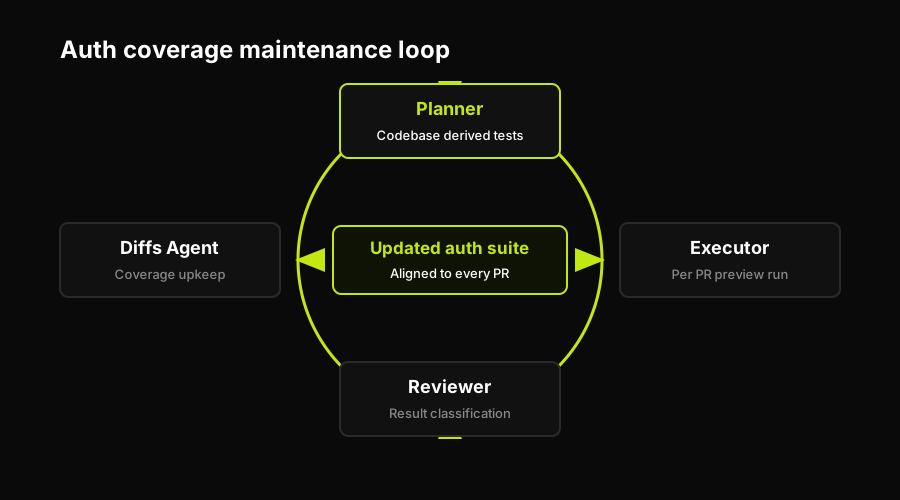
Autonoma turns auth test upkeep into a per-PR loop: plan from the codebase, run on the preview, review the result, and update coverage from the diff.
The hand-written path is not wrong for every team. If you have a single, stable auth provider with predictable flows, a well-maintained Playwright suite can serve you well. But the moment you add a second provider, introduce SSO, or start shipping features at AI-accelerated velocity, the maintenance burden compounds faster than the test suite grows.
How Autonoma Keeps Auth Coverage Current
The team most likely to ship a broken auth flow is the one with no QA and AI-accelerated velocity. They merge fast. Auth code touches many parts of the stack. There is no human review gate. The question is not whether to cover auth flows; it is how to sustain that coverage without it becoming a second job.
The practical playbook for a lean team:
Start with coverage, not perfection. Get a test running against login, one against SSO (if you have it), and one against your checkout flow. Green on each environment. Do not wait until the suite is comprehensive. Two tests that run in CI beat thirty tests that live in a ticket.
Treat auth test maintenance as a product decision, not a chore. When your auth flow changes, the test suite needs to change with it. If you are on the hand-written path, that means someone reviews the test impact of every auth-adjacent PR. If that is realistic given your team's capacity, great. If it is not, the agent path exists for exactly this reason.
Use your codebase as the spec. Autonoma reads your routes, your components, and your provider configuration to understand what the auth surface actually looks like. It does not require anyone to click through flows or write test scripts. The codebase tells the story; the agents generate and maintain coverage from it.
We built that loop for teams in exactly this position: fast-moving, no dedicated QA, auth flows too important to leave uncovered. The Planner maps the auth surface and prepares the DB state each scenario needs. Autonoma's SDK can create test users with specific characteristics, return auth credentials for the state that scenario needs, and delete the same records afterward; the Environment Factory Guide documents that endpoint. The Executor drives the UI in a live preview environment. The Reviewer separates real bugs from agent errors and test-plan mismatches. The Diffs Agent adds, deprecates, and updates tests on every PR so coverage does not rot when auth changes. The team gets a QA function over auth without hiring one.
If you want to understand more broadly how to build a reliable shipping pipeline without a QA hire, ship reliable software without a QA team covers the full strategy. For the E2E strategy layer beyond auth specifically, E2E testing strategy for AI teams is worth reading alongside this post.
Your Auth-Testing Checklist
Use this as a planning checklist when scoping auth coverage for your product. Each item links to a dedicated deep-dive where the implementation details live.
Login flow. Does your login page E2E test cover valid credentials, invalid credentials, lockout behavior, and token refresh? The test cases for the login page post has the full scenario matrix for 2026, including OAuth, OTP, and magic link variants.
SSO. If you have enterprise customers on SSO, is the SAML or OIDC round-trip tested end-to-end in CI? SSO testing deserves dedicated coverage because provider-specific configuration is the most common source of enterprise-tier incidents.
Payments. Does your checkout flow have E2E coverage that runs in CI? Payment gateway testing, including the webhook handler, is the layer most teams skip and the one that produces the most severe production incidents.
Writing the tests. If you are on the Playwright path, Playwright authentication testing covers the storageState pattern, multi-role fixtures, and the provider-specific setup for Clerk, Auth0, and Supabase.
The failure mode. Understanding what actually happens when auth breaks in production shapes how you prioritize coverage. An AI agent breaking authentication in production is the failure mode this entire strategy is designed to prevent.
FAQ
You automate end-to-end coverage of your highest-stakes auth flows (login, SSO, payments) and remove the human maintenance burden. The options are: hand-written scripts in a framework like Playwright, which you maintain through every auth change, or an agent-based tool like Autonoma that generates tests from your codebase and keeps them current on every PR via a Diffs Agent. The agent path is the more sustainable one for lean teams shipping at high velocity.
Prioritize by business stakes. Login comes first because it gates every user session and breaks visibly when something goes wrong. SSO comes second because a failure locks out an entire organization rather than one user. Payments come third because they carry direct revenue impact and users interpret payment failures as security incidents. Cover these three before expanding to secondary flows like password reset or account linking.
The build path (hand-written scripts) works when your auth surface is stable and your team has capacity for ongoing maintenance. The buy path (an agent that generates and maintains tests) makes more sense when you are shipping at AI-accelerated velocity, have multiple auth providers, or cannot afford the 30-50% of automation budget that test maintenance typically consumes. For most no-QA teams, the maintenance burden is the deciding factor.
Login: write end-to-end tests that cover valid login, failed credentials, lockout, and token refresh. SSO: test the full SAML or OIDC round-trip including attribute mapping and redirect behavior. Payments: test the checkout flow end-to-end including the provider redirect and webhook handler. For each flow, decide upfront who owns the tests when the underlying integration changes; that decision determines whether hand-written scripts or an agent-based approach is the right fit.
An authentication testing strategy is a prioritized plan for achieving end-to-end coverage of the flows that gate user access and revenue in your application. It answers three questions: which flows to cover first (login, SSO, payments), how to cover them (manual QA, hand-written scripts, or an agent), and how to sustain that coverage as auth changes over time. A strategy is what turns a list of test cases into a durable QA function.


