

SSO testing verifies that a user authenticated by an identity provider is correctly signed into your app, by driving the full SAML or OIDC round-trip and asserting the assertion is consumed, the session is created, and protected routes load. It is distinct from OAuth testing (which covers delegated authorization): SSO testing is specifically about enterprise federated identity, where your app trusts an external IdP to authenticate users on its behalf.
Most teams have at least one E2E test for the login form. Almost none have an automated test for the SSO flow. The reasoning usually goes something like: "our IdP handles it, there's a manual smoke test, and it's worked fine for years." Until it doesn't. The call comes at 2 a.m. on a Tuesday. An enterprise customer's entire org can't log in. The SSO config broke silently somewhere between a certificate rotation and a metadata URL update, and the first signal was a P1 support ticket.
That pattern repeats across the industry. SSO is the auth flow teams put off automating the longest, for understandable reasons: it involves an external identity provider, redirect-heavy flows that don't behave well under naive automation, and configuration that lives partly outside your codebase. This post walks through what SSO testing actually is, both flow directions, what to assert, and how to catch the silent breaks before your customers do.
What Is SSO Testing?
SSO testing verifies the full authentication round-trip between your app (the service provider) and the identity provider that authenticates your users. Before you can test it, you need to understand what you're actually exercising.
Single sign-on is the pattern where users authenticate once with an identity provider and gain access to multiple applications without re-entering credentials. The identity provider holds the user's credentials and issues assertions that your app trusts.
Identity provider (IdP) is the system that authenticates the user and issues those assertions. In enterprise contexts this is typically Okta, Azure AD (Entra ID), or a managed service like WorkOS that wraps multiple upstream IdPs. The IdP is the authority: if it says the user is who they claim to be, your app accepts that.
Service provider (SP) is your app. It receives the assertion, validates it, and creates a session. When something goes wrong in SSO, it almost always comes down to a mismatch between what the IdP sent and what the SP expected.
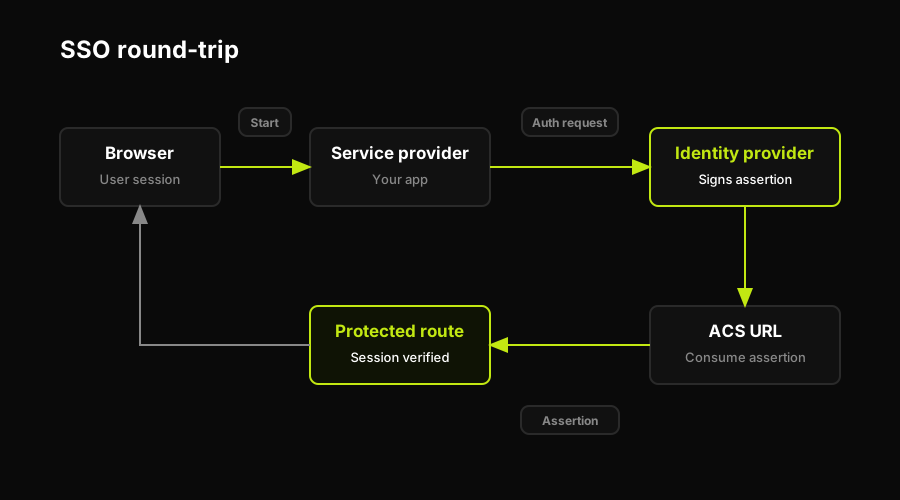
An SSO test needs to drive the browser through the IdP and back to the ACS URL, then confirm the protected route loads with a real session.
The two main protocols underlying enterprise SSO are different in structure but share the same trust model.
| Dimension | SAML 2.0 | OIDC |
|---|---|---|
| Assertion format | Signed XML document (SAML assertion) | Signed JSON (ID token / JWT) |
| Transport | Browser POST or redirect binding | Authorization code + token endpoint |
| Typical users | Enterprise, legacy systems | Modern SaaS, mobile, new builds |
| Config artifact | IdP metadata XML, SP metadata XML | Discovery document (.well-known) |
| Where it breaks | Cert rotation, clock skew, attribute mapping | Client secret rotation, scope changes |
SAML is more common in enterprise SSO integrations because most large organizations standardized on it before OIDC existed. OIDC is preferred for new builds. WorkOS supports both and abstracts the differences behind a normalized user object. Okta issues both SAML assertions and OIDC tokens depending on how the application is configured. For the purposes of what to test, the concepts are nearly identical: an external party asserts user identity, your app validates the assertion, and a session is created. This post focuses on SAML because that's where most SSO testing complexity lives, but the assertions carry over to OIDC.
An OAuth testing guide (covered separately) addresses delegated authorization between apps. SSO is not OAuth. SSO is federated authentication: an IdP vouches for the user's identity. OAuth authorizes one app to act on behalf of a user. The distinction matters because the tests are different.
IdP-initiated vs SP-initiated Flows
Enterprise SSO breaks down into two flow directions. Both need to be tested. They fail in different ways.
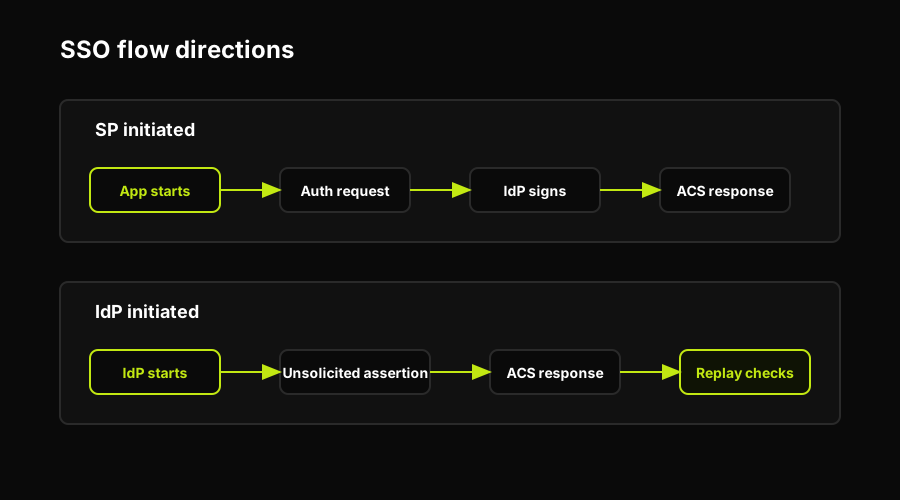
SP-initiated SSO starts in your app and correlates a request; IdP-initiated SSO starts from the IdP and needs separate replay and assertion checks.
SP-initiated is the flow most teams know. The user lands on your app and clicks "Sign in with SSO." Your app generates a SAML authentication request, redirects the browser to the IdP with that request, the IdP authenticates the user and posts a signed SAML assertion back to your app's assertion consumer service (ACS) URL. Your SP validates the assertion and creates a session. This is the canonical flow and the one most integration docs walk you through.
IdP-initiated is less understood and more dangerous to leave untested. The user starts at the IdP dashboard (Okta's app launchpad, for example), clicks your app's tile, and the IdP posts a SAML assertion directly to your ACS URL without any prior authentication request from your app. Your SP receives an assertion it never asked for: an "unsolicited response."
The IdP-initiated flow is structurally different in a way that has security implications. In SP-initiated SSO, your app generates a random RelayState parameter and a request ID, and you can validate that the assertion corresponds to a request you actually made. In IdP-initiated SSO, there is no prior request. Your SP must be configured to accept unsolicited assertions. If that validation is too permissive, a SAML replay attack becomes possible: an attacker who captures a valid assertion can replay it to log in as that user.
Teams that only test SP-initiated flows ship IdP-initiated handling without adequate coverage. The IdP-initiated path is used constantly in enterprise environments, because large organizations build apps into the SSO dashboard and employees launch everything from there. Testing only one direction means the other fails silently.
What to verify in each direction:
SP-initiated: the authentication request is correctly formed and sent, the browser completes the round-trip to the IdP and back, the assertion is validated and consumed, the session is created, the user lands on the correct post-login destination.
IdP-initiated: the unsolicited assertion is accepted and the session is created, the NotOnOrAfter condition is enforced (the assertion isn't accepted outside its validity window), a replayed assertion is rejected, and the user lands on the correct post-login destination.
What to Assert in an SSO Test
Once you can drive the round-trip in a test environment, the question is what to actually check. Here are the concrete assertions that matter.
Assertion signature and audience. The SAML assertion is signed with the IdP's private key. Your SP must verify the signature against the IdP's public certificate. If certificate validation is skipped or misconfigured, anyone who can craft a valid-looking SAML document can log in as any user. In a test, you're asserting that your application correctly validates the signature (misconfigured certs should result in rejection) and that the Audience element in the assertion matches your SP's entity ID. If the audience is wrong, the assertion is for a different service provider and should be rejected.
Conditions: NotBefore and NotOnOrAfter. The SAML assertion contains a Conditions element with time bounds. NotBefore and NotOnOrAfter define the validity window. Clock skew between your server and the IdP can cause valid assertions to be rejected. Testing this means verifying that assertions within the window are accepted and that assertions outside the window are rejected. This is a common production failure mode when servers drift.
Session creation. After the assertion is consumed, a session cookie should exist in the browser. Assert that the cookie is set, that its attributes match your expectations (HttpOnly, Secure, SameSite), and that a subsequent request to a protected route succeeds.
User provisioning (JIT). In most enterprise SSO configurations, users are provisioned just-in-time on first login: if the user doesn't exist in your database, they're created from the assertion's attribute statements. Assert that the user record is created with the correct attributes (email, name, role, org) mapped from the IdP's attribute statements. A misconfigured attribute mapping is one of the most common SSO bugs in production.
Attribute mapping accuracy. The IdP sends user attributes in the assertion (email, display name, groups, custom attributes). Your SP reads these via the attribute mapping configuration. Test that the values in the session match what the IdP sent. For Okta, this means confirming the attribute names your app expects (e.g., email, firstName, lastName) map correctly to what Okta is configured to send. For WorkOS, the normalized user object handles much of this, but organization-specific attribute mappings still need verification.
Protected routes load post-auth. After login, assert that at least one route requiring authentication loads correctly with a 200. This sounds obvious but catches a common class of bugs where SSO completes but the session isn't correctly wired to the route protection middleware.
Logout. SAML Single Logout (SLO) is optional but should be tested if your app supports it. Assert that logging out in your app terminates the IdP session (if SLO is configured), and that logging out at the IdP propagates to your app. Partial logout (one side but not the other) is a common oversight.
How Autonoma Keeps SSO Coverage Current
The SSO failure pattern documented here is not just a test-authoring problem. It is a maintenance problem: certificate rotation, metadata changes, attribute mapping drift, and callback route changes can all break the real round-trip while ordinary CI stays green.
Autonoma addresses that by deriving SSO tests from the codebase and running them against a live preview environment on every PR. The Planner reads the routes, components, and SSO integration code to plan both SP-initiated and IdP-initiated coverage. For app-side tenant, role, or user records that the SSO scenario depends on, the Environment Factory Guide documents the SDK endpoint for creating users with the right tenant and role characteristics, returning auth credentials, and deleting those records after the run. The Executor drives the browser through the real preview flow, including the assertion handoff back to the ACS URL. The Reviewer classifies failures so certificate, mapping, and app regressions are not collapsed into generic flake. The Diffs Agent keeps the SSO tests current when the callback, route guards, or user provisioning paths change.
The result is continuous coverage for the enterprise auth path that usually depends on manual smoke tests. When a PR changes SSO-adjacent code, the test coverage changes with it instead of waiting for the next customer login failure.
Why SSO Breaks Silently (and How to Catch It)
SSO is fundamentally a wrapper around your identity provider's configuration. Your app trusts the IdP. The integration is maintained through metadata: a certificate, a metadata URL, attribute mapping rules. When any of these change outside your deployment cycle, your app breaks, and your test suite may not catch it.
Here's how it typically happens. The IdP rotates its signing certificate (a routine security operation). Your SP still has the old certificate cached. The next SSO attempt fails with a signature validation error. No code changed. No deployment happened. The test suite is green because it mocks the SAML assertion instead of driving the real IdP.
The same pattern plays out with metadata URL changes (the IdP moves its SAML metadata endpoint), attribute mapping changes (an admin renames a custom attribute in Okta), and clock skew accumulation (a VM's clock drifts past the NotOnOrAfter window).
Unit and integration tests that mock the IdP response will not catch any of these. They test your app's SAML parsing logic, which is fine, but they don't test the integration. The only test that catches IdP configuration drift is one that drives the real round-trip: a browser that hits your login page, gets redirected to the real IdP (or a test tenant that mirrors real IdP behavior), receives the real assertion, and lands on a protected page.
For lean teams, this is exactly where automated end-to-end testing matters most. Running the SSO round-trip manually before every release is time-consuming and skippable under pressure. An agent that drives the real browser flow on every PR catches cert drift and attribute mapping regressions before they reach production. Autonoma reads your codebase, generates the SSO test cases (SP-initiated and IdP-initiated), runs them against a live preview environment on every pull request, and maintains the test suite as your integration evolves. When WorkOS normalizes a new attribute or Okta changes a claim name, the Diffs Agent updates the tests automatically. The gap between "green CI" and "SSO actually works" closes.
For testing Auth0 login via the OAuth layer, the approach differs (Resource Owner Password grant to mint tokens directly). SSO is the enterprise federated identity layer; OAuth covers delegated authorization. A complete authentication testing strategy guide covers both. The login page test cases checklist includes SSO as one of several auth flow categories, useful for validating test coverage across your entire login surface.
FAQ
SSO testing verifies that a user authenticated by an identity provider is correctly signed into your application by driving the full SAML or OIDC round-trip. It asserts that the SAML assertion is cryptographically valid and consumed, that a session is created, that user attributes are correctly provisioned, and that protected routes load after login. It is distinct from OAuth testing, which covers delegated authorization rather than federated identity.
To test SAML, drive the full round-trip in a browser against a real test IdP tenant (Okta sandbox, WorkOS staging environment, or a local SAML IdP like SimpleSAMLphp). Assert that the SAML assertion is consumed without errors, the signature is validated against the correct certificate, the Audience and NotOnOrAfter conditions are enforced, a session cookie is set, user attributes are correctly mapped, and a protected route loads. Mocking the SAML response in unit tests is useful for testing your parsing logic but will not catch IdP configuration drift.
In SP-initiated SSO, the user starts at your application and is redirected to the IdP for authentication before being sent back with a SAML assertion. In IdP-initiated SSO, the user starts at the IdP dashboard (for example, the Okta app launchpad) and the IdP pushes an unsolicited assertion to your application's assertion consumer service URL. Both directions need separate test coverage. IdP-initiated flows require extra scrutiny for replay prevention because your application receives an assertion with no prior request to correlate it against.
End-to-end SSO testing requires a browser that drives the full redirect flow against a real or realistic test IdP. The test starts at your login page, follows the SSO redirect to the IdP, authenticates (using test credentials in a sandbox IdP tenant), receives the SAML assertion at your ACS URL, and asserts that the session is created and a protected route loads. Integration tests that mock the IdP response cover SAML parsing logic but not the full integration. Testing with tools like WorkOS sandbox environments or Okta developer tenants gives you a realistic IdP without touching production credentials.
SSO breaks in production when IdP configuration changes outside your deployment cycle. The most common causes are: certificate rotation (the IdP rotates its signing cert, your SP still has the old one cached), metadata URL changes (the IdP moves its SAML metadata endpoint), attribute mapping drift (an admin renames a custom attribute in the IdP), and clock skew (server time drift causes assertions to fail NotOnOrAfter validation). None of these involve code changes, so they are not caught by unit tests or typical CI pipelines. Only an end-to-end test that drives the real IdP round-trip will surface them.


