

OAuth testing verifies the authorization-code round-trip: the redirect to the provider, the consent, the callback with the code, and the token exchange, asserting that a valid flow signs the user in and a tampered or expired code is rejected. The redirect-to-callback boundary is the fragile point, and most test strategies fail because they mock it rather than drive it.
The OAuth flow that worked fine in development broke in production. Not because the code changed. Because the provider tweaked its redirect behavior, a query parameter moved in the callback, and the callback handler silently stopped working. The mocked test passed. The real sign-in did not.
This is the failure mode that OAuth testing is supposed to catch and usually does not. The authorization-code flow spans two origins, involves a provider you do not control, and has several points where a small configuration change produces a silent breakage rather than a loud error. Getting your tests to catch that class of failure requires understanding exactly what the flow does, where it breaks, and what "testing" it actually means.
How the OAuth Authorization-Code Flow Works
The authorization-code flow is a round-trip that moves between three parties: your application, the user's browser, and the OAuth provider.
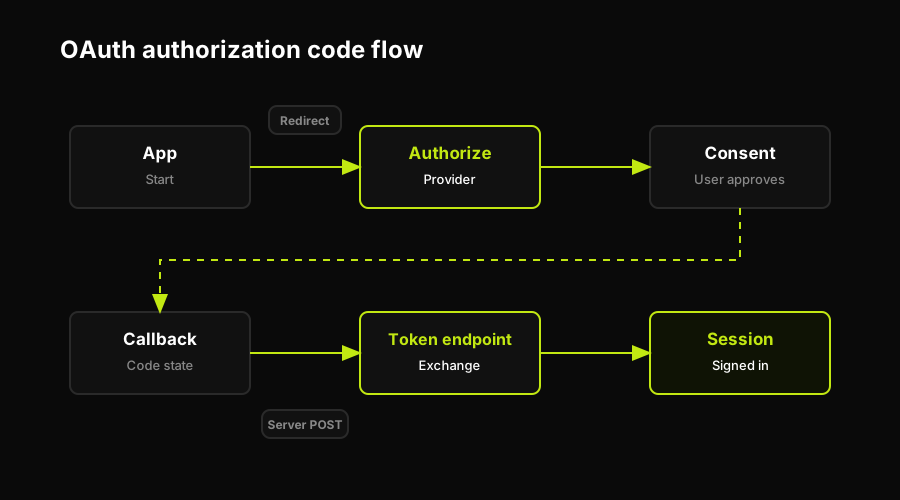
The six-step OAuth 2.0 authorization-code round-trip. The dashed return path is where redirect URI mismatches and dropped state parameters silently break the flow.
Your application initiates by redirecting the user's browser to the provider's authorize endpoint. The redirect URL includes client_id, response_type=code, redirect_uri, scope, and a state parameter your application generates. The state value is a random string tied to the session; its job is CSRF protection, correlating the callback to the original request.
The user lands on the provider's consent screen and approves (or denies) the request. On approval, the provider redirects the browser back to your application's registered callback URL. The redirect carries two query parameters: code (a short-lived authorization code) and state (the same value your application sent).
Your application's callback handler receives that redirect, verifies the state matches the session, then makes a server-side POST to the provider's token endpoint exchanging the code for an access token. That exchange includes the client_id, client_secret, and redirect_uri. The provider validates all three before issuing the token.
For public clients (single-page apps and mobile apps without a backend secret), PKCE replaces the client secret. The app generates a code verifier and a code challenge at the start of the flow, includes the challenge in the authorize request, and sends the verifier during the token exchange. The provider verifies they match. PKCE closes the authorization-code interception attack for clients that cannot keep a secret.
The important structural point for testing: the authorization code is single-use and short-lived (typically 60 seconds). The redirect URI in the token exchange must exactly match the URI registered with the provider and included in the original authorize request. A mismatch on either side produces a hard rejection.
What to Test in an OAuth Flow
OAuth testing has two parts: positive assertions (the happy path signs the user in) and negative assertions (bad inputs are rejected cleanly). Both matter, but the negative paths are where the security and reliability requirements live.
Happy-path assertions. When a valid flow completes, assert that the authorize redirect fires with the correct client_id, scope, and a state value in the URL. After the consent, assert that the callback receives a code and a state that matches what was sent. After the token exchange, assert that the user session exists and a protected route is accessible.
Negative-path assertions. A tampered or forged code should be rejected at the token endpoint with a 400 or 401, not silently accepted. An expired code (reused after the TTL or used twice) should be rejected. A mismatched state value should cause the callback handler to abort the flow, not proceed with a potentially hijacked session. A denied consent should result in a clean error state, not a crash or a broken redirect loop.
The redirect-to-callback boundary is where the most fragile behavior lives. The callback URL is registered with the provider. If the provider updates how it constructs the redirect, or if someone changes the registered callback URL, the authorization code arrives at the wrong handler (or nowhere), and the flow breaks silently. Your positive-path test catches this. Your negative-path tests do not, because they test rejection logic, not delivery logic.
This is why the callback URL and the handler it maps to are the things most worth testing explicitly. They connect your application to the provider's side of the contract, and a mismatch on either end is invisible to the user until sign-in fails in production.
Mock vs Real OAuth in Tests
The core decision in any OAuth test strategy is whether to mock the provider interaction or drive the real one. Both approaches have legitimate uses. Neither is sufficient alone.
Mocked OAuth replaces the provider with a stub: your test intercepts the authorize redirect and returns a synthetic callback with a fake code, then stubs the token endpoint to return a canned access token. This is fast, deterministic, and easy to parallelize. It also tests a fiction. The stub does not exercise the real redirect URL, does not confirm that the registered callback is reachable, and does not confirm that the callback handler correctly parses what the real provider sends. If a provider changes the structure of its callback redirect, your mocked test does not notice.
Real OAuth drives an actual provider or a test tenant through a real browser (typically with a tool like Playwright). The Executor in your test suite navigates to your app, triggers the OAuth flow, lands on a real consent screen, completes authentication, and observes the callback round-trip. This is slower and requires a test tenant with stable credentials. It is also the only approach that catches a broken callback, a misconfigured redirect URI, or a provider-side change in the redirect structure.
| Dimension | Mocked OAuth | Real OAuth |
|---|---|---|
| Provider behavior | Stubbed callback and token response | Actual provider or test tenant |
| Callback reachability | Not verified | Verified through the browser |
| Redirect URI drift | Usually missed | Caught on the round-trip |
| Best use | Unit and fast CI checks | Critical sign-in coverage |
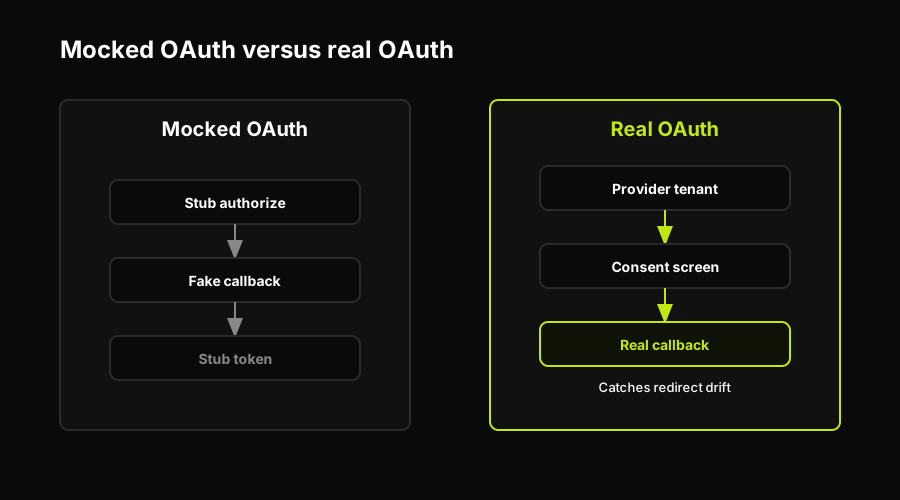
Mocks are useful for callback logic, but the real OAuth round-trip is the layer that proves the provider can still reach your app.
The practical recommendation is a layered approach. Mock OAuth for unit tests and most CI runs, where speed and determinism matter more than end-to-end fidelity. Drive the real authorization-code round-trip for at least the critical happy path, on a cadence that matches how often your callback configuration or provider settings change. If you are deciding between these two approaches in depth, the case for real-browser OAuth testing covers the full tradeoff analysis.
The layered strategy gives you fast feedback on regressions in your application code (from mocks) plus real verification that the actual round-trip works (from real OAuth). The second part is what most teams skip, and it is the part that catches the production incident.
How Autonoma Handles OAuth Callback Testing
The OAuth callback is the part of your login flow you only partly own. Your application handles the callback route and the token exchange, but the provider owns the other half: the authorize endpoint, the consent screen, and the redirect structure. A mocked test validates your half in isolation. It cannot tell you whether the real redirect arrives at your callback correctly, or whether a changed redirect URI configuration has silently broken the round-trip.
Autonoma closes that gap by driving the real authorization-code flow end to end. The Planner agent reads your codebase, identifies the OAuth callback routes and the flows that depend on them, and plans test cases for the full round-trip: redirect to provider, consent, callback with a real authorization code, and token exchange. The Executor agent drives those test cases in a live browser against a real preview environment, exercising the actual redirect and callback markup. The Reviewer agent classifies results, separating a genuine callback failure from an agent execution error. The Diffs Agent runs on every pull request, analyzing code changes to the callback handler or redirect configuration and updating the test cases accordingly.
For teams shipping auth-gated apps without a dedicated QA engineer, this matters because the authorization-code flow is stateful and cross-origin in ways that are hard to cover manually. A changed redirect URI, a dropped query parameter, or a callback handler regression surfaces as a failed Autonoma test on the pull request that introduced it, not as a support ticket after deploy. When those tests need seeded app-side users or session credentials, the Environment Factory Guide documents the SDK endpoint Autonoma uses to create users with specific characteristics, authenticate in the state the callback test needs, and tear the records down afterward.
Provider Specifics
Each provider has its own quirks in the authorization-code flow: different consent screen behavior, different test-tenant setup paths, different callback URL validation strictness, and different approaches to token lifetime and refresh.
For Google OAuth, the consent screen behavior differs between test and production mode, and the set of allowed redirect URIs is strictly validated per client. The Google OAuth testing guide covers the test-tenant configuration, the OAuth playground for token inspection, and the specific quirks of the Google consent screen in a test environment.
For Auth0, the hosted Universal Login page lives on Auth0's domain and cannot be directly driven from a test runner without dealing with cross-origin constraints and bot detection. The Auth0 login testing guide covers the Resource Owner Password grant as the standard shortcut for minting tokens directly in test setups, plus the tradeoffs of that approach.
For teams also working with SSO flows, the SSO testing pattern shares the same redirect-and-callback structure as OAuth but adds identity provider federation, which introduces additional callback registration requirements and additional points where a configuration change can break the round-trip silently.
Autonoma keeps OAuth callback coverage current by deriving the flow from the codebase, running it against a live per-PR preview environment, and letting the Diffs Agent update tests when callback handlers, redirect configuration, or auth-gated routes change.
FAQ
OAuth testing verifies the authorization-code round-trip: the redirect to the provider, the user consent, the callback with the authorization code, and the token exchange. A correct OAuth test asserts that a valid flow signs the user in and that a tampered code, an expired code, a mismatched state parameter, or a denied consent is rejected cleanly. The redirect-to-callback boundary is the most fragile point, because it connects your application to behavior the provider controls.
A practical OAuth test strategy has two layers. For unit and most CI tests, mock the provider: stub the authorize redirect to return a synthetic callback, stub the token endpoint to return a canned token, and assert your application's callback handler behaves correctly. For the critical happy path, drive the real authorization-code round-trip against a test tenant, using a browser to navigate the full flow and verify the callback receives a real code and the token exchange succeeds. The real-browser layer is the only thing that catches a broken callback or a misconfigured redirect URI.
Mocking OAuth is appropriate for unit tests and most CI runs: it is fast, deterministic, and good at testing your application's callback logic in isolation. The tradeoff is that mocks test a fiction. A mocked test does not exercise the real redirect, does not confirm the registered callback URL is reachable, and does not catch a provider-side change in redirect behavior. For the critical sign-in path, complement mocks with at least one real-browser test that drives the full authorization-code round-trip against a real provider or test tenant.
The authorization-code flow is the standard OAuth 2.0 pattern for delegated login. Your application redirects the user to the provider's authorize endpoint with a client_id, scope, redirect_uri, and a state parameter for CSRF protection. After the user consents, the provider redirects back to your registered callback URL with a short-lived authorization code. Your backend exchanges that code (plus the client secret or PKCE verifier) for an access token at the provider's token endpoint. The code is single-use and expires quickly, typically within 60 seconds.
OAuth callback testing has two aspects. For the negative paths, assert that a tampered code, a reused code, and a mismatched state parameter all result in a clean rejection rather than a signed-in session. For the positive path, the most reliable approach is to drive the real authorization-code flow in a browser, confirm the callback receives a valid code from the provider, and confirm the token exchange completes and the user is signed in. Mocked callback tests verify your handler logic but cannot confirm the provider is actually delivering to the correct URL.


