

Mocking authentication makes tests fast and green, but it verifies your mock, not your login. Testing without mocking, by signing in through the real browser, is the only way to catch a dropped auth wrapper, a broken OAuth callback, or a guard that stopped guarding.
The test suite was all green. Every test passed. The deploy went out on a Friday afternoon, which was, in retrospect, the first warning sign.
By Monday morning, support had three tickets from users who could not log in. The OAuth callback was returning a 500. The login UI was rendering fine. The redirect was firing. But the session never got established, because someone had silently removed the auth wrapper from the session handler two weeks earlier and no test had caught it. The mocked tests had been happily asserting that the mocked user was logged in, which they were, because the mock said so.
This is not a story about a careless team. It is a story about what mocking authentication actually tests, and what it does not.
What mocking auth actually tests
Mocking is a legitimate tool. Understanding where it works well is the starting point for any honest discussion.
When you mock authentication in a test, you are telling the test framework to skip the real login path and instead inject a pre-authenticated state. The test opens the app already logged in. No credentials, no token exchange, no redirect. This is fast, it is deterministic, and it is useful in a specific set of situations.
Unit tests are the clearest case. If you are testing a component that renders differently for authenticated versus unauthenticated users, you do not need a real login to test that rendering. Inject the auth state, assert the output. Done. The real login path is irrelevant to what that test is measuring.
Isolating non-auth logic is another legitimate use. If you are writing tests for a checkout flow, a settings page, or a data visualization, the authentication layer is overhead, not the subject. Mocking it out means your checkout tests break when the checkout logic breaks, not when the login page has a typo. That focus is valuable.
There is also the speed argument. A mocked test suite that runs in two minutes gives you faster feedback than a real-auth suite that takes ten. For teams iterating quickly, that gap matters.
The honest summary: mocking authentication gives you speed, determinism, and focused isolation. It is right for unit tests and right for tests that are not about authentication. The problem is not that mocking is wrong. The problem is what happens when it becomes the only approach at the end-to-end layer.
What only real auth catches
The three failure modes that mocked tests consistently miss have one thing in common: they all live in the real browser path that the mock deliberately skips.
The dropped auth wrapper. A developer refactors a route handler. The auth middleware call was at the top of the file, maybe two screenfulls above the logic being changed. It gets lost in the diff. The route now renders for unauthenticated users. Every mocked test that loads that route starts pre-authenticated, so the wrapper's absence is invisible. A real-browser test that navigates to the route as an unauthenticated user would catch it on the first run.
The broken OAuth callback. OAuth is a multi-step dance between your app, the identity provider, and the browser. When the callback URL changes, when the state parameter validation breaks, or when the redirect logic silently drops the intended destination, the mock never sees any of it. It injected the session before any of those steps happened. A real sign-in through the browser exercises every step. Playwright authentication testing patterns covers the specific points in the flow where this tends to break.
The guard that stopped guarding. Route guards, middleware checks, and role-based access controls are exactly the kind of logic that drifts silently. A guard is added, it works, and six months later someone changes the condition and it still "works" in the sense that it does not throw an error. It just no longer blocks unauthorized access. Mocked tests skip the guard. Real-browser tests hit it.
These are not edge cases. They are the class of bugs most likely to reach production from a team with good test coverage, because the coverage is real but it is covering the wrong surface.
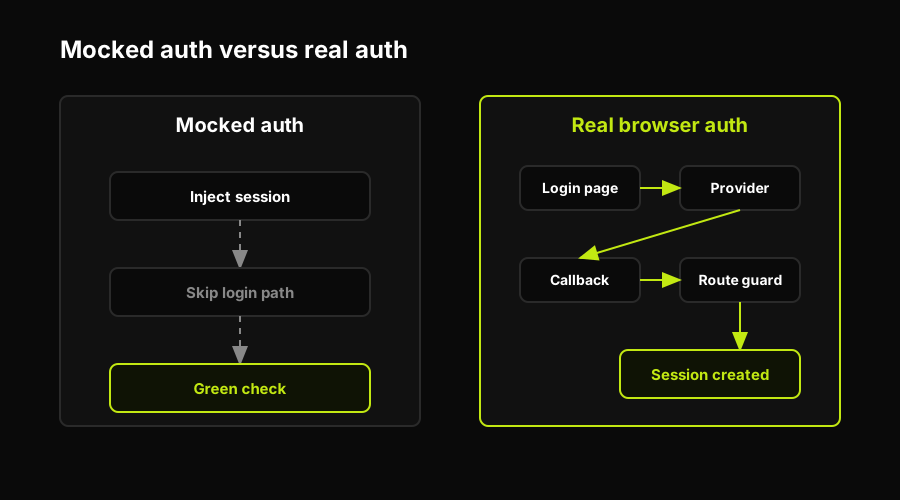
Mocked auth verifies the app after a session is injected; real-browser auth verifies the login, callback, guard, and session path that users actually take.
The tradeoff: setup cost vs confidence
The honest comparison is not "mocking is bad." It is "these two approaches give you different things, and one of them has a significant setup cost."
| Dimension | Mocked auth | Real-browser auth |
|---|---|---|
| Speed | Fast (no network calls) | Slower (full browser flow) |
| What it verifies | Logic given auth state | The full auth path |
| Catches dropped wrapper? | No | Yes |
| Catches broken callback? | No | Yes |
| Setup cost | Low (inject state) | High (credentials, env, callbacks) |
| Maintenance burden | Low (mock rarely changes) | High (auth surface changes) |
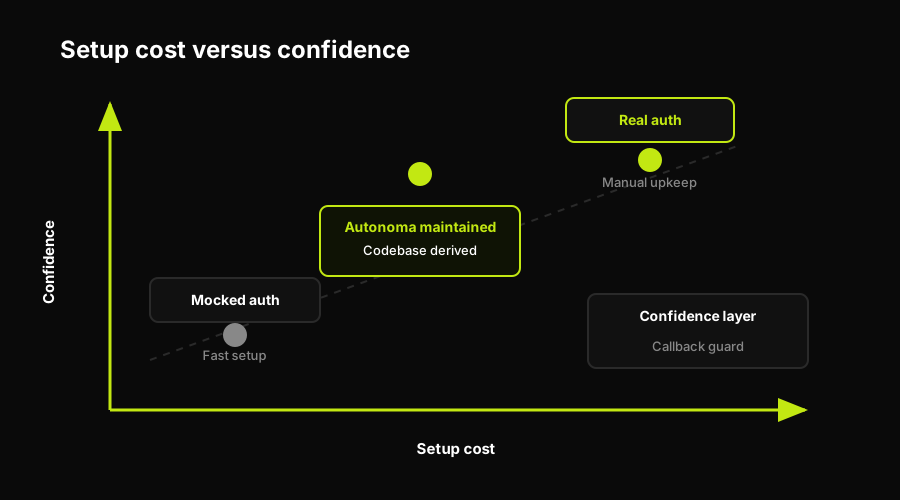
The real-auth layer costs more to set up by hand, but it is the layer that catches callback, guard, and session failures before production.
The setup cost row is what drives most teams toward mocking at the end-to-end layer. Standing up real authentication in CI means managing test user credentials, configuring OAuth test apps, pointing callbacks at preview environments, handling token expiry, and keeping all of it in sync as the auth provider configuration changes. That is real work, and when the alternative is a three-line mock that keeps CI green, most teams pick the mock.
This is a rational tradeoff. The problem is that the confidence row does not appear in the CI dashboard. You see green; you do not see the surface that was never tested.
How Autonoma Removes the Setup Tax for Real-Auth Testing
The argument for real-browser authentication testing collapses on setup cost. If you could get the confidence without paying the maintenance cost, the tradeoff changes entirely. The pattern this article has documented is that teams reach for mocking not because it is more accurate, but because the real-browser alternative requires sustained setup effort: test credentials to manage, OAuth apps to configure, callback URLs to keep in sync with preview environments, and state to rebuild every time the auth surface changes. That setup cost is the reason mocking becomes the default at the end-to-end layer.
Autonoma is the approach we built to remove that tax. The Planner agent reads your codebase directly, identifying your auth routes, middleware, login UI, and callback handlers, then generates test cases for the real login path (not a mocked shortcut) based on what the code actually does, while a real browser drives the full sign-in flow on a per-PR preview environment and the results get classified as a genuine broken callback or an environment configuration error. The Diffs Agent watches every PR for changes to auth routes, middleware, and login components, and updates the test plan when the surface changes, which is exactly the situation where mocked tests would silently miss a regression.
The practical effect is that you get real-auth confidence on every pull request without the maintenance ritual. The Planner handles DB state setup (test users, role assignments) through generated endpoints, so there is no manual credential management between runs. The Environment Factory Guide covers the SDK endpoint behind that setup: create test users with specific characteristics, return auth credentials for a particular user state, and delete those users afterward. The auth surface is covered by a layer that actually signs in, and that layer maintains itself as the code changes.
To be direct about scope: Autonoma is the end-to-end real-auth layer, not a replacement for unit-level mocks. If you are testing a component's rendering behavior given an auth state, mocking is still the right tool. The value we provide is in catching the class of bugs that mocked tests structurally cannot see: the dropped wrapper, the broken callback, the guard that stopped guarding.
For teams thinking about a full authentication testing strategy guide, the right frame is both layers: fast mocked tests for logic isolation, real-browser tests for the login path itself. Each layer is testing a different surface. The mistake is treating one as sufficient for both jobs.
When real-browser auth testing is not the right answer
This framing deserves a counterpoint, because not every team needs the full real-auth layer immediately.
If your application has a simple, stable login flow and your biggest testing risk is not the auth path but the product logic behind it, adding real-auth end-to-end tests before you have coverage of the core flows is the wrong priority. Fix the coverage gaps in the product first.
If your team is pre-launch and iterating on the auth design itself, your end-to-end tests will be brittle by definition. Mocking during this phase is sensible. The maintenance cost of real-auth tests is highest when the auth surface is still moving.
If your auth flow is an external provider (Google, GitHub, enterprise SSO) and you have no test account setup in that provider, real-browser tests against the live provider are unreliable in CI. The right approach is a mock for the provider-side redirect combined with real-browser testing of your app's callback and session handling. See the coverage pattern in the Playwright authentication testing guide.
The goal is not to eliminate mocking. The goal is to have at least one layer of tests that exercises the real login path on every change to the auth surface.
For teams without a QA owner, Autonoma keeps that real-login layer alive by deriving tests from the codebase, running them on each per-PR preview environment, and using the Diffs Agent to maintain coverage as auth code changes.
FAQ
Yes, in specific contexts: unit tests that test component rendering or logic given an auth state, and integration tests that are testing non-auth product flows where authentication is overhead rather than the subject. Mocking is legitimately wrong as the only approach at the end-to-end layer, because it cannot catch a dropped auth wrapper, a broken OAuth callback, or a guard that stopped guarding. Use mocking for speed and isolation; use real-browser authentication for the login path itself.
Mocking auth misses any failure that lives in the real browser login path: a dropped auth middleware wrapper on a protected route, a broken OAuth callback (wrong state parameter, missing redirect handling, silent 500 from the session handler), a route guard whose condition changed so it no longer blocks unauthorized users, and token expiry or refresh handling that only surfaces in a real session lifecycle. These are the bugs most likely to reach production from a team with green CI, because the mocked tests pass while the real login path is broken.
You drive a real browser through the full sign-in flow: load the login page, submit real credentials, follow the redirect, and assert that the authenticated state is established in the app. In Playwright, this means a setup test that fills the login form and saves the resulting storageState, then reuses that state in downstream tests. For end-to-end coverage on every PR, an agent-driven approach like Autonoma handles this automatically: the Planner reads your auth routes and generates the test cases, the Executor drives the real browser through sign-in, and the Diffs Agent maintains the coverage as your auth surface changes.
Real auth in E2E is better for coverage of the login path itself. Mocking is better for speed and for testing product logic behind authentication where the login path is not the subject. The practical compromise most teams reach is: mocked auth for the bulk of the E2E suite (so tests are fast and focused), plus a real-browser auth layer that signs in for real and checks the login path on every PR. The second layer is what catches the class of bugs that reach production through teams with good (but mocked) test coverage.
Because mocked login tests skip the real browser path. When you mock authentication, you inject a pre-authenticated state before the test touches your app. The test never calls the login endpoint, never follows the OAuth redirect, never hits the route guards, and never exercises the session establishment logic. If any of those steps breaks, the mock does not see it. The test asserts that the mocked user is in the correct state, which they always are, because the mock put them there. The bug lives in the path the mock skipped.


