

The suite was green on Friday. On Monday, after a routine front-end redesign shipped, it was almost entirely red.
Nothing about the app was actually broken. The checkout flow worked. The login form worked. What didn't work was the recording: a frozen sequence of clicks and selectors captured months earlier, now pointed at DOM elements that had moved, been renamed, or been restructured entirely. The team spent the better part of the week re-recording flows one by one, clicking through the same login, the same checkout, the same settings page, just to get the suite back to green so it could tell them something useful again.
Nobody on the team disagreed that the tests had caught real value before. That was the frustrating part. The suite had flagged genuine regressions in the past, which is exactly why it was hard to just let it rot. But every redesign meant the same ritual: watch the dashboard turn red, sigh, open the recorder, click through the flow again, save, rerun, repeat for every test that touched the changed component. A QA lead can only do that so many times before Monday afternoons start feeling like a tax on shipping anything visual at all.
That week is the reason most teams start Googling "Ghost Inspector alternative." Not because the product is bad. Because record-and-playback, as a category, has a structural weakness that shows up right when you need the suite most: the moment after a redesign.
What Ghost Inspector is good at (and where teams outgrow it)
Ghost Inspector earns its place in a lot of QA stacks, and it's worth saying plainly what it does well before talking about alternatives.
The browser recorder is genuinely low-friction. You click through a flow, Ghost Inspector captures the steps, and you have a runnable test in minutes, no Selenium script required. That matters for teams without dedicated engineers: a product manager or a support lead can build a smoke test for a critical flow without learning a framework. Scheduled runs, cross-browser and responsive execution, and visual/screenshot comparisons round out a toolset built for continuous monitoring rather than one-off checks. Failure alerts route to Slack, Teams, PagerDuty, or GitHub, so a broken flow shows up where the team already looks. For non-engineering stakeholders who need visibility into whether the app still works, it's an accessible, fast way to get there.
Where teams outgrow it is almost always the same story: scale exposes the weakness of a recording. A recording is a snapshot, a fixed sequence of actions bound to the DOM as it existed the day you clicked through it. It doesn't know why a button exists, only where it was. As the suite grows past a handful of flows into dozens or hundreds, every UI change (a redesign, a component library upgrade, a rebrand) forces a wave of re-recording. The low-code editor helps with small tweaks, variables, conditions, custom JavaScript steps, but it wasn't built for complex branching logic or conditional flows the way a real programming language is. Teams that started with Ghost Inspector because it was fast to adopt often hit a second wall a year later: it's fast to adopt, but the maintenance curve doesn't stay flat as the suite grows.
There's also a subtler cost that only shows up at scale: who owns the suite. Record-and-playback is pitched as accessible to non-engineers, and it genuinely is for the first few tests. But once a suite covers dozens of critical flows, keeping those recordings current becomes a job in itself, one that tends to fall on whoever has the most patience for re-clicking through the app, rather than whoever understands the product best. That's a strange place for test ownership to end up.
Ghost Inspector alternatives, by approach
Rather than ranking individual products, it's more useful to group Ghost Inspector alternatives by the underlying approach, since that's what actually determines your long-term maintenance cost.
| Approach | How tests are created | Maintenance when UI changes | Who it's for |
|---|---|---|---|
| Record-and-playback SaaS (Testim, mabl, Rainforest) | Click through the app; tool records steps | Manual re-record or accept AI-assisted patching | Non-engineers, fast onboarding |
| Code frameworks (Playwright, Cypress, Selenium) | Engineers write test scripts | Manual code updates by a developer | Teams with engineering capacity |
| AI-agent-generated (Autonoma) | Agents read the codebase and generate tests | Agents regenerate tests from the new code | Teams tired of re-recording or rewriting |
Each approach trades something for something else. Recorder SaaS trades long-term maintenance cost for a low barrier to entry. Code frameworks trade setup effort (you need engineers) for precise control over exactly what a test does. AI-agent-generated testing trades some of that granular control for tests that don't require a human to notice the UI changed before fixing them.
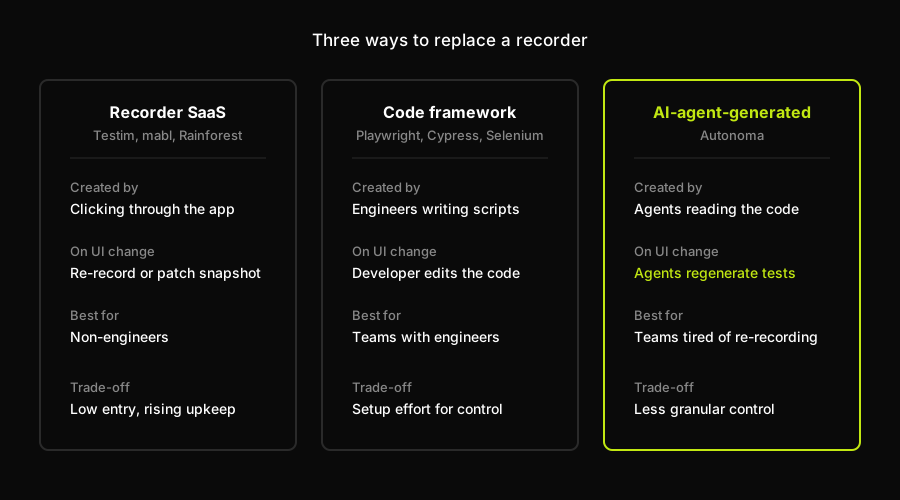
The choice isn't really between vendors. It's between three approaches with very different maintenance curves as a suite grows.
It's worth being specific about what "another recorder" actually buys you. Tools like Testim and mabl still capture flows through recording and offer some AI-assisted self-healing on top, matching an element by nearby attributes rather than a single brittle selector, which reduces breakage on small changes. But the underlying model is the same: a human clicks through the app once, and the tool tries to keep that specific recording alive as the DOM shifts around it. That's meaningfully better than a plain recorder with zero self-healing, but it's still patching a snapshot rather than regenerating from current behavior. A large redesign that restructures a page will still outrun the patching layer.
Why record-and-playback hits a wall
A recording is a snapshot of one specific run: click here, type this, click there, at these coordinates, against this DOM. It's an artifact of a moment, not a description of intent. The tool doesn't know that "the email field" is conceptually the input that accepts an email address; it knows that a click landed on an element with a particular selector at a particular pixel. That's the entire model, and it's why it works so well for a demo and so poorly six months into a live product.
The failure mode is predictable. A redesign changes class names. A component library migration restructures the DOM. A rebrand moves a button three pixels to the left and renames its container. None of these change what the app does, but all of them break a snapshot bound to specific selectors, the same brittleness problem covered in more depth in our piece on selectors and locators. The snapshot doesn't degrade gracefully. It just stops matching, and someone has to notice, open the recorder, and re-record the flow from scratch.
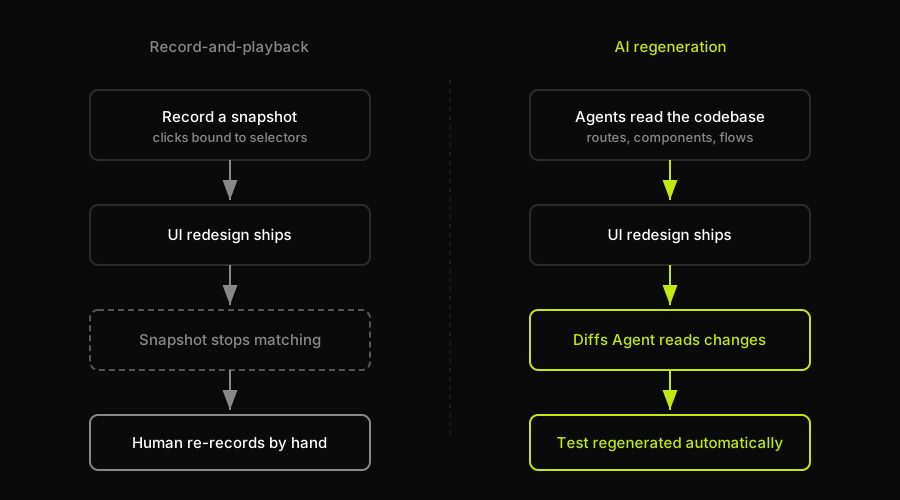
A recorded snapshot breaks silently and waits for a human. A regenerated test rebuilds itself from what the app does today.
Regeneration is a different bet entirely. Instead of replaying a frozen sequence of clicks, an approach built on regeneration asks what the app actually does today and builds the test from that. When the UI changes, there's no stale recording to notice and fix: the test gets rebuilt against the current behavior. Autonoma's agents work this way end to end. A Planner agent reads the codebase, routes, components, and user flows, and plans test cases directly from what the app does rather than from a human's remembered click path. An Executor agent runs those tests against a live preview environment. A Reviewer agent looks at the results and separates a real bug from an agent error or a stale test plan. A Diffs Agent runs on every pull request, reading the code changes and updating, adding, or deprecating test cases so the suite tracks the codebase instead of drifting away from it. Nobody has to notice the UI changed and start clicking through the recorder again.
This is a more general shift than a feature comparison suggests. Broader context on how UI test suites survive (or don't) past their first year lives in our guide to automated UI testing, and the underlying problem, testing an application that keeps changing shape underneath a fixed set of assumptions, is covered from the ground up in our web application testing overview.
None of this means regeneration is magic or that it removes verification from the picture entirely. Each of Autonoma's agents includes verification layers so results stay consistent run over run, and the Planner agent also handles harder setup work like generating the endpoints needed to put a database in the right state for a given test scenario, work that a recorded click path simply can't do on its own. The point isn't that regeneration is effortless. It's that the effort moves from "notice the recording broke and manually fix it" to "let the agents re-derive the test from what the app does today," which scales very differently as a suite grows from a dozen flows to a few hundred.
How to choose
If you like the no-code model, your UI is genuinely stable, and re-recording a handful of tests once in a while doesn't bother anyone, another record-and-playback SaaS is a reasonable lateral move. You're not solving the snapshot problem, just changing vendors.
If you have engineers on the team and want full, explicit control over test logic, branching, and edge cases, a code framework is the right call. Our Cypress alternatives and Playwright alternatives guides go deep on that comparison specifically for teams choosing between frameworks, not recorders. That path trades no-code convenience for precision and requires developer time to write and maintain tests directly.
If the real complaint is "we keep re-recording things because the UI keeps changing," neither of those paths actually fixes the root cause; they just relocate the maintenance work. That's the specific gap AI-agent-generated testing is built for. This is the Autonoma fit: not another recorder, and not a framework your team has to maintain by hand, but a codebase-first testing layer that plans, runs, reviews, and updates E2E tests as the app changes. It's worth trying if your team is small, your UI iterates quickly, or your current suite has quietly become something nobody wants to touch.
A useful gut check: pull up your last three months of test maintenance work, however you track it, and sort it into two piles. Work that added new coverage for a new feature goes in one pile. Work that only existed to fix a test that a UI change broke goes in the other. If the second pile is small, your current tool is fine and switching would be solving a problem you don't have. If the second pile is most of the work, that's the re-recording tax showing up in your own data. For that team, Autonoma is the more direct alternative to Ghost Inspector because it changes the maintenance model instead of asking someone to keep the same recording model alive.
FAQ
It depends on why you're leaving. For teams that want to stay no-code with a different vendor, another record-and-playback SaaS like Testim or mabl is the closest match. For teams with engineers who want full control, Playwright or Cypress are the leading code frameworks. For teams switching because recordings keep breaking on UI changes, AI-agent-generated testing (Autonoma) regenerates tests from the app's behavior instead of replaying a frozen recording.
No. Ghost Inspector is a record-and-playback tool: you click through a flow in the browser and it captures the steps as a test. It includes a low-code editor for adjusting assertions, selectors, and variables, but it isn't a programming framework. Teams that want full code-based control typically move to Playwright, Cypress, or Selenium instead.
A recording captures a snapshot of one specific run: exact selectors, exact DOM structure, exact click coordinates at the time it was recorded. It doesn't understand the intent behind the flow, only the literal path taken. When a redesign, component migration, or rebrand changes the DOM, the recording no longer matches what's on screen, and the test fails even though the underlying feature still works correctly.
There are two broad alternatives. Code frameworks like Playwright, Cypress, and Selenium replace recordings with test scripts written and maintained by engineers, trading no-code convenience for precise control. AI-agent-generated testing replaces recordings with tests planned and regenerated directly from the application's code and behavior, so a UI change triggers regeneration instead of requiring a human to re-record.
Yes. Autonoma connects to a codebase and uses a Planner agent to read routes, components, and user flows and plan test cases from that analysis rather than from a human clicking through the app. An Executor agent runs the tests against a live preview environment, a Reviewer agent classifies failures as real bugs, agent errors, or plan mismatches, and a Diffs Agent updates the suite on every pull request by analyzing what changed in the code. The suite is generated and maintained from the codebase instead of from recorded sessions.


