

AI code review catches what static analysis catches: structure, style, and obvious logic. It cannot catch a dropped auth wrapper or a broken login flow, because that code compiles and only fails at runtime, which is what end-to-end testing is for.
A PR came in: a refactor of the protected route layout. Clean diff, well-named variables, no obvious red flags. The AI reviewer approved it. A human engineer did a second pass and approved it too. The PR merged. Within an hour, a customer reported they could not log in. The auth wrapper had been quietly removed during the refactor. The code still compiled. Every review tool in the pipeline had passed it.
That scenario is not a failure of diligence. It is a failure of category. Code review is a static analysis tool. Authentication is a runtime property. Expecting review to catch auth regressions is like expecting a spell-checker to catch a factual error: it is not what the tool is built to do. We built Autonoma specifically to cover the runtime gap that review leaves open, and we have seen this class of bug often enough to write it up honestly.
What AI Code Review Is Good At
This is worth being honest about, because the answer is: quite a lot. Modern ai code review tools are genuinely useful for the category of problems that static analysis handles well.
They catch type errors that a compiler might miss in weakly-typed code. They flag dead imports and unused variables. They surface naming inconsistencies and style deviations that slow down future readers. They identify obvious logic bugs: a negated condition, a missing break in a switch, a comparison that will always evaluate to true. They enforce patterns that the team has agreed on, whether those are documented in a linting config or captured implicitly from the existing codebase.
For AI-generated code specifically, these tools catch the most common failure mode: code that looks right at a glance but contains a subtle structural mistake. An AI model generating a permissions check might transpose the operands. A review tool reads that in milliseconds.
The automated code review vs testing comparison is not a competition. Both layers serve the pipeline. The mistake is treating review as a superset that makes the testing layer optional.
What It Cannot See: Runtime Auth Behavior
Here is the structural limitation: code review reads the source. It does not run it.
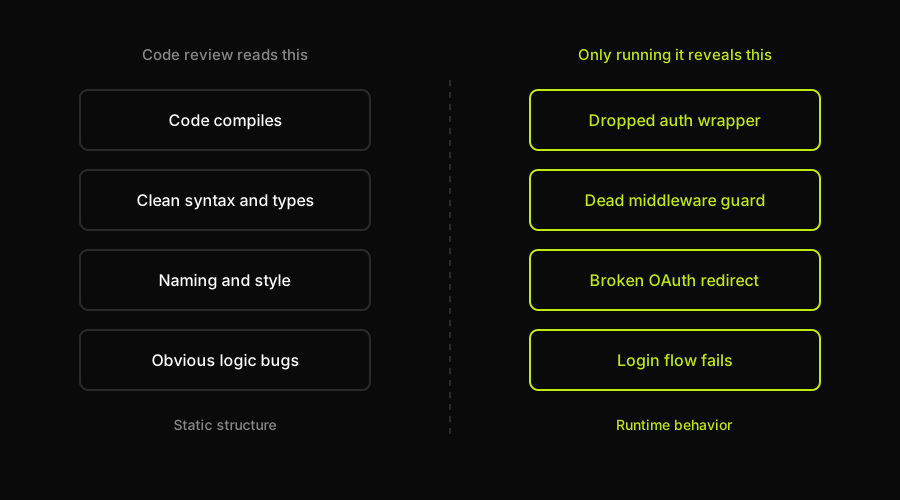
Code review reads static structure. Auth regressions only surface when the application actually runs.
Authentication is almost entirely a runtime property. A route is protected not because a file is named a certain way, but because a middleware function intercepts the request before the handler runs, checks a session or token, and either allows or redirects. That middleware dependency is invisible to a static reader unless the reviewer already knows exactly what to look for, in exactly the right file, at exactly the right moment.
An auth regression usually does not look like incorrect code. It looks like code that is missing something. A wrapper was removed. A guard was extracted into a helper and the helper was never called. A route was duplicated to add a new feature and the duplicate was not protected. These are omissions. Static analysis is not designed to detect absent behavior. It analyzes what is there, not what should be there.
The same limitation applies to OAuth flows. A callback handler can look perfectly correct in review: it extracts the authorization code, exchanges it for a token, sets a session cookie, and redirects the user. What review cannot see is whether the redirect URI registered in the provider matches what the code expects. That mismatch produces a broken auth flow at runtime. It is invisible until a browser actually follows the redirect.
The Auth Bugs That Pass Review
These are the three patterns we see most often. All three produce clean code that passes review.
| Bug pattern | Caught by code review | Caught by end-to-end testing |
|---|---|---|
| Dropped auth wrapper (refactor removes a load-bearing guard) | Rarely. The removal looks like cleanup. | Yes. The protected route loads without a session. |
| Dead middleware guard (guard extracted but never applied to new routes) | No. The guard still exists in the codebase. | Yes. An unauthenticated request reaches the handler. |
| Broken OAuth callback (redirect URI mismatch or state param dropped) | No. The code is syntactically correct. | Yes. The login flow fails at the provider redirect. |
The dropped wrapper is the most common. A developer refactors the layout component that wraps protected pages to add a new feature. The wrapper contains an auth check. During refactoring, the check is seen as a concern that "should probably live elsewhere." It gets removed with the intention of moving it, and that intention does not make it into the PR. The code is cleaner after the refactor. The PR description mentions the new feature, not the removed guard. Review approves it.
The dead middleware guard appears when route structures change. The middleware was correctly protecting a set of routes. A new section of the app is added with a different routing pattern. The middleware does not apply to the new pattern. No code is wrong. Coverage is simply absent for the new paths. A reviewer scanning the diff for the new feature would not be looking for middleware coverage. An end-to-end test that exercises the new section while unauthenticated would find it immediately.
The OAuth callback failure is the most silent. The code can be functionally identical to a working version, with the only difference being a misconfigured redirect URI in the provider's dashboard, or a state parameter that an AI-generated refactor quietly dropped from the exchange flow. It compiles. It lints. It ships.
Review Plus E2E: The Honest Combination
Code review is not the problem. Treating it as the only verification layer for auth is.
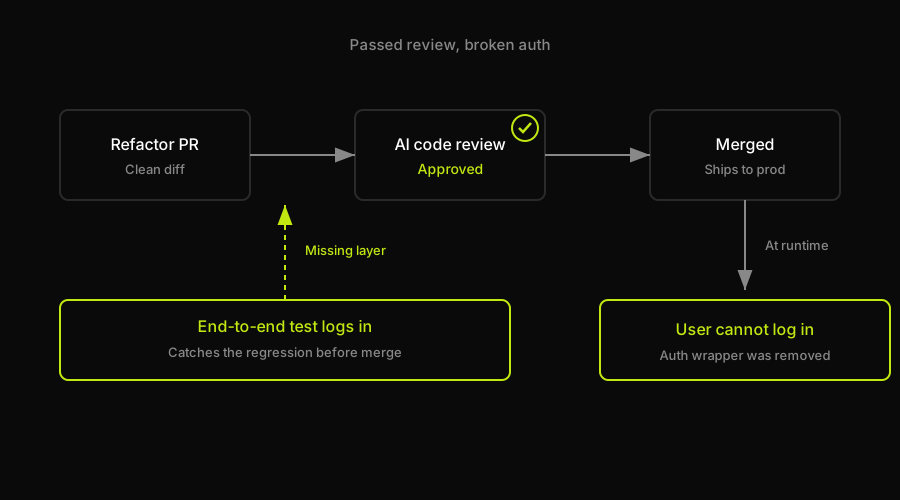
A green-checkmarked PR can still lock users out. End-to-end testing is the layer that logs in and catches it.
The combination that actually works is review for structure plus end-to-end testing for behavior. Review handles what it is built to handle: the things a careful reader can see in a diff. End-to-end testing handles what only execution can reveal: whether auth regression has been introduced, whether the login flow completes, whether protected routes stay protected after a refactor.
For auth specifically, an agent that actually logs in is the missing half. Not a test that mocks the session and asserts on the mock. A test that drives a real browser, submits credentials, follows the OAuth redirect, and confirms that the route loads for authenticated users and redirects for unauthenticated ones. That is the only verification that catches all three of the bug patterns above.
Autonoma is our answer to the runtime gap. When a PR touches a route, a layout, a middleware file, or an auth utility, the Diffs Agent identifies which test cases are affected. The Planner generates or updates the test scenarios, including the database state setup needed to put the app in a logged-in or logged-out condition. The Executor drives a real browser through the login flow against a live preview environment. The Reviewer classifies the result: real auth regression, agent error, or plan mismatch.
The point is not to replace code review. Review still catches the structural problems it is designed to catch, and those are worth catching. The point is that auth regression is a behavior problem, and behavior problems require behavioral testing. A team relying on review alone for auth coverage has a gap that only shows up in production, typically at the worst possible time.
The practical path is to treat auth as a first-class E2E testing target on every PR that touches auth-adjacent code. Define what "working auth" means in behavioral terms: the login flow completes, protected routes return the right status for authenticated and unauthenticated users, the logout flow destroys the session. Run those checks on every merge. Let review handle everything else it does well. The two layers are complementary, not competing, and Autonoma is built to run that behavioral half against the live PR instead of leaving it to production.
FAQ
Not reliably. AI code review reads static code. Auth bugs are runtime behaviors: a missing middleware guard only shows its absence when a request actually flows through it, a dropped auth wrapper only causes a failure when a user tries to load the protected page, a broken OAuth callback only fails when the redirect URL is resolved. None of those failures are visible to a tool that reads the source without executing it.
AI code review misses anything that only manifests at runtime: race conditions, session state bugs, middleware ordering failures, redirect chain problems, and authentication regressions caused by removing a guard rather than writing incorrect code. It also misses configuration drift in OAuth providers and environment-specific routing behavior.
No. AI-generated code compiles confidently and looks structurally correct, which makes it harder to spot missing guards visually. The volume of AI-generated PRs also increases the surface area that review has to cover. Code review catches the things static analysis catches. End-to-end testing is required to verify that the generated code behaves correctly when the application runs.
Code review reads the code. End-to-end testing runs the application. For auth, that difference is decisive: a reviewer can see that a middleware function exists, but only a test that actually submits a login form, handles the OAuth redirect, and checks that the protected route loads can confirm that authentication works end-to-end.
Because the breakage was a runtime behavior, not a code structure problem. The most common patterns are: a refactor removed an auth wrapper that looked redundant but was load-bearing; a middleware was restructured so a guard no longer runs on the intended routes; or an OAuth callback URL was changed in the codebase without updating the registered redirect URIs in the provider. Each of these produces clean, reviewable code. None of them fail until the application runs.


