

STLC vs SDLC comes down to two different life cycles running over the same project: the Software Development Life Cycle (SDLC) covers everything from requirement to retirement, and the Software Testing Life Cycle (STLC) is the life cycle of verifying it, nested inside the SDLC rather than sitting after it. The STLC used to run weeks behind the SDLC on most teams. On a team shipping daily, the two now run on close to the same cadence.
Somewhere in an interview, a study guide, or an internal wiki page nobody has touched since 2019, someone asks you to name the difference between STLC and SDLC, and "one is testing, one is everything" does not survive the follow-up question. This is that follow-up answer, not a QA lead writing a test strategy document and not a team trying to decide whether their AI-generated tests are real, just the two life cycles laid out on one timeline instead of two lists memorized separately.
If any of that vocabulary, SDLC, STLC, life cycle, is unfamiliar rather than just fuzzy, software testing basics covers the fundamentals first. What follows assumes you already have the terms and want the relationship between them made precise.
The comparison
Both life cycles answer a different question about the same release. Here is where they actually diverge:
| Dimension | STLC | SDLC |
|---|---|---|
| Scope | Confirms the build meets the spec | Everything from idea to retirement |
| Owner | QA and test engineering | Engineering, product, and QA together |
| Trigger | A build ready to test | A requirement or a release |
| Output | A pass/fail verdict plus a defect list | A shipped, working feature |
| Cadence | Used to be per release, now per commit | Sets the rhythm the STLC runs inside |
None of that table is controversial, and every ranking page for this query publishes some version of it. What none of them show is where these two clocks actually meet on a real project, and that is the part worth drawing.
One timeline, two clocks
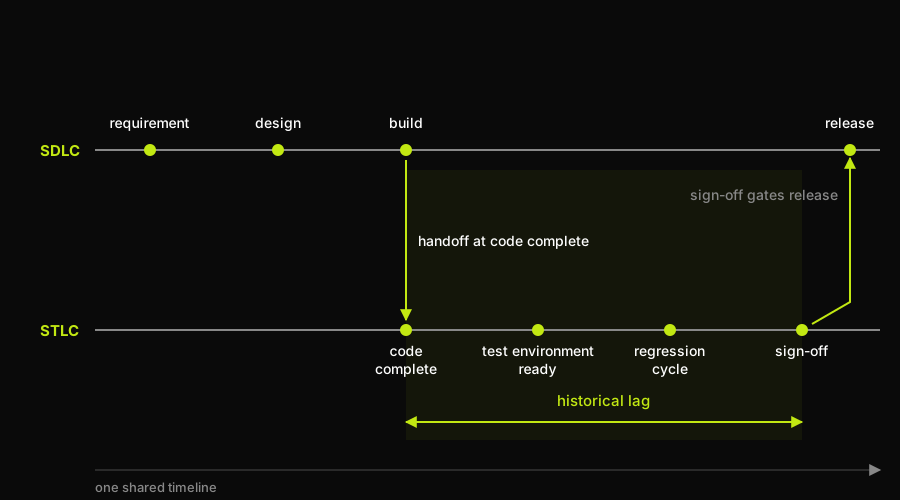
The table above hides the one fact that actually matters: the STLC is not a phase inside the SDLC, it is a second clock running alongside it. (The STLC itself breaks into six named phases, requirement analysis through closure; the software testing life cycle piece covers the phase-by-phase gates in detail.) For most of the history of the two life cycles, that second clock ran behind the first one by weeks.
Draw both clocks on one timeline instead of two lists and the lag becomes visible. The SDLC clock moves through requirement, design, and build. Code complete is the moment the SDLC clock hands off to the STLC clock: a build exists and now has to be verified. Historically, the STLC clock did not start ticking at that handoff, it queued behind it. First it waited for a test environment, which was itself a ticketed request with its own turnaround. Then it waited for a full regression cycle, run by hand or by a suite slow enough that it had to be scheduled rather than triggered. Then it waited for sign-off, which had to complete before the SDLC clock was allowed to move to release. Four handoffs, three of them mostly idle time, and the gap between code complete and sign-off is where the STLC visibly lagged the SDLC, sometimes by weeks on a release with any real regression scope.
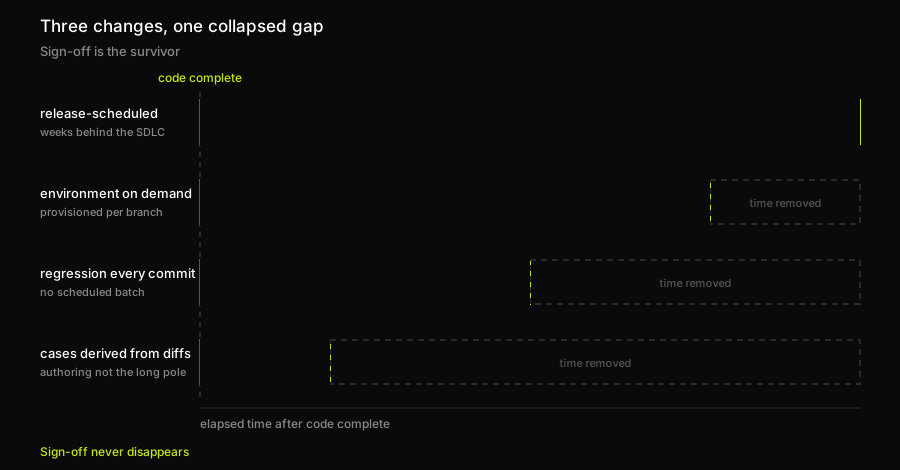
That lag did not close because of one improvement. Three separate changes had to happen, on different timelines, and it's worth being precise about which did what. A test environment stopped being a scheduled request and became something a pipeline provisions on demand, per branch or per pull request, which is most of what shift left testing is actually describing when it talks about moving verification earlier. The regression cycle stopped being a batch event scheduled near a release and became something that runs on every commit, because running the suite got cheap enough to trigger constantly instead of rationing it. And the slowest step in the old picture, which was usually authoring the tests in the first place, stopped being the long pole once a system could derive test cases from the code that changed instead of waiting for a person to write them by hand. Any one of those three changes alone would have shortened the gap. Together, they collapsed most of it.
How Autonoma removes the lag
The third change above, authoring no longer being the long pole, is the one closest to our own architecture. We built our agents to read the codebase directly, so test cases get derived from the routes, components, and flows that already exist in the repository rather than waiting on a person to write a test plan after the build is already sitting in a queue. The Diffs Agent is the part of that architecture that runs on every pull request: it updates the suite from the code diff itself, so the regression cycle does not wait for someone to notice what changed and go update tests by hand.
That is the specific place Autonoma closes the STLC-to-SDLC gap: not by testing faster in some general sense, but by moving test authoring and test maintenance off the human critical path and onto the same trigger the SDLC clock already runs on, a commit or a pull request. It's an architectural fact about where the lag lived, not a benchmark: the STLC's execution and regression steps run against a live preview environment on the same cadence the SDLC produces builds, instead of on a cadence someone had to schedule separately.
Where the two cycles touch
Four handoffs still exist between the two clocks. Only their timing changed.
Code complete is still the moment the SDLC hands a build to the STLC, but it now fires on every commit that lands on a branch, not once near a release. Test environment ready used to be its own handoff with its own wait; now it is bundled into the same trigger, so the environment exists by the time there is a build to put in it. The regression cycle used to be the STLC's longest phase and the reason it lagged; running the same suite on every commit turns it from a scheduled event into a side effect of the commit itself. Sign-off is the one handoff that hasn't disappeared, and shouldn't: a person or a policy still decides whether a passing suite is enough to merge or deploy, because that decision carries consequences a test result alone doesn't capture. Reading that result and deciding whether it clears the bar is still a distinct job from producing it, which is the reason a fast pipeline doesn't automatically mean a well-governed one. Which checks get to make that call automatically, and which still need a person in the loop, is exactly the gating-policy question the QAOps piece works through.
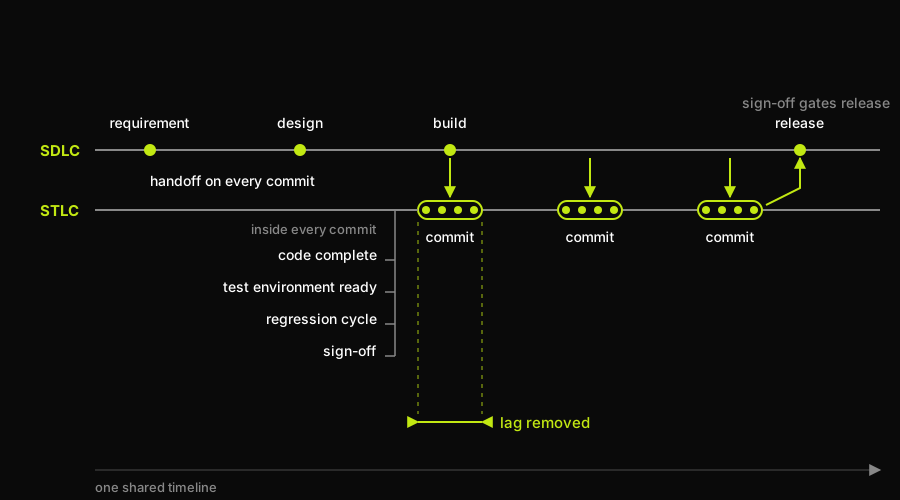
This is also why "STLC vs SDLC" keeps surfacing as an interview and vocabulary question even after the lag between them closes. The two clocks answer different questions on a permanent basis, not as an artifact of how slowly either one used to run. A system that ships in minutes still needs a separate answer to "is this build correct" from "did we build the right thing," and closing the gap between the two clocks does not collapse the distinction between the questions they're asking.
None of this makes the STLC disappear into the SDLC, and it shouldn't: verifying a build is still a different question from building it, even when both happen inside the same pull request. What changed is the distance between asking that question and getting an answer back. A team that wants to see this instead of read about it can watch Autonoma run the STLC's execution and regression steps against a live preview environment on the same commit that triggers the SDLC's build, with no separate schedule required.
Frequently Asked Questions
SDLC is the complete life cycle of building software, covering everything from gathering requirements through design, development, deployment, and maintenance. STLC is the life cycle of verifying that software, and it runs inside the SDLC rather than after it: every SDLC phase that produces something testable has a corresponding STLC activity checking it. SDLC answers whether the software got built; STLC answers whether it works.
Yes. STLC is not a separate life cycle that starts once the SDLC finishes, it is nested inside the SDLC and runs alongside its phases. Historically it also ran behind the SDLC by a lag of days or weeks, waiting for a build to be complete before a test environment, a regression cycle, and a sign-off could happen in sequence. On a team shipping continuously that lag has mostly collapsed, but STLC remains a sub-cycle of the SDLC rather than an independent process.
SDLC comes first in the sense that a requirement or a build has to exist before it can be tested. In practice the two run in parallel on most modern teams: test planning starts as soon as requirements are known, well before the corresponding code is written, and test execution against a specific build happens continuously as that build changes rather than as a single step after development is declared finished.
SDLC phases are typically requirement gathering, design, development, testing, deployment, and maintenance. STLC phases are requirement analysis, test planning, test case development, environment setup, test execution, and test closure. The two lists don't line up one to one: STLC's planning and case-development phases usually start alongside SDLC's design phase, well before SDLC's own testing phase begins.
Yes, though the phases stop being strictly sequential. On an Agile or continuous-delivery team, STLC's test case development, environment setup, and execution phases run as per-pull-request activities rather than scheduled steps, often several times a day. Requirement analysis and test closure are the two STLC phases that still tend to happen on a slower, more deliberate cadence, because they involve judgment about scope and risk rather than a checkable, automatable gate.
By putting test authoring, maintenance, and execution on the same trigger the SDLC clock already runs on. Autonoma's agents derive test cases from the codebase rather than waiting for someone to write them after a build is already sitting in a queue, its Diffs Agent updates the suite from each pull request's diff, and the cases run against a live preview environment on the same commit that produces the build. The STLC's execution and regression steps therefore land on the SDLC's cadence instead of weeks behind it, which is the gap the two timelines in this article are drawn to show. Verification is still its own question, and still worth asking deliberately. The waiting between the two clocks is the part that goes away.


