

QAOps is the discipline of building quality checks directly into the CI/CD pipeline, so the pipeline itself decides whether a change can merge, deploy, or ship, instead of a person gating it by hand afterward. TestOps is a narrower, adjacent term for operating the test suite itself (environments, data, execution infrastructure), and it's also a specific product name in this market, which is part of why the two get blurred. QAOps is the umbrella; a documented gating policy is what makes it real instead of a slide.
QAOps gets defined in one sentence and left there: quality built into the pipeline. That sentence is correct, and it does nothing for the engineer who has to write the policy, decide which checks stop a merge, and explain the difference to an auditor who wants specifics, not a slide. Somebody asked you to name the term, maybe an interviewer testing your vocabulary, an onboarding doc a junior reads before their first on-call shift, or a teammate who said "QAOps" in standup and you nodded along. That's a fair reason to want a definition, and this one doesn't stop there.
If what's keeping you up is how much of your suite should live at the unit layer versus end-to-end, that's the QA lead's allocation call, already owned by test entry and exit criteria, risk-based testing, and a test plan template. If it's whether your AI-generated tests are testing anything real, that's the narrower question in AI test theater. What follows is neither: the term itself, separated from its marketing, plus the one artifact almost nobody who uses the word actually publishes.
QAOps and TestOps: what is a real distinction and what is marketing
QAOps is quality built into the pipeline instead of bolted onto the end of it. The name follows the DevOps pattern: DevOps collapsed the wall between building and running software; QAOps collapses the wall between writing it and deciding it's good enough to ship. A quality gate is any evaluation point where a check's result decides what happens next; whether it blocks or only reports is a property of the gate, not a difference in kind.
TestOps is real and genuinely different. Where QAOps is a decision discipline (what blocks, who overrides it), TestOps is an operations discipline: keeping the environments, data, and execution infrastructure your tests run on healthy enough to trust. A gating policy is worthless if that environment is flaky, the real overlap, not a shared definition.
Here's where it gets muddy: TestOps is also a specific product name in this market. Katalon has shipped a TestOps product, since folded into its broader platform, and vendor content uses both words as a synonym for "our platform, generally." The honest read: QAOps names a decision structure, TestOps names the operational layer underneath it, and much of what blurs them is shorthand. Neither replaces continuous testing, the broader practice both sit inside.
| Term | What it decides | What it owns |
|---|---|---|
| DevOps | How building and running software merge | Infra, deployment, release practices |
| QAOps | Which checks can block a merge or deploy | The gating policy itself |
| TestOps | Nothing; it operates, not decides | Environments, test data, execution infra |
| Continuous testing | How much testing runs, and when | The broader testing practice overall |
The QAOps gating policy: what blocks a merge, a deploy, or nothing
Most definitions of QAOps stop at "quality gates in the pipeline": no metrics, no policy, no example of which checks block anything. Fair enough for a platform running checks generically, not fair enough for the one who has to write the policy.
Here's the policy: every check runs, classified into one of three gates, with a reason attached, not just the label. The rule fits in one sentence: block on checks that are fast, deterministic, and wrong when they fail; report on checks that are slow, flaky, or merely suspicious when they fail. Get it wrong either way and the cost lands in the DORA metrics: an unnecessary blocking gate inflates lead time, a missing one inflates change failure rate.
Six checks earn a hard stop before merge, because a red result there is never ambiguous. The enforcement mechanism is GitHub's required status checks on protected branches, or the equivalent on your platform:
| Check | Why it blocks merge |
|---|---|
| Static checks (lint, format, type check) | Fails fast, deterministic, wrong if red |
| Unit tests | Deterministic, isolates the exact break |
| Build | Unmergeable code isn't a judgment call |
| Secret scanning | A leaked credential is never marginal |
| Contract tests | Deterministic schema break, cheap to run |
| Dependency and CVE audit | Known-bad version, no ambiguity |
Two checks earn a hard stop before deploy specifically, not before merge, because they need a real build, and in one case a real environment, to mean anything:
| Check | Why it blocks deploy |
|---|---|
| Build verification suite (E2E smoke) | Confirms this build is worth testing further |
| Performance / Lighthouse budget | A regression here shouldn't reach users |
The rest still run on every pull request. They just don't get to stop one, because a red result there means "look at this," not "this is broken":
| Check | Why it's report only |
|---|---|
| Unit coverage delta | A drop is a signal, not proof |
| Full regression E2E | Comprehensive, too slow to gate every merge |
| Visual regression | Pixel diffs need a human, not a gate |
| Accessibility scan | Flags candidates; false positives are common |
| Load test | Too slow and costly to run per commit |
| Bundle size | Worth tracking, rarely worth blocking alone |
Worth being explicit: these are CI gates, not the six-phase gates of the software testing life cycle. An STLC gate asks whether planning is complete enough to move into execution, once. A CI gate asks whether this commit is safe to merge or deploy, every time. Conflating the two is what makes an audit conversation go sideways.
Here's that same policy as the file that gets checked into the repository, the source every row above traces back to, with an owner and a time budget attached to each check:
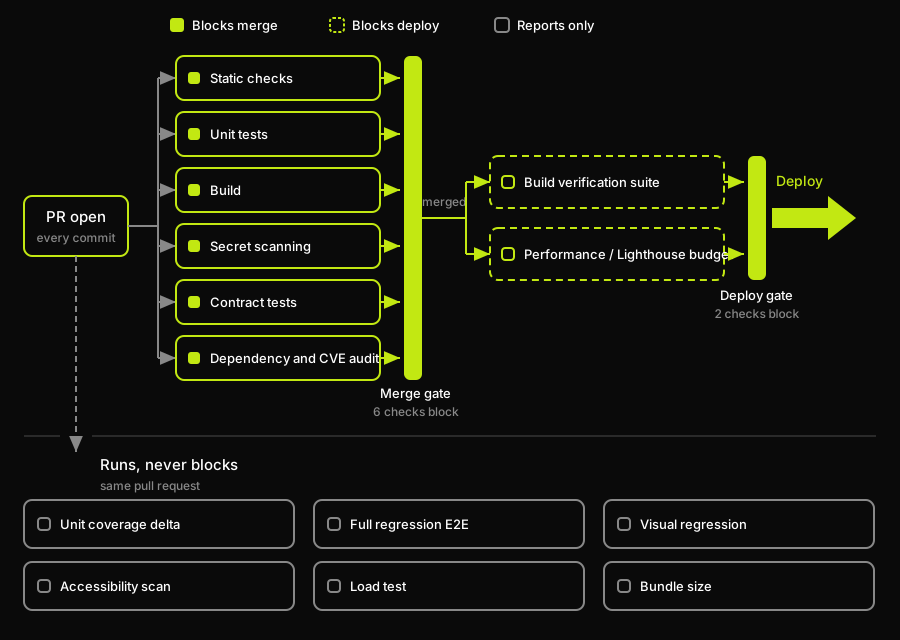
New to quality gates in CI/CD? The CI/CD testing overview and the quality gate case for vibe-coded apps are the right starting points. On Vercel, the deploy-gate mechanics differ; see Vercel deployment checks.
Build verification testing: the suite that gates the deploy
Build verification testing earns its own QAOps gate because it answers a narrower question than "did we break anything": is this build worth testing further? It runs before the expensive suites, so a broken build fails in under five minutes instead of burning twenty on a full regression run.
Four flows belong in it: if any fails, nothing downstream can be trusted. The application boots and serves its home route. Authentication succeeds for a real user. Primary navigation resolves without a client error. And one core write path commits and reads back: create the object your product exists to create, then confirm it's there.
Edge cases don't belong here, nor do permutations, unguaranteed data state, or anything a unit test already owns more cheaply. The moment a build verification test starts asserting on a validation message or a rare input combination, it's stopped being a smoke test and become a regression test wearing a fast badge, the same drift an end-to-end suite falls into when nobody's watching for the anti-patterns that creep in over time.
The budget is the point of the suite, so make it explicit, not aspirational. Four flows, each driving a real preview through a couple of UI interactions and one assertion, average forty-five seconds including cold start, three minutes total. One shared setup step, roughly ninety seconds, lands the suite at four and a half minutes end to end: a pipeline can enforce that number, not an adjective like "fast."
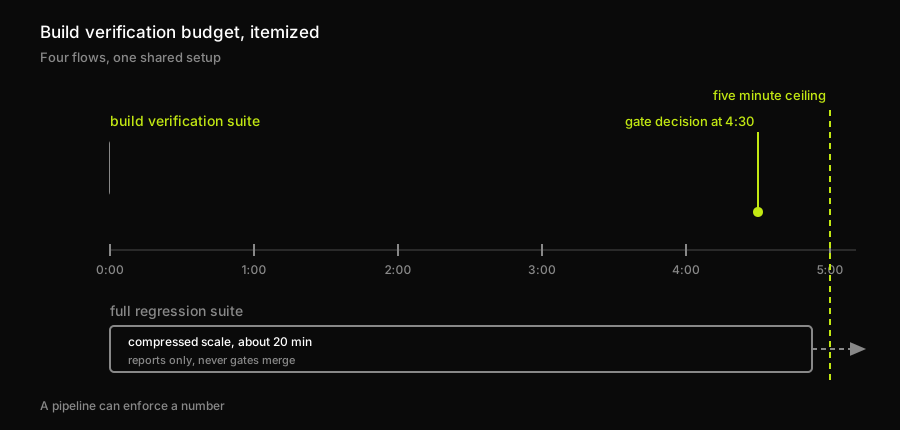
Here's the workflow that wires this together: a fast blocking job on every pull request, the build verification suite gated behind it with a needs: dependency (see GitHub Actions workflow syntax), the slower suites reporting without blocking, and a deploy job scoped to the right environment.
If you're building this suite in Playwright specifically, Playwright with GitHub Actions covers the runner-level setup this workflow assumes.
How Autonoma fits a gating policy
The pain a gating policy exposes is specific: most teams don't have an under-classification problem, they have a suite they don't trust enough to classify honestly. Hesitating to put an end-to-end suite on a blocking gate isn't being cautious, it's telling you the suite has a track record of failing for reasons unrelated to whether the product actually broke: a selector that moved, a recorded path that assumed yesterday's layout, a fixture two tests quietly fight over.
We built Autonoma around a checkable claim: an end-to-end suite only earns a blocking gate if it fails for the right reasons. Our agents read the codebase directly instead of working from a recording, so a test describes what the flow should do, not steps someone happened to take. Our Diffs Agent re-examines each pull request's diff and updates, adds, or retires test cases so the suite tracks what changed. A review step classifies each failure as a real bug, an agent error, or a mismatch between the test and what it was supposed to check, before it ever reaches your pipeline. That's the gap between having an end-to-end suite and trusting it enough to block a merge, and it's why most generated suites, ours included, start on a reports-only track before they've earned a blocking one.
Mapped onto the policy above: Autonoma isn't a static analyzer, a secret scanner, a unit test runner, a load-testing tool, or an accessibility scanner, and isn't trying to be. Your lint, type check, unit, secret scan, dependency audit, and load test rows stay exactly where the tables above put them, owned by the tool category built for that job. Where Autonoma changes the policy's shape is the build verification suite and the reports-only regression layer beneath it: both stay honest more easily once the suite maintaining them updates against the actual code, instead of waiting for someone to notice it's gone stale.
The escape hatch: overriding a quality gate on purpose
Every QAOps gating policy needs a documented override, and almost nobody writes one down. A gate with no escape hatch becomes a suggestion: the first time a real deploy is blocked by a check everyone privately doubts, someone finds a way around it anyway. Better to design that path deliberately than discover it improvised at six on a Friday.
Who can override matters more than most policies admit, and so does what gets recorded when they do:
| Override authority | Tradeoff |
|---|---|
| Anyone who is blocked | Defeats the point of the gate |
| Only the CTO | Doesn't scale, invites workarounds |
| Named rotating role | Accountable, no personal stake |
The workable middle is the third row: a release captain or on-call lead, already accountable for what ships today, with context but no personal stake in this particular call.
| Override record field | What it captures |
|---|---|
| Check | Which gate is being overridden |
| Reason | Why the failure is believed wrong or acceptable |
| Follow-up issue | Tracks the real fix |
| Expiry date | When the override stops being valid |
Skip any one of those four fields and the override stops being a record, and becomes a bypass with a timestamp.
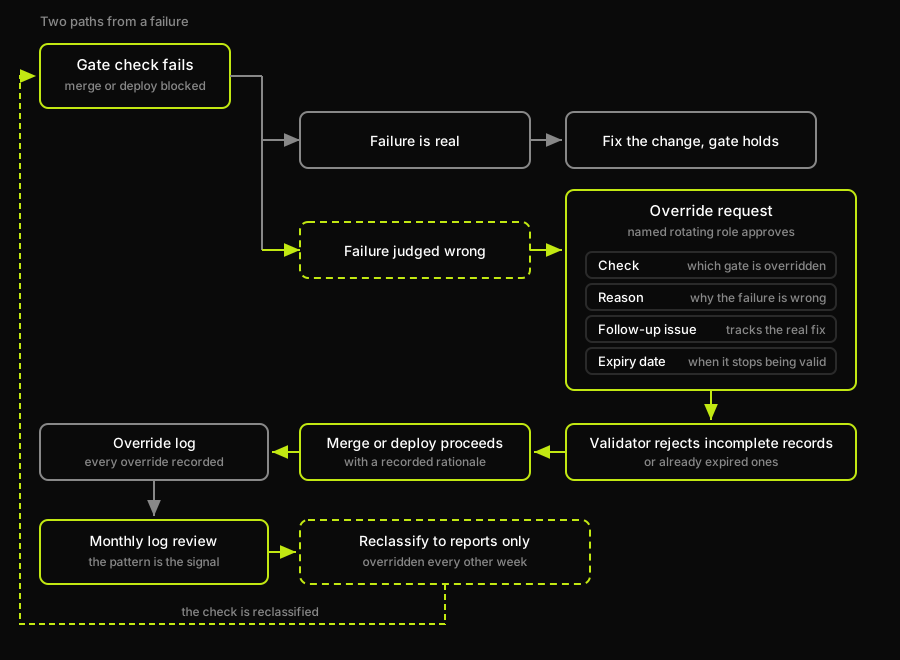
Here's what a single override record actually looks like once someone writes it down instead of approving it in a Slack thread:
And here's the small script that refuses to accept one missing any of those fields, or one that's already expired:
How it's reviewed turns overrides from a liability into a signal. One override tells you almost nothing, someone likely had a legitimate one-off reason. A recurring monthly review of the log tells you a great deal: the interesting finding is never the individual call, it's the pattern. A check overridden every other week is misclassified, not a team lacking discipline; move it to reports-only, or fix whatever makes it fail for reasons unrelated to the product, and the log should shrink over time, not grow. A closure report for a whole test cycle is a related, separate artifact, covered in test closure report; an override record is its narrower cousin for a single check.
None of this required inventing new vocabulary, just writing down what each piece of it actually means:
| Term | What it means here |
|---|---|
| QAOps | Quality moved into the pipeline |
| Gating policy | What makes QAOps concrete |
| Build verification suite | Fast check protecting the slower ones |
| Escape hatch | A documented override, not a bypass |
That's the full shape of the term, past the slide.
If the honest blocker to building this policy is that your end-to-end layer isn't reliable enough for the blocks-merge table, that's a narrower, more solvable problem than a process one. Autonoma exists for exactly that gap: a suite generated from your codebase, kept aligned to it on every pull request, reviewed before a failure ever reaches your pipeline, is the kind that can move from reports-only to blocking without anyone crossing their fingers.
Frequently Asked Questions
QAOps is the practice of building quality checks directly into the CI/CD pipeline so the pipeline itself decides whether a change can merge, deploy, or ship, instead of a human QA gate reviewing it afterward. In practice it means a documented policy that classifies every check as blocking or informational, plus the automation that enforces that policy on every pull request.
DevOps is the broader discipline of removing friction between building and operating software, covering infrastructure, deployment, and release practices. QAOps is the quality-specific slice of that: which checks run, which ones can block a merge or deploy, and how the suite itself stays fast and trustworthy enough to sit on a gate. Every QAOps decision lives inside a DevOps pipeline, but not every DevOps decision is a QAOps one.
TestOps is the operational side of running a test suite: provisioning environments, managing test data, scheduling execution, and keeping the infrastructure the tests run on healthy. It overlaps with QAOps because a flaky environment produces flaky gate decisions, but TestOps is about running the tests reliably, while QAOps is about what happens with the result. TestOps is also the name of an actual product in the testing market, which is part of why the two terms get used interchangeably in vendor content.
Build verification testing is a small, fast suite that checks whether a build is stable enough to test further: the app boots, authentication works, primary navigation resolves, and one core write path can commit and read back data. It is not a substitute for full regression coverage. It exists to fail fast and cheaply on a broken build, before spending time on the slower suites that assume the build is basically sound.
Only two checks should block a deployment specifically: the build verification suite and the performance or Lighthouse budget. Both need a real build to evaluate, and the build verification suite needs a real environment to run against, which is why neither can run at merge time the way faster checks can. Everything that can be evaluated on the diff alone runs earlier and blocks the merge instead: lint and type checks, unit tests, the build itself, secret scanning, contract tests, and a dependency and CVE audit. Slower or noisier checks, like full regression suites, visual regression, accessibility scans, and load tests, only report. They surface results without stopping anything, because their failure means the change is merely suspicious, not necessarily broken.
By failing only for reasons that mean the product genuinely broke, which is the specific problem Autonoma is built around. Its agents read the codebase instead of replaying a recording, so a test describes what a flow should do rather than the steps someone happened to take. Its Diffs Agent revisits each pull request's diff and adds, updates, or retires cases so the suite tracks what changed. And a review step classifies every failure as a real bug, an agent error, or a mismatch between the test and its plan before the result reaches your pipeline. That last step is what makes an Autonoma-maintained suite a realistic candidate for the blocks-merge or blocks-deploy column rather than a permanent resident of the reports-only track, and running it on reports-only for a release or two is the cheapest way to confirm it has earned the promotion.


