

Test automation anti-patterns are the specific, recognizable ways a suite decays while every build still reports green. Six recur constantly: the ice cream cone, the recorded click path, one-test-per-requirement, the sampled input set, the shared-state suite, and the assertionless test. The root cause behind all six is the same: each was a sound rule for a person running a handful of test cases by hand, kept in place long after running tests stopped being the scarce resource.
Somebody handed you a suite you didn't build and asked what's wrong with it: an engineer who left it behind, an interview prep list that name-drops "test automation anti-patterns," or an auditor who won't accept "we've always done it this way" as an answer.
This is a naming exercise, not a planning one. How much of your suite should be unit versus end-to-end is a resourcing call for whoever owns your test strategy. If the question keeping you up is whether your AI-generated tests are testing anything at all, that's a narrower failure covered in AI test theater. What follows is six checkable anti-patterns you can find in your own repository today, plus the one habit of mind behind all six.
The ice cream cone anti-pattern
The ice cream cone is an inverted test pyramid: most of the coverage sitting in slow end-to-end suites that click through the UI for logic a unit test would have caught in milliseconds. A healthy pyramid, the shape Martin Fowler's bliki post on the test pyramid made canonical, has it the other way: a wide unit base, integration in the middle, a thin end-to-end layer on top.
The tell is arithmetic: count test files per layer, then pull the CI minutes each layer consumes. A thin unit layer next to an end-to-end layer eating most of the minutes is a cone, not a pyramid, and it worsens every sprint as end-to-end becomes the default for unclear cases.
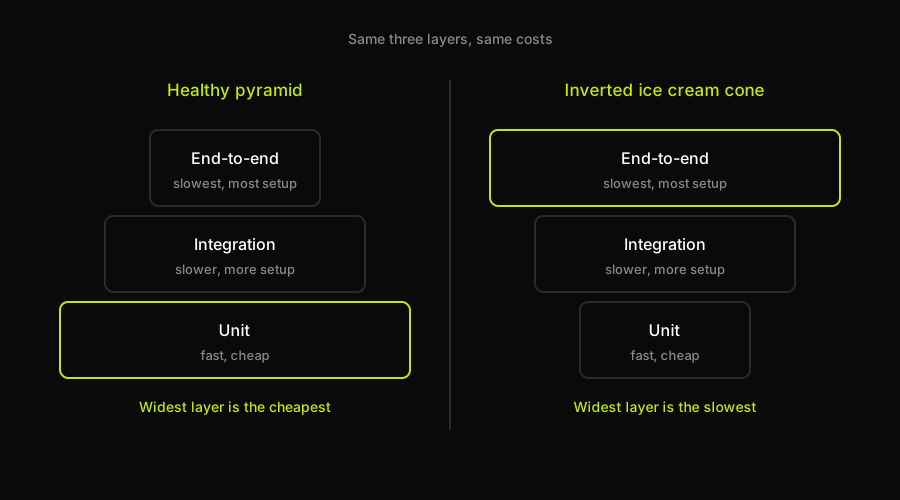
The distinction is deliberate versus accidental. A team that chooses to lead with end-to-end coverage of its critical paths, because maintenance is no longer the cost it used to be, has made an allocation call it can defend. A cone is what you get when nobody made that call.
The cost compounds quietly: CI slows and flaky failures get harder to isolate. The fix isn't deleting end-to-end tests, it's relocating the assertions that don't need them: pure functions and state transitions belong at the unit or integration layer, where they fail in milliseconds instead. Reserve end-to-end for what only a real browser can tell you: that the pieces are wired together and the journey completes.
The recorded click path
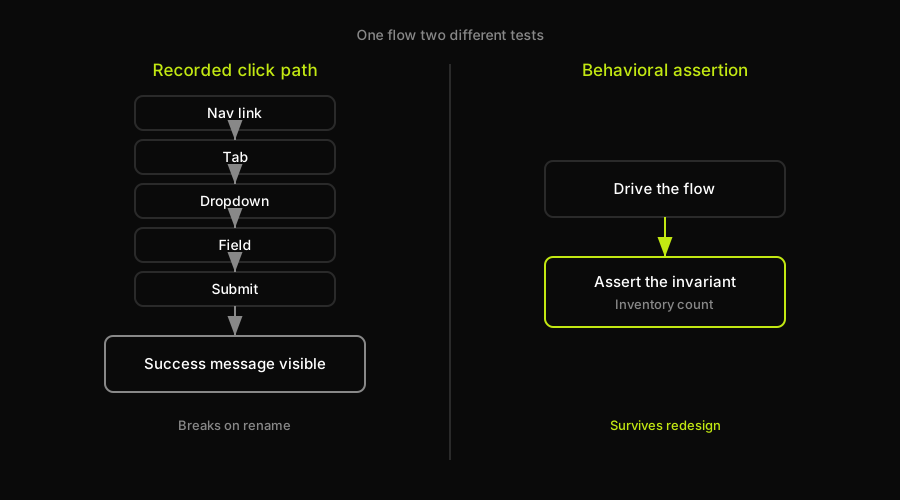
A recorded click path is a test that encodes how a person happened to navigate the app instead of what has to remain true about it: click the nav link, then a tab, then a dropdown, then assert on the toast message.
Search your suite for tests whose body is a long chain of navigation steps with the only assertion on the final line: twelve steps and one generic expectation ("success message is visible").
The cost shows up the moment your UI changes for a reason unrelated to what the test verifies: rename a tab in a redesign and the test breaks, not because the behavior changed, but because the incidental path to it did. The fix is to state the invariant the test cares about: assert on inventory, not on a confirmation banner, and derive the steps from what the flow requires today.
One test per requirement
One-test-per-requirement is what happens when a traceability matrix decides test count instead of reporting it: every requirement gets exactly one test, regardless of which requirements are risky, trivial, or interacting.
Check your own numbers. Test count tracking requirement count closely means you're testing for traceability, not risk. A risk-driven suite has requirements with five tests and others with zero, because some are load-bearing and some are cosmetic.
The cost is coverage that looks complete on a spreadsheet and full of holes in practice: requirements that interact rarely get a test of their own, since no single requirement names the interaction. The fix separates two questions traceability collapses into one: which tests exist, and which requirements are covered. A requirements traceability matrix answers the second by querying your actual suite, not by deciding the first.
The sampled input set
The sampled input set is a team still running the same two or three values years after the whole range stopped costing anything. Boundary value analysis earned its place because a human could only run a handful of cases by hand, so you picked the values most likely to expose an off-by-one error and called it coverage.
Look at your parameterized tests. A @ParameterizedTest, or its equivalent, with a hand-picked handful of literals and no generator or range is a sampled input set nobody has revisited since it was written.
The cost is the gap between the four values you run and the thousands you could run for the same price: regressions between your sampled points slip through. The fix is cheap: convert the hand-picked set into a real range or a generator, now that execution no longer justifies sampling. We cover where a small sample still earns its keep in boundary value analysis.
The shared-state suite
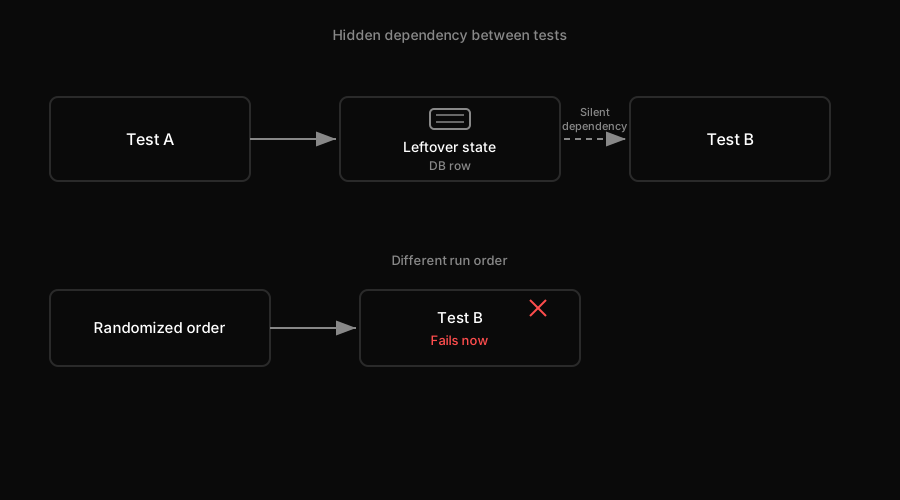
A shared-state suite passes every time you run it start to finish and fails the moment you don't. Test B silently depends on a database row, a global variable, or a cache entry test A left behind, a dependency nobody wrote down.
The tell takes thirty seconds: run your suite in randomized order, or run a suspect file in isolation, and compare against your normal run. A test that fails on a different order, or a file that fails only inside the full suite, means shared state your default run order has been hiding.
The cost is a suite nobody trusts when they need to: a red build gets re-run as "probably just flakiness," and the one time it's real, it ships. Google's testing team has documented this exact failure mode at their own scale. We go deeper in flaky tests; the short version is isolation, each test with its own fixtures.
The green-but-assertionless test
An assertionless test runs, exercises real code, and reports green, without ever checking the output was correct. It's the most dangerous test in your suite, the one that can't fail because it never asked the question.
Grep for it directly: zero assertion calls, or assertions incapable of failing, like expect(true).toBe(true) (the deep dive on this exact pattern lives in useless unit tests), a truthy check on an always-truthy value, or a snapshot against an empty object. Each executes, passes, and tells you nothing.
The cost is a pass rate that means less than it claims: "98% passing" with assertionless tests baked in is a number, not a fact about the software, worse still with generated tests, the specific failure in AI-generated tests that pass but don't assert. The fix is an assertion audit: confirm every test has one assertion that could plausibly fail.
Six anti-patterns, one shape to the fix.
The six test automation anti-patterns, compared
Every anti-pattern above resolves to the same three columns: name, diagnostic tell, and fix.
| Test automation anti-pattern | Diagnostic tell | Fix |
|---|---|---|
| Ice cream cone | Files vs. CI minutes per layer, inverted | Move logic assertions to unit/integration |
| Recorded click path | Long step chain, one assertion at the end | Assert the invariant, not the path |
| One-test-per-requirement | Test count tracks requirement count | Size tests by risk, not by matrix row |
| Sampled input set | Hand-picked literals, no generator | Run the full range or a generator |
| Shared-state suite | Fails on random order or isolation | Isolate fixtures per test |
| Assertionless test | Zero or unfalsifiable assertions | Audit for a real, failable check |
How Autonoma avoids the maintenance anti-patterns
Two of the six get worse specifically because someone wrote the test by watching a human do something once, and nobody revisited it. The recorded click path breaks when the path changes for reasons unrelated to the behavior it claims to verify. The shared-state suite breaks when execution order shifts, because nothing about the test declares what state it actually needs.
We built Autonoma to generate tests from the codebase itself rather than from a recording of someone clicking through the app. Our platform reads the routes, components, and flows in your repository and derives what has to remain true, then runs that against a live preview environment (a deployed environment is always required). That changes the recorded-click-path failure at the root: there's no recording to go stale, because the test is a statement about the flow, not a transcript of one session. It changes the shared-state failure differently: our agents also generate the database state each test needs before it runs, so dependencies are explicit instead of whatever the previous test in the run order left behind.
This doesn't touch the other four, and it shouldn't. Autonoma doesn't decide your unit-versus-end-to-end ratio, how many tests a requirement deserves, your parameter ranges, or whether an assertion is meaningful. Those are choices your team makes; Autonoma changes how the end-to-end layer gets authored and kept current, alongside your unit tests, not in place of them.
The one mistake underneath all six
Every one of the six is a heuristic that was correct once. Sampling boundary values was correct when a person could only afford to run four by hand. Recording a click path was correct when the fastest way to describe a flow was to watch someone perform it. One test per requirement was correct when the requirements document was the only trusted artifact, because running the whole suite more than once a day wasn't realistic.
None of those constraints hold anymore, and the two premises collapse into one sentence that applies to every anti-pattern here: each was a way to pick a small number of cases when running them was expensive, running them is no longer expensive, and what survived the transition is the part that says what the answer should be, not the part that picked which four cases to check.
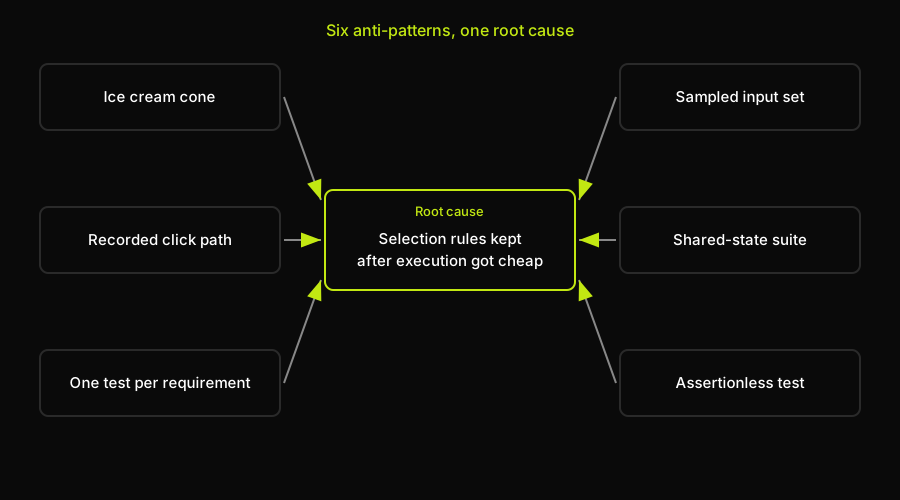
That's why these six look like discipline instead of debt: a real methodology applied responsibly, accruing debt quietly until the suite runs in a different order or a 98% pass rate misses a live bug.
For the techniques re-derived, start with test design techniques, then boundary value analysis. For traceability as a query instead of a spreadsheet, that's a requirements traceability matrix. And for capturing intent once instead of six different ways, that's BDD testing.
Limitations of automation testing: two anti-patterns no tool can fix
Of the six, two are the real limitations of automation testing: process problems, not tooling gaps, that no automation touches. This is also the pair worth having cold: if you're justifying the suite to an auditor, walking a junior through it, or naming it in an interview, these are the two anti-patterns where the honest answer is "that's a people decision, not a tooling gap."
One-test-per-requirement is a governance problem. Somewhere, someone decided test count should mirror requirement count, usually as a proxy for "coverage" that's easy to report to someone who doesn't read code. Fixing it means changing what your organization accepts as evidence of coverage, from a row count to an actual risk assessment, not a gap in execution.
The ice cream cone is an allocation problem, specifically a skills one: nobody sat down and chose the ratio a cone represents. The suite is shaped that way because the people writing tests were confident with end-to-end browser tests and less confident against the implementation, or weren't given access to the code a unit test would touch. That's an org chart and a training budget, not a tool.
Naming these two honestly matters. A pitch implying a platform fixes governance or staffing is what makes this genre untrustworthy, and it's the gap the cost of test maintenance walks through: tooling changes the cost curve, not who decided what to test.
None of this requires guessing: every tell above runs against your own suite before lunch. Six anti-patterns, six checks, no philosophy required.
If what you find is an end-to-end layer that has become the anti-pattern, and rewriting it by hand is why nobody's touched it in a year, that's the gap Autonoma exists to close: it regenerates that layer from your codebase instead of asking a person to re-record it, and keeps it aligned as the code moves under it.
Frequently Asked Questions
Test automation anti-patterns are recurring, checkable ways a test suite decays while still reporting green, most often carried over from testing rules that made sense when a person ran a small number of cases by hand: the ice cream cone, the recorded click path, one-test-per-requirement, the sampled input set, the shared-state suite, and the assertionless test.
Test automation fails when a test encodes a stale click path instead of an invariant, depends on shared state left behind by another test, samples four inputs when it could run the whole range, or passes without asserting anything meaningful. Each of these traces back to a manual-testing-era shortcut applied to a suite that no longer has the constraint that justified it.
Automating a test rarely makes sense when the case is exploratory by nature, such as a human judging whether something looks or feels right, when the underlying feature changes faster than a stable test could be written for it, or when the cost of writing and maintaining the automation exceeds the cost of the bug it would catch. Automating everything indiscriminately is itself part of how a suite ends up with anti-patterns like one-test-per-requirement.
The ice cream cone is an inverted test pyramid. Instead of a broad base of fast unit tests with a thin layer of end-to-end tests on top, the suite has a thin base of unit tests and a large, slow layer of end-to-end tests carrying most of the coverage. You can check for it by counting test files per layer and comparing that against the CI minutes each layer consumes.
Run it in randomized order and see if previously passing tests start failing, grep for assertions that can never fail, and compare your test count against your requirement count. If your suite only passes in one specific order, contains tests with no failable assertion, or grows in lockstep with a requirements document regardless of risk, you're looking at technical debt wearing the shape of coverage.
Autonoma directly fixes the two anti-patterns caused by tests going stale: it generates end-to-end tests from your codebase instead of a recorded click path, and keeps them current as the code changes, closing the recorded-click-path and shared-state failures at the root. The other four, your unit-versus-end-to-end ratio, sizing tests by risk instead of requirement count, parameter ranges, and whether an assertion is meaningful, stay decisions your team makes on purpose. Autonoma is built to keep the end-to-end layer it owns cheap enough to trust, so those four are the only decisions left to make deliberately instead of by neglect.


