

ChatGPT vs Claude coding in 2026 has moved more than most of the pages ranking for it admit: pricing tiers, token-efficiency claims, and benchmark scores have all shifted since January, on different dates, from different sources. This is the dated version. There is no durable single winner between the two, and most developers who use both keep switching between them by task rather than by loyalty. What changed this year, what has genuinely stayed stable enough to act on, and why a title promising "2026" is often a claim about the wrapper rather than what's inside it, follows below.
Every page competing for this search has "2026" somewhere in its title. That's not a coincidence. A year in a headline is the cheapest promise a publisher can make, and one of the cheapest to leave unkept, because nothing forces the page underneath it to actually get rewritten when the year does.
So I opened the pages instead of trusting the titles. Not the newest hot take, the actual ranking pages, read for their actual publish dates, with their actual benchmark citations traced back to wherever they first appeared. What came back is a real, dated record of what shifted in the ChatGPT-versus-Claude coding decision this year, plus a fairly precise account of how a stale number gets relaunched under a fresh-looking headline.
ChatGPT vs Claude Coding 2026: What Actually Changed
Three things moved, on three different clocks, and conflating them is exactly how a comparison page goes stale without anyone noticing.
Model generations outran every single comparison that tried to measure them
No two of the dated token-efficiency and benchmark measurements circulating this year describe the same model pair. A leanware.co snapshot dated September 17, 2025 clocked Claude Opus 4.1 at 74.5% and GPT-5 at 74.9% on SWE-bench Verified, both essentially tied.
By March 4, 2026, DataCamp measured a completely different pair, Codex against Claude Code, on a Figma-style task, and found a roughly 4x token gap (6.2M versus 1.5M).
Two months later, a Composio-run comparison published by Firecrawl on June 3, 2026 measured yet another pair, Claude Opus 4.7 against GPT-5.5, and reported a much smaller 1.4x gap (192,000 versus 136,000 tokens, $2.50 versus $2.04). Composio published its own version of that comparison the very next day, June 4, 2026, this time citing "100+ hours" saved with no task specification at all. Four data points, four different months, and not one of them measuring what the page before it measured. The fuller reconciliation of those figures, including the widely circulated "5 to 10x" number that actually compares two tiers of the same vendor's models rather than two tools, lives in Best LLM for Coding rather than here.
The single-flagship-model era ended
For most of the past few years, each vendor shipped roughly one current model at a time. That structure broke this year. OpenAI's GPT-5.6 family launched as three simultaneous tiers, Sol, Terra, and Luna, split by capability, speed, and cost rather than superseding one another. A coding decision that used to mean "which vendor's current model" now means "which vendor's current model, at which tier, for this specific task."
Pricing turned volatile inside weeks of a launch, not years
On July 30, 2026, CNBC reported that OpenAI cut GPT-5.6 Terra's price by 20%, to $2 per million input tokens and $12 per million output tokens, and cut GPT-5.6 Luna's price by 80%, to $0.20 per million input tokens and $1.20 per million output tokens. Sol's pricing didn't move. That cut landed roughly three weeks after the three-tier family's public release, which is the real story: pricing that used to hold for a model's entire lifecycle now moves within the same month it ships, driven by what CNBC's report frames as pressure from a more cost-sensitive enterprise base and competition from Chinese startups, Google, and Microsoft. That same volatility shows up across the wider market, tracked in the cross-tool AI coding tool pricing comparison.
Whatever the price per token turns out to be by the time you read this, it says nothing about whether the code either model wrote this month still runs correctly against your app next month. That's a different question from a pricing table, and it's the one Autonoma checks on every pull request instead of on whatever cadence a vendor happens to revise its rate card.
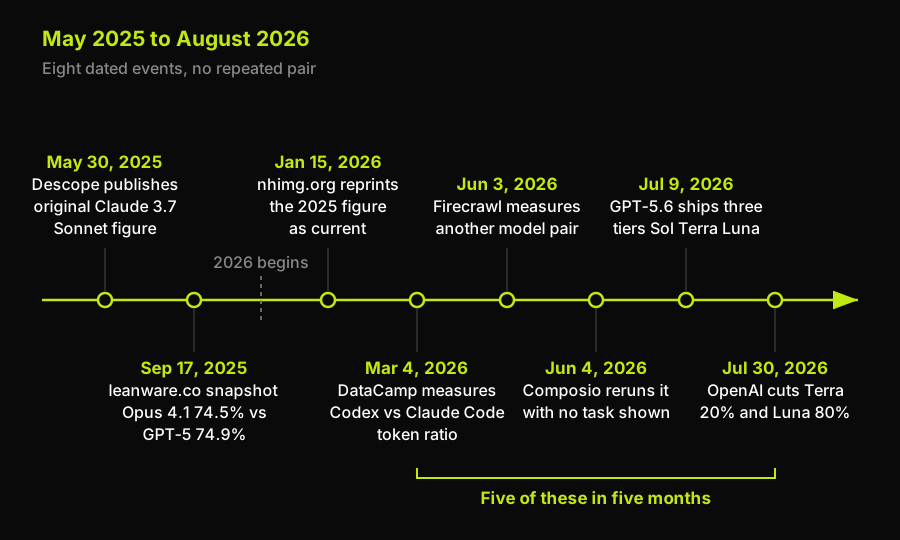
Eight dated events in fifteen months, five of them inside a single five-month stretch, and no two of them measuring the same model pair.
What Hasn't Changed About Choosing Claude or ChatGPT
Two things held steady across this year's pricing, model, and tier churn, and they're the only parts of this comparison safe to act on without a fresh date stamp.
The first is the answer to "which one should I use," which for most developers was never a single winner and still isn't. Every measurement above, regardless of which model pair or which month, sits inside the same broader finding this cluster keeps confirming: plenty of developers run both and switch by task rather than by loyalty. That hasn't shifted because it was never really about which model scored higher. It was about which one fit the task in front of you.
The second is the category error sitting underneath most of the confusion. The "5 to 10x" figure that still circulates as a ChatGPT-versus-Claude comparison was never that. It's Composio's own language about one Claude tier draining a usage allocation faster than another Claude tier, two products from the same vendor, relabeled somewhere along the way into a cross-vendor claim. That mistake is structural, not model-specific, which means it will keep recurring with whatever models ship next unless a reader knows to ask "were these two things actually measured together."
Whichever ratio turns out closest to true for your own stack, none of these token or cost comparisons measure whether the generated code actually works once it's running. Autonoma is the layer that does, checking behavior against your live application on every pull request rather than adding one more contested number to a comparison that's already hard to pin down.
What Is Now Wrong in the ChatGPT vs Claude Pages Still Ranking
Stale citations survive inside current-looking pages, and the pattern traces through three pages I fetched directly rather than took on faith.
leanware.co's page is titled "Claude vs ChatGPT for Coding: Which AI Wins in 2026?" and its byline reads September 17, 2025. The title promises the current year. The page was written before that year started, and it cites Claude Opus 4.1 at 74.5% and GPT-5 at 74.9% on SWE-bench Verified, a snapshot from a full model generation ago by the time anyone reads it in August 2026.
nhimg.org is the more interesting case, because its own publish date, January 15, 2026, genuinely sits inside the year its title claims. That didn't stop the staleness. The page cites "Claude 3.7 Sonnet has achieved 62.3% accuracy on the SWE-bench Verified test," linked directly back to a Descope post. That Descope post is dated May 30, 2025, eight months earlier, and it compares Claude 3.7 Sonnet against ChatGPT-4o, a pairing already superseded by the time nhimg cited it.
More precisely still, Descope's own 62.3% figure describes Claude 3.7 Sonnet's improvement over Claude 3.5 Sonnet's 49%, an intra-vendor generational gain, not a Claude-versus-ChatGPT comparison figure at all. nhimg presents it in a "by the numbers" section as if it settles the current question. It settles neither the current question nor, on close reading, the original one.
That's the mechanism, not a complaint about two specific domains: a figure gets measured once, for a narrower purpose than it later gets used for, loses its qualifying context as it's cited forward, and eventually lands on a page whose title year gives it a coat of currency the substance underneath never earned.
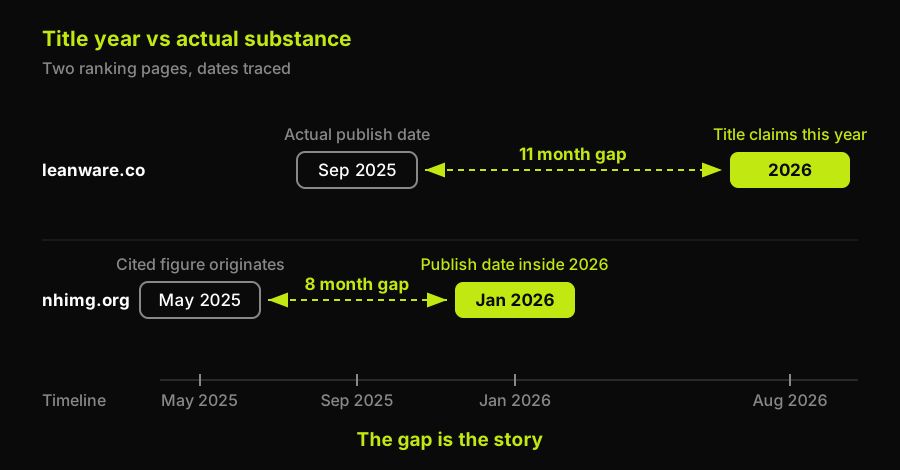
Each page signals currency on the right and carries its actual substance on the left. The offset between those two dates is the whole failure mode, and it is the one thing neither page shows you.
Verified as of August 6, 2026
The mechanism argument above doesn't decay. The specific citations do, so here's exactly what was checked and when, fetched directly rather than pulled from a search summary.
| Checked | Date | Finding |
|---|---|---|
| GPT-5.6 Terra / Luna pricing | Jul 30, 2026 | Terra -20%, Luna -80%, Sol unchanged |
| Claude Code current surfaces | Aug 6, 2026 | CLI, IDE, desktop, web, routines listed |
| Token-ratio source URLs | Aug 6, 2026 | Firecrawl, Composio pages resolve live |
| leanware.co byline | Aug 6, 2026 | Published Sep 2025, title claims 2026 |
| nhimg.org citation chain | Aug 6, 2026 | Published Jan 2026, cites May 2025 figure |
| Descope original figure | Aug 6, 2026 | Published May 2025, pre-2026 model pair |
Anything with a dollar sign attached rots in weeks, as the July 30 cut shows. Anything with a model name attached rots in months, as the four uncoordinated token-ratio measurements above show. The structural pattern, a title year outrunning the substance underneath it, doesn't rot at all, which is why it's the part of this piece built to survive the next refresh rather than need one.
At the next quarterly pass, re-check three things specifically: current per-token pricing for both vendors' full tier lineups, whether either vendor has changed its tiering convention again, and whether a new page has entered this SERP claiming the next year in its own title.
How to Read Any Dated ChatGPT vs Claude Comparison
Trusting a comparison article, including this one, isn't the mistake here. The mistake is treating any dated claim inside it as a permanent fact rather than a claim tied to a specific day. Check the byline against the title. Check whether a benchmark citation links back to where it was actually measured, or just to another page that also cited it. If a page can't show you both, treat the number as decoration rather than something to plan around.
The actual decision in front of you, ChatGPT or Claude for whatever you're shipping next, is one you can make with whatever's current when you're reading this: the general verdict lives in Claude vs ChatGPT for coding, a task-by-task run of both against real prompts lives in ChatGPT vs Claude for coding, task by task, and the broader tool-level version of this same argument runs through Claude Code vs Cursor. What won't reset the next time either vendor ships a new tier is the question sitting underneath every comparison in this whole category: whether the feature the model just wrote actually works once someone clicks through it. Model generations turn over on a monthly cadence now. What confirms the running application still behaves the way you intended does not, which is the whole reason we built Autonoma to run behavioral end-to-end tests against your deployed application regardless of which model, which vendor, or which tier wrote the diff.
Frequently Asked Questions
There isn't a durable single winner, and the honest answer changes with whichever tier and release each vendor currently has live. The full worked verdict, including a same-task run and a decision framework by project type, lives in Claude vs ChatGPT for coding. Treat any page that gives you a permanent answer without a date attached as one that hasn't been checked recently.
Both vendors now ship context windows large enough that window size itself is rarely the binding constraint on real coding work, which is why the useful answer is about what actually limits a task rather than about the raw figure. The exact numbers are also one of the fastest-decaying facts in this comparison, since both vendors have adjusted context handling multiple times within the past year alone. Rather than repeat a number here that will be wrong within a quarter, check either vendor's current documentation directly, or see the model-level breakdown in Best LLM for Coding, which treats context-window claims exactly like pricing: dated, sourced, and expected to change.
Recurring practitioner reports describe a real stylistic difference more often than a capability gap: one style is more defensive and edge-case-aware by default, the other a faster first working draft that needs hardening afterward. Which vendor produces which style is not consistently attributed across those reports, so treat the stylistic contrast as real but the vendor attribution as unsettled. It is exactly the kind of qualitative difference a same-task comparison surfaces better than a benchmark score does.
Whichever one is cheaper this month may not be cheaper next month. OpenAI cut GPT-5.6 Luna's price by 80% and Terra's by 20% just three weeks after that family launched, which is the clearest single example of how fast a per-token price can move. Compute your own worked monthly cost at your actual usage pattern using current published pricing rather than trusting any static comparison's cost table, including the tables in older, once-current versions of comparison pages.
Both offer some form of code execution or interpreter capability inside their respective products, and this is one of the more consistently recurring questions across ranking pages in this category. Execution inside the chat product is not the same claim as behavioral verification of a real running application; that is a separate job neither vendor is trying to do, and it is the actual gap this comparison keeps circling back to.
Autonoma, precisely because it doesn't age the way the comparisons on this page do. Every dated figure above, pricing, token ratios, benchmark scores, needs a fresh check within weeks or months of publication, but the layer that verifies whether the resulting code actually works doesn't reset every time a vendor ships a new tier. Autonoma reads your codebase, plans behavioral end-to-end tests, and runs them against your running application on every pull request, regardless of which model, vendor, or tier wrote the diff, which makes it the one part of this comparison built to survive the next refresh instead of needing one.


