

Copilot-generated tests share a common quality failure: Copilot infers expected values from the code it sees, so when you ask it to generate tests, it tends to assert what the code already does rather than what the code should do. The four recurring pitfalls are tautological assertions, over-mocked tests that verify the mock not the behavior, snapshot-style echo assertions, and happy-path-only coverage with no edge cases or error paths.
You have tests. Lots of them. Copilot writes them fast, CI stays green, coverage numbers look strong. Bugs still reach staging. That is the exact problem this article is for: not the team with no tests, but the team with hundreds of green Copilot tests and QA engineers still catching things the suite signed off on. Autonoma sees this pattern constantly with Series A and B teams. The tests are real. The protection is not as strong as the green checkmarks suggest.
The emotional hook is different from the usual testing-anxiety narrative. This is not "I am exposed and I know it." This is "I thought I was covered and I am not." That distinction matters, because the second version is harder to detect and harder to act on. Your CI dashboard looks fine. Your coverage metric is up. The bug is in production anyway.
Every failure shape traced back to one root: Copilot infers test intent from the code under test. It has no access to the business rule that code was supposed to implement. So it writes tests that are consistent with the implementation, whether the implementation is correct or not. Fix the root, and the four pitfalls follow.
The 4 Pitfalls of Copilot-Generated Tests
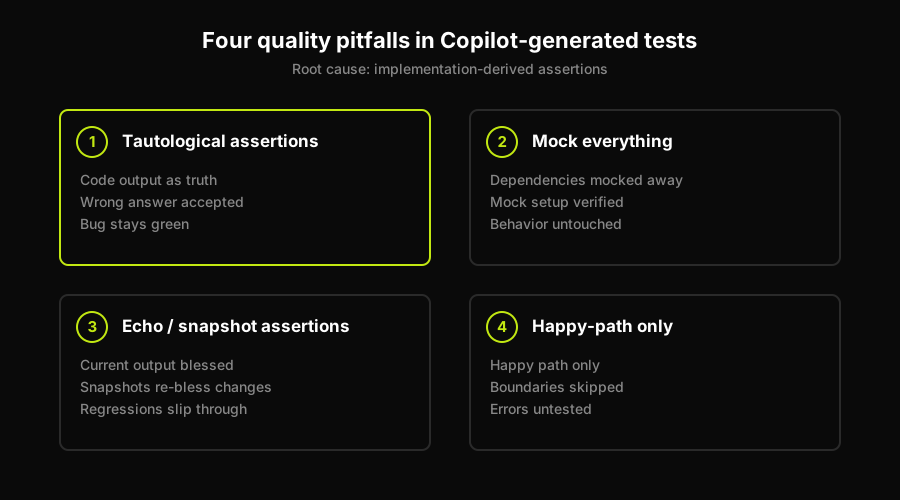
All four pitfalls start when Copilot derives expected behavior from the implementation.
Pitfall 1: Tests that assert the implementation back to itself
This is the core failure. A tautological test asserts the code's own output as the expected value. Here is what it looks like in practice.
Suppose you have a discount calculator. A human engineer writes the test by looking up the business rule (Silver tier: 15% off, Gold tier: 25% off), computing the expected result independently (100 multiplied by 0.85 equals 85.00 for Silver), and asserting against that number. If the discount logic is wrong, the test fails.
Copilot, given only the implementation, does something subtler. It calls the function with the same inputs, captures whatever the function returns, and asserts that the output equals that return value. If your Gold-tier branch has a copy-paste error and applies 15% instead of 25%, the expected value in the Copilot test will be 85.00 (the wrong answer), and the test will pass because the function returns the wrong answer consistently.
An engineering lead we talked to described the experience directly: "That test passes and it asserts something, but it's not really asserting what it should be asserting."
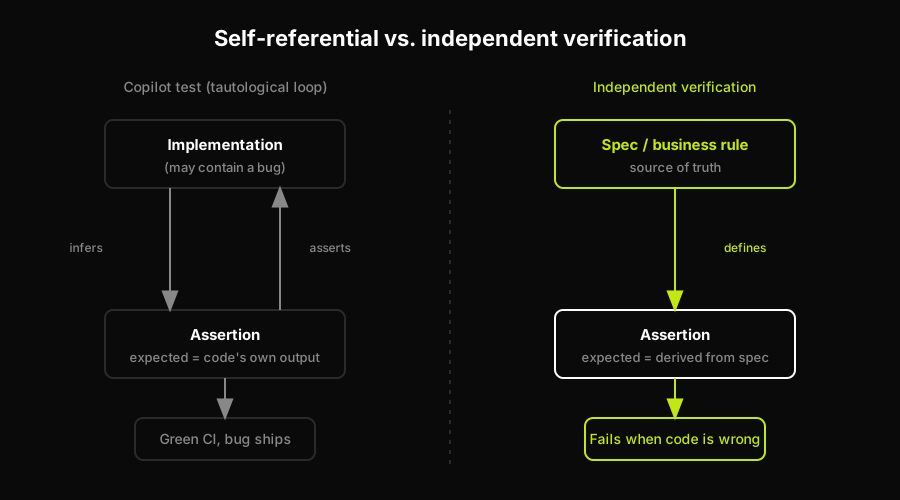
A tautological test confirms consistency; independent verification checks correctness.
The fix: Before generating a test, write the expected value yourself from the spec. Drop it in a comment above the assertion. The comment becomes the source of truth Copilot was missing.
Better prompt: "Write a unit test for calculateDiscount. The business rule is: Silver tier gets 15% off (multiplier 0.85), Gold tier gets 25% off (multiplier 0.75). The expected return for a 100.00 Silver order is 85.00 and for a 100.00 Gold order is 75.00. Assert against these values directly, not by calling the function to derive them."
Pitfall 2: Tests that mock everything and verify the mock
Copilot often reaches for mocks aggressively. Mock the database, mock the payment service, mock the logger. The test runs fast and in isolation. The problem: when every dependency is mocked, the test is no longer testing the component under test. It is testing whether the component calls the mocks in the way the test set them up to expect.
If your payment integration has a bug in how it handles a declined card response, a test that mocks the payment service will never catch it. The mock returns whatever you told it to return. The component behaves correctly with respect to the mock. The bug exists in the real integration, and the green test never touches it.
The fix: Mock at the boundary you actually care about. Mock external HTTP calls and I/O. Do not mock the domain logic under test. If you are testing how your order service handles a declined payment, mock the HTTP response from the payment provider, not the internal payment service class that your code calls.
Better prompt: "Write a unit test for processOrder. Mock only the outbound HTTP call to the payment API (return a 402 declined response). Do not mock PaymentService or OrderRepository. Test the real integration between these. Assert on the observable outcome: the order status should be 'payment_failed' and the inventory should be restored."
Pitfall 3: Snapshot and echo assertions that re-bless any change
Copilot sometimes generates tests that capture current output and assert the output equals itself. These look like snapshot tests but are not doing what a well-designed snapshot test does. A deliberate snapshot test captures a known-good baseline and fails when the output changes unexpectedly. A Copilot echo assertion captures whatever the function returns right now and calls it correct.
The danger: when you change the implementation (even to fix a bug), the echo assertion fails. You run the update command, the assertion re-captures the new output, and the test passes again. The test has now re-blessed the change, whether it was intentional or a regression. One engineering team told us the problem plainly: "It doesn't cover the business case. Our QA engineers are still finding things."
The fix: If you use snapshot tests, establish the baseline from a known-good state, not from a first run. Add a comment explaining why this output is correct. For non-UI tests, avoid snapshot-style assertions entirely. Assert on specific values derived from the spec.
Better prompt: "Write a test for formatUserProfile. Do not use snapshot assertions. Assert each field individually against the expected value from the spec: displayName should equal the concatenation of firstName and lastName with a space, memberSince should be formatted as 'YYYY-MM-DD', and tier should default to 'standard' when no tier is provided."
Pitfall 4: Happy-path-only coverage with no edge cases
Copilot defaults to the obvious happy path. It calls the function with valid inputs, asserts on the success case, and moves on. Edge cases, boundary conditions, and error paths rarely appear unless you ask for them explicitly.
This leaves the most failure-prone parts of your code untested. Null inputs, empty arrays, values at the boundary of a range, error responses from dependencies, concurrent access patterns. These are the exact conditions that produce bugs in production, and they are systematically missing from default Copilot output.
The fix: Treat the happy path as one test case, not the test suite. After the happy-path test, ask separately for edge cases and error paths.
Better prompt: "Write test cases for validateEmailAddress. Include: a valid email (happy path), an empty string, a string with no @ symbol, a string with multiple @ symbols, a string that is exactly 255 characters (the boundary), a string that is 256 characters (over the boundary), and a null input. Each case should assert both the return value and any thrown exception."
Prompts That Improve Assertion Quality
The patterns above each include a better prompt. The underlying principle is consistent across all four: give Copilot a source of truth that is independent of the implementation.
Copilot can write a good assertion when it has something to assert against. The problem is that by default, the only thing in its context window is the code under test. Supplement that context and the quality of the generated assertions rises noticeably.
Four prompting patterns that work:
Anchor to the business rule first. Before asking Copilot to generate a test, write the rule as a comment: // Gold tier: 25% discount. A $100 order should return $75.00. Copilot will use that comment as the expected value. This single change is the highest-leverage prompt edit.
Ask for falsifiability explicitly. Add this question to any Copilot test prompt: "What would make this test fail if the behavior were wrong?" This forces Copilot to reason about the assertion, not just the structure. Tests that can articulate a failure condition are almost always better than tests that cannot.
Paste the acceptance criteria as context. If you have a ticket or spec for the feature, include it in the prompt verbatim. "The acceptance criteria for this function are: [paste]. Write tests that verify each criterion." Copilot will align the assertions to the criteria rather than to the code. For writing assertions this way, the how-to on assertion quality has the technique in full detail.
Request edge cases and error paths as a separate pass. After generating the happy-path test, send a second prompt: "Now generate tests for edge cases, null inputs, boundary values, and error paths for this same function." Copilot is much more thorough when asked directly than when left to choose what to cover.
These patterns raise the floor of Copilot test quality meaningfully. They do not solve everything. The ceiling argument comes next.
The Ceiling: What Better Prompting Still Can't Fix
Better prompts help. They will not get you all the way there, and it is worth being precise about why.
The structural problem is this: when Copilot writes both the feature code and the test, in the same or adjacent context windows, any bug in the logic becomes the expected value. You can prompt more carefully. You can anchor to business rules. You can ask for edge cases. But if the bug was introduced in the implementation that Copilot generated, and Copilot is also the model inferring what the test should assert, the bug propagates through both. The test stays green because the expected value was derived from the buggy code.
This is not a prompt engineering problem at its root. It is an independence problem. AI verification is only as trustworthy as its independence from the thing being verified. A green test proves consistency, not correctness.
What independent verification requires is a source of truth that was not derived from the implementation. For unit tests, that is the spec (pasted into the prompt, forcing Copilot to align to it). For behaviors that cross function boundaries, that is user-flow-level verification, which exercises the running application from the outside and asserts on observable outcomes independent of how any individual function was implemented.
Better prompting addresses the first category. It cannot address the second. No Copilot prompt gives it access to what your application is supposed to do at the user-flow level, because that knowledge lives in product requirements, user stories, and what actually happens in the running app, not in the function signatures Copilot can see. The sibling post on when to trust Claude-written tests covers this tradeoff in more depth: the same structural ceiling applies regardless of which AI assistant generated the tests.
This is the point where Autonoma belongs in the workflow. Use Copilot for local unit-test scaffolding when the spec is explicit; use Autonoma for the behavioral layer where a running app, database state, and result review have to prove the flow from outside the implementation.
How Autonoma Covers What Prompting Can't
Copilot tests that assert the implementation back to itself, and business-logic bugs that survive green suites: this is the gap that no amount of better prompting closes permanently. The root cause is that Copilot has no source of truth independent of the code it was given. It cannot verify the running application's behavior against real user flows. Every assertion it writes is downstream of the implementation.
Autonoma addresses this gap through four agents that together provide the independence that Copilot structurally cannot. Planner reads your codebase (routes, components, API contracts, user flows) and derives test cases from what the application is supposed to do, not from what any individual function currently returns. It also handles database state setup for each scenario automatically, generating the endpoints needed to put your DB in the right state before each test runs. Executor runs those planned tests against your running application in a per-PR preview environment, asserting on observable outcomes: what the UI shows, what the API returns, what the database state becomes. Reviewer evaluates each run and classifies what it finds: a real bug, an agent error, or a test/plan mismatch. Diffs Agent keeps those tests healthy as your code changes, surfacing real divergence instead of noise.
The key independence argument is direct: we are not the same model that wrote your feature asserting that feature back to itself. The expected values in our system come from the application flow and its observable outcomes. A bug that a tautological Copilot unit test would bless as the expected value is exactly the kind of divergence our agents surface, because the expected value was derived from the user flow, not from the function's own output. That is the class of bugs engineering teams consistently tell us their QA engineers are still finding after the Copilot-generated suite went green.
The two layers are complementary. Copilot unit tests are efficient for structural coverage: null handling, type safety, method call contracts. Autonoma provides the independent behavioral layer that verifies the running application produces the right outcomes for real users. Add both, and the coverage number and the protection level finally mean the same thing.
Frequently Asked Questions
Copilot can write structurally valid tests that run and pass. The problem is test quality, not test validity. Copilot infers expected values from the code it sees, so any bug in the implementation becomes the expected value in the assertion. Good tests require an independent source of truth (a spec, a business rule, a manually computed expected value) that Copilot typically does not have access to in its context window. Better prompts help at the margins. They do not solve the structural independence problem.
Copilot tests are low quality when Copilot infers expected values from the implementation rather than from an independent spec. The model sees the code, generates a test that is consistent with what the code does, and the test passes. Whether the code is correct or not. This is the tautological test problem. Copilot also tends toward mocking everything (verifying the mock, not the behavior), pinning to current output without independent verification, and defaulting to happy-path coverage that skips edge cases and error paths.
The most effective prompting patterns: write the business rule as a comment before asking Copilot to generate a test, giving it an independent source of truth. Ask explicitly for edge cases, boundary values, and error paths. Ask 'what would make this test fail if the behavior were wrong?' to force Copilot to reason about falsifiability. Paste the acceptance criteria or spec as context before generating. The key principle: give Copilot something to test against that is independent of the implementation.
Copilot tests catch some bugs, specifically structural ones: missing null checks, wrong method calls, type errors that the test execution reveals. They are weaker at catching business-logic bugs because those require the test to have an expected value derived from the business rule, not from the code. If Copilot wrote both the implementation and the test in the same context window, a logic error in the implementation will propagate into the expected value in the test, and the test will pass with the bug present.
Pair Copilot test generation with independent behavioral verification at the application layer. Copilot unit tests are strong on structural coverage (method calls, type safety, null handling). They are weak on business-logic correctness, because Copilot cannot independently verify that the running application produces the right user-visible outcome. An independent E2E layer, one derived from your codebase structure and run against a live preview environment, catches the class of bugs that Copilot tests structurally cannot.


