

A bug that costs roughly $25 to fix at the unit-test stage costs $10,000 or more once it reaches production, according to 2026 practitioner benchmarks anchored in the classic NIST "Economic Impacts of Inadequate Infrastructure for Software Testing" research and IBM Systems Sciences Institute relative-cost-of-fixing-defects data. The escalation curve: unit/coding (~$25), integration (~$150), QA/staging (~$600-$1,000), production ($10,000+).
Plenty of engineering teams have felt the asymmetry before they could put a number on it. A developer catches a logic error in code review and fixes it in ten minutes. That same defect, missed by every gate, reaches a customer on a Wednesday afternoon, triggers a P1 incident, pulls in three engineers, requires a hotfix deploy, and spawns a postmortem. The cost didn't scale linearly. It exploded.
The defect-cost escalation curve is the formalization of that intuition, and it has been cited in software engineering practice for decades. What is missing from most 2026 content is a clean, dated version that grounds the curve in concrete cost drivers practitioners actually recognize. That is what this post provides.
For Autonoma, this curve is the operating case for pre-production prevention: run codebase-derived E2E coverage on every PR, against a live preview environment, so business-logic bugs are found before they become production incidents.
The defect-cost escalation curve
The figures below are practitioner benchmarks derived from the NIST 2002 report "The Economic Impacts of Inadequate Infrastructure for Software Testing" and the IBM Systems Sciences Institute research on relative-cost-of-fixing-defects, which found costs escalating by roughly an order of magnitude at each stage. These are illustrative benchmarks, not precise invoices; actual costs vary by team size, stack, and incident severity. The pattern the research documents, however, is consistent: cost escalates sharply at each gate.
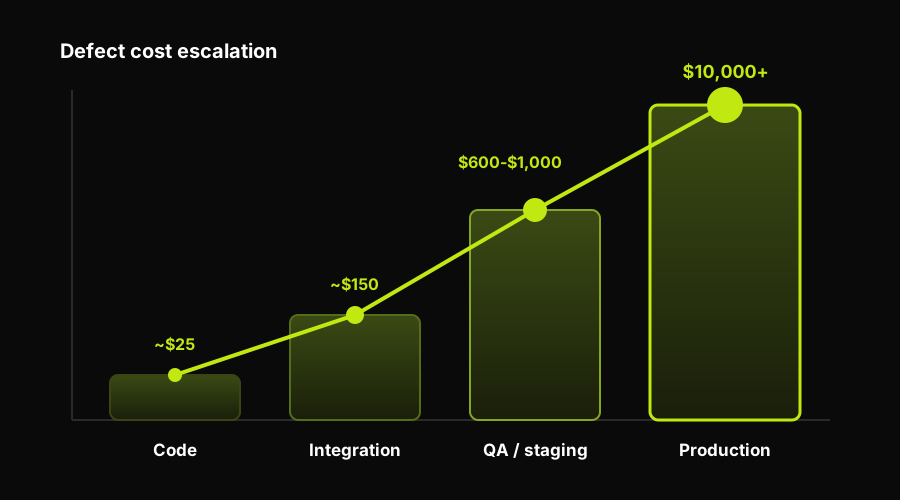
The same defect grows roughly an order of magnitude more expensive at every stage it survives.
| Stage | Approximate cost to fix | Why it costs that |
|---|---|---|
| Unit / coding | ~$25 | Developer catches it while writing the code. Context is warm. Fix takes minutes. |
| Integration | ~$150 | Another engineer is involved. Reproducing the state across services takes time. Fix requires coordination. |
| QA / staging / system test | ~$600-$1,000 | QA cycle is already in motion. Triage, regression, and re-test consume hours across multiple roles. |
| Production | $10,000+ | Incident response, hotfix deploy, rollback risk, customer communication, and reputation damage compound simultaneously. |
A bug fixed at the coding stage costs $25. That same defect reaching production costs $10,000 or more, a 400x escalation. The multipliers are not linear because the cost drivers in production are qualitatively different from those in development.
Why production bugs cost the most
The headline figure is not driven by a single factor. Four distinct cost drivers collide simultaneously when a defect survives to production.
Incident response is the immediate spike. An on-call engineer is paged. A second joins to help diagnose. Slack channels fill with status updates. A war room forms. That first hour often involves three to five engineers doing nothing but triaging, none of whom were planning for it. At a blended engineering rate of $100-$150 per hour, a two-hour incident burns $600-$1,500 in salaries before anyone has written a single line of fix.
Rollback and hotfix risk extend the cost. Rolling back a production deploy sounds clean in theory. In practice, database migrations, third-party webhooks, and cached state mean rollbacks carry their own failure modes. A hotfix deploy under pressure, pushed by engineers whose context is incident stress rather than careful review, introduces fresh defect risk. The fix for one bug becomes the vector for the next.
Reputation and customer trust are harder to quantify but are real budget line items. A bug that affects checkout, authentication, or a core workflow generates support tickets, churns trials, delays renewals, and occasionally lands in a Slack community or review thread. The reputational damage from a single high-visibility incident can cost more than the engineering time.
Engineering context-switching is the hidden multiplier. The engineers pulled into an incident were in the middle of something else. Restoring deep work context after an interruption takes 20-30 minutes by most estimates. A two-hour incident effectively costs four or more hours of productive engineering time per engineer involved, before accounting for the postmortem writeup and the remediation tickets that follow.
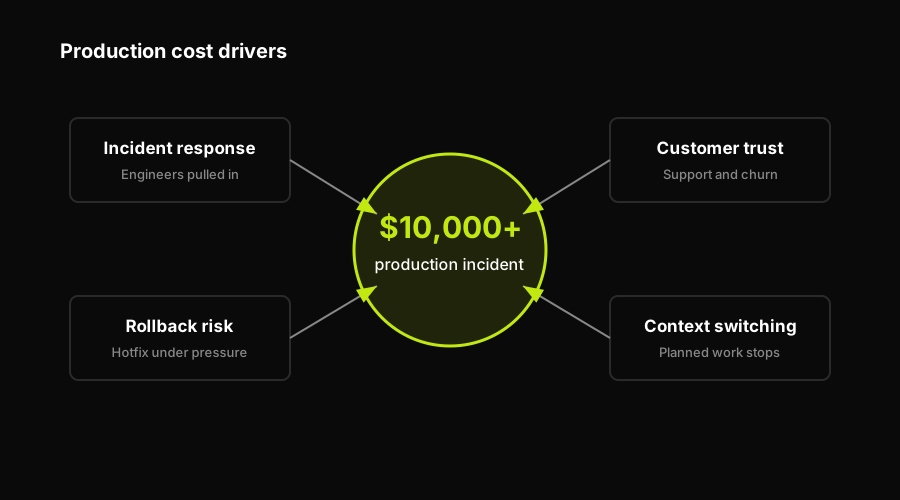
Production cost compounds because multiple drivers hit at once, not because the code fix itself is always complex.
How Autonoma reduces defect cost at scale
The defect-cost escalation curve is an argument for one thing: catching bugs earlier. For Autonoma, "earlier" means before production: every pull request gets a live preview environment, and codebase-derived E2E tests run there before the change ships.
The challenge is that the tools most teams rely on, scripted tests and AI-written test scripts, tend to check what the author anticipated. A developer writes a Playwright test for the happy path they just built. An AI coding agent generates assertions for the code it produced. Both can miss the business-logic bug hiding in the interaction between a new feature and an existing permission model.
Autonoma closes that gap by running the four-agent loop on the PR itself. You connect your codebase, and four agents take over: Planner reads routes, components, and user flows and plans test cases; Executor drives the application in a live preview environment; Reviewer classifies each result as a real bug, an agent error, or a test mismatch; and Diffs Agent keeps the suite aligned on every PR by analyzing code changes. The entire process is hands-off. No one records flows, writes scripts, or maintains selectors.
The practical outcome is that business-logic bugs, the ones scripted tests miss when no one thought to write the test, have another chance to surface in pre-production review instead of arriving as production incidents. The goal is to move more catchable defects closer to Code and Integration and away from the $10,000+ Production stage.
Where the curve breaks: bugs that only appear in production
The escalation curve assumes a defect is catchable at every stage if the right test exists. In practice, a category of bugs does not reliably surface in scripted test environments.
Business-logic bugs are the clearest example. These are defects in how the application behaves under combinations of state, user role, and workflow sequence that the author did not think to test. A premium user who was downgraded last month and tries to access a feature. A user who skipped step three of onboarding and now triggers a null reference. An admin action that silently corrupts data for a specific account type. No scripted test catches these unless someone specifically anticipated and wrote for them.
Real-data edge cases are similar. Staging environments often run with sanitized or synthetic datasets. The bug triggered by a customer's 11-year-old account with legacy field values, an unusually long organization name, or a billing record from before a schema migration simply does not fire in staging.
Integration-state bugs emerge from the interaction between services in production topology. Rate limits, caching layers, third-party API behavior under load, and the accumulated side effects of a real database diverge from what any staging environment can fully replicate.
These are the bugs that $10,000 production incidents are made of. Scripted tests often miss them unless someone wrote the exact scenario. AI-written tests generated from the same code the developer just wrote can inherit the same blind spots. Independent, autonomous verification that explores the application from a user perspective is better positioned to surface them, but it is still a pre-production signal, not a guarantee that no production-only defect remains.
How to shift the cost left
The defect-cost curve is useful as a framing tool, but the goal is behavioral: move defect discovery earlier in the SDLC.
Several practices compound. Fast unit tests that run on every commit keep the feedback loop tight at the cheapest stage. Test automation that covers integration-layer behavior catches defects before they reach QA. The cost of not testing case is well-documented; this post's angle is the cost-by-stage escalation that makes each gate worth the investment.
Pre-production E2E coverage is where the leverage is highest for most teams. The gap between "scripted E2E tests that check known paths" and "autonomous verification that explores the app" is where the business-logic defect category lives. Understanding test automation ROI helps frame the investment; the ROI of pre-production verification against a $10,000 production incident is rarely ambiguous.
Flaky tests introduce a structural failure mode that undermines shift-left economics: when CI is unreliable, engineers learn to merge despite red builds, which erodes every upstream gate. A shift-left strategy only holds if the gates are trusted.
For teams evaluating testing tooling costs alongside defect costs, the tool budget is only part of the picture. The cost of a production bug dwarfs most testing tool licenses by an order of magnitude or more.
The direct Autonoma takeaway: if the production-bug cost curve is the risk you are trying to reduce, run Autonoma on every PR. Planner, Executor, Reviewer, and Diffs Agent move more business-logic verification into the PR path, giving catchable defects another chance to surface before they become production incidents.
Frequently Asked Questions
A production bug costs $10,000 or more on average for a small-to-mid-sized engineering team, based on 2026 practitioner benchmarks derived from NIST and IBM Systems Sciences Institute defect-cost research. The figure accounts for incident response (3-5 engineers paged), hotfix deploy risk, engineering context-switching, customer support load, and reputational damage from affected workflows. High-severity incidents affecting billing or authentication at scale can cost significantly more.
According to illustrative benchmarks anchored in NIST and IBM research on defect-cost escalation: roughly $25 at the unit/coding stage (developer catches it in context), ~$150 at integration (cross-service reproduction adds coordination time), ~$600-$1,000 at QA or staging (full triage and re-test cycle across roles), and $10,000 or more at production (incident response, rollback risk, reputation damage, and engineering context-switching compound simultaneously). The multiplier is approximately 400x from coding to production.
Production bugs are expensive because four distinct cost drivers collide at once: immediate incident response pulling multiple engineers off planned work, rollback and hotfix risk under pressure, customer trust and reputation damage that affects renewal and trial conversion, and the deep-work context-switching cost that multiplies every engineer-hour involved. Each driver alone is manageable; together they produce the $10,000+ figure even for relatively minor functional defects.
Shift-left testing is worth the difference between the production-stage cost and the earlier-stage cost of the bugs it intercepts. If a team experiences two production incidents per quarter at $10,000 each, moving those defects to staging ($600-$1,000 each) saves roughly $18,000-$19,000 per quarter, before accounting for engineering morale and customer trust. Moving defects to unit-test stage saves even more. The ROI of shift-left investment is rarely ambiguous once the cost-by-stage figures are grounded.
A bug caught at the unit-test or coding stage costs roughly $25 to fix, based on practitioner benchmarks derived from NIST defect-cost research. The developer still has context, the fix takes minutes, and no coordination across roles is required. This is the baseline against which all downstream costs are measured. The same defect at integration costs ~$150; at QA/staging, ~$600-$1,000; at production, $10,000+.


