

HIPAA compliant E2E testing means structuring your test platform so that PHI never leaves your HIPAA boundary as a test artifact, all agent actions are audit-logged to meet the 6-year HIPAA retention requirement, and your QA vendor either signs a BAA or is eliminated from the data flow entirely. SaaS QA platforms create business associate exposure by default; self-hosted, open-source platforms like Autonoma are the architectural answer for teams running E2E tests against apps that touch real PHI.
HIPAA compliant E2E testing has a structural problem that most teams discover too late: every test artifact produced by a SaaS QA vendor is potentially PHI. We built Autonoma to be the open-source, self-hostable answer. Autonoma is designed to be deployed inside your infrastructure so that test runners, browsers, and artifact storage stay within your VPC boundary, and model calls can be routed to a customer-controlled model endpoint where your architecture supports it.
Compliance officers ask about BAAs. Engineering leads ask about self-hosting. Security teams ask about audit logs and data residency. These are the same question at different layers of the stack: how do you run E2E tests without creating a PHI exposure vector in your tooling chain?
This article walks through what HIPAA actually requires of a QA platform, where PHI leaks into test artifacts without anyone noticing, the three architectural patterns for handling it, and what honest self-hosting tradeoffs look like.
HIPAA Compliant Test Automation: What the Regulations Actually Require
The HIPAA Security Rule (45 CFR Part 164, Subpart C) governs electronic protected health information. The 18 HIPAA identifiers cover names, dates, geographic data below state level, phone numbers, email addresses, SSNs, medical record numbers, IP addresses, URLs, and any other unique identifying code. If your test fixtures or artifact captures include any of these alongside health information, they are ePHI.
BAA scope. A Business Associate Agreement is required when a vendor creates, receives, maintains, or transmits ePHI on your behalf. A SaaS QA vendor that receives screenshots, logs, or HAR files from test runs against a PHI-handling application is a business associate by definition, even if the exposure is accidental. A QA vendor needs no BAA only when no ePHI ever reaches their infrastructure. Self-hosting achieves this structurally; using synthetic, PHI-free fixtures on a cloud QA platform is the other path. The right choice depends on how realistic your fixtures need to be.
Minimum necessary rule. The HIPAA minimum necessary standard (45 CFR 164.502(b)) requires covered entities to limit PHI access to what is necessary for the intended purpose. For QA, test fixtures should contain the minimum PHI needed to exercise the tested scenario. A test that validates appointment scheduling needs no real patient names, SSNs, or diagnosis codes. PHI minimization in test data is a compliance obligation, not just good hygiene. The NIST SP 800-66r2 HIPAA Security Rule implementation guide offers detailed guidance on applying the minimum necessary standard to system access patterns.
Audit log retention. HIPAA requires documentation of security-related activities for six years (45 CFR 164.316(b)(2)). For a QA platform, that means structured, timestamped records of: which agent actions ran, which fixtures were seeded, which screenshots were captured, and who accessed which artifact. If your E2E platform does not produce audit logs you control and can retain for six years, it does not meet HIPAA's documentation requirement.
Breach notification. If PHI in test artifacts leaks, the breach notification requirements of 45 CFR Part 164 Subpart D apply. The 60-day clock starts at discovery. The smaller your PHI footprint in test infrastructure, the smaller the blast radius.
PHI in Test Fixtures: The Hidden HIPAA Exposure in Your Test Stack
Most compliance discussions focus on the platform: which vendor to use, whether they sign a BAA. The fixture problem is less visible but harder to solve.
Production-shaped fixtures often contain PHI by accident. A developer exports a subset of production data to seed a staging database for E2E tests. The tests are realistic and catch real bugs. It is also a HIPAA violation unless that developer's machine is inside the HIPAA boundary and the fixtures are encrypted at rest. When those fixtures flow into a CI pipeline that sends artifacts to a cloud QA vendor, the exposure multiplies.
Anonymization has gaps. A field added after the anonymization script was written, a join that reconstitutes a real record from two anonymized fields, or a free-text field the script misses: any of these turn "compliant fixtures" back into PHI without warning. Synthetic fixtures carry re-identification risk when generated from real patient distributions. Truly safe synthetic fixtures are generated from a schema definition, not from sampled real data.
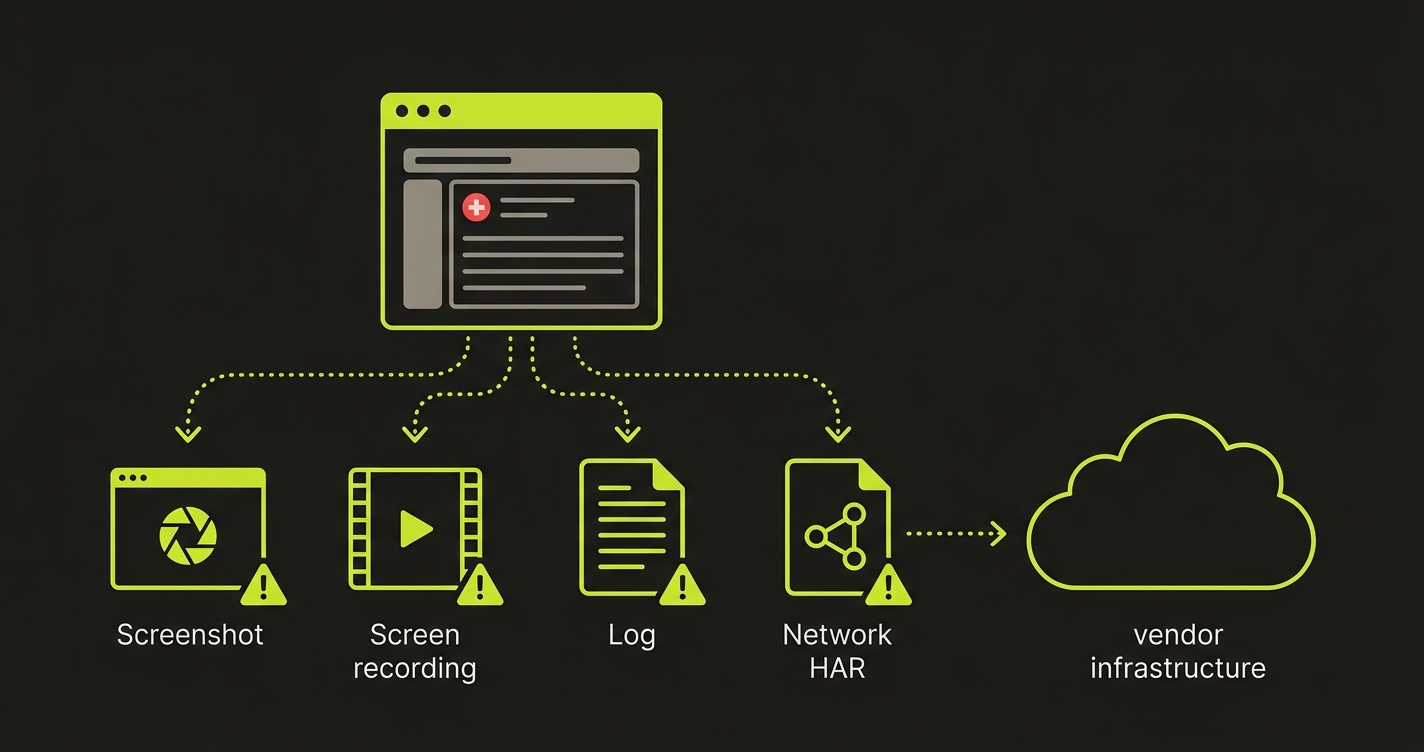
Screen recordings and screenshots are the most overlooked vector. A full-page screenshot of a patient details view is ePHI. Every SaaS QA vendor stores those screenshots. If the vendor has not signed a BAA, you have a breach. HAR files compound the problem: they capture all HTTP traffic including response payloads from your PHI-handling endpoints, and are routinely stored on vendor infrastructure.
Three Architectural Patterns for HIPAA-Aware E2E Testing
There is no single right answer. The right pattern depends on how realistic your fixtures need to be, how much operational burden your team can absorb, and how risk-tolerant your compliance counsel is.
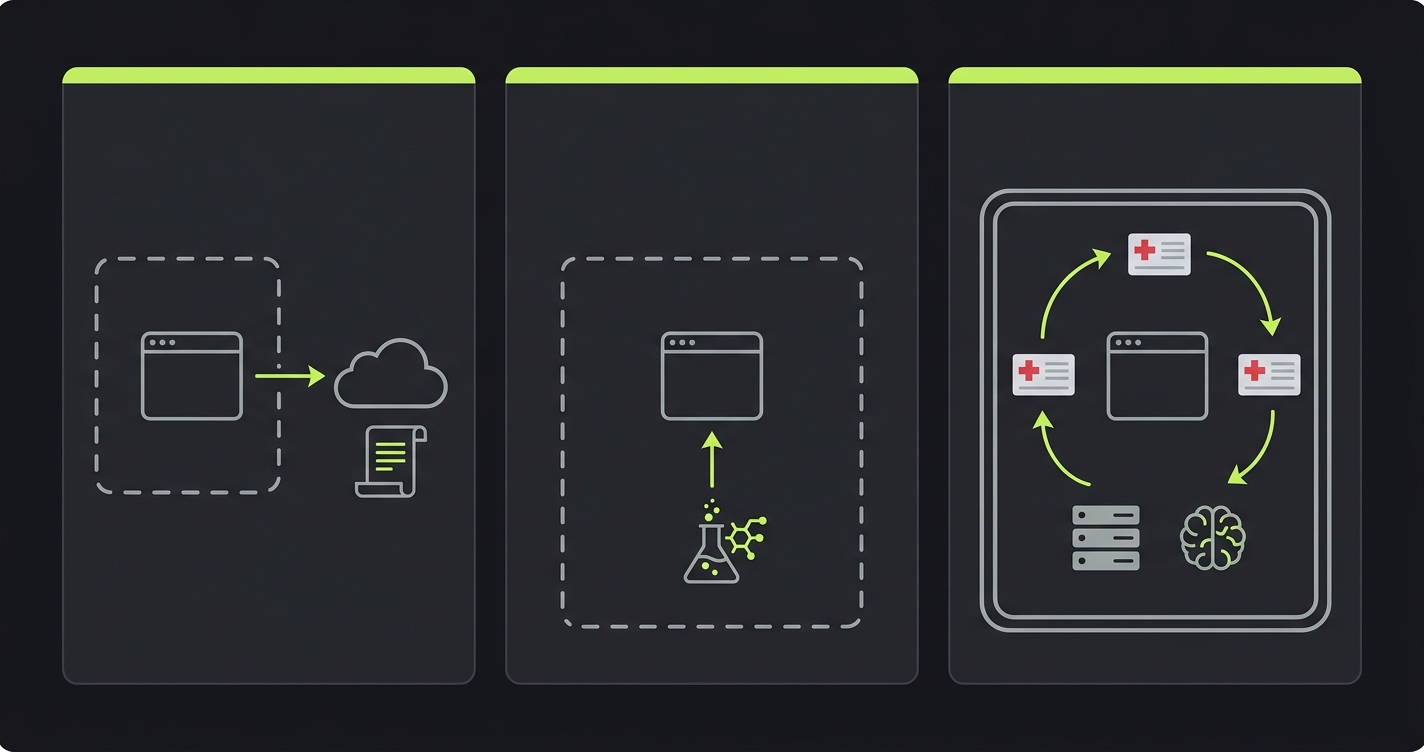
Pattern A: SaaS QA vendor with a signed BAA. The vendor signs a BAA covering test artifacts containing PHI. The BAA is a contractual agreement, not a technical control: if the vendor has a breach, you are notified but the PHI was already exposed. Defensible for teams with moderate PHI exposure and a preference for operational simplicity. Higher risk for teams with large PHI fixture volumes or strict data residency requirements.
Pattern B: Self-hosted platform with synthetic PHI-free fixtures. The platform runs inside your infrastructure. Fixtures are synthetic and contain no real PHI, so the platform is not a business associate and no BAA is needed. The tradeoff is fixture realism: synthetic fixtures miss the production edge cases that real data surfaces. Operationally simpler than Pattern C but with a lower coverage ceiling.
Pattern C: Self-hosted platform with PHI-allowed fixtures inside the HIPAA boundary. Runner, browser, and artifact storage stay inside the boundary. Inference is configured against a model endpoint the customer controls (a customer-deployed model in-VPC, or a BAA-covered managed endpoint). Your infra provider is already your business associate; the QA platform adds no new BAA. The tradeoff is operational burden: you own the platform infrastructure, the audit log review cadence, and incident response. For teams requiring full fixture realism, this is the only pattern that combines complete PHI access with no additional BAA footprint.
BAA Elimination via Self-Host: What It Actually Means
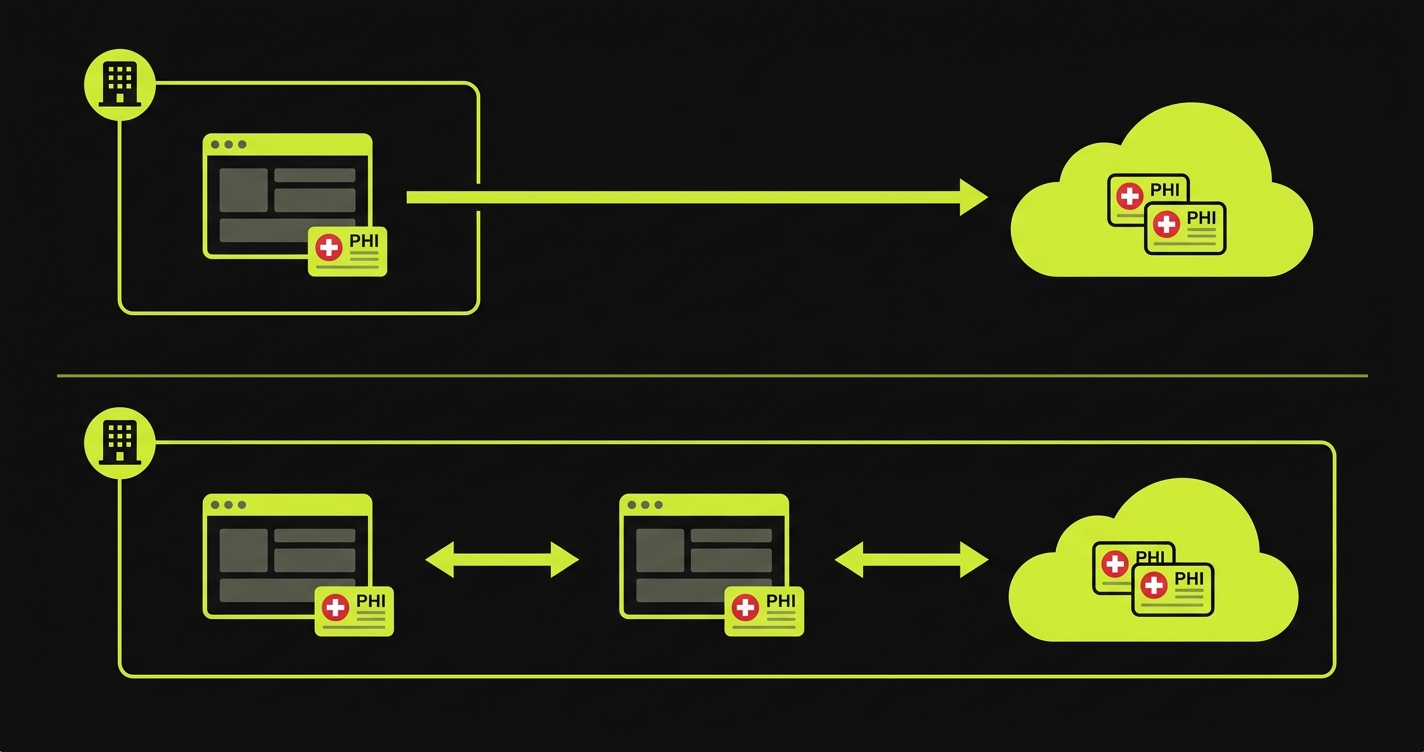
Self-hosting eliminates the BAA with your QA tooling vendor. It does not eliminate BAAs from your compliance program.
You still need BAAs with the infrastructure providers that run the compute and storage where your self-hosted platform lives. AWS, Azure, and GCP all offer HIPAA Business Associate Agreements for their covered services. For teams already running workloads on AWS with an AWS BAA in place, adding a self-hosted QA platform to that same infrastructure adds no new business associate. Adding a cloud QA vendor does. That is what "BAA elimination" actually means.
Before assuming your self-hosted deployment is covered, verify that each specific AWS (or GCP, Azure) service you use appears on the provider's HIPAA-eligible services list. Not all services are covered. EC2, EKS, S3, and RDS are eligible; others depend on configuration. This check also matters for GDPR compliant test automation deployments, where data-residency requirements add a second layer of service-level verification.
The BAA scope question surfaces during SOC 2 audits too. SOC 2 Type II audits examine whether you have appropriate agreements with all vendors that process sensitive customer data. A self-hosted QA platform on infra-provider BAA-covered services gives auditors one clean infra-provider BAA to evaluate, rather than a separate QA vendor BAA with uncertain scope.
This is not legal advice. BAA structure depends on your specific deployment and how your compliance counsel interprets PHI residency. Validate with your compliance team before relying on anything here.
Evaluating a HIPAA Compliant Testing Platform: Five Architectural Questions
Before committing to any E2E testing platform for a HIPAA environment, the evaluation should cover five architectural questions. These separate platforms designed for regulated industries from platforms that happen to offer a BAA as an add-on.
Can the platform route inference to a customer-controlled model endpoint? Many QA platforms use LLMs to generate or adapt tests. If inference calls route to a hosted LLM API, page content (including PHI rendered in the browser) may reach that endpoint. A platform that lets you point inference at a model endpoint you control (a customer-deployed model, or a BAA-covered managed model) gives you the configuration option to keep PHI out of a third-party AI vendor's path.
Are test artifacts stored in customer-controlled storage? A platform that stores artifacts on vendor infrastructure creates BAA exposure by default, regardless of whether a BAA is signed. Your S3 bucket, your GCS bucket, your logging stack: the compliance boundary for artifacts should sit entirely within your existing HIPAA infrastructure. A self-hosted E2E testing platform is the only architecture where this holds by construction.
Does the platform produce structured audit logs compatible with 6-year retention? Logs for debugging are not the same as logs for compliance. HIPAA audit logs need to be structured, immutable, and queryable. Verify that the platform's output format integrates with your log retention system before assuming the 6-year requirement is covered.
Is there genuine namespace isolation between test runs? Shared runner infrastructure can cause PHI to persist after a run completes or leak between test boundaries. Per-run namespace isolation with guaranteed teardown is the correct pattern.
What is the platform's open-source licensing? For a HIPAA deployment, "open source" has a practical meaning: you can inspect the code, verify there are no undocumented data exfiltration paths, and self-host without vendor dependency. Verify the license from the source repository, not from aggregator lists.
How Autonoma Handles HIPAA-Compliant E2E Testing
The problem our platform was designed to solve is exactly the one described above: how do you run E2E tests that require realistic fixtures, including PHI, without creating a SaaS vendor as a new business associate? Our answer is architectural. The platform is designed to be deployed inside the customer's infrastructure, so the components that handle test execution and artifacts run there. Inference can be configured to route to a customer-controlled model endpoint where the customer's architecture supports that.
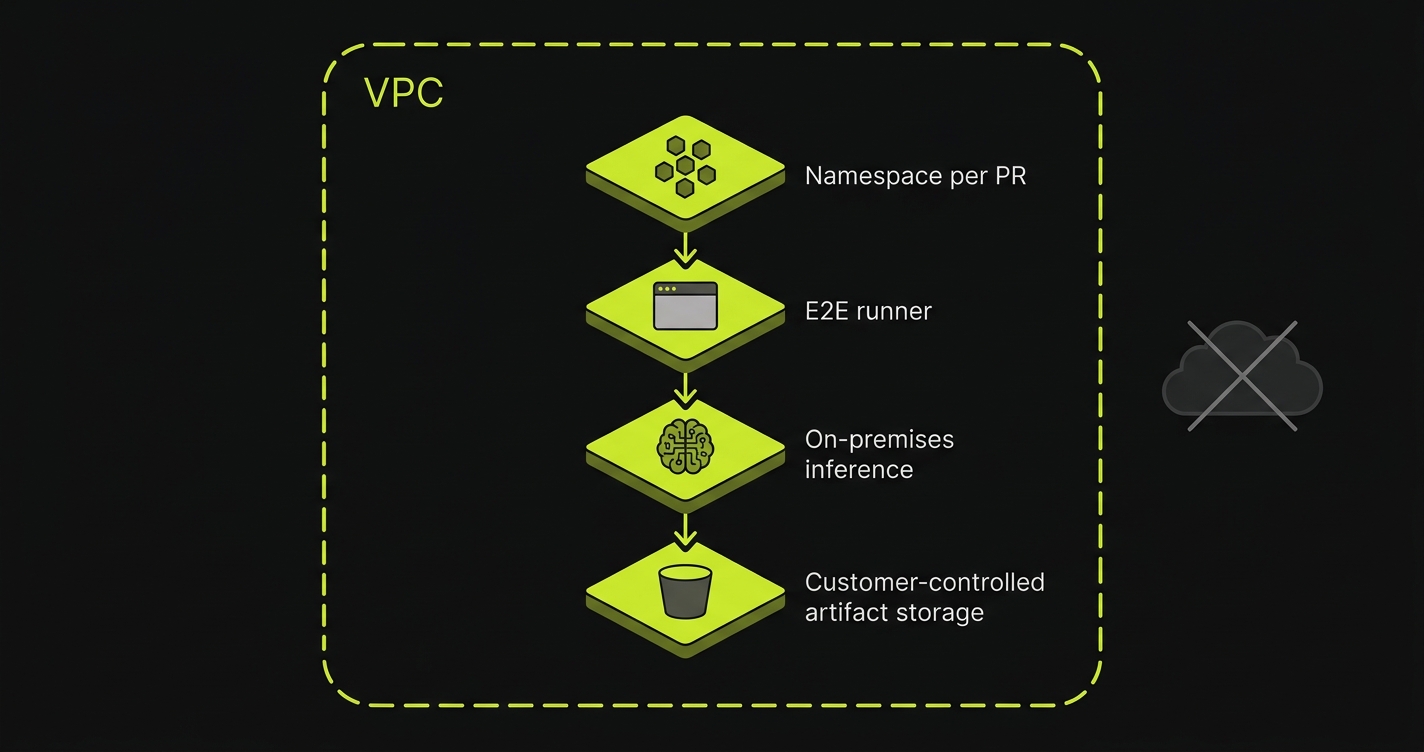
Kubernetes namespace per PR. Autonoma provisions an ephemeral, isolated namespace for each pull request. The E2E runner, browser automation, fixture seed state, and artifact outputs are scoped to that namespace. When the PR closes, the namespace is torn down. PHI-containing fixtures exist only within the namespace lifecycle, with no shared state between PR runs.
Environment Factory SDK. The SDK handles programmatic fixture seeding, including PHI-free synthetic seeds for Pattern B teams. For Pattern C deployments, it seeds from schema-defined factory definitions that stay within the namespace. All database state setup is handled by our Planner agent reading your codebase and generating the seed endpoints needed for each scenario, without any data leaving the namespace.
Configurable inference endpoint. For HIPAA deployments, customers can configure Autonoma to route inference at a model endpoint they control. Examples include a model deployed inside the customer's own VPC, or a managed endpoint already covered under their BAA. Whether PHI in page content is kept off third-party AI infrastructure depends on how the deployment is configured; it is a deployment choice, not an automatic guarantee.
Artifact retention and audit logging. Screenshots, recordings, and logs land in customer-controlled storage (your S3 bucket, your GCS bucket, your Azure Blob). We do not receive or store artifact files. Every agent action and fixture mutation produces a structured, timestamped audit record written to your log sink, compatible with CloudWatch, Splunk, and Datadog with a standard 6-year retention policy applied.
What we do not claim. Autonoma is open source and self-hostable, and the platform itself is not HIPAA-certified. We do not guarantee on-prem inference, automatic PHI containment, or BAA elimination as built-in features. What we provide is an architecture that supports compliant deployment patterns; configuring inference routing, artifact residency, and BAA scope to satisfy HIPAA is the customer's responsibility, and the certification is yours to obtain.
Comparison: HIPAA-Aware E2E Testing Options
The table below reflects publicly available information and architectural facts. BAA availability changes with product tier and is subject to vendor confirmation. Verify directly with each vendor before making compliance decisions.
| Tool | Open source | Self-hostable | BAA available | Customer-controlled inference endpoint | Audit log retention | PHI fixture handling | License |
|---|---|---|---|---|---|---|---|
| Autonoma | Yes | Yes | Not required (self-host) | Configurable (customer can route to their own model endpoint) | Customer-controlled (6-yr capable) | PHI-allowed inside VPC boundary | open-source platform (see /blog/introducing-open-source-ai-self-driving-testing) |
| Mabl | No | No | Enterprise tier (verify) | No (hosted AI) | Vendor-controlled | Requires BAA; artifacts leave VPC | Proprietary SaaS |
| Testim | No | No | Enterprise tier (verify) | No (hosted AI) | Vendor-controlled | Requires BAA; artifacts leave VPC | Proprietary SaaS |
| BrowserStack | No | No | Enterprise tier (verify) | No | Vendor-controlled | Requires BAA; test sessions on vendor infra | Proprietary SaaS |
| Sauce Labs | No | Partial (Sauce Connect) | Enterprise tier (verify) | No | Vendor-controlled | Requires BAA; sessions on vendor infra | Proprietary SaaS |
| Cypress Cloud | No | No | Not publicly offered | No | Vendor-controlled | Requires BAA or PHI-free fixtures | Proprietary SaaS (Cypress runner is MIT) |
| Sorry Cypress | Yes | Yes | Not applicable (self-host) | No (no AI layer) | Self-managed | PHI stays on-prem if self-hosted | MIT (OSS dashboard for Cypress; not full E2E platform) |
| Selenium Grid + custom | Yes | Yes | Not applicable (self-host) | No (library only) | Custom implementation required | PHI stays on-prem if self-hosted | Apache 2.0 (library only) |
| Playwright + custom | Yes | Yes | Not applicable (self-host) | No (library only) | Custom implementation required | PHI stays on-prem if self-hosted | Apache 2.0 (library only) |
The Selenium and Playwright rows deserve a clarification: both are testing libraries, not platforms. They have no artifact storage, no runner infrastructure, no AI inference, and no audit logging out of the box. Choosing Playwright for HIPAA compliance means choosing to build your own compliant platform using Playwright as the browser automation layer. ZeroStep and Shortest ship MIT-licensed client libraries that call hosted LLMs. The client library is open source; the inference endpoint is not. If page content from a test run reaches a hosted LLM endpoint, you have a potential PHI transmission to a business associate.
A Note on "License Laundering"
Several tools appear on "open source QA" lists despite not being open source. Parasoft, AccelQ, Ranorex, Mabl, Functionize, BrowserStack LCA, and Testsigma are proprietary commercial products with no modification rights and no self-hosting option. They appear in OSS lists because they have free tiers or open APIs adjacent to their core product. For HIPAA purposes, "open source" means self-hostable with no PHI transmitted to vendor infrastructure. A proprietary tool with a free tier does not meet that bar. Verify self-hostability directly with the vendor.
What You Still Own
Self-hosting eliminates PHI transmission to a QA vendor. It does not eliminate your compliance obligations.
PHI minimization in fixtures. Your team defines what goes into test fixtures. The platform can assist with synthetic fixture generation, but the decision about how much PHI to include is yours. Minimum necessary is a compliance obligation that lives in your design decisions, not in the tooling.
Test data anonymization pipelines. If you use production-derived fixtures, the anonymization pipeline is your responsibility: detecting all 18 HIPAA identifier types, handling schema evolution, and validating that anonymized records do not re-identify through combination.
Breach notification for the self-hosted deployment. If your self-hosted QA platform has a security incident that exposes PHI, the 60-day notification clock runs from discovery regardless of whether the breach was in a vendor product or your own infrastructure.
Audit log review and incident response. Generating audit logs meets the documentation requirement. Reviewing them, alerting on anomalous access, and maintaining incident response procedures for the self-hosted deployment are all internal processes your team owns.
BAAs with your infra provider. AWS, Azure, and GCP each offer HIPAA BAAs for covered services. You need that BAA in place before running PHI workloads on their infrastructure. The QA platform vendor BAA is eliminated; the infra provider BAA is not.
Picking the right HIPAA testing architecture
Running E2E tests against PHI-handling applications is not a checkbox exercise. The architectural choice between SaaS with a BAA, self-hosted with synthetic fixtures, and self-hosted with PHI-allowed fixtures shapes how realistic your test coverage can be, how much operational burden you absorb, and what your breach blast radius looks like.
For teams that need realistic PHI fixtures and have the operational maturity to run self-hosted infrastructure, Autonoma provides the platform layer: namespace-per-PR isolation, Environment Factory SDK for deterministic fixture seeding, configurable inference routing so customers can point at a model endpoint they control, customer-controlled artifact storage, and structured audit logs that integrate with a 6-year retention policy. The platform is open source and self-hostable, so the customer's deployment is what gets certified rather than a vendor product.
If you are earlier in the evaluation and trying to map your compliance requirements to an architecture, the ephemeral environments per PR with testing article covers the broader isolation model. For a deeper look at the self-hosted deployment itself, see self-hosted E2E testing platform. For European deployments where GDPR compliance adds data-residency requirements on top of the BAA framework, the GDPR compliant test automation article covers the overlap.
FAQ
Mabl does not publicly certify HIPAA compliance. Mabl offers a Business Associate Agreement on enterprise tiers, but BAA availability and scope should be confirmed directly with Mabl before assuming coverage. With a BAA in place, test artifacts processed through Mabl's cloud infrastructure are within the BAA scope, meaning Mabl becomes a business associate handling your PHI. Teams with strict PHI minimization or data residency requirements should evaluate whether a self-hosted, open-source alternative that eliminates the vendor BAA entirely is more appropriate for their compliance posture.
Yes, if your QA vendor processes, transmits, or stores PHI on your behalf. This applies whenever test artifacts (screenshots, logs, recordings, HAR files) may contain PHI captured from your application's UI or network traffic. The requirement holds even when the PHI exposure is accidental. If your QA platform is cloud-hosted and test runs capture any screen content from pages that render PHI, the vendor is a business associate. A self-hosted platform where all artifacts stay inside your VPC is a structural way to avoid making your QA vendor a business associate at all, which is different from and simpler than managing a vendor BAA.
Yes, with design care. Purely invented data with no statistical relationship to real patient records is safe. The risk is with synthetic data generated from real distributions: if your generator was parameterized from real patient data, the outputs may be re-identifiable by adversaries with access to public demographic datasets. The safest synthetic fixtures are generated from schema definitions rather than from sampled real data, and validated to ensure no synthetic record matches a real patient identifier. Synthetic fixtures built this way are safe by construction and eliminate BAA exposure for test data entirely, regardless of whether the platform is self-hosted.
Self-hosting eliminates the BAA with your QA tooling vendor specifically, because that vendor never receives or processes your PHI. It does not eliminate BAAs from your compliance program. You still need BAAs with your infrastructure providers (AWS, Azure, GCP) that operate the compute and storage where the self-hosted platform runs. What self-hosting achieves is a narrower BAA footprint: your infrastructure provider is already a business associate by necessity; your QA platform vendor does not need to be. This is not legal advice; consult your compliance counsel to validate the BAA structure for your specific deployment.
SOC 2 is necessary but not sufficient for HIPAA-compliant testing. SOC 2 Type II demonstrates that a vendor's security controls are operating effectively over a period of time, which gives you confidence about the vendor's general security posture. However, SOC 2 does not address HIPAA-specific requirements: it does not require PHI minimization in test fixtures, it does not mandate the 6-year audit-log retention window under 45 CFR 164.316(b)(2), and it does not establish the Business Associate Agreement framework that HIPAA requires. A QA platform can be SOC 2 Type II certified and still create BAA exposure if test artifacts touch PHI and the BAA either does not exist or does not adequately cover the artifact types being processed. When evaluating a vendor for a HIPAA environment, SOC 2 is a starting point, not a substitute for verifying HIPAA-specific controls like data residency, artifact storage boundaries, and BAA scope.


