

QA outsourcing means paying an outside team to run your testing instead of hiring for it in-house, and it comes in three distinct models: staff augmentation (you get people, you still manage the work), managed QA (you get a function with its own lead), and outcome-based coverage (you get results, not headcount). Each replaces something different on your org chart, and the standard failure is buying one while expecting the other.
The pitch deck never says which of three things you're actually buying: a vendor sells headcount, a manager, or a role that disappears from your org chart entirely, and which one you got only becomes clear once you're living with the model you signed. Every page on this topic was written by the company selling it, so none of them will tell you when to say no.
This is written for the other side of that conversation: a QA lead, a QA manager, or an engineering manager who owns quality without a dedicated QA function, somewhere around Series A through Series C, with a real test suite already running and a real release cadence to protect. Somebody upstream, a VP or a founder, asked for a resourcing decision, and you're the one who has to answer it credibly.
If you're pre-seed with no tests at all, this isn't your read; that's a different starting point. If your worry is whether the tests an AI coding tool generated are trustworthy in the first place, that's a separate question with its own answer. This is specifically about the moment someone asks you to add capacity for testing and you have to decide what kind.
What follows covers what each model replaces, what onboarding costs, what switching vendors costs later, and the questions to ask before you sign. Whatever you decide belongs as a line in the test strategy document itself, because the org-chart question and the coverage question are the same question asked two ways.
The three models of QA outsourcing
Software QA outsourcing is not one purchase, it's three different ones wearing the same name. The vendor pitch deck rarely says which one you're being sold, so ask directly, and compare the answer against what it actually replaces in your organization:
| Model | What you get | What it replaces on your org chart | What it does not replace | Fits when |
|---|---|---|---|---|
| Staff augmentation | Contracted testers, your process | Headcount you'd otherwise hire | A QA lead or test strategy owner | You have a plan, need more hands |
| Managed QA | A function with its own lead | A QA manager and their team | Your product judgment calls | No one owns quality internally yet |
| Outcome-based coverage | Maintained coverage, not people | The automation engineer role itself | Exploratory, manual domain testing | You want coverage, not a team to run |
The central failure mode: teams buy staff augmentation and expect a managed function. They contract for headcount, watch it execute a backlog they still have to write and prioritize, and get frustrated that no one is making triage calls the way a QA manager would. That's not the vendor failing to deliver. That's the org chart doing exactly what the contract said it would, which was add hands, not add a layer of hierarchy.
Staff augmentation replaces the requisition you'd have opened for a QA engineer. It does not replace the person who decides what to test first, triages a failure at 2am, or owns the acceptance criteria; that's still you. Managed QA replaces that layer too: you get a lead who makes those calls, which is the actual thing you're buying once the model is managed rather than augmented. Outcome-based coverage replaces neither role. It replaces the automation engineer specifically, the person who would otherwise write and maintain the suite, while judgment calls about what "correct" means on an edge case still sit with your product team, same as before. That's the model closest to a pure automation service, and QA automation services covers that comparison separately.
Deloitte's 2024 Global Outsourcing Survey found that 83% of surveyed executives are already using AI as part of their outsourced services. Worth knowing before you treat the third model as the exotic one, because the line between renting people and buying an outcome is already blurrier than the pitch decks admit.
What each costs differs the same way the org chart does; the actual numbers live in the QA vendor pricing comparison. Whether to hire a QA engineer instead of outsourcing is its own separate decision, outside this comparison entirely.
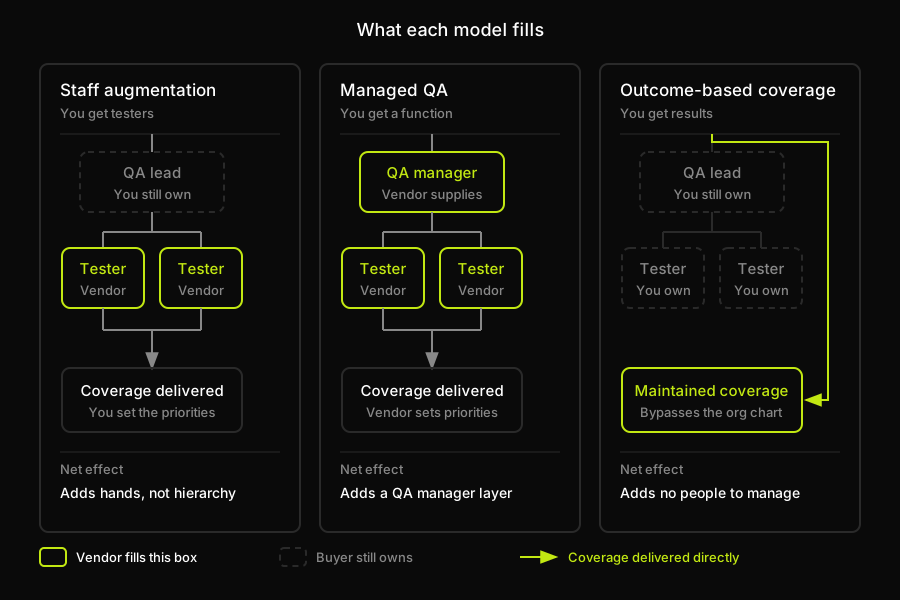
The same org chart under all three models. Staff augmentation fills the tester boxes and leaves the QA lead box to you, managed QA fills that box too, and outcome-based coverage fills no people box at all and routes the coverage straight past the chart. The empty boxes are the part of the purchase nobody quotes.
Onboarding time, the number nobody quotes
Every vendor pitch quotes a start date. None of them quote the onboarding time that has to happen before that date means anything, and treating it as a formality is the first mistake most buyers make.
Five things have to be true before a vendor, in any model, can produce a result you can act on, and none are optional. Two are infrastructure: an environment that behaves like production, and a stable account or seeded data that doesn't shift mid-test. Skip either one and the first weeks get spent debugging your environment instead of testing your product.
The other three are human, and teams forget to plan for them. Someone on your side has to be reachable to answer product questions; a tester guessing at intended behavior produces false positives that cost more trust than the bugs they'd have caught. Acceptance criteria has to be written down somewhere a stranger can read it, because "you'll know it when you see it" doesn't scale past the person who already knows the product. And the vendor needs a named triage owner, not a queue, because an unowned bug report is a bug report nobody fixes.
The clock doesn't start at contract signature. It starts once all five are actually true, and a vendor that quotes a start date without asking about any of them is quoting a number that has nothing to do with when useful testing begins.
Some managed models add a prerequisite of their own on top of those five: a dedicated test manager assigned to the engagement before work starts, and a provisioned environment or set of VMs reserved specifically for that engagement rather than shared across clients. That's a heavier onboarding lift than staff augmentation typically carries, and it's worth asking about explicitly rather than discovering it in week three. It's also part of why slow onboarding shows up as a real cost well before the hiring-versus-tooling comparison even gets calculated.
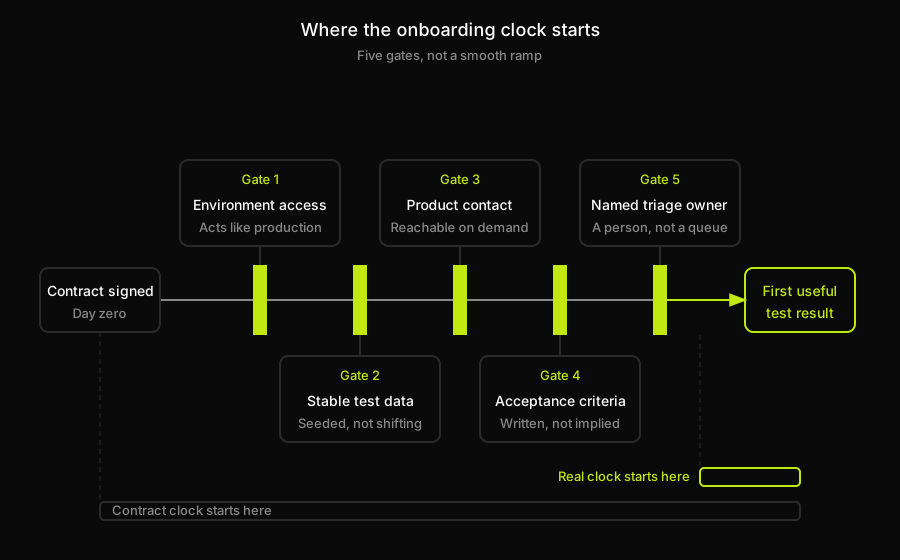
The contract clock starts at signature. The clock that produces a usable test result starts after the fifth gate clears, and every one of those gates is on your side of the table, not the vendor's. A quoted start date that names none of them is measuring the wrong span.
Switching cost is context, not contract
The termination clause is the easy part to negotiate and the least important part of the decision. Read it, understand it, then set it aside, because it's not where the real cost of switching lives.
What actually gets expensive when you switch vendors, or bring testing back in-house, is everything nobody wrote down: which flows matter to revenue, what "correct" looks like on edge cases with no spec, which failures are known and accepted, and the tribal knowledge that took the outgoing team months of runs to accumulate. None of that is in the contract. All of it walks out the door with the team that leaves.
The distinction that matters here is portability, not price. A test suite written in a standard framework, sitting in your own repository, is portable: hand it to the next vendor, your own hires, or an automation platform, and it keeps working. A test suite living inside a vendor's proprietary platform, reachable only through their dashboard, is not portable, no matter how good the coverage looked while they ran it. And every judgment call that lived only in a triage lead's head, never written into a ticket, isn't portable either. It's just gone.
The practical move is to contract for artifacts you can keep, before you sign, not after you're trying to leave: the test suite itself, in a format and location you own, plus documented rationale for the edge cases, not just passing test names. The order you migrate coverage in matters too if you're moving to something more automated at the same time you're changing who runs it; doing both at once is how teams lose the thread on what the tests were verifying.
How Autonoma compares to outsourcing
Outsourcing and Autonoma aren't competing for the same job, and the honest version of this comparison says so plainly rather than picking a side.
Outsourcing wins, clearly, wherever the work needs a human making a judgment call: exploratory testing that goes looking for problems nobody specified, manual verification on real devices and real locales, a person checking a real payment rail with real money moving through it, someone deciding whether a screen "feels" broken in a way no assertion would catch. None of that is what Autonoma does, and no automated system, ours included, replaces a human deciding something wasn't right.
What Autonoma replaces is the ongoing, maintained cost of automated behavioral coverage, without adding a person to run it. Our agents read the application's actual behavior from the codebase, generate end-to-end tests against it, and execute them in a live preview environment. The part that matters over time is what happens after that first pass: our Diffs Agent reads what changed in the code on every pull request and updates the relevant test cases to match, so the suite doesn't quietly drift out of sync the way a static suite, human-written or vendor-written, tends to once nobody's paid to keep revisiting it.
That's the actual resourcing question underneath all of this, stated plainly: a test strategy spends a resource that's genuinely scarce, and what that resource is has changed. It used to be the hours it took a person to write the next test. Now it's the attention it takes someone to review what an agent already wrote and decide if it's right. Outsourcing solves the first version of that problem by renting more hours. We solve the second version by keeping the review load small enough that one person, not a vendor team, can carry it.
Worth being precise about scope: Autonoma owns maintained end-to-end coverage of what your application actually does, and it pairs with a QA hire rather than standing in for one. If your gap is unit testing, load and performance, accessibility, or the API layer, the right shape of coverage without a QA team looks different depending on which one, and outsourcing one of those specific gaps can be exactly correct even for a team already running Autonoma for E2E.
Questions to ask a QA outsourcing partner before signing
Ask these regardless of which model is on the table, and expect specific answers, not category names. Treat each one as something you could paste into an email to a vendor today. If you're the QA lead or engineering manager fielding this without a dedicated QA function yet, this is the list to bring into the vendor call, not the pitch deck they hand you. None of these are gotcha questions; a vendor confident in what they actually do will answer specifically and quickly, and the hedging is usually a bigger signal than any single answer.
- Which model is this, actually? Get them to say the word: augmentation, managed, or outcome-based. A vendor who answers with "we're flexible" is telling you they haven't decided who owns triage, and neither will you, six weeks in.
- Who triages a failure at 2am, and what's the response window? Get a number in hours, not "we're responsive."
- Who owns the test artifacts, and in what format, if you part ways? This is the switching-cost question from earlier, asked directly, before signature.
- What has to be true on your side before the first test runs, and who's accountable for the gap if it isn't? This is the onboarding question, asked directly, and a vendor who can't name the prerequisites hasn't onboarded many clients.
- How do you measure success: escaped defects reaching production, or tests written? The second number is easy to inflate and doesn't correlate with quality; the first one does.
- What's your onboarding timeline, named against the specific prerequisite gates, not a generic range?
- Which compliance certifications do you hold, and can they produce the SOC 2 report rather than just naming it? For regimes that actually apply to your product, that's its own detailed checklist at PCI DSS compliance testing and CCPA compliance testing, and a vendor who can't answer the certification question specifically hasn't been through a real compliance review yet, which matters more than anything else on this list if you're in a regulated space.
None of this makes the decision for you, and it shouldn't. What it should do is make you harder to sell to in the specific way this market currently gets away with: quoting a start date with no onboarding gate named, calling a staffing contract a QA function, or answering the switching-cost question with a shrug about the termination clause instead of an answer about the artifacts. The three models aren't a ranking, they're a fit exercise, and buying the wrong one costs more in re-explaining your product to someone new than the contract itself ever will.
If the honest read of your situation is that you need maintained, automated coverage of what your product actually does, not more people to manage, Autonoma is built for exactly that piece of the resourcing question, and it's worth putting next to whichever outsourcing model you're evaluating rather than only against the other QA outsourcing companies on the list.
Frequently Asked Questions
QA outsourcing means contracting an outside team or vendor to handle software testing instead of building that capability in-house. QA outsourcing services are sold in three distinct models: staff augmentation, where you get contracted testers but still manage the work yourself; managed QA, where you get a function with its own lead making triage and process decisions; and outcome-based coverage, where you're buying maintained coverage rather than people. Each replaces something different on your org chart, and most disappointment with outsourcing comes from buying one model while expecting another.
Cost depends heavily on which model you're buying: staff augmentation, managed QA, and outcome-based coverage price out differently, and rates vary widely by region and scope. Rather than quoting figures that go stale quickly, the detailed breakdown by model and vendor type lives in our vendor pricing comparison. As a directional note, whatever the quoted rate is, the real cost also includes onboarding time before the first useful test result, which most quotes leave out entirely.
It depends on stage and what's missing. If no one owns quality decisions yet, managed QA can supply that ownership faster than a first QA hire would ramp. If a plan already exists and the gap is hands to execute it, staff augmentation fits better and costs less in management overhead. If the real gap is maintained automated coverage rather than people, outsourcing may be solving the wrong problem entirely, and tooling is worth evaluating first. The mistake is defaulting to outsourcing because hiring feels slower, without naming which specific gap it's meant to close.
Longer than the quoted start date, in most cases. Onboarding isn't complete until five things are true: access to an environment that behaves like production, a stable test account or seeded data, a reachable contact on your side for product questions, documented acceptance criteria, and a named triage owner on the vendor's side. Some managed models add a dedicated test manager and a provisioned environment on top of those five before anything executes. A vendor who quotes a timeline without naming these prerequisites is estimating, not reporting.
When the gap is maintained regression coverage rather than people to brief, which is worth naming before signing anything. All three models above scale by adding humans, and every one of them waits on the same five prerequisites: an environment that behaves like production, seeded data, a reachable product contact, documented acceptance criteria, and a named triage owner. Autonoma starts from the codebase instead. It reads your routes and flows, generates end-to-end tests from them, runs them against a live preview environment on every pull request, and its Diffs Agent adds, updates, and deprecates cases as the code changes, which is the part of an automated suite that decays fastest once a contract ends and nobody owns the upkeep. It does not do exploratory testing, and it does not make the judgment call that something feels wrong, so teams that need that layer keep a human in it. But if you are weighing a contract mainly to stop a regression suite from rotting, that is the specific job it takes over.
At minimum: which of the three outsourcing models they're actually selling you (they should name it directly, not describe themselves as flexible), who triages a failure and how fast, who owns the test artifacts if you part ways, what has to be true on your side before the first test runs, how they measure success (escaped defects, not tests written), their onboarding timeline against named prerequisites, and which compliance certifications they hold if that applies to your product.


