

Software testing cost in 2026 runs $40,000 to $180,000 per year for a typical 10-engineer team, based on 2026 market pricing and typical team composition. That range spans three cost buckets: tools (test runners, cross-browser grids, test management platforms), people (QA engineers, developer time writing and maintaining scripts), and infrastructure (CI compute, preview environments, dedicated test runners). Most teams only see the tools invoice. The people and infra buckets are larger and mostly invisible.
Most engineering leaders who budget for testing think about it as a line item for one or two tools. A BrowserStack subscription. Maybe a test management platform. The invoice arrives, gets approved, and the cost is considered known.
The actual testing spend is two to four times higher. Tools are the visible third. People-time on writing, maintaining, and triaging tests is often the biggest bucket, and it never appears on a vendor invoice. Infrastructure runs underneath every test execution and compounds quickly as teams scale. By the time a team reaches 15 to 20 engineers, testing spend is a meaningful operational cost whether or not anyone has added it up.
The Three Buckets of Testing Spend
Every testing budget breaks into the same three cost buckets, regardless of team size or stack. The proportions shift by stage, but the categories are universal.
Tools cover everything with a vendor invoice: cross-browser testing platforms, test management systems, test-case tracking, screenshot diffing services, load testing tools, and any SaaS that sits in the testing layer. These are the line items that show up in finance reviews. They feel controllable because there is an invoice attached.
People cover the engineering time that never shows up in a testing budget but costs more than the tools. Writing test scripts, maintaining them when the UI changes, triaging flaky failures in CI, investigating false positives, reviewing test coverage, and updating tests when features change. At a fully loaded $150K to $200K annual cost per engineer, two days per engineer per sprint on test maintenance at a 10-person team is roughly $60,000 to $80,000 per year in hidden testing labor. That number does not appear on any invoice.
Infrastructure covers the compute that runs the tests: CI pipeline minutes, parallel execution workers, cloud browser grids, dedicated test runners, and any preview environments where tests execute. Cloud CI costs scale nonlinearly. A team running 50 E2E tests per PR across 10 parallel workers generates substantially more CI spend than teams expect when they first instrument their pipelines.
The benchmark range for a 10-engineer team below reflects all three buckets at once. Most teams are only pricing one.
| Bucket | What's in it | Typical annual range (small team, ~5 engineers) | Typical annual range (scaling team, ~15-20 engineers) |
|---|---|---|---|
| Tools | Cross-browser grids, test management, screenshot diffing, CI integrations | $6,000 – $18,000 | $24,000 – $72,000 |
| People | QA headcount, developer time writing and maintaining scripts, triage hours | $15,000 – $40,000 | $80,000 – $200,000 |
| Infrastructure | CI compute minutes, parallel runners, preview environments, cloud browser nodes | $3,600 – $9,600 | $14,400 – $36,000 |
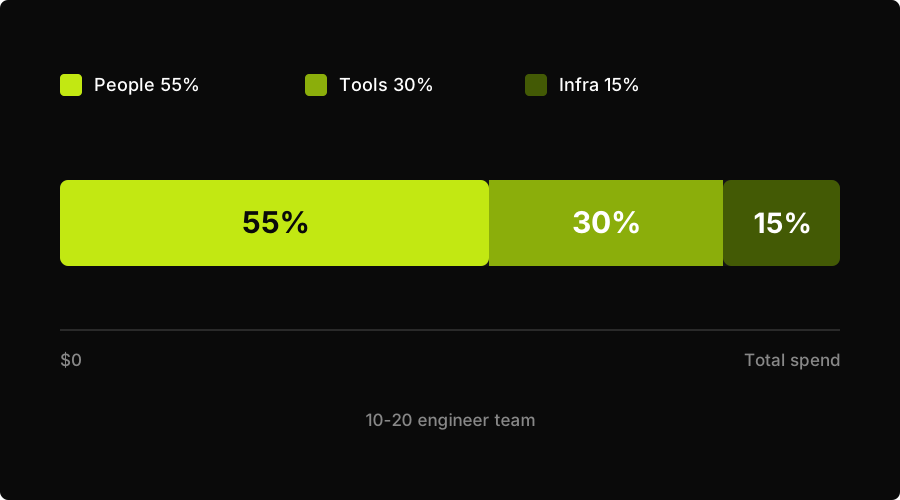
Testing spend split for a 10-20 engineer team in 2026. People-time is the largest hidden bucket.
How Testing Spend Shifts by Team Stage
The total benchmark range changes substantially by team stage, and so does the composition. Understanding how the mix shifts is the most useful input to a testing budget conversation.
At seed stage, testing spend is mostly people-time and free or low-cost tools. There is no dedicated QA headcount. Developer time on test maintenance ranges from informal to nonexistent. The tools tier is dominated by whatever is bundled into the CI system already. Infrastructure is the default GitHub Actions or GitLab CI allocation. Total annual testing spend for a seed team of three to five engineers typically runs $8,000 to $25,000, nearly all of it in hidden developer-hours on test-related work. The tools invoice is close to zero. The people cost is real but invisible.
At Series A (eight to fifteen engineers), the first paid tools appear. Teams buy a cross-browser grid subscription when they realize CI-only browser coverage misses Safari and mobile. A test management platform often follows when the spreadsheet-based test-case tracking breaks down. A QA contractor or first QA hire enters the picture. Infrastructure costs rise sharply as the PR volume grows and each PR runs an E2E suite. Testing spend by team stage at Series A typically runs $40,000 to $120,000 annually. The tools bucket is now visible on invoices. The people bucket has grown faster.
At Series B (20 to 40 engineers), dedicated QA headcount is the norm and sometimes the majority of testing spend. One to three QA engineers at $120K to $160K annually can represent $120,000 to $480,000 in the people bucket alone. Tool sprawl is the defining characteristic of this stage: separate vendors for browser testing, visual regression, load testing, mobile, test management, and flake tracking. Infrastructure scales with PR volume and test parallelism. Total testing spend by team stage at Series B is often $150,000 to $500,000 annually when all three buckets are counted. Finance typically only sees $40,000 to $80,000 in tool invoices.
Where the Money Leaks
Testing budgets have predictable leak points regardless of team stage. These are the categories where spend accumulates without a corresponding improvement in coverage or confidence.
Maintenance burden is the largest single leak. Every manually written test script requires ongoing maintenance as the product changes. When a designer renames a button, a selector breaks. When a form gains a new required field, the test fails for the wrong reason. When a flow is refactored, three tests need rewrites. A team with 200 Playwright tests running daily is spending meaningful engineering cycles each sprint on maintenance that has nothing to do with catching bugs. Studies on test maintenance burden consistently estimate 20 to 40 percent of total test-related engineering time goes to keeping existing tests current rather than writing new ones or investigating real failures.
Flaky tests are the second major leak. A test that fails intermittently trains engineers to ignore failures. Once the team learns to re-run tests until they pass, the tests stop functioning as a quality gate. The cost is twofold: CI compute is wasted on retries, and real failures get dismissed as likely flakes. Teams often spend significant engineering time on flake investigations that resolve to "probably a timing issue" without a real fix. Flaky tests also erode trust in the suite, which increases the probability that a real regression gets merged.
Redundant and overlapping tools compound at Series A and beyond. Teams accumulate test infrastructure by solving one problem at a time. A browser grid for E2E, a separate service for visual regression, a different tool for API tests, and a test management platform that duplicates the structure already in the CI system. Each tool has a subscription cost. Each tool has an integration to maintain. Each tool requires its own credential rotation, alert routing, and status-page monitoring. The overhead of managing the testing toolchain becomes a meaningful operational cost in its own right.
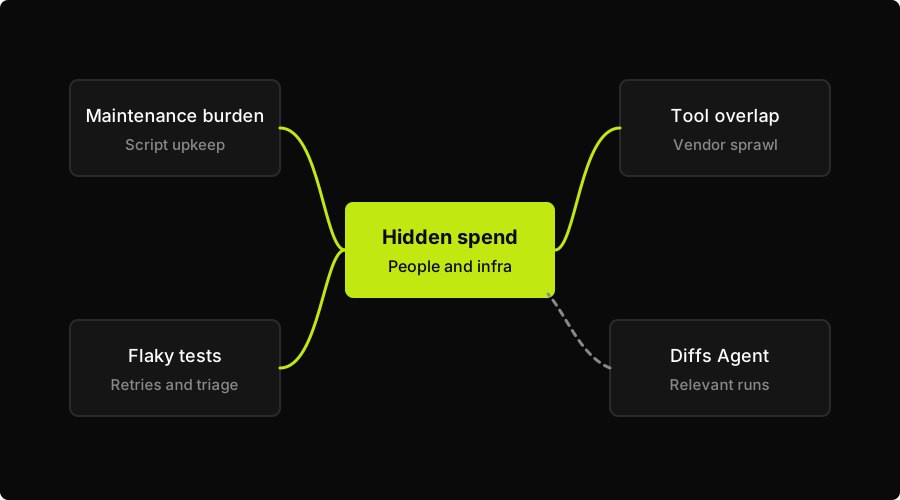
Most leaks are hidden labor and infrastructure. The Diffs Agent reduces waste by selecting relevant test work.
The flip side, covering what happens when testing infrastructure fails entirely, is detailed in the cost of not testing companion piece. This post is about the cost of the testing infrastructure itself.
How Autonoma Collapses Testing Line Items
The core problem this post documents is that testing spend fragments across three buckets, each with its own overhead and none of them fully visible on a single invoice. The leaks (maintenance burden, flaky tests, tool sprawl) compound the fragmentation.
Autonoma addresses this from the codebase level. Our four agents handle the full testing lifecycle: the Planner reads your routes, components, and user flows and generates test cases, including the database-state setup for complex scenarios. The Executor runs those test cases against a live preview environment per PR. The Reviewer classifies each result as a real bug, an agent error, or a test/plan mismatch, so engineers never triage ambiguous CI failures. The Diffs Agent runs on every PR, adding, deprecating, and updating test cases based on the code changes, which reduces manual maintenance pressure and avoids running irrelevant tests.
Because the Executor runs against a managed preview environment that we provision per PR, several of the three cost buckets become easier to control. Autonoma still has a consumption model: runs and generations consume a fixed amount of credits from the user's credit pool, and preview-environment usage may carry metered-pricing characteristics. The efficiency argument is that the Diffs Agent selects relevant test work from the code diff, so teams spend fewer credits and less engineering time on unnecessary execution while coverage improves across the route surface.
Per-Tool Cost Breakdowns
For deeper teardowns of the individual line items inside the tools bucket, we have published detailed analyses of the major platforms. Each post models actual costs at different team sizes rather than repeating list-price ranges.
The BrowserStack true cost breakdown covers how parallel-session pricing and peak-utilization patterns drive the real bill, with a worked example for a 12-engineer team. The QA Wolf pricing teardown covers the managed-service model and what you get versus what you maintain. For Mabl pricing, TestRail pricing, and a full test automation ROI model, posts in this series are publishing this week as part of the testing-economics cluster.
Each teardown covers one line item from the tools bucket in depth. The goal of this hub post is the overall spend picture. The teardowns are for when you need to model a specific vendor.
Final Thoughts
The benchmark range for software testing cost in 2026, $40,000 to $180,000 annually for a 10-engineer team, is large enough to be material in any engineering budget conversation. Most teams are paying something in that range whether or not they have budgeted for it, because the people and infra buckets accrue regardless of intent.
The practical implication is that testing is not primarily a tools-buying decision. Tools are the visible third of the bill. The decisions that move total testing spend most are: how much maintenance burden you carry (determined by how tests are written and maintained), whether you have flake under control (determined by your test architecture), and whether your toolchain is consolidated or sprawling (determined by how the suite evolved over time).
Autonoma was built specifically to compress the maintenance and sprawl dimensions. Codebase-first test generation with Planner-driven coverage, Executor-driven execution, Reviewer-driven result classification, and Diffs-Agent-driven maintenance reduces the engineer time required to keep E2E coverage aligned with each PR. For teams doing the full three-bucket accounting, that compression is where the budget argument lives.
FAQ
Software testing costs $40,000 to $180,000 per year for a typical 10-engineer team in 2026, based on 2026 market pricing and typical team composition. The range spans three buckets: tools ($6,000-$72,000 depending on team size), people-time ($15,000-$200,000), and infrastructure ($3,600-$36,000). Most teams only price the tools bucket. The people and infra buckets are typically larger and rarely appear on a single invoice.
Industry benchmarks typically place QA at 15-25% of the total engineering budget when all three cost buckets are counted (tools, people, infra). Teams that only count tool invoices often report 2-5%, which underestimates actual spend by 3-5x. The right percentage depends on product risk, release velocity, and how much manual versus automated coverage the team carries. High-release-velocity B2B SaaS teams often land closer to 20-25% of engineering spend once hidden maintenance time is included.
For a seed-stage startup of 3-5 engineers, QA cost for a startup typically runs $8,000-$25,000 per year, mostly in hidden developer time rather than tool subscriptions. At Series A (8-15 engineers), it grows to $40,000-$120,000 as paid tools and first QA headcount appear. At Series B (20-40 engineers), dedicated QA headcount plus tool sprawl can push total spend to $150,000-$500,000 annually. The jump between stages is driven more by headcount than tool cost.
People-time is the largest single component of testing spend for most teams, accounting for roughly 55% of the total. Tools account for approximately 30%, and infrastructure accounts for 15%. These proportions hold fairly consistently from Series A onward. At seed stage, tools are near-zero and the split is almost entirely people-time. The implication is that the biggest lever on total testing spend is not tool pricing but maintenance burden: how much engineer-time goes to writing and maintaining test scripts versus shipping features.
The three highest-leverage actions to reduce testing costs are: (1) eliminate maintenance burden by shifting to test generation that self-updates when code changes, rather than hand-written scripts; (2) fix flaky tests aggressively, since flake wastes CI compute and causes engineers to dismiss real failures; (3) audit for tool overlap and consolidate wherever a single platform covers multiple current line items. Tool pricing is rarely the biggest lever. Reducing the people-time bucket, primarily maintenance and triage hours, has a larger impact on total testing spend.


