

QA Wolf pricing is not published publicly. Based on publicly discussed ranges and team reports as of June 2026, a managed QA service engagement covering roughly 150 flows runs an estimated $72,000–$126,000/year as a recurring line item. QA Wolf is a fully managed QA service: their team builds and maintains your end-to-end tests, priced on test count with minimum commitments rather than a flat platform fee.
QA Wolf doesn't list a price. You click through to a demo gate, and unless your company name is familiar to them, you're waiting days for a reply before you know whether the number fits your budget. That opacity is intentional: managed QA services price on scope, and scope varies by suite size, team structure, and commitment length.
This article reconstructs what teams actually pay. Every dollar figure below is a modeled estimate based on publicly discussed ranges, third-party deal data, and team reports. Nothing here is an official QA Wolf quote. Treat these numbers the way you'd treat a Glassdoor salary range: directionally useful, individually variable.
How QA Wolf Prices
QA Wolf operates as a managed QA service, not a SaaS platform. You do not buy a seat license or a parallel-session tier. Instead, their team of human QA engineers and automation engineers builds your E2E test suite and maintains it as your application changes. That changes the pricing structure fundamentally.
The core model is per-flow pricing: the recurring line item scales with the number of user flows (tests) they cover on your behalf. A "flow" is roughly analogous to a user journey, a checkout, a login sequence, a settings update. QA Wolf scopes the engagement, agrees on coverage, and bills accordingly.
Three structural factors shape the final number:
| Pricing dimension | How it works | Buyer impact |
|---|---|---|
| Per-flow rate | Recurring charge per covered flow/test (modeled range: $40–$70/flow/month, based on publicly discussed figures) | Suite growth raises your bill. Scope creep is expensive. |
| Minimum commitment | Annual contract with a minimum floor (teams report 12-month minimums; shorter terms carry a premium) | Budget certainty, but limited flexibility if your product shrinks |
| Onboarding / setup | Initial build phase for existing flows; may carry separate project fee | Front-loaded cost before ongoing billing begins |
The key thing to understand: QA Wolf's pricing is a recurring service fee, not an infrastructure fee. You are paying for a human team to write, run, and maintain tests. That team's time is what drives the per-flow number, and it is why the model does not naturally come down as your suite grows the way a SaaS seat license does.
Modeled by Suite Size
Using the publicly discussed per-flow range of $40–$70 per flow per month (figures circulated in buyer communities and deal databases as of June 2026), here is what annual cost looks like at three common suite sizes. These are modeled estimates, not official QA Wolf pricing.
| Suite size | Flows covered | Low estimate (annual) | High estimate (annual) |
|---|---|---|---|
| Small team | ~50 flows | $24,000/yr | $42,000/yr |
| Mid-size team | ~150 flows | $72,000/yr | $126,000/yr |
| Large team | ~400 flows | $192,000/yr | $336,000/yr |
A few things worth noting before reading these numbers. First, the per-flow rate assumption ($40–$70/month) comes from deal reports and buyer community discussions, not from QA Wolf's website. Second, actual contracts likely negotiate volume discounts at the high end, so the large-team high estimate may overstate for well-negotiated deals. Third, these figures assume steady-state pricing after onboarding; the initial build phase may carry an additional project cost.
The pattern is clear regardless of where you land in the range: QA Wolf is a significant recurring line item, sized more like a contractor engagement than a SaaS tool.
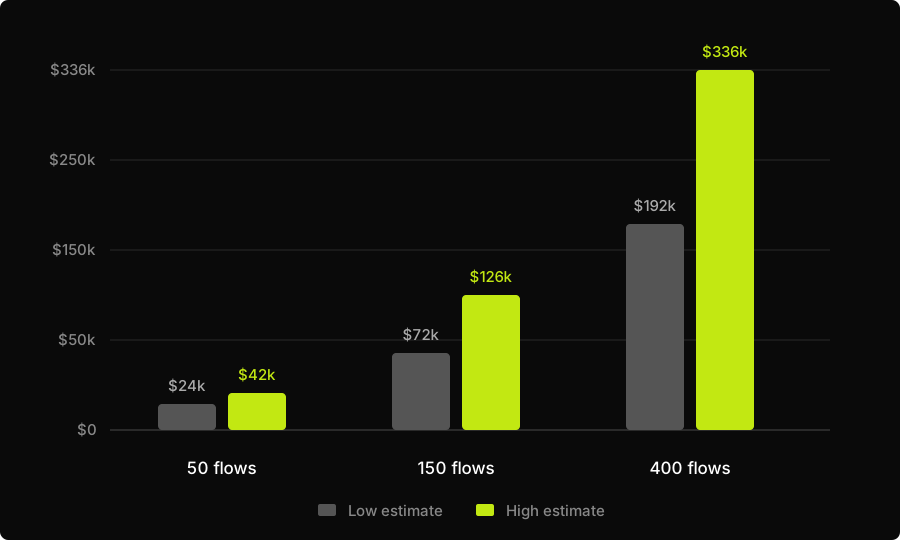
Modeled QA Wolf annual cost using $40-$70 per flow per month as of June 2026; not official QA Wolf pricing.
Managed Service vs Autonomous Tooling
The managed-service model has a clearly defined value proposition: a human team builds and maintains your tests, and you do not have to hire or operate anything. For teams that genuinely have zero appetite to run tooling, that is a real trade.
The cost structure, however, is a recurring line item priced on test count. Every flow you add raises the monthly bill. Every flow the team maintains represents ongoing labor cost. As your product grows, your QA Wolf contract grows with it.
Autonoma takes a different structural approach. Our four agents (Planner, Executor, Reviewer, and Diffs Agent) build and maintain E2E coverage from your codebase automatically, on every PR. The Diffs Agent keeps the suite aligned as your code changes, reducing the manual triage and rewrite work that drives human service pricing. Autonoma still has a consumption model: runs and generations each consume a fixed amount of credits from the user's credit pool, and preview-environment usage may carry metered-pricing characteristics.
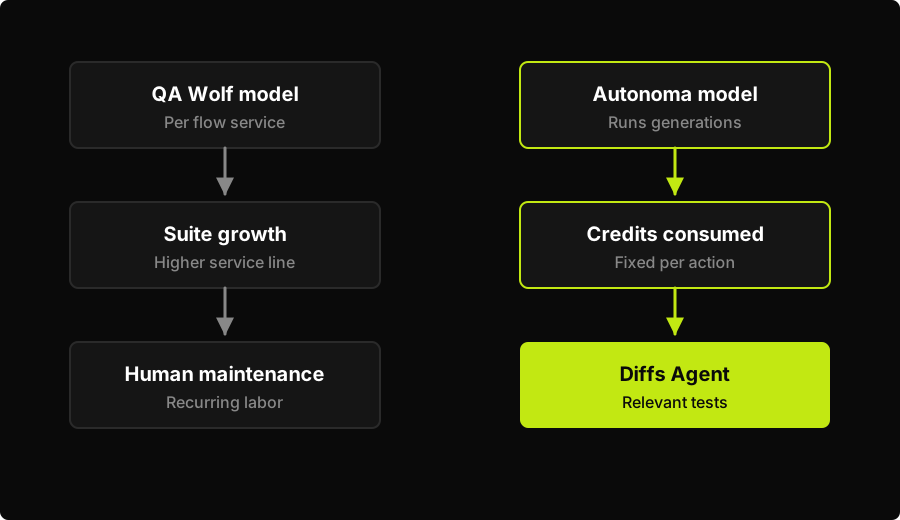
QA Wolf scales by covered flows. Autonoma uses credits for runs/generations; the Diffs Agent selects relevant tests.
For teams evaluating both models, a comparison of Autonoma vs QA Wolf walks through the full architectural difference in one place.
Who QA Wolf's managed service genuinely fits. Teams that want a completely done-for-you, human-backed QA operation are the right fit for QA Wolf. If you have no one on staff with any QA or automation background, and you want a team you can hand a Jira board to and walk away, a managed QA service earns its fee. For that buyer, the per-flow pricing is the cost of delegation, not an inefficiency.
What Teams Spend on QA Overall
QA Wolf is one line item in a broader QA budget. Whether you are comparing it against in-house tooling costs or a competing service, the managed-service model occupies a specific cost tier: higher than pure SaaS tooling, positioned as an alternative to internal QA headcount. For a full picture of where QA Wolf sits in the broader landscape of software testing cost, including tool costs, headcount costs, and the tradeoffs between them, that hub article is a useful starting point.
For a direct comparison between hiring in-house versus paying a managed service, the breakdown in cost of hiring a QA engineer vs a tool covers the full math. If you are also evaluating test management platforms alongside QA services, TestRail pricing covers that parallel cost.
How Autonoma Addresses the Per-Flow Cost Structure
The pattern QA Wolf surfaces is a persistent one in managed testing: the cost of maintaining tests grows in proportion to suite size, because humans are doing the maintenance work. That is not a knock on QA Wolf specifically. It is the underlying economics of any managed service built on human labor.
We built Autonoma to change that relationship. Our Planner agent reads your codebase (routes, components, user flows) and plans the test cases. The Executor agent runs them against a live preview environment. The Reviewer agent classifies results: real bug, agent error, or test/plan mismatch. The Diffs Agent runs on every PR, analyzing code diffs and updating the test suite to stay aligned as the codebase evolves.
The result is that suite size does not create the same human-service cost curve as a managed QA engagement. A 400-flow suite still consumes more execution resources than a 50-flow suite, and Autonoma runs and generations subtract credits from the user's credit pool. The economic difference is that the agents do the maintenance work that would otherwise be billed as recurring service hours, while the Diffs Agent selects relevant tests instead of blindly running the whole suite.
FAQ
QA Wolf does not publish pricing publicly. Based on publicly discussed ranges and team reports as of June 2026, teams covering roughly 150 flows report paying an estimated $72,000–$126,000 per year. Smaller suites (~50 flows) run an estimated $24,000–$42,000/year. Larger suites (~400 flows) can reach $192,000–$336,000/year. All figures are modeled estimates, not official QA Wolf quotes.
No. QA Wolf uses a demo-gated pricing model. You must book a call to receive a quote. This is standard for managed QA services, where pricing depends on suite size, team structure, and commitment length rather than a fixed tier.
QA Wolf operates as a managed QA service with per-flow pricing. Their team builds and maintains your end-to-end tests, and you pay a recurring line item that scales with the number of flows (user journeys) they cover. Contracts typically include minimum commitments, commonly 12-month annual terms.
For teams with no QA or automation staff and no appetite to operate tooling, a managed QA service can earn its fee as a delegation cost. For teams that can connect a codebase to an autonomous testing platform, the comparison should separate QA Wolf's per-flow service model from Autonoma's credit-based runs and generations, with efficiency coming from diff-based test selection.
A mid-size QA Wolf engagement (~150 flows) runs an estimated $72,000–$126,000/year. A single mid-level QA engineer costs $90,000–$130,000/year in fully-loaded comp before benefits. The managed service is roughly cost-competitive with one headcount for that suite size, but without the ramp time or the flexibility to redirect the person to exploratory or non-automation work.
Final Thoughts
QA Wolf is a well-regarded managed QA service with a clear value proposition: a human team handles the entire test-build-and-maintain cycle. The cost is real and it scales with suite size, structured as a recurring line item with minimum commitments that reflect annual contract norms in managed services.
For buyers evaluating the economics: model your expected suite size against the per-flow range above, add a buffer for suite growth over the contract term, and compare that against what it would cost to operate an autonomous testing platform. Autonoma's agents cover the same build-and-maintain cycle automatically on every PR, with runs and generations consuming credits and the Diffs Agent selecting relevant tests based on the code diff. If you are still in evaluation mode, the Autonoma vs QA Wolf comparison is the most direct place to see the architectural difference side by side.
The right choice depends on your team. But now you have the number to start the conversation with.


