

TestRail pricing starts at approximately $36 per user per month on Cloud Professional billed annually (per testrail.com, as of June 2026). A 10-person team pays roughly $4,320 per year in subscription alone, before any Enterprise uplift or Server licensing. Cloud is SaaS (subscription); Server is self-hosted (perpetual-style license plus annual maintenance). Exact figures require a quote from TestRail directly.
Per-user pricing sounds straightforward until you model it across a realistic team. A solo QA engineer is one thing. A 25-seat QA org on the Enterprise plan is something else entirely, and the difference compounds every year the headcount stays flat. This post builds the cost model that testrail.com's pricing page and the major review sites skip: annual spend by headcount, with the math shown.
TestRail's plans, decoded
TestRail sells two delivery models (Cloud/SaaS and Server/self-hosted) and two tiers (Professional and Enterprise) within each. That gives four combinations, each suited to a different buyer profile.
| Plan | Delivery | Per-user price | Billing model | Best fit |
|---|---|---|---|---|
| Professional | Cloud (SaaS) | ~$36/user/month (annual) | Subscription, billed annually | Small-to-mid QA teams that want managed hosting |
| Enterprise | Cloud (SaaS) | Custom (est. ~$69/user/month) | Subscription, custom contract | Large orgs needing SSO, advanced reporting, dedicated support |
| Professional | Server (self-hosted) | Est. ~$5,400 per 10-user pack (one-time) + annual maintenance | Perpetual license + renewal | Teams with data-residency or air-gap requirements |
| Enterprise | Server (self-hosted) | Custom/quote-based | Perpetual license + renewal | Large regulated orgs needing self-host + enterprise features |
Sources: testrail.com pricing page and Capterra, as of June 2026. All per-user figures are published list prices or third-party estimates. Server figures are commonly cited estimates from third-party listings; TestRail has shifted its primary emphasis toward Cloud. Minimum seat counts and annual-billing requirements apply. Confirm exact pricing with TestRail before purchasing.
A few things worth unpacking. Cloud Professional is the entry point most teams land on: $36/user/month billed annually, no infrastructure to run. Cloud Enterprise is quote-only; the ~$69/user/month figure appears in Capterra listings and third-party comparisons but is an estimate, not a published rate. Server Professional flips the model to a perpetual license in user-count packs, which can look cheaper on paper at small scale but adds a maintenance-and-support renewal each year and requires your team to operate the instance.
Modeled by team size
This is the section the official pricing page doesn't show. Below is the annual subscription cost for TestRail Cloud Professional at $36/user/month, alongside an estimate for Cloud Enterprise at the commonly cited ~$69/user/month, modeled at four realistic team sizes.
| Team size | Cloud Professional (annual) | Cloud Enterprise est. (annual) |
|---|---|---|
| 5 users | $2,160 | ~$4,140 |
| 10 users | $4,320 | ~$8,280 |
| 25 users | $10,800 | ~$20,700 |
| 50 users | $21,600 | ~$41,400 |
Math: Cloud Professional = users × $36 × 12. Enterprise estimate = users × $69 × 12. Enterprise column is an estimate based on Capterra and third-party sources; actual Enterprise pricing requires a quote from TestRail. Figures are for the subscription only and do not include implementation, training, or the labor cost of managing test cases inside the platform.
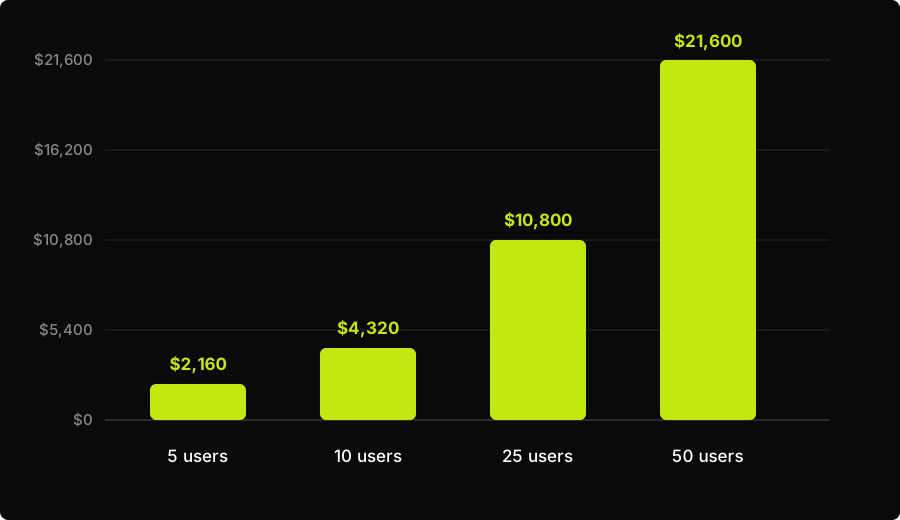
TestRail Cloud Professional annual cost at 5, 10, 25, and 50 users, using the $36/user/month list rate.
The curve is linear but the pain isn't. At 5 users, $2,160 is a rounding error in most engineering budgets. At 50 users, $21,600 on the Professional plan alone is a budget line that gets reviewed. And that's before the actual labor cost of the test-case workflow those seats are paying to manage.
Test management vs test execution
TestRail is a test management platform. That is a specific, well-defined category: it stores and organizes manual test cases, manages test runs and plans, tracks which cases passed and which failed in a given run, generates traceability reports against requirements, and gives QA managers a reporting dashboard. TestRail does not run your application. It does not generate test steps from your code. It manages the records of tests that humans define, execute (manually or via automated runners reporting results back to the API), and maintain.
Autonoma is not a test-management platform. That is a hard exclusion, not a marketing hedge. We do not store or organize manual test cases. We do not provide a requirements-traceability dashboard. We do not replace the system-of-record function that TestRail serves for compliance-heavy or large manual QA organizations.
The honest bridge between the two is the cost structure of the manual test-case workflow itself. TestRail's per-user pricing scales with the number of people who author, update, triage, and review test cases inside the platform. At 50 users paying ~$21,600 per year in subscriptions, a meaningful share of that team's time is also spent writing and maintaining the test cases that TestRail tracks. The subscription is the visible line item. The authoring labor is the invisible one, and it tends to grow with the same headcount.
An autonomous E2E testing approach does something different: it generates and maintains tests directly from the codebase rather than from human-authored test steps. The test cases that TestRail tracks (login flow, checkout flow, onboarding) describe behaviors that live in code. If the code is the spec, the spec can be read directly.
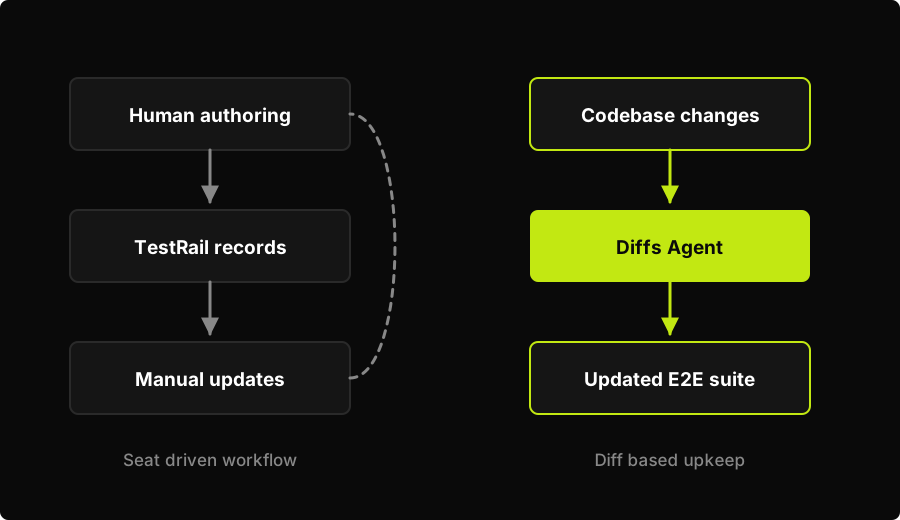
TestRail organizes human-authored cases. Autonoma shifts E2E upkeep toward code diffs and relevant test selection.
That does not mean TestRail is the wrong buy. If your organization has manual testing workflows, compliance traceability requirements, or a large QA team coordinating test execution across multiple platforms, TestRail is solving a real organizational problem. The question is whether the volume of manually authored and maintained test cases that drives your per-user seat count is fixed by your workflow, or whether part of it could be shifted upstream.
For a comparison with open-source alternatives in this space, see our post on the open-source alternative to TestRail and our breakdown of QA Wolf pricing as a managed-service point of comparison. For the bigger picture, our guide to what software testing actually costs puts subscription fees in context with the labor that surrounds them.
How Autonoma Reduces the Manual Test-Case Maintenance Tax
The pattern this article documents is straightforward: TestRail's subscription cost grows with headcount because test management is a per-person coordination problem. More people writing, reviewing, and updating test cases means more seats. More seats means a larger annual invoice. The subscription and the labor overhead scale together.
Our four agents tackle the root of that pattern. The Planner agent reads your codebase (routes, components, user flows) and plans the test cases directly from code structure, without anyone authoring test steps in a management tool. The Executor agent runs those cases against a live managed preview environment on every PR. The Reviewer agent classifies each result: real bug, agent error, or test/plan mismatch. The Diffs Agent analyzes code diffs on every PR and adds, updates, or deprecates test cases automatically, so the suite stays aligned with the codebase as it evolves.
The Planner also handles database state setup automatically, generating the endpoints needed to put the database in the right state for each test scenario. That eliminates a category of test-case authoring work (writing and maintaining precondition setup steps) that typically requires dedicated effort in a manual test workflow.
The result is a different cost shape. Instead of a per-seat subscription that grows with the number of people managing test artifacts, Autonoma uses runs and generations that each consume a fixed amount of credits from the user's credit pool. The manual authoring and maintenance overhead that fills TestRail seats shrinks because the agents own much of that work, and the Diffs Agent selects relevant tests from each code diff rather than running everything.
For teams that need to remain on TestRail for compliance or coordination reasons, the two approaches are not mutually exclusive: run Autonoma's agents for automated E2E coverage, keep TestRail for the traceability and reporting workflows that require it. For teams evaluating whether to invest in a test-management platform at all, the more relevant question may be how much of the test-case volume they are paying to manage could be generated and maintained automatically instead.
Final thoughts
TestRail pricing is transparent at the per-user level ($36/user/month on Cloud Professional, per testrail.com as of June 2026) and opaque at the team-cost level, because no official source models it. A 5-person team at $2,160 per year is a different decision than a 50-person team at $21,600. The Enterprise plan, which requires a custom quote, adds another layer of uncertainty for growing organizations.
The right buy decision depends on what the seats are actually doing. TestRail is the correct tool for organizations that need a system of record for manual test cases, compliance traceability, and coordinated test-run management. The per-user pricing is the cost of that organizational coordination function.
Where Autonoma fits is in the layer before that: generating and running the E2E tests that manual test cases describe, directly from the codebase, without the authoring and maintenance overhead that drives test-management seat counts. The subscription cost modeled above is real. The question worth asking is how much of the workflow generating that cost could be automated instead.
FAQ
TestRail Cloud Professional is approximately $36 per user per month billed annually, per testrail.com as of June 2026. That works out to $432 per user per year. A 10-person team pays roughly $4,320 per year. Cloud Enterprise is custom-priced (commonly estimated around $69/user/month by third-party sources). Server (self-hosted) uses a perpetual-license model, with a commonly cited figure of around $5,400 for a 10-user pack plus annual maintenance. All figures should be confirmed directly with TestRail before purchasing, as pricing can change.
Yes. TestRail uses per-user pricing on both its Cloud and Server plans. On Cloud Professional, the list rate is approximately $36 per user per month billed annually. This means the annual subscription grows linearly with headcount: 5 users costs roughly $2,160 per year, 25 users costs roughly $10,800 per year. Minimum seat counts and annual-billing requirements apply; verify on testrail.com.
TestRail Cloud is a SaaS subscription, approximately $36/user/month on Professional billed annually. TestRail Server is a self-hosted perpetual-license model sold in user packs (commonly cited at around $5,400 for 10 users) plus an annual maintenance and support renewal. Cloud shifts the infrastructure cost to TestRail; Server requires your team to operate the instance. TestRail has shifted its primary emphasis toward Cloud. Server may look cheaper upfront at small scale but adds ongoing operational overhead and a recurring maintenance fee.
TestRail does not offer a permanent free plan. It does offer a free trial so teams can evaluate the product before committing. After the trial period, a paid subscription is required. Check testrail.com for current trial terms, as these can change.
For a small team of 5 users on TestRail Cloud Professional at $36/user/month billed annually, the cost is approximately $2,160 per year. For 10 users, roughly $4,320 per year. These figures assume the published list rate from testrail.com as of June 2026 and annual billing. If minimum seat counts apply, the floor cost may be higher than these figures suggest. Confirm directly with TestRail for your specific team size and requirements.


