

Free test case management comes in three real forms: capped SaaS free tiers like Qase (about 3 users) and Tuskr (5 users, 1,000 cases), open-source test management systems like Kiwi TCMS and TestLink that are free to license but require self-hosting, and the plain spreadsheet, which is free and unlimited but entirely manual. Each option is genuinely free, up to a point: free tiers cap users and cases, open source trades money for your maintenance time, and spreadsheets stop scaling once nobody trusts the rows anymore.
The sticker price on all of this is zero. The real bill shows up later, in the hours someone spends writing test cases by hand, then rewriting them six months later when the checkout flow changes and half the rows quietly stop being true.
That's the part most "best free test case management tools" roundups skip. They'll tell you Qase has a free plan and TestLink is open source, then move on without saying what the free tier actually caps, or what self-hosting actually costs in engineer time. If you want the full buyer-neutral rundown across every price tier, that comparison lives in a separate hub post. This page is narrower: what's actually free right now, where each option caps out, and what "free" still doesn't solve for any of them.
Autonoma matters in this comparison because it attacks the work that free storage never touches. A free TMS can hold a case after someone writes it; Autonoma can generate, execute, review, and update the automated E2E slice so fewer cases need to be stored by hand at all.
The free test case management options
Free test management software comes in three categories, and they mean three different things by "free." SaaS tools cap the free tier by seats and cases. Open-source tools remove the license cost but not the hosting cost. The spreadsheet caps nothing, until the sheet itself becomes the problem.
| Tool | Free tier | User/case cap | Best for |
|---|---|---|---|
| Qase | Free forever plan | 3 users, 2 projects | Solo QA, evaluating before buying |
| Tuskr | Free forever plan | 5 users, 1,000 cases | Small teams, full features free |
| Kiwi TCMS | Open source, self-host | Unlimited (GPL-2.0) | Teams with capacity to self-host |
| TestLink | Open source, self-host | Unlimited (GPL) | Budget-constrained, PHP/MySQL stack |
| Testmo / TestRail | Trial only, not free | 14 to 30 day trial | Evaluating before a paid commitment |
| Google Sheets / Excel | Free, unlimited rows | No cap, fully manual | Under roughly 200 cases |
A couple of these are worth calling out directly. Qase's free tier is real but narrow: 3 users and 2 projects, with 500MB of storage and a 30-day test history window, positioned by Qase itself as a plan for individuals learning the tool rather than a production team. Tuskr's free tier is the most generous of the SaaS options: 5 users, 5 projects, and 1,000 test cases, with SSO, 2FA, and Jira integration included rather than gated behind a paid plan. Testmo and TestRail don't belong in a "free" list at all; both offer a time-boxed trial and nothing beyond it, which is a fundamentally different commitment than a free tier that doesn't expire.
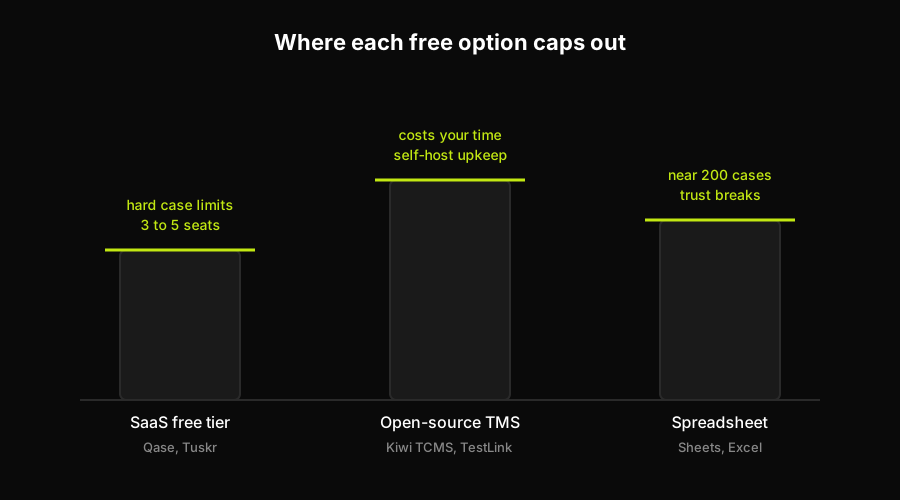
Every free option has a different ceiling. The question is which ceiling you hit first.
Spreadsheets: free until they aren't
The spreadsheet is the only option on that table with no seat cap, no case cap, and no trial clock. For a small team with a few dozen manual cases, it's genuinely fine: fast to set up, free forever, and editable by anyone who can open a browser. A copyable test case template with the standard ID, precondition, steps, and expected-result columns will get a new team further than most paid tools' onboarding flow.
Where it breaks isn't a fixed row count, it's a set of failure modes that show up together as the sheet grows. There's no execution history: a Status column shows the last run, not the last ten, so you can't tell if a case has been flaky for months or just failed once. There's no traceability back to the code a case is actually testing, so a redesigned checkout flow leaves rows behind that nobody remembers to delete. Two people editing the same file produce merge conflicts or silently overwritten cells instead of a clean record. And there's no run tracking across a cycle, only whatever the most recent edit happened to say. In practice, teams feel this somewhere around 200 cases, not because of a technical limit, but because that's roughly where nobody can hold the whole sheet's state in their head anymore.
Open-source TMS as a free option
Kiwi TCMS and TestLink solve the license-cost half of "free." Both are free to download, free to self-host, and free of per-seat pricing forever, which is a real advantage over a capped SaaS tier if your team has the operational bandwidth. Kiwi TCMS's Community Edition ships under GPL-2.0 and runs from an upstream container image; TestLink has been available under GPL since 2004 and still ships bug fixes, though its release cadence and community have both slowed over the years.
What "free" doesn't include is upkeep. Someone owns the server, the database, the upgrades, and the backups, and that someone is now doing test management administration instead of testing. For a full breakdown of what that tradeoff actually costs in hours, and how it compares across the open-source field, see the dedicated open-source test management comparison. This page's job is narrower: naming open source as a legitimately free option, not walking through every tool in the category.
The hidden cost of free: maintaining the cases
Here's what all six rows in that table have in common. Every one of them solves storage. None of them solve authoring, and none of them solve maintenance. Qase, Tuskr, Kiwi TCMS, TestLink, and the spreadsheet all give you somewhere to put a test case once it exists. Not one of them writes the case for you, and not one of them notices when the feature underneath it changes and the case is now wrong.
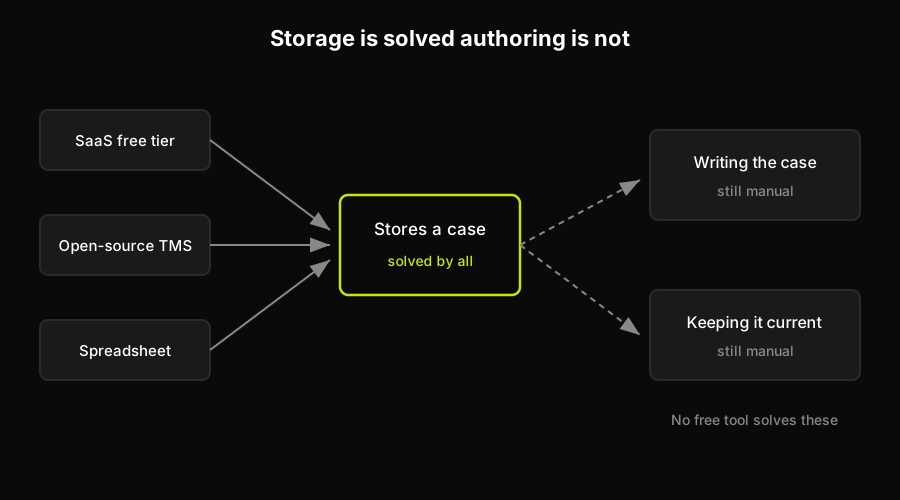
Free tools compete on storage. The real cost is the writing and the rewriting they all leave to you.
That reframes the actual question. It isn't "which free tool should hold our test cases," it's "how many test cases does a human actually need to author and keep current." For manual, exploratory, and compliance testing, the answer is still a real number, and a TMS or a spreadsheet is still the right place to track it. But for the automated browser and E2E testing slice, that number can shrink dramatically. We built Autonoma to generate and run that automated slice directly from your codebase instead of from a human's memory of what the app used to do, and to keep those cases current as the code changes, so there's nothing left in a spreadsheet or a TMS to go stale. That's scope, not a replacement: manual and exploratory cases still belong in a real test case management tool, but the automated slice stops being cases someone has to hand-author at all.
How Autonoma removes the authoring step entirely
Every option in the comparison table above is a place to store a test case someone already wrote. That's the pain this whole guide has been circling: free tools reduce your bill, but none of them reduce the hours spent writing cases and then rewriting them every time the product changes underneath.
Autonoma's architecture attacks that labor directly instead of giving it a cheaper home. The Planner agent connects to your codebase, reads the actual routes, components, and user flows, and plans test cases from what the application does, including the database state each scenario needs to run correctly. The Executor agent then runs those cases against a live preview environment, driving the real UI rather than replaying a recorded script. The Reviewer agent looks at each result and sorts it into a real product bug, an agent error, or a case that no longer matches the current code, so a red run doesn't automatically mean a broken feature. On every pull request, the Diffs Agent reads the code diff and adds, deprecates, or updates the affected cases, which is the step a free tier, an open-source install, or a spreadsheet never does on its own.
Mapped against the free options above: where Qase and Tuskr give you a place to log a case, Autonoma generates it. Where Kiwi TCMS and TestLink ask you to trade license cost for hosting and upkeep time, Autonoma's agents absorb the upkeep for the automated slice of your suite. Where a spreadsheet goes stale the moment a flow changes, the Diffs Agent updates the case in the same pull request that changed the flow. None of that touches your manual, exploratory, or compliance test cases; those still need a TMS or a spreadsheet, and that's fine. It just means fewer cases in that spreadsheet need a human's name next to them.
Picking the right free option for where you are
Match the tool to the actual constraint, not to the word "free." A solo QA person or a two-to-three-person team validating a workflow before committing budget gets enough from Qase's free plan to learn a real test case management interface without spending money that hasn't been approved yet. A small team of up to five that wants a genuinely complete tool, not a stripped-down demo meant to push an upgrade, currently gets the most out of Tuskr's free tier: SSO, 2FA, and Jira integration included rather than gated behind a paid seat.
If your case count is going to blow past a thousand rows and someone on the team can own a server, Kiwi TCMS or TestLink remove the seat cap entirely in exchange for that ownership, and either one is a reasonable long-term home for manual and exploratory cases once self-hosting stops being a novelty and starts being routine maintenance. If none of that fits yet, because there's no formal QA process at all, start with the spreadsheet. A test case template with the right columns for precondition, steps, and expected result will outlast most tool trials, costs nothing to set up, and costs nothing to abandon later if the team outgrows it.
None of these choices are permanent, and none of them are wrong at the stage they're built for. The question worth asking before committing to any of them is different from "which one is free": how much of what's about to get logged by hand is repeatable browser and E2E behavior that doesn't strictly need a human typing it into a spreadsheet or a TMS in the first place.
That is the practical recommendation: pick the free tool that fits your manual and exploratory cases, but use Autonoma for the automated E2E layer before it becomes another stale backlog. The spreadsheet, Qase, Tuskr, Kiwi TCMS, and TestLink can all store what remains. Autonoma is the better answer for the slice that should generate and maintain itself from the codebase.
FAQ
For a capped SaaS free tier, Tuskr is currently the most generous: 5 users, 5 projects, and 1,000 test cases with SSO, 2FA, and Jira integration included. Qase's free tier is narrower (3 users, 2 projects, 30-day history) but works well for a solo tester evaluating the tool. If you need no user or case cap at all, an open-source option like Kiwi TCMS or TestLink is free to self-host indefinitely, in exchange for owning the hosting and maintenance yourself.
Yes. Qase and Tuskr both offer permanent free tiers (not time-limited trials) with real user and project caps. Kiwi TCMS and TestLink are free open-source software you self-host with no user cap, at the cost of running and maintaining the server yourself. Testmo and TestRail, by contrast, only offer a free trial, not a free tier, so they don't belong in the same category.
Yes, and it's genuinely free and unlimited in rows. It works well for a small team with a few dozen manual cases: fast to set up, easy to share, no login limits. It breaks down as the sheet grows because there's no execution history beyond the last run, no traceability back to the code being tested, and no protection against merge conflicts when two people edit at once. Most teams feel this somewhere around 200 cases.
Kiwi TCMS and TestLink are the two most established free open-source test management systems. Kiwi TCMS's Community Edition ships under GPL-2.0 and is actively maintained with a container-based self-host path. TestLink, under GPL since 2004, is older and has a slower release cadence, but it's simple to run on a standard PHP and MySQL stack and still receives bug fixes.
Only within their caps. SaaS free tiers like Qase and Tuskr scale until you hit the user, project, or case ceiling, at which point you're on a paid plan. Open-source tools like Kiwi TCMS and TestLink scale in case count without a hard limit, but scale in operational effort as you self-host, upgrade, and back up the system yourself. A spreadsheet scales in row count but not in trustworthiness, since nothing keeps the rows in sync with the product as it changes.


