

Test reporting tools aggregate test results across your CI pipeline into dashboards, trend lines, flake detection, and history views. They are the layer between raw pass/fail output and actionable signal. But a report is only as honest as the tests behind it: a beautiful green dashboard sitting on a flaky, brittle suite is still a lie.
The dashboard was entirely green. All 847 tests passing. The on-call engineer closed the alert and went back to bed.
Production was down for four hours.
Every experienced QA lead has a version of this story. Either you stare at a perfect green report while users are hitting a broken checkout flow, or you stare at a wall of red that turns out to be a single CSS selector change that broke three hundred tests in one go. The report looked authoritative. The report was wrong in both directions.
That is the real problem test reporting tools are trying to solve. Not just pretty dashboards. Not just CI integration. The signal-to-noise problem: is this result telling me something real?
What a test reporting tool should do
The basics are table stakes. Any tool worth using gives you aggregation (pull results from every runner into one place), a CI integration that doesn't require a custom script, and something to look at after the run. Teams reach for automation test reporting tools precisely when a suite outgrows a single runner's terminal output: once you have multiple pipelines, parallel shards, or several languages in the same repo, you need a place that pulls everything together. What separates the useful tools from the decorative ones is what they do with that combined history.
Trend lines matter because a single run is almost meaningless. A test that fails once in fifty runs is a different problem than a test that fails every third run. Flake detection is the feature that separates good reporting tools from great ones: the ability to identify which specific tests have an unstable pass rate over time, scored across dozens of runs rather than just flagging the last three. Without it, your team manually tracks which tests to trust, which creates tribal knowledge instead of process. A per-test flake score that persists across builds is the difference between "this test was flaky this morning" and "this test has been flaky 30% of the time for two weeks and we should fix or quarantine it."
False failure identification is the hardest problem. A false failure is a test report outcome that shows a failed test when the application behavior was actually correct. The test failed because of a selector mismatch, a timing issue, or an environment fluke. This category of false negative poisons every trend line and every dashboard, because a team that sees a wall of red learns to ignore red. That is far more dangerous than no reporting at all.
A good test reporting tool helps you separate signal from noise. The best ones give you enough historical data, flake scores, and CI integration depth that you can distinguish a real regression from a broken environment. If you want to understand what metrics to track alongside that, the test automation metrics and release quality strategy post covers the measurement layer in detail.
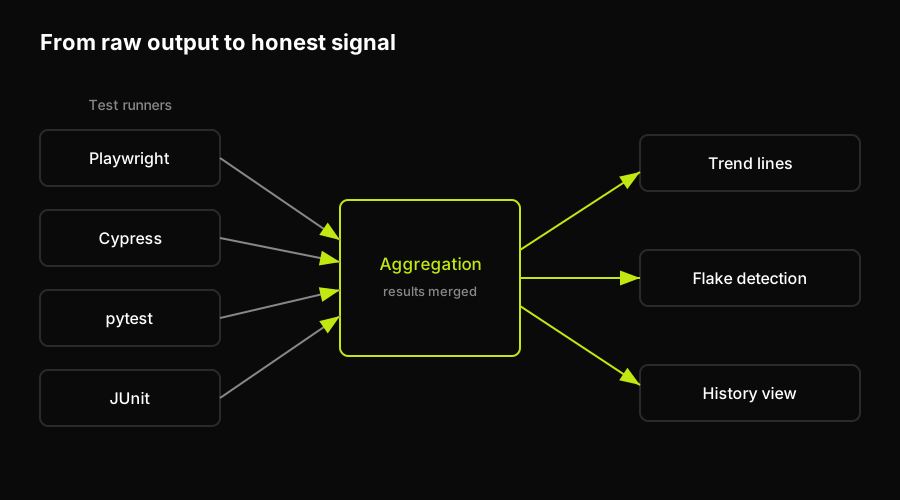
Reporting tools merge results from every runner, then turn the combined history into trend lines and flake scores.
The best test reporting tools in 2026
| Tool | Best for | CI integration | Open source? |
|---|---|---|---|
| Allure Report | Self-hosted, rich HTML reports | Any (CLI artifact) | Yes (Apache 2.0) |
| Allure TestOps | Test management + reporting | Native agents | No (commercial) |
| ReportPortal | AI-assisted triage at scale | Agents + REST API | Yes (Apache 2.0) |
| Currents | Cypress / Playwright hosted dashboard | Drop-in Cypress/PW | No (hosted SaaS) |
| Playwright HTML Reporter | Zero-config local HTML reports | Any (file artifact) | Yes (built-in) |
| Cypress Cloud | Cypress-specific hosted dashboard | Native to Cypress | No (hosted SaaS) |
| TestRail | Test case management + reporting | API + JUnit XML | No (commercial SaaS) |
| Datadog CI Visibility | Flake detection across CI pipelines | Native agents + API | No (commercial SaaS) |
Allure Report is the most widely used open-source test reporting tool. It generates a self-contained HTML report from a JSON result set, which means it works with almost any test framework (JUnit, pytest, Playwright, Cypress, Mocha, and more) by publishing to the allure-results directory. The output is polished: timelines, categories, trend history across multiple runs, and per-test attachments like screenshots and logs. The drawback is that Allure Report is static by default. You need to manage your own history storage (usually a CI artifact or S3 bucket) to get trend lines across builds. Without that persistence layer, each report is an island: you can see what happened in this run, but not whether this failure is new or has been recurring for three weeks. Allure TestOps is the commercial layer on top: adds live dashboards, test case management, and team workflows. Worthwhile if you're already using Allure and need multi-team reporting with persistent history managed for you.
ReportPortal is the choice for teams running large, heterogeneous suites that need triage support rather than just visibility. It stores results server-side, builds a historical model per test, and applies ML-based defect classification to distinguish infrastructure failures from application regressions. The AI triage feature is genuinely useful at scale: it groups similar failures, suggests defect types, and shows you which failures are new versus recurring. The pattern recognition becomes powerful once you have hundreds of tests and need to understand root-cause clusters rather than reading individual failures. Self-hosting is meaningful overhead (Kubernetes-friendly but not trivial), and the UI has a learning curve. It is open source and free to self-host; cloud versions are available from Reportportal.io.
Currents is a hosted test results service built specifically for Cypress and Playwright. If you're already on Cypress Cloud and want more: better pricing, parallel orchestration without the per-seat model, and a cleaner API for external dashboards, Currents is a direct alternative. It stores every run in the cloud, surfaces flaky tests with per-test pass-rate history, and integrates with GitHub, Slack, and Jira. The per-test flake score is based on recent pass rate across real runs, not just the last retry, which makes it one of the more accurate flake detection implementations in the hosted category. No self-hosting required.
Framework built-in reporters are underrated for early-stage suites. Playwright's built-in HTML reporter produces a clean, navigable report with screenshots on failure, traces, and a retry timeline. It runs with no additional config: just set reporter: 'html' in your Playwright config. For pytest users, the combination of pytest-html (simple static HTML) and the Allure-pytest plugin (richer output) covers most needs without adding a separate service. Cypress Cloud is Cypress's own hosted dashboard: parallel run coordination, video storage, and flake detection tied directly to the Cypress test runner. Worth the cost if your whole suite is Cypress; less compelling if you're mixing frameworks.
TestRail is the option teams reach for when they need test case management alongside reporting, not reporting alone. It stores manual and automated test cases, tracks coverage by feature, and accepts automated results via a JUnit XML upload or REST API. The workflow is: run your automated tests, push results to TestRail via its API, and get a combined view of manual and automated coverage in one place. This matters for teams that own a mix of manual regression cycles and automated pipelines and need a single source of truth for both. TestRail is commercial and hosted; it is not an open-source option. Think of it as the test-management-led choice rather than the reporting-led one.
Datadog CI Visibility is the observability-team's answer to flake detection. It is part of the broader Datadog platform, which means if your infrastructure is already in Datadog, you get CI test analytics without adding another service. It instruments test runs through native integrations with pytest, Jest, JUnit, and others, stores results as spans in Datadog's trace backend, and provides a purpose-built flake detection dashboard that correlates test stability with infrastructure metrics. The flake detection is one of the most mature in this category: it tracks per-test pass rates, identifies tests that are consistently flaky in specific environments or on specific branches, and surfaces the failure pattern over configurable time windows. The tradeoff is cost and vendor lock-in: it works best if you're already paying for Datadog APM, and it is not useful as a standalone reporting tool if you aren't.
For a practical walkthrough on wiring any of these into a CI pipeline, the automated test reporting how-to guide covers the CI configuration step by step. And if you're evaluating dashboards as part of a broader QA metrics strategy, the QA metrics dashboard post walks through what to put on that dashboard once the reporting pipeline is running.
A report is only as honest as the tests behind it
Here is the problem none of these tools can solve on their own: a reporting layer is downstream of the test suite. If the test suite is generating false failures at scale, the best AI-assisted triage in the world is doing cleanup work, not prevention work.
False failures come from two places. Flaky tests: tests that interact with async state, make timing assumptions, or depend on external services in ways that are inherently unstable. And brittle selectors: tests written against CSS classes, positional XPath, or implementation details that break the moment a designer renames a class or moves a button. Both types produce the same symptom on your dashboard: a red test for a green application. Over time, teams learn to ignore the reds. That is when reporting stops being useful.
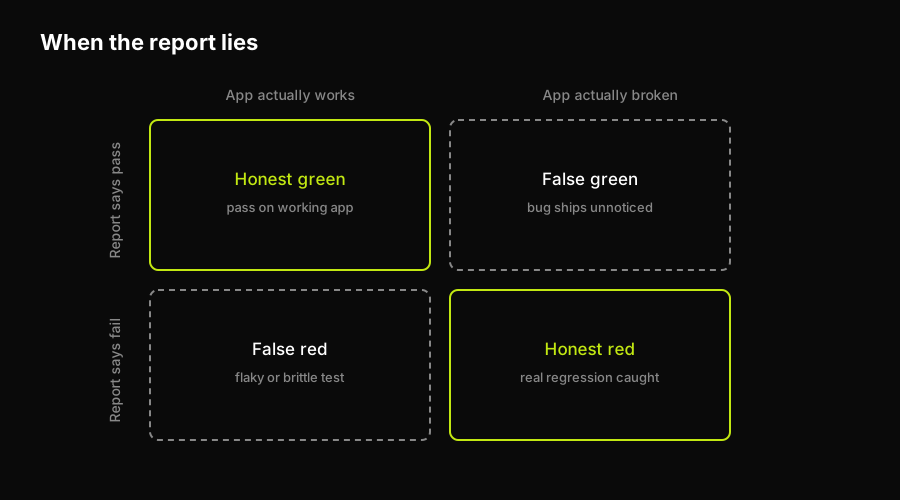
A report can lie in two directions. False reds train teams to ignore failures, and false greens let real bugs ship.
How Autonoma keeps reports honest before reporting starts
This is where Autonoma fits into the picture, and it is not as a reporting tool. Autonoma generates and maintains your E2E tests from your codebase. The Planner agent reads your routes and components and generates test cases. The Executor runs them against a live preview environment. The Reviewer classifies results: real bug, agent error, or test mismatch. The Diffs Agent runs on every PR, updating tests when code changes so that UI renames don't produce false failures.
That last part is the direct answer to the false-failure problem. When a button label changes or a component is refactored, a Playwright test written against a class name breaks and shows red. The Diffs Agent regenerates the test to match the new implementation. The report stays honest because the tests stay current. The dashboard stops crying wolf.
The cycle that kills reporting adoption is: tests go stale, false reds multiply, team ignores reds, real bugs hide in the noise. The way to break that cycle isn't a smarter triage model. It's a test suite that doesn't generate false reds in the first place.
How to choose
There are now more test report tools than any team can evaluate properly. The decision framework is simpler than the landscape makes it look.
Start with your framework. If your whole suite is Cypress, Cypress Cloud is the lowest-friction choice for hosted reporting. If you're on Playwright, the built-in HTML reporter gets you far before you need anything else. If you have a mixed-framework suite or multiple languages, Allure Report gives you a unified view without lock-in.
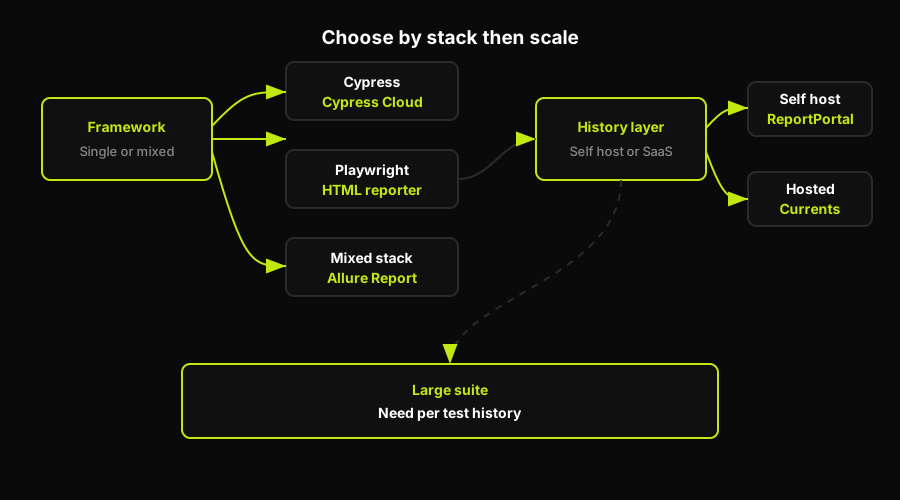
Three questions narrow the field fast: which framework, self-host or SaaS, and how much flake-detection maturity you need.
Then ask the self-hosting question. ReportPortal and Allure Report are the two serious open-source options. ReportPortal is heavier operationally but richer in triage features. Allure Report is lighter but you manage your own history storage. If you don't want to run infrastructure, Currents or Cypress Cloud are the hosted SaaS choices (Playwright or Cypress respectively).
Flake detection maturity matters at scale. If your suite is under a few hundred tests, any tool's built-in retry annotation is enough. Above that, you want per-test pass-rate history, not just a retry count. ReportPortal's ML classification and Currents' flake scoring are both meaningfully better than a simple "this test failed twice in a row" heuristic.
Cost follows team size. Framework built-ins are free. Allure Report is free. ReportPortal is free to self-host. Currents and Cypress Cloud charge per-seat or per-run above the free tier, which becomes meaningful at 20+ seats.
FAQ
Test reporting tools collect the output from your test runners, aggregate results across multiple CI runs, and present them as dashboards, trend lines, and per-test history. They turn raw pass/fail JSON into actionable signal: which tests are flaky, which failures are new versus recurring, and whether a given build is actually ready to ship. Common examples include Allure Report, ReportPortal, Currents, Playwright's built-in HTML reporter, and Cypress Cloud.
There is no single best tool. For Cypress-only teams, Cypress Cloud or Currents are the lowest-friction choices. For multi-framework suites, Allure Report is the most portable open-source option. For large teams that need AI-assisted triage and server-side history, ReportPortal is the most capable self-hosted solution. For Playwright users who want zero configuration, the built-in HTML reporter is often enough to start. Match the tool to your framework, your infrastructure preference, and how much flake detection maturity your suite actually needs.
Allure Report is an open-source test reporting framework (Apache 2.0) that generates a self-contained HTML report from test result files. It works with most test frameworks by writing results to an allure-results directory, then rendering them into a navigable report with timelines, categories, per-test attachments, and multi-run trend history. Allure TestOps is the commercial extension that adds live dashboards, test case management, and team collaboration features on top of the same data model.
The mechanics depend on your framework and chosen tool, but the pattern is consistent: run your tests with a reporter flag, preserve the result artifacts between CI steps, and either upload them to a hosted service or generate a static HTML report in the build. For a complete step-by-step walkthrough covering GitHub Actions, GitLab CI, and CircleCI configuration for Allure, Playwright, and pytest, see the automated test reporting how-to guide at /blog/automated-test-reporting.
False failures in test reports almost always come from two sources: flaky tests (tests that are inherently unstable because of timing assumptions, async state, or external dependencies) and brittle selectors (tests written against CSS classes, XPath positions, or other implementation details that break when the UI is refactored). The result is a dashboard that shows red when the application is actually fine. The tooling fix is to use flake detection to identify and quarantine unstable tests. The structural fix is to write tests against stable attributes and to keep tests updated when the codebase changes, so that UI changes don't produce a wave of false reds after every deploy.


