

Claude write tests reliability splits into two zones. Green zone: boilerplate, test scaffolding, setup/teardown, pure functions, utility parsers, parameterized cases over a known spec. These are trustworthy because the spec lives in the code Claude already read. Red zone: business logic, integration flows, permission rules, billing calculations, and anything where Claude also wrote the code under test. There, the bug becomes the expected value, and your tests pass while the real behavior stays broken.
You ship fast. You already have tests, lots of them, most generated with Claude or Cursor or Copilot. CI is green. The issue is not that you have no coverage. The issue is that you thought you were covered and you might not be.
This is specifically not a problem for pre-seed teams trying to get any tests at all. It is a problem for AI-forward Series A and B teams who already have large test suites built quickly with AI assistance, and who are discovering that green CI no longer means what it used to. The risk is not exposure. It is false confidence. Those feel different, and the second one is harder to catch.
Autonoma sits at the independent-verification layer that resolves this, but first you need a practical rubric for when Claude-written tests are fine and when they are the problem.
Green zone: where Claude is reliable
Claude is genuinely excellent at a class of tests, and that class is larger than people give it credit for. The pattern is consistent: Claude is reliable when the spec lives inside the code it can read.
Test scaffolding and setup/teardown is the clearest example. Wiring up a Jest config, writing a beforeEach that seeds a test database, generating the boilerplate for a new test file against an existing pattern -- this is all mechanical work where Claude reads your existing structure and extends it correctly. There is no business rule to encode incorrectly. The spec is the convention.
Pure functions are the other high-trust case. A formatter that converts a date string to a localized display format has a spec that is completely visible to Claude: the input type, the expected output, the edge cases documented in the code. A regex helper, a number formatter, a slug builder: these have deterministic, verifiable correctness. Claude writes parameterized test cases that cover the input space, and the correctness of those tests is checkable by reading the function. When you review the test, you can confirm whether the expected output is right. When the spec is readable, the test is auditable.
Parameterized cases over a known API contract also fall here. If you have an existing endpoint with documented input/output behavior, Claude can generate a table of inputs and expected responses. The value is throughput on mechanical coverage. The risk is low because you (or your API schema) are still the source of truth for the expected values.
The common thread: green zone tests are tests where an independent reader can verify the expected value without knowing the business rule history. You can read the function, read the test, and confirm they match. If they do not match, you catch it in review.
Red zone: where it manufactures false confidence
The red zone has a specific shape. It is not simply "Claude gets complex logic wrong." The problem is structural, not a model quality issue. When Claude writes the code and the test in the same session (or the same PR), the test inherits the bugs in the code as its expected values.
A security-software team described it plainly: "That test passes and it asserts something, but it's not really asserting what it should be asserting." They had tests with real assertions, real expected values, and green CI. The assertions were just wrong, because they had been generated by the same reasoning that generated the buggy implementation.
This is the self-verification loop. Claude writes a billing tier calculation. Claude writes the test for that calculation. The calculation has an off-by-one error on the boundary between tiers. The test, generated from the same code, encodes the boundary at the wrong value. CI is green. The bug ships. When a customer on the boundary tier gets charged incorrectly, nothing in the test suite fails.
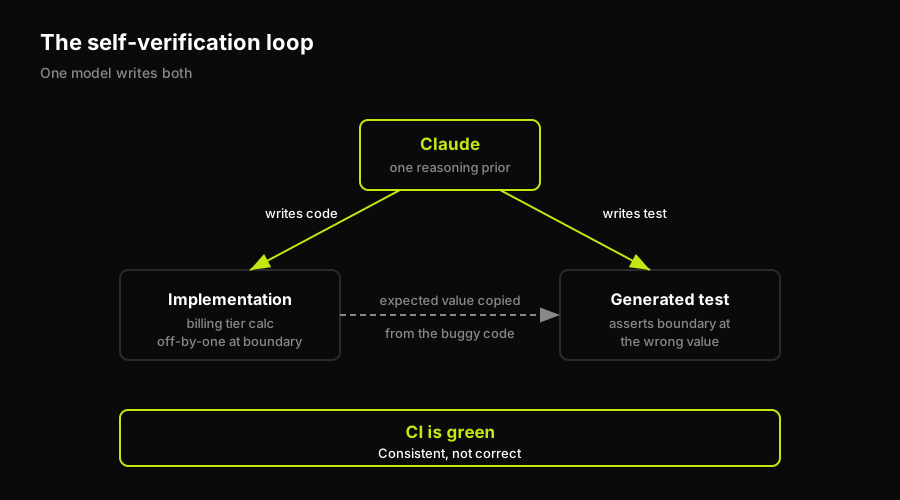
Claude can make code and tests agree while the product behavior is still wrong.
The same team noted: "It doesn't cover the business case... our QA engineers are still finding things." The tests existed. The assertions existed. What was missing was an independent source of truth.
AI verification is only trustworthy when it is independent of the thing being verified. Green means consistency, not correctness.
The architectural reason this happens is explained in depth in the companion piece on why Claude and Cursor cannot test themselves. The short version is that the model writing the code has a prior that the implementation is correct, so the test it generates asserts the implementation, not the requirement.
Business logic is the highest-risk category: pricing rules, discount application, subscription tier gates, tax calculations. These are places where the requirement lived in a Notion doc or a Slack thread or a stakeholder conversation, not in the code Claude read. Claude cannot recover that requirement from the implementation. It writes a test that proves the implementation is self-consistent, which is not the same thing.
Integration flows compound the risk. When a test spans two services, Claude is encoding an assumption about the contract between them. If that contract was negotiated between two teams and never formalized in a schema Claude can read, the test will pass even when the integration is wrong.
Permission and authorization logic is particularly dangerous. An authorization test that Claude generated from Claude-written permission code may pass while a real user with the wrong role gets access they should not have. The test proves the code is self-consistent. It does not prove the policy is implemented correctly.
For a deep look at the specific shapes this takes in AI-generated suites, the article on AI-generated tests that pass but do not assert anything covers the tautological test pattern in detail. For the self-verification loop critique as an architectural problem, see who checks AI-generated code logic.
The decision rubric
The question to ask for any test Claude is about to write: is the spec for the expected value inside the code Claude can read, or is it somewhere Claude has never seen?
| Scenario | Trust level | Why |
|---|---|---|
| Pure formatting or parsing util | High | Spec is in the code; output is verifiable by inspection |
| Test scaffolding and boilerplate | High | Mechanical extension of existing patterns; no business rule encoded |
| Regex or date helper | High | Deterministic, input/output visible; expected values are auditable |
| Refactor of an existing human-written test | Medium-High | Expected values already established; Claude changes structure only |
| Billing tier calculation Claude also wrote | Low | No independent source of truth; bug becomes expected value |
| Integration across two services | Low | Contract assumption encoded without schema; mismatches pass |
| Permission or authorization rule | Low | Policy requirement not in code; wrong access can pass all tests |
| Snapshot test of UI Claude built | Low-Medium | Snapshot encodes current output; regressions on behavior not caught |
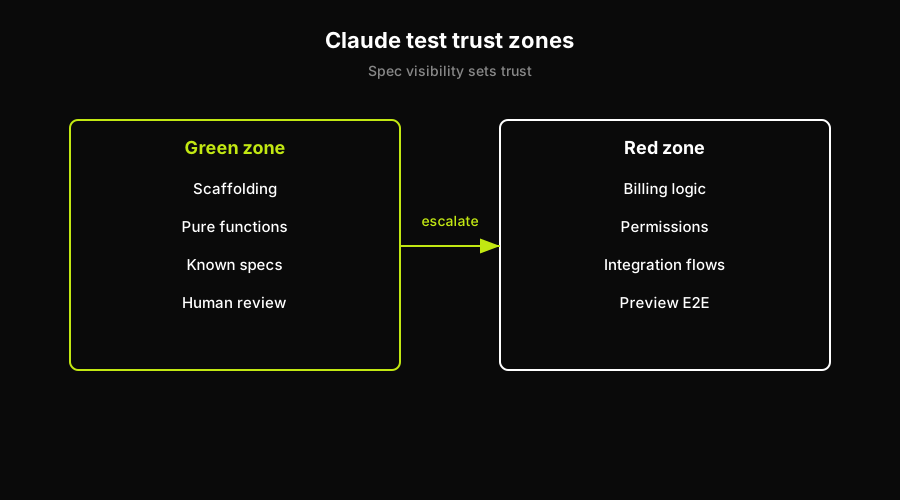
Trust Claude for mechanical tests; move red-zone flows to independent verification.
That middle layer is where Autonoma fits: keep Claude for green-zone scaffolding, then put a separate E2E verification system on the red-zone flows that need observable behavior, database state, and result review. The handoff is not from Claude to another prompt; it is from generated tests to independent preview-environment execution.
How to keep the speed without the false confidence
The goal is not to stop using Claude for tests. That would discard real productivity. The goal is to let Claude cover what it is good at and put independent verification where it cannot be trusted.
For green zone code, let Claude run. Generate the scaffolding, the helper tests, the parameterized cases. Review them quickly to confirm the expected values match what you know the function should do, then ship. The review cost is low because the spec is readable.
For red zone code, the workflow changes. The expected value for a business logic test needs to come from somewhere outside the code Claude wrote. That means reading the requirement, the ticket, the design doc, or the stakeholder conversation, and writing the expected value yourself before Claude generates the test. You supply the assertion target; Claude supplies the scaffolding around it. This is slower, but it is the only way to make the test independent.
The mutation check is worth building into your review process. For any test on business logic, ask: if I flip the comparison operator, does this test go red? If it stays green, the assertion is not guarding what you think. For teams using mutation testing tools (Stryker for TypeScript/JavaScript is the standard), the mutation score against AI-generated suites reliably surfaces the gap.
The hardest constraint to enforce is this one: never let the same agent be author and verifier of business logic. Not Claude, not Copilot, not any single model. The architectural reason is in the cursor and claude code companion piece. The practical rule is that the assertion on a business rule needs a human or an independent system to supply the expected value. The Copilot-specific version of these pitfalls follows the same pattern and is worth reading alongside this.
How Autonoma covers the red zone
The core problem in the red zone is the absence of an independent check. Claude writes the code. Claude writes the test. Nothing in that loop has ever looked at whether the running application does what users expect it to do.
We built Autonoma to be that independent layer. Our four agents work from a read of your codebase and a live preview environment, not from the diff Claude just produced. Planner reads your routes, components, and user flows to plan test cases. Executor runs those cases against the deployed preview. Reviewer evaluates each run and classifies what it finds: a real bug, an agent error, or a test/plan mismatch. Diffs Agent adds, deprecates, and maintains tests on every PR as your code changes. Crucially, the test cases are derived from an independent reading of your application's actual user flows, not from the same session that wrote the code under test. When Planner reads your checkout route and plans a billing tier test, it is verifying what the application does end to end, not asserting that the implementation is self-consistent.
Planner also handles database state setup automatically, generating the endpoints needed to put your DB in the right state for each scenario. This matters for the red zone specifically: a billing test that reaches production-like state (the right subscription tier, the right user record, the right discount in the DB) is the test that would have caught the off-by-one error the Claude-generated unit test missed.
This is the layer red zone code demands: something that reads what the app actually does, independent of who wrote it.
FAQ
Yes, for a specific class of tests. Claude is reliable for boilerplate, scaffolding, setup/teardown, pure functions, utility helpers, and parameterized cases where the spec lives in the code it can read. For business logic, integration flows, permission rules, or anything where Claude also wrote the code under test, trust calibration is required. The self-verification loop means the bug in the implementation becomes the expected value in the test, and CI stays green.
Do not rely on AI-written tests when the expected value cannot be derived from the code alone. Business logic where the rule lived in a requirements document, integration contracts negotiated between teams, authorization policies, and billing calculations are the highest-risk cases. In all of these, the AI writing the test has no independent source of truth. It will encode whatever the implementation currently does as correct, including the bugs.
For mechanical, deterministic code: yes. For business logic: only if the expected values were supplied by a human or a system independent of the code being tested. The reliability question is not about Claude's model quality. It is about independence. A test is only as reliable as the source of its expected values. When Claude generates both the code and the expected value, the two are consistent with each other but neither is verified against the actual requirement.
Not reliably for business logic. When Claude writes code and then writes the test for that code, it has a prior that the implementation is correct. The test asserts the current behavior, including any bugs. This is the self-verification loop: the model checks for consistency with itself, not correctness against an external requirement. AI verification is only trustworthy when it is independent of the thing being verified.
Use Claude freely for green zone tests: scaffolding, boilerplate, pure function coverage, parameterized helpers. For red zone code, supply the expected values yourself before asking Claude to generate the test structure. Run a mutation check on any business logic test: flip a condition and confirm the test goes red. Add an independent behavioral verification layer (E2E tests driven from your actual application, not from the code that wrote it) for flows that touch billing, permissions, and cross-service contracts.


