

Functionize pricing is not publicly listed. Functionize is fully enterprise-gated: no pricing page, no self-serve tier, no public per-seat or per-user anchor. Based on reverse-engineered estimates from software aggregator listings, review-site mentions, and benchmarks for the AI-test-automation tier (G2, Capterra, third-party SaaS intelligence sources), the estimated annual contract range for Functionize sits between $30,000 and $100,000+ per year depending on team size and feature scope (as of June 2026). These figures are estimates, not quoted prices. Functionize did not confirm any figure in this article.
Functionize doesn't publish a price. No pricing page, no tier list, no free trial with a credit card. You fill out a form, sit through a discovery call, go through a demo, and eventually someone on their sales team tells you a number. That number is the figure this article tries to reconstruct before you get there.
The estimates below are built from publicly available signals: aggregator listings, review site mentions, and benchmarks from comparable AI-test-automation vendors. Every figure is explicitly dated to June 2026 and carries the uncertainty that comes with reverse-engineering a number the vendor is deliberately withholding. If you have a more recent or more precise figure from a real Functionize quote, that data takes precedence over anything in this article.
For this comparison, Autonoma is the counter-model: connect your repository, run codebase-derived E2E tests on a live preview environment, and evaluate the run results before a sales cycle controls the timeline.
Why Functionize is enterprise-only
Functionize positions itself as an AI-powered autonomous testing platform aimed squarely at enterprise QA teams. The product's core pitch is that its ML engine can generate, execute, and self-heal test cases without requiring QA engineers to write or maintain scripts manually.
That positioning explains the billing model. Functionize operates a classic enterprise-gated sales motion: no public pricing, a mandatory demo before you see any number, and sales qualification before a contract quote. This is the demo-gate pattern common in enterprise software. It serves the vendor by controlling information, allowing sales reps to anchor pricing based on a prospect's perceived budget and team size rather than on a published rate card.
For buyers, the demo-gate has a real cost beyond inconvenience. You cannot build an accurate budget line without a quote. You cannot compare Functionize's cost to alternatives without sitting through two or three sales conversations first. You cannot sanity-check whether the pricing range is reasonable for your team size without disclosing your internal budget signals to a sales rep.
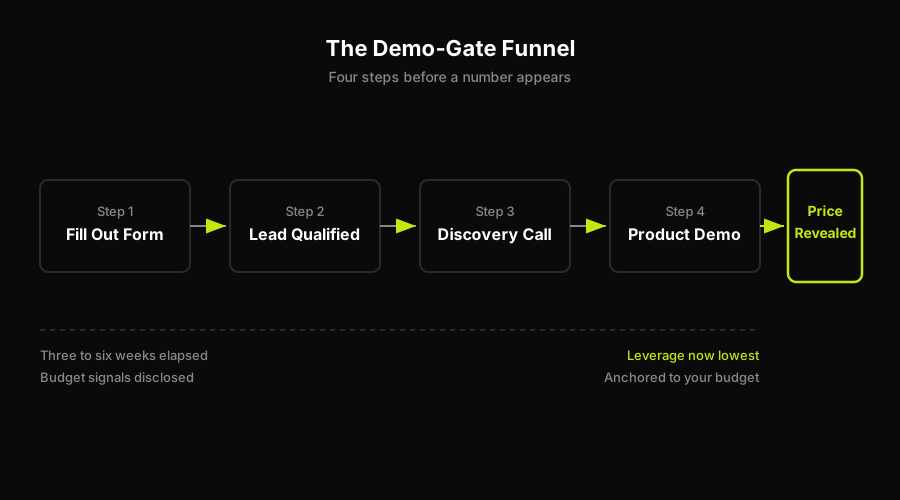
The demo-gate makes information flow to the vendor for weeks before a single price ever flows back to you.
This article exists to reduce that information asymmetry. The estimates are imprecise by nature, but they are better than zero.
The reverse-engineered cost of Functionize
Functionize's pricing signals from public sources point consistently toward annual contracts at the enterprise tier. Software review platforms (G2, Capterra, GetApp) categorize Functionize as "contact for pricing." Third-party SaaS intelligence and software marketplace listings occasionally surface anecdotal ranges, and a handful of G2 reviews mention contract values indirectly in the context of ROI discussions.
The patterns that emerge from these sources, all treated as estimates with meaningful uncertainty (June 2026), look approximately like this:
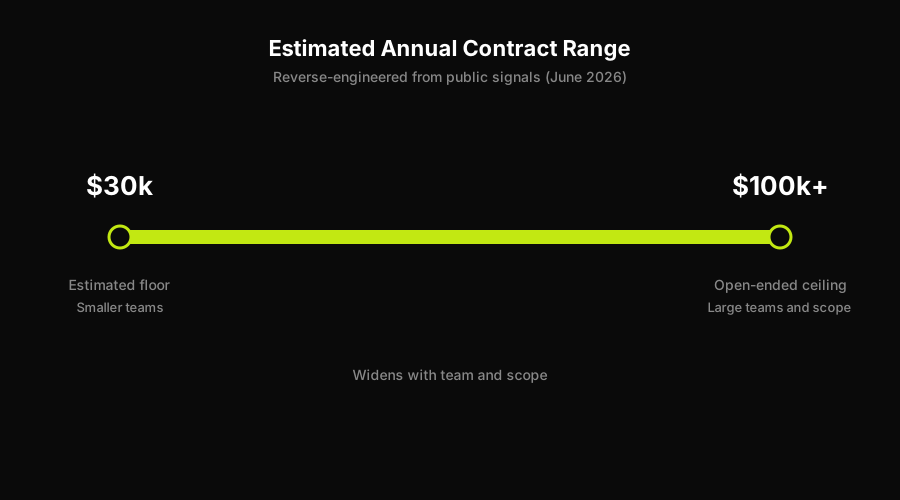
Reverse-engineered estimates, not quotes: the band runs from roughly $30k for smaller teams to $100k and up at full enterprise scope.
| Segment | Estimated annual range | Source basis |
|---|---|---|
| Small team (5-15 users) | $30,000 - $50,000/yr | Aggregator listings, review-site ROI mentions (est., June 2026) |
| Mid-market (15-50 users) | $50,000 - $80,000/yr | Competitor benchmarks, enterprise AI-test tier (est., June 2026) |
| Enterprise (50+ users) | $80,000 - $120,000+/yr | Enterprise AI-test-automation segment benchmarks (est., June 2026) |
These ranges are reverse-engineered estimates, not quoted prices. Functionize has not confirmed any figure in this article. The ranges are built from the following signal types:
Aggregator category placement. Functionize consistently appears in the "enterprise / custom pricing" tier on software marketplaces alongside tools that are independently known to contract in the $40,000-$100,000+ annual range for comparable team sizes.
Competitor benchmarks in the AI-test tier. The closest pricing comparators are other AI-test-automation platforms that have at least partial public pricing. mabl pricing anchors its mid-market plans in the $15,000-$40,000 annual range for medium teams. testRigor pricing is similarly in the mid-five-figures annually for enterprise tiers. Functionize competes in the same category and, based on its enterprise-only sales motion, is unlikely to price below the mid-market floor for these tools.
Review-site ROI signals. Several G2 reviewers describe Functionize in the context of ROI justifications that imply contracts in the "tens of thousands annually." No reviewer provides an explicit contract figure, but the language of the ROI framing is consistent with a product priced well above $20,000 per year.
Historical pricing references. Pre-2024 discussions in QA-community forums and Slack groups occasionally mentioned Functionize in the same budget conversations as enterprise tools ranging from $30,000 to $60,000/year. These are dated and should be treated as directional only.
The honest summary: expect an annual contract. Expect a number in the $30,000-$100,000 range depending on your team size and usage scope. Expect the actual quote to vary significantly based on your negotiating position, which features you need, and how much Functionize's sales team has assessed your organization's budget.
Compared to the Testim per-author/per-seat model (which at least partially published pricing before being acquired into Tricentis), Functionize sits in the most opaque tier of the AI-test-automation market on pricing transparency.
What enterprise gating costs you (time and leverage)
The dollar figure on the eventual Functionize contract is one cost. The costs that accumulate before you ever see that number are less visible but equally real.
Time. A typical enterprise-gated sales cycle for a QA platform runs three to six weeks from initial contact to a contract quote. You fill out a form, someone qualifies the lead, a discovery call happens, a demo is scheduled, product-specific questions get answered over email, and eventually a proposal arrives. If you are evaluating three vendors simultaneously, you are managing three parallel sales cycles. Each one requires calendar time, context-switching for your team, and preparation work before each call.
Leverage. The demo-gate is asymmetric by design. By the time Functionize sends you a number, you have invested time in their process, seen their product, and potentially gotten your team interested. Your willingness to walk away from a proposal is lower after four weeks of engagement than it was at the beginning. Functionize's sales team knows this. The number they send reflects it.
Evaluation blind spot. The most expensive outcome of enterprise gating is the one that does not show up in the contract at all: you cannot evaluate whether the tool finds bugs in your specific application before you commit. You see the product in a demo environment, against demo data, in a demo flow. That is not the same as knowing whether Functionize's AI can handle your routing patterns, your auth flows, or your edge-case UI states.
Autonoma inverts this evaluation sequence. You connect your codebase and agents generate and run tests against your actual app before any sales conversation. Planner reads routes, components, and user flows and plans test cases. Executor runs those tests against a live preview environment. Reviewer classifies results as real bugs, agent errors, or test mismatches. Diffs Agent keeps the suite aligned on every PR by analyzing code changes. You can judge the run output on your app before you ever need to talk to anyone.
That changes the leverage dynamic in any pricing conversation. You walk into a demo or a contract discussion already knowing whether the tool produces value for your specific stack. You are not evaluating on faith built up over a demo.
For a small team or a startup, the calculus is sharper. The billing model for Functionize is an annual contract at the enterprise tier. If the estimated floor is $30,000/year, that is a significant commitment for a 5-10 person engineering team. The per-credit AI-test alternatives (mabl, testRigor) offer lower-cost entry points with more transparent pricing, even if they cap out at lower scale. Teams that have not yet established whether AI-powered E2E testing will produce ROI at all should be cautious about committing to an annual contract before getting evidence from their own codebase.
Recommendation: evaluate real value before the sales cycle
Functionize can make sense for enterprise QA organizations that already know they want a high-touch annual contract, a vendor-led onboarding process, and an AI testing platform evaluated through a formal sales cycle. That is a procurement fit, not a universal value fit.
If the problem is evaluating real value before that sales cycle, Autonoma is the stronger path. The evidence comes from your application: Planner plans test cases from routes, components, and user flows; Executor runs them in a live preview environment; Reviewer classifies each result; and Diffs Agent keeps the suite aligned on every PR. You are not deciding from a demo script or a quoted feature checklist. You are deciding from the system's output on your codebase.
The practical recommendation is simple: do not spend three to six weeks in an enterprise funnel just to learn whether an AI testing tool can produce useful coverage. Run the evaluation where the risk lives: on your app, before the vendor process consumes your team's leverage.
Frequently Asked Questions
Functionize does not publish pricing publicly. Based on reverse-engineered estimates from aggregator listings, review-site signals, and competitor benchmarks in the AI-test-automation tier, the estimated annual contract range is roughly $30,000 to $100,000+ per year depending on team size and feature scope (as of June 2026). These are estimates, not quoted prices. Contact Functionize directly for a current quote.
No. Functionize is fully enterprise-gated with no published pricing page, no self-serve tier, and no public per-seat or per-credit anchor. Pricing is only revealed after a demo and sales qualification call. Every figure in this article is a reverse-engineered estimate from public sources, not a confirmed Functionize price.
Yes, in practice. Functionize's sales motion is exclusively enterprise-gated: there is no free trial, no self-serve onboarding, and no public starter plan. The product is positioned toward enterprise QA teams and the billing model is annual contract. If you are a small team or an early-stage startup, the entry cost and sales-cycle overhead may outweigh the benefits relative to per-credit or lower-cost AI-test alternatives.
The estimated annual cost range for Functionize is $30,000 to $50,000 per year for a small team (5-15 users), $50,000 to $80,000 for a mid-market team (15-50 users), and $80,000 to $120,000+ for larger enterprise deployments, based on reverse-engineered estimates from public sources as of June 2026. These are not official Functionize figures. Actual pricing depends on team size, negotiated terms, and features included.
For a small team of 5-10 engineers, Functionize is a high-cost commitment at the estimated $30,000+ annual floor before knowing whether the tool produces value on your specific codebase. The demo-gate means you invest weeks in a sales process before getting a number, let alone running tests. For small teams still establishing whether AI-powered E2E testing delivers ROI for their stack, starting with a tool that lets you evaluate your repo before any sales conversation is a lower-risk evaluation path.


