

testRigor pricing follows a plan-tier billing model (Free/Public, Pro, Enterprise) with exact figures gated behind a sales conversation. Based on G2 reviews and the testRigor pricing FAQ (as of June 2026), the Pro plan runs approximately $900–$1,000/month, or roughly $10,800–$12,000/year for a single plan. Modeled against a 300-test suite, that puts the per-test-case cost at $36–$40/test/year (MODELED, not an official testRigor quote). The billing model scales with your plan tier and organization, not with individual test count.
The honest answer: nobody outside sales knows for certain, because testRigor gates exact figures behind a sales conversation. What we do know comes from G2 reviews and testRigor's own FAQ, and the numbers are specific enough to model a real business case before you pick up the phone.
That is also where Autonoma belongs in the comparison: not as another quote to reverse-engineer, but as the codebase-first testing approach you can evaluate against your own repository before modeling per-test authoring and maintenance costs.
testRigor pricing tiers, decoded
testRigor publishes three plan names. Exact figures are not listed publicly, which means every number below is attributed to third-party sources and presented as a modeled estimate, not an official quote.
| Plan | Who it's for | Pricing (modeled estimate) | Key limits |
|---|---|---|---|
| Free / Public | Open-source projects, public repos, early evaluation | $0 (publicly documented) | Tests must be public; limited run volume; no SSO or SAML |
| Pro | Small-to-mid teams wanting private, codeless E2E coverage | ~$900–$1,000/month (G2 reviews + testRigor pricing FAQ, June 2026) | Private tests; team seats; bounded run volume per plan |
| Enterprise | Larger orgs needing SSO, SLA, custom limits | Custom (quote required) | Unlimited seats negotiated; dedicated support; custom integrations |
The Pro plan is the one most engineering teams hit first. At roughly $10,800–$12,000/year, it sits in a comparable range to other codeless testing platforms in the mid-market, including Functionize pricing which lands in a similar band for comparable feature sets. Whether that's the right value trade depends on what you're buying it for, and we'll get to the ICP question below.
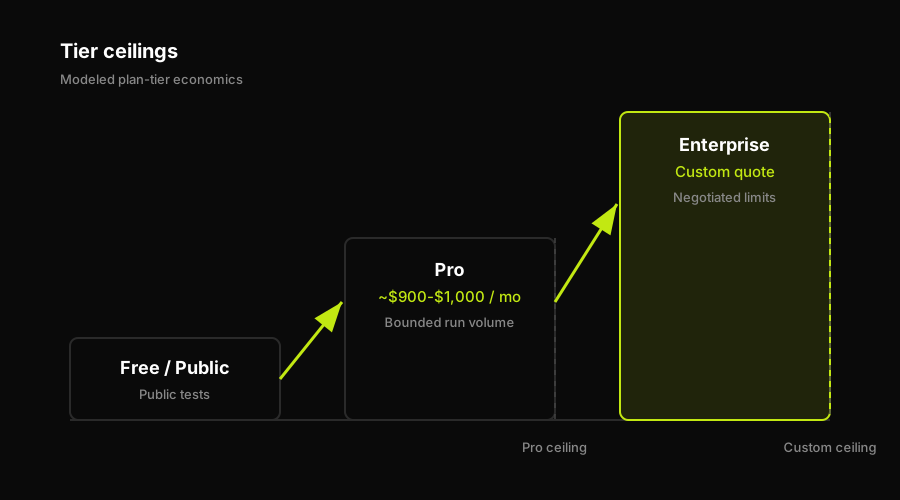
Plan-tier pricing is predictable while you stay inside a ceiling, then becomes opaque when growth forces the next tier conversation.
testRigor cost per test: the per-test-case economics
The plan-tier model means your bill doesn't move when you add or remove individual tests. It moves when you upgrade tiers or add seats. That's a fundamentally different cost structure than, say, a per-execution or per-minute billing model like mabl pricing uses with its credit-based system.
Here's how the arithmetic looks for a typical mid-size suite.
Assume a single Pro plan at $1,000/month and a suite of 300 tests running once per day. The annual plan cost is $12,000. Divided across 300 tests, you're paying roughly $40/test/year for the platform line item alone. Run the suite twice daily and the per-run economics improve on a per-execution basis, but the annual plan cost stays flat.
Now model growth. At 600 tests, you're at $20/test/year on the same Pro plan, assuming you stay within the plan's run volume limits. Push past those limits and you're negotiating an upgrade, at which point the modeled per-test-case cost resets upward again.
This is the core dynamic of any plan-tier billing model: your cost per test drops as your suite grows, until you hit the tier ceiling. Then it spikes. If your suite is bounded and predictable, the economics are favorable. If your run volume is variable or your suite is growing rapidly, the tier ceiling creates recurring budget conversations.
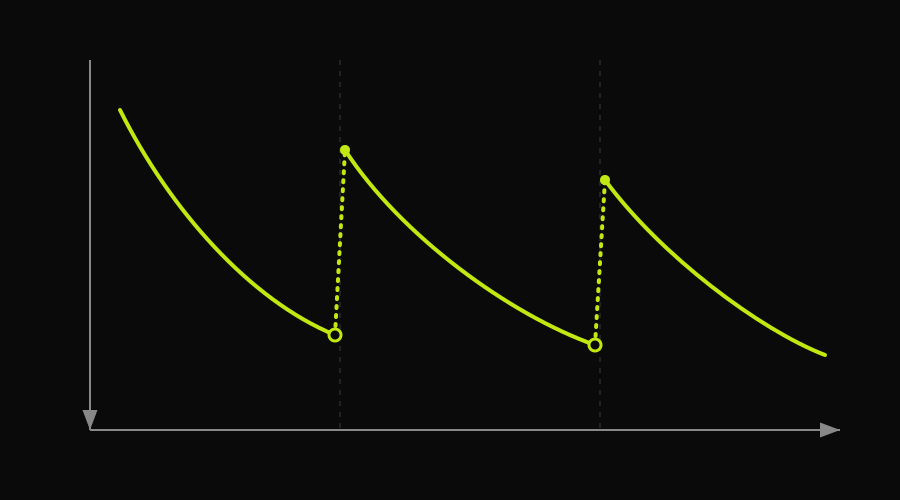
Per-test-case cost falls as a suite grows, then resets upward each time run volume crosses a plan-tier ceiling.
A useful third scenario is a suite that outgrows the Pro plan's run volume limits entirely. If your team runs 600 tests across three environments (dev, staging, and pre-production), that's potentially 1,800 executions per cycle. At a daily cadence, run volume climbs fast. When that volume triggers an Enterprise conversation, the per-test-case cost resets upward from the $20/test/year figure you modeled on Pro, and you're negotiating against a custom quote rather than a published tier. The plan-tier model is predictable at steady state; it becomes opaque the moment you cross a threshold.
The other variable is maintenance time. testRigor is a codeless testing platform, which reduces the authoring cost per test. But you still pay engineering hours when tests break on UI changes. That indirect cost isn't in the plan price, and it's worth modeling separately.
testRigor vs an autonomous approach
testRigor's plan-tier model is sensible for a specific buyer profile: teams that want codeless test authoring, have a predictable and bounded suite, and need AI-assisted natural-language test creation without hiring a dedicated automation engineer. If that describes your team, the Pro plan's annual cost is defensible.
The structural limit shows up when either the suite grows unpredictably or the test maintenance burden exceeds what codeless authoring saves. At that point, the per-plan billing model doesn't bend: you negotiate upward or carry the maintenance overhead. The maintenance side is worth separating from the platform cost explicitly. When a UI component is renamed or a flow is restructured, codeless tests tied to those selectors or step sequences still break. A senior QA engineer spending four to six hours per sprint diagnosing and re-recording broken flows is an indirect cost that doesn't appear on the testRigor invoice but absolutely appears in your engineering burn rate. The plan-tier price is fixed; the hidden cost per test is not.
An autonomous, codebase-driven approach changes the per-test economics at the authoring and maintenance layer. Instead of an engineer describing every test in natural language or clicking through flows, the system reads the codebase and derives coverage from code structure. Autonoma Cloud still uses a credit pool for test runs and test generation activity; the point is that fewer costs come from humans writing, repairing, and re-recording each test case.
For teams already evaluating the testRigor vs autonomous question, the full head-to-head comparison is in our autonoma-vs-testrigor breakdown, which covers coverage model, maintenance model, and integration depth side by side.
Who testRigor is the right call for: Teams running stable, bounded test suites where the primary need is codeless authoring by non-engineer QA staff. If you have dedicated QA contributors who don't write code, testRigor's natural-language authoring approach is genuinely strong. The billing model rewards predictability. Plan-tier pricing fits teams that know their suite size and run cadence in advance.
How Autonoma changes the per-test cost model
The reason testRigor's plan-tier economics work well for bounded suites is also the reason they strain under growth: someone has to define, author, and maintain every test case. That authoring cost is paid either in time or in platform fees, and usually both.
Autonoma moves authoring away from manual test-case writing. Our four-agent system reads your codebase directly: Planner reads routes, components, and user flows and plans test cases from code structure, not from a human writing natural language descriptions. Executor runs those tests in a live preview environment. Reviewer classifies each result as a real bug, an agent error, or a test/plan mismatch. Diffs Agent keeps the suite aligned on every PR by analyzing code changes, adding new test cases when new flows appear, and deprecating stale ones when flows are removed.
The practical consequence for cost modeling: do not model Autonoma as a queue of tests a person has to author and maintain one by one. Model it around repository-driven generation, test-run and generation usage, and reduced upkeep from Diffs Agent keeping the suite aligned on every PR. What you are comparing against testRigor is the manual authoring and maintenance burden, not a claim that testing has no consumption.
For teams hitting the ceiling of testRigor's Pro plan, or trying to model what a 500-test suite looks like at scale, the comparison worth running is between the plan-tier model and a codebase-first approach. The unit economics shift when manual maintenance is no longer the dominant variable.
FAQ
testRigor does not publish exact pricing on its website. Based on G2 reviews and the testRigor pricing FAQ (as of June 2026), the Pro plan is widely estimated at approximately $900–$1,000/month, which works out to roughly $10,800–$12,000/year for a single plan. Enterprise pricing requires a custom quote. These are modeled estimates, not official testRigor figures.
Yes. testRigor offers a Free/Public tier for open-source and public projects. Tests on the free plan must be publicly accessible. The free plan has limited run volume and does not include SSO, SAML, or private test repositories. For private test suites, a paid Pro or Enterprise plan is required.
testRigor uses a plan-tier billing model: Free/Public, Pro, and Enterprise. Your bill is determined by your plan tier, not by the number of individual test cases you run. This means adding tests within a plan tier does not increase the monthly cost directly, but growing past a tier's run volume limits will require a plan upgrade. Exact tier prices are not listed publicly and require a sales conversation.
testRigor is a strong fit for teams that need codeless test authoring, have non-engineer QA contributors who write tests in natural language, and maintain a stable, predictable suite. At roughly $10,800–$12,000/year for the Pro plan (modeled estimate), the value equation is favorable when the alternative is hiring a dedicated automation engineer or maintaining a large Selenium/Playwright framework. The cost calculus changes when suite size grows unpredictably or maintenance overhead exceeds what codeless authoring saves.
testRigor does not charge per individual test case. Its plan-tier model means the per-test-case cost is a derived figure, not a line item. Modeled against the Pro plan at approximately $1,000/month and a 300-test suite, the implied per-test-case cost is around $40/test/year. At 600 tests on the same plan, that drops to roughly $20/test/year. These are modeled figures based on G2 reviews and the testRigor pricing FAQ (June 2026), not official testRigor quotes.


