

Mabl pricing is not published on mabl.com. Reverse-engineered from third-party sources as of mid-2026: Starter lists around $499/month (500 cloud-run credits/mo, per docketqa), Growth/Professional at $1,200-$3,000/month (per docketqa and Vendr deal data), and Enterprise starting above $40,000/year (Vendr median). Every figure here is a third-party estimate, unverified by Mabl. Local and CI runs are free; cloud-run credits are the meter.
Mabl's pricing page contains no prices. It offers a demo button and a sales form. The number you need to budget a testing tool is simply not there.
This article is the page Mabl's website refuses to be. Every figure below is reverse-engineered from public third-party sources: Vendr contract aggregates, docketqa's published estimates, and SaaSworthy tier data. All figures are labeled with their source and explicit uncertainty. That transparency is the point. A vendor that publishes nothing leaves you negotiating blind. This page gives you the numbers, the math, and the questions to ask before you sign.
The Autonoma comparison is not "no credits versus credits." Mabl meters cloud-run credits; Autonoma Cloud uses a credit pool for test runs and test generation activity. The defensible difference is operational: Planner, Executor, Reviewer, and Diffs Agent derive, run, review, and maintain E2E coverage from the codebase so each PR can run the tests the diff actually needs instead of relying on manual full-suite scheduling.
What Mabl publishes vs. what it hides
Mabl's public-facing pricing page does contain information. It just omits the one piece of information you actually need.
What the page shows: a feature comparison across tiers (Starter, Growth, Enterprise), confirmation that cloud runs are metered at 500 credits per month on Starter, and confirmation that local execution and CI pipeline runs are unlimited and free. There is no per-seat pricing. The metering axis is run-volume, not headcount.
What the page hides: every dollar figure. Clicking any "Get started" or "Contact sales" button drops you into a demo-gate. You schedule a 30-minute consultation call before you can see a number. This is the standard demo-gate pattern: product-led pricing data is replaced by a sales qualification step.
The practical effect is that you cannot budget Mabl without entering a sales funnel first. This article changes that.
Mabl's reverse-engineered pricing tiers (2026)
The figures below are third-party estimates compiled from Vendr, docketqa, and SaaSworthy as of mid-2026. Mabl has not verified or confirmed them. Treat them as directional estimates, not official pricing.
| Tier | Estimated monthly price | Cloud-run credits/mo | Key limits | Source |
|---|---|---|---|---|
| Starter | ~$499/mo | 500 | Limited integrations | docketqa (2026) |
| Growth / Professional | ~$1,200-$3,000/mo | Custom / higher pool | Expanded integrations, branching | docketqa, Vendr deals |
| Enterprise | $40,000+/yr (~$3,333+/mo) | Custom | SSO, dedicated support, SLA | Vendr median contract data |
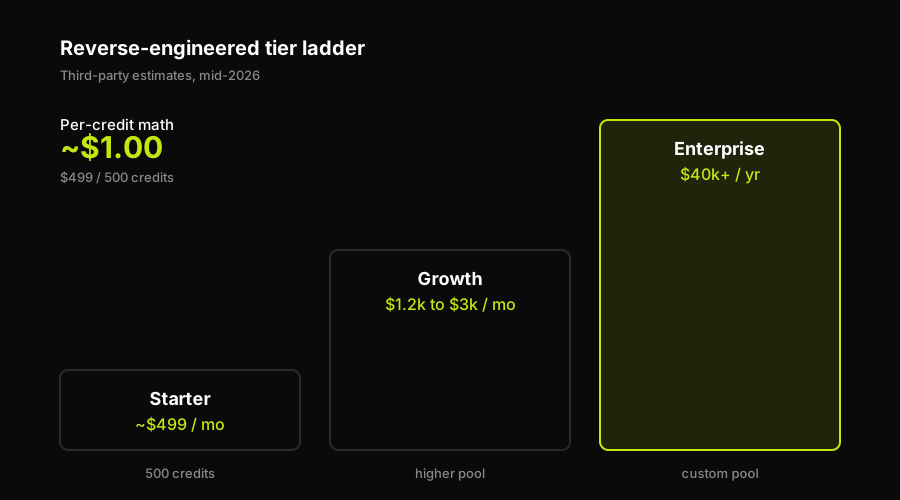
Each tier raises the credit pool, but the underlying unit cost stays near $1 per cloud-run credit.
The Vendr $40,000/year figure is a floor for enterprise contracts, not a midpoint. Vendr's deal aggregates typically represent what teams actually paid after negotiation. A $40,000 contract floor suggests list price and negotiated price can diverge significantly at the enterprise tier.
SaaSworthy lists Mabl with a starting price around $499/month, corroborating the docketqa Starter estimate. Neither source is an official Mabl disclosure.
How Mabl's credit model works
Mabl separates execution environments into two categories with fundamentally different cost structures.
Local and CI runs are free and unlimited. If your tests run on your own infrastructure or inside your CI pipeline against a locally running application, Mabl does not meter them. This is a meaningful concession and worth noting: teams with a self-hosted test environment pay nothing per run.
Cloud runs consume cloud-run credits from a shared monthly pool. Cloud runs are what you use when Mabl executes tests against Mabl-hosted browser infrastructure, including scheduled runs, cross-browser executions triggered from the Mabl platform, and any test run that requires Mabl's cloud rather than your own environment.
The Starter plan's 500-credit monthly pool is shared across all cloud runs in the billing period. Credits do not roll over. The lever Mabl uses to justify upgrades is run-volume: as your test suite grows or your CI cadence increases, you exhaust the pool faster.
No per-seat cost means adding engineers does not directly raise your bill. But adding tests to a cloud-run schedule does. Understanding this distinction is the difference between budgeting correctly and receiving a surprise invoice.
Per-credit and per-test economics
The Starter plan's economics reduce to a single number: at $499 per month for 500 cloud-run credits, each credit costs approximately $1.00.
That $1/credit rate is not Mabl's advertised unit price. It is the arithmetic result of dividing the estimated list price by the included credit pool ($499 ÷ 500 = $0.998/credit). Mabl does not publish a per-credit overage rate publicly; what happens when you exhaust the pool is a question for your sales conversation.
Per-test cost depends entirely on how many credits a single test run consumes. Mabl's documentation describes cloud-run credit consumption as varying by test complexity and execution time. A simple flow might consume one credit. A longer scenario with multiple steps, waits, and assertions may consume more. Without Mabl confirming its consumption curve, teams can only discover the actual per-test cost by running against their own suite.
The practical implication: a 50-test suite where each test averages one credit consumes 50 credits per run. At the Starter per-credit cost of ~$1, that is $50 per full-suite run from the cloud. Ten full runs exhaust the $499 Starter plan.
The regression-on-every-PR worked example
This is the scenario that generates the most Mabl billing surprises in practice, and the math is not complicated.
Assume a team with 40 automated tests and a reasonably active trunk: 20 pull request merges per day. The team runs a regression suite on every PR merge to catch regressions before they reach staging. This is a sound engineering practice. On Mabl, it is also an expensive one.
The arithmetic: 40 tests per run, 20 merges per day, assuming one cloud-run credit per test.
40 tests × 20 merges = 800 cloud-run credits consumed per day.
The Starter plan includes 500 cloud-run credits per month. At 800 credits per day, the entire monthly Starter allowance is exhausted in under 16 hours of a single working day. Not in a month. In less than one day.
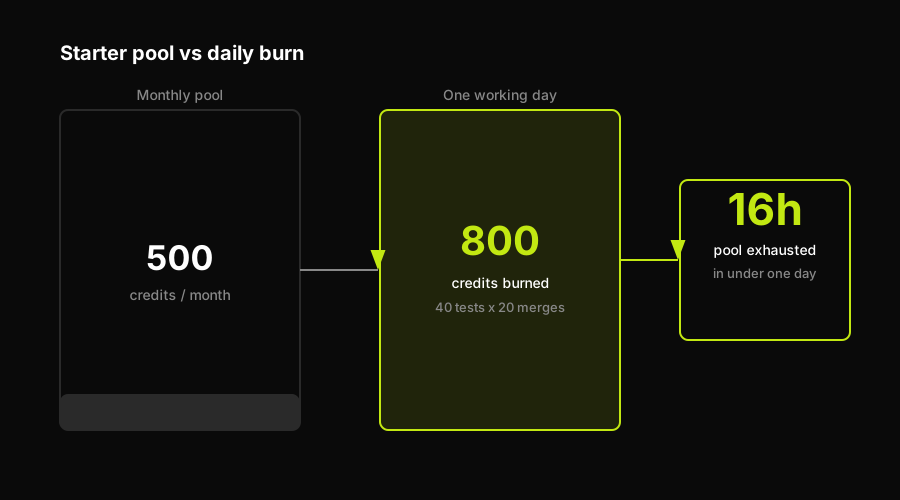
A regression suite on every PR burns the full monthly Starter pool before the first day ends.
Growth-tier teams with a larger credit pool face the same math at a different threshold. A team running regression on every PR at this cadence needs hundreds of thousands of credits annually. The credit model does not bend to accommodate CI-first development practices; it meters them.
This is the core tension with Mabl's pricing architecture: cloud-run credits are not designed for regression on every PR as the default workflow. They are priced for scheduled or selective runs. Teams that want full regression coverage on every merge should model credit consumption before signing.
True annual cost (TCO)
The annual number is what matters for budget planning. List price, multiplied out and extended for likely add-ons, looks like this based on third-party estimates as of mid-2026.
| Tier | List annual estimate | Likely add-ons | Estimated annual TCO | Source |
|---|---|---|---|---|
| Starter | ~$5,988/yr ($499 × 12) | Overage credits if CI-heavy | $6,000-$9,000/yr | docketqa estimate |
| Growth | ~$14,400-$36,000/yr | Add-on integrations, support | $16,000-$42,000/yr | docketqa, Vendr range |
| Enterprise | $40,000+/yr | SSO, onboarding, SLA tiers | $45,000-$80,000+/yr | Vendr floor data |
All TCO figures are estimates. Overage credit pricing is not publicly disclosed by Mabl; the TCO ranges assume modest overages at Starter and Growth but may understate them significantly for teams running regression on every PR.
The enterprise range up to $80,000+ is based on Vendr's observation that enterprise contracts commonly include onboarding packages, dedicated CSM access, and SLA tiers as line items beyond the base platform fee. Whether those are bundled or itemized depends on the contract.
How Autonoma changes the credit math
The credit-consumption problem documented above is not a budgeting inconvenience. It is a structural constraint: Mabl's cloud-run credit model can make full regression on every PR hard to budget at the Starter and Growth tiers.
Autonoma takes a different architectural approach, but not because Autonoma Cloud has no consumption. Autonoma Cloud uses a credit pool for test runs and test generation activity. The difference is that Diffs Agent analyzes each pull request, decides which tests are relevant, adds tests for new flows, deprecates stale cases, and keeps the suite aligned as the app changes. Planner reads routes, components, and user flows and plans test cases from code analysis rather than from recordings. Executor runs those cases against a live preview environment. Reviewer classifies results as a real bug, an agent error, or a test/plan mismatch.
For the team with 40 tests and 20 merges per day: a naive full-suite policy still implies 800 executions daily. Autonoma's advantage is not a claim that usage disappears. It is that the suite is codebase-derived and PR-aware, so the system can focus runs on relevant coverage and keep tests maintained without turning every UI change into a manual repair cycle.
This is the bridge between Mabl's pricing architecture and Autonoma's: if Mabl's cloud-run meter is the reason you cannot afford to run useful regression coverage on each PR, evaluate whether codebase-first, diff-aware testing reduces unnecessary full-suite runs and manual maintenance enough to change the economics.
For a direct feature comparison, see our Autonoma vs. Mabl breakdown. Mabl genuinely serves teams that want a mature, codeless recording platform with enterprise support. If that describes your team, the demo-gate conversation is worth having and the pricing is negotiable. Autonoma fits teams that want codebase-derived E2E coverage on every PR, with Diffs Agent keeping the suite relevant instead of relying on manually scheduled full-suite cloud runs.
You can find context on what a missed bug costs (the other side of this equation) in the cost of a production bug analysis.
What the demo-gate hides, and what to ask on the call
The demo-gate exists for a reason that is familiar to anyone who has sold B2B SaaS: it converts pricing conversations into relationships. Before you see a number, you have spoken to a sales engineer, established a business context, and been qualified as a prospect. That context allows Mabl to price toward your budget rather than toward a fixed schedule.
For buyers, this is leverage, not just friction. Vendr's aggregated data on Mabl contracts suggests a discount range consistent with other mid-market SaaS vendors: meaningful reductions are available on annual commits versus monthly billing, multi-year agreements, and competitive displacement situations (i.e., when you have an alternative quote in hand).
Specific questions worth asking before you commit:
The overage rate per cloud-run credit when you exceed your plan's pool. This is the single most important undisclosed number for CI-heavy teams. Get it in writing before you sign.
Whether cloud-run credits roll over between billing periods. They do not on the published Starter tier; confirming rollover policy on Growth and Enterprise is worth a direct question.
What the minimum annual commit is at Growth and Enterprise tier, versus the list range. Vendr data suggests enterprise contracts close well below the list ceiling when buyers negotiate on volume.
Whether the contract includes credit pools that adjust based on usage, or whether overages are billed separately at a per-credit rate.
Coming to the call with a modeled credit-consumption estimate (like the regression-on-every-PR example above) gives you a concrete anchor for negotiating the credit pool size rather than accepting the default.
If you are comparison-shopping AI testing tools on price, our teardowns of testRigor pricing and Testim pricing apply the same reverse-engineering to two more demo-gated vendors.
The direct Autonoma takeaway: if Mabl's cloud-run credit pool is the blocker, Autonoma is worth evaluating for codebase-derived E2E coverage that uses Diffs Agent to select and maintain tests around each PR.
Frequently asked questions
Mabl does not publish prices on its website. Based on third-party reverse-engineering from Vendr and docketqa as of mid-2026, the Starter tier lists around $499/month, Growth/Professional ranges from approximately $1,200 to $3,000/month, and Enterprise contracts start above $40,000/year per Vendr's median deal data. These are estimates, not official Mabl pricing.
Mabl does not advertise a free tier on its public pricing page as of mid-2026. The entry point appears to be the Starter plan at approximately $499/month. Local and CI runs are free and unlimited on paid plans; only cloud-run credits are metered.
Mabl gates all pricing behind a demo request and 30-minute sales consultation. This is a standard B2B SaaS practice that allows the vendor to qualify prospects, understand budget context, and price toward individual team needs rather than a fixed schedule. For buyers, it also means pricing is negotiable: Vendr data suggests meaningful discounts are available on annual commits and competitive displacement deals.
Based on docketqa's published estimate and SaaSworthy data as of mid-2026, the Mabl Starter plan lists around $499 per month. This includes 500 cloud-run credits per month and unlimited local and CI runs. These figures are third-party estimates unverified by Mabl.
The Starter plan includes 500 cloud-run credits per month. Local execution and CI pipeline runs are unlimited and free across all tiers. Cloud-run credit consumption depends on test complexity; a simple flow may consume one credit, while longer scenarios consume more. A team running 40 tests per run would exhaust the 500-credit Starter pool in approximately 12-13 full cloud suite runs per month.


