

Testim pricing is entirely demo-gated as of 2026: Testim (now owned by Tricentis) publishes no public price list. Based on reverse-engineered estimates from third-party aggregators including G2, Capterra, and procurement intelligence platforms, annual contracts for mid-market teams land in the $20,000-$50,000/year range (smaller teams of 3-5 engineers start near $10,000), with per-seat billing, minimum seat counts, and annual-only commitments as the standard model. Enterprise bundling under Tricentis pushes larger deals higher. These figures are estimates, not official Testim prices.
Testim's price is behind a demo. Here's what it costs.
That sentence is the entire pricing experience on the Testim website. There is no tier page, no "starts at" number, no calculator. You click "Request a Demo" and a salesperson determines the price for you. For a buyer trying to build a testing budget before engaging a vendor, that creates a specific problem: you cannot know whether Testim fits your budget until you have already given Tricentis a qualified lead.
This article does what the SERP does not. It reverse-engineers what real teams pay based on third-party procurement data, G2 reviews, and aggregated contract intelligence, then explains the billing model, the demo-gate structure, and what the Tricentis acquisition changed.
The Autonoma contrast is an evaluation contrast, not another estimated Testim price. With Autonoma, the first proof point is whether agents can generate and run tests against your actual app before a commercial conversation; the Testim figures below remain vendor estimates from external sources.
What Testim publishes vs. what it hides
Testim's public-facing website presents what looks like an approachable product. There is a free trial offer, a "Request a Demo" CTA, and messaging around AI-powered test authoring and self-healing selectors. Nothing on the marketing surface indicates enterprise pricing or minimum contract values.
What the demo-gate hides is structural, not accidental.
Per-seat billing. Testim prices by seat: the number of users who access the platform. The per-seat cost is not disclosed publicly. Teams with 5 users and teams with 50 users are both routed to the same demo flow, which means the starting point for any budget estimate is unknown without a sales conversation.
Minimum seat counts. Enterprise software vendors typically enforce a minimum number of seats to qualify for a contract. Based on G2 reviews and procurement intelligence data, Testim applies seat minimums that price out very small teams regardless of the per-seat rate. A team of two engineers wanting to evaluate seriously is unlikely to qualify for a contract at the floor price.
Annual-only commitments. Testim does not offer month-to-month contracts in its current enterprise form. Contracts are annual, which means a team that wants to trial the product at production scale must commit to a full year before knowing whether it works for their codebase.
Enterprise bundling. Since the 2022 Tricentis acquisition, Testim has been positioned as part of Tricentis' broader platform. Sales conversations increasingly include upsell toward Tricentis' other products (NeoLoad, Tosca), which pushes deal values higher than a standalone Testim license would warrant.
The combined effect: the "free trial" impression the marketing site creates is technically accurate (there is a trial), but the trial does not reflect production-scale pricing, and moving from trial to contract requires a full sales cycle with no public reference point for what you'll pay.
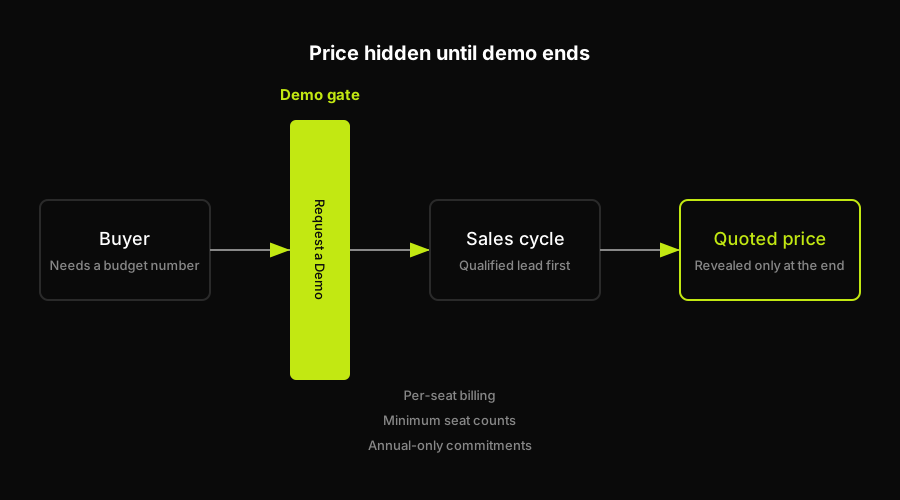
A buyer has to clear the demo gate and a full sales cycle before Testim reveals a single number.
Reverse-engineered Testim pricing tiers (2026)
The figures below are reverse-engineered estimates derived from third-party sources including G2 reviews, Capterra buyer reports, and procurement intelligence aggregators. They are not official Testim prices. Actual contract pricing depends on seat count, negotiated terms, and Tricentis bundling. Use these as a pre-demo budget anchor, not a quote.
| Team profile | Est. seats | Est. annual contract | Key variables |
|---|---|---|---|
| Small team (3-5 engineers) | 3-5 | $10,000-$20,000/yr | Near or below seat minimum; may require minimum-seat uplift |
| Mid-market (10-20 engineers) | 10-20 | $20,000-$50,000/yr | Per-seat billing model; annual commitment standard |
| Enterprise (50+ engineers) | 50+ | $60,000-$150,000+/yr | Tricentis bundle pricing; multi-product deals common |
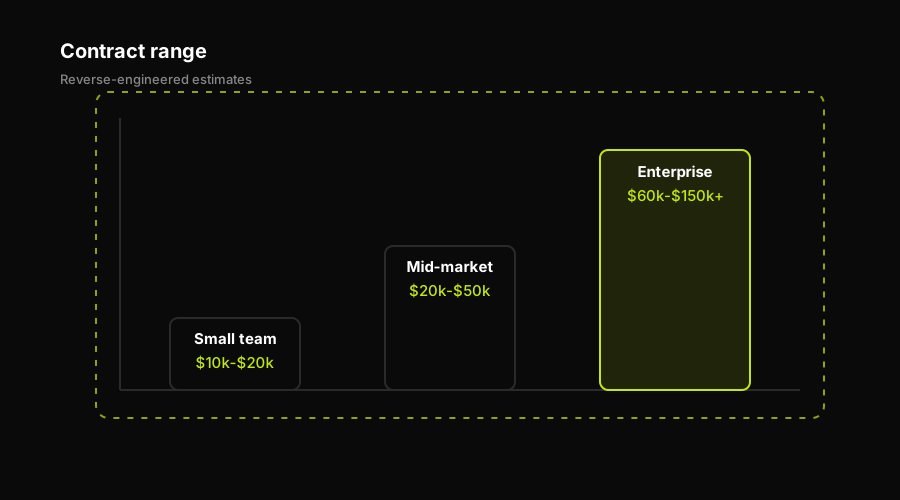
The demo gate hides a contract range that expands from small-team minimums to enterprise bundles before the buyer sees a quote.
Figures are reverse-engineered estimates from third-party aggregators as of 2026, not official Testim or Tricentis prices. Individual contracts vary based on negotiated terms, seat minimums, and bundling.
These estimates align with the pattern reported by buyers on G2 and Capterra: mid-market teams consistently describe Testim as "expensive for the value" and note that pricing is "not transparent" or "requires a long sales process." The price range for a 10-engineer team in the $20,000-$50,000/year band is consistent with similar AI testing tools that use enterprise per-seat billing models. For a direct comparison, the mabl pricing breakdown covers a comparable AI testing tool with a similarly opaque billing model, and the testRigor pricing post covers a tool in the same category with different positioning.
What the Tricentis acquisition means for pricing
Tricentis acquired Testim in January 2022. At the time, Testim was an independent AI-powered test-automation SaaS with lower entry price points and a more self-serve orientation. The acquisition changed the commercial model in ways that matter for buyers evaluating Testim today.
Enterprise portfolio alignment. Tricentis is one of the largest enterprise software testing vendors, known for tools like Tosca and NeoLoad. Its commercial model is built around large annual contracts, named accounts, and multi-year enterprise deals. Testim has been progressively aligned with that model since the acquisition. Buyers who interacted with Testim pre-acquisition and assumed pricing continuity have found the contract dynamics meaningfully different.
Bundling pressure. Tricentis sales motions frequently involve cross-selling across its product portfolio. A team evaluating Testim may find themselves in conversations that include NeoLoad (performance testing) or Tosca (enterprise test automation) at the account level, regardless of whether those products are relevant. This bundling can inflate the effective cost of a Testim-only purchase or obscure the per-product unit economics.
Minimum deal sizes. Tricentis' business model targets enterprise accounts. The minimum viable deal size has risen since the Testim acquisition, which prices out smaller teams more systematically than Testim's original pricing did. Teams under 10 engineers should model a potential seat-minimum surcharge in their budget estimates.
Pricing opacity as sales strategy. The absence of public pricing is not a website oversight. It is a deliberate enterprise-pricing strategy: by gating all price discovery behind a demo, Tricentis ensures that buyers reveal budget and team size before receiving any numbers, giving the sales team maximum anchoring leverage. This is standard enterprise software practice, but it is worth naming plainly for buyers who expect SaaS-style transparency.
For context on how other AI testing tools structure pricing in the same market, the Functionize pricing breakdown covers another enterprise-oriented AI testing platform with similar demo-gate dynamics.
How Autonoma inverts the demo gate
The cost the demo hides is not just a number. It is the cost of evaluation friction: you cannot know whether Testim works on your codebase until you have committed a sales cycle, and you cannot see the product running on your actual code until you have committed seats.
At Autonoma, we built the product to invert that structure. Connect a repository and our four agents start working immediately. Planner reads routes, components, and user flows and plans test cases from the code itself. Executor runs those tests against a live preview environment. Reviewer classifies each result as a real bug, an agent error, or a test-plan mismatch. Diffs Agent keeps the suite aligned on every PR by analyzing code changes.
No recording. No test scripts. No demo required to see the agents run against your actual application. If the run produces real findings, you see that evidence before any commercial conversation.
The contrast with a demo-gated enterprise model is structural, not cosmetic. Testim requires a sales cycle to evaluate; Autonoma's evaluation happens on your repository, at your pace, before any conversation. For teams budgeting AI-powered E2E testing in 2026, that difference shapes the decision process, not just the invoice.
Our approach is also codebase-first rather than recording-first. Where Testim's AI layer is built around authored tests and AI-enhanced maintenance, Autonoma's agents derive tests from the code itself. The suite evolves with the codebase via the Diffs Agent, without making a growing pile of authored scripts the center of the model.
Frequently asked questions
Testim publishes no public pricing. Based on reverse-engineered estimates from third-party aggregators including G2, Capterra, and procurement intelligence platforms, annual contracts for mid-market teams (10-20 engineers) land in the $20,000-$50,000/year range. Small teams may face minimum seat requirements that push entry costs toward $10,000-$20,000/year. Enterprise deals with Tricentis bundling can exceed $100,000/year. These are estimates, not official Testim prices. Always verify with Testim directly.
Testim offers a free trial, but not an ongoing free plan. The trial gives access to the product for evaluation purposes, but moving to production use requires a paid annual contract with per-seat billing. The trial does not include the full feature set available at contract tiers, and it does not reflect production-scale pricing. Minimum seat counts apply to paid contracts.
Testim routes all pricing through a 'Request a Demo' funnel rather than publishing a public price list. This is a deliberate enterprise-pricing strategy: buyers reveal budget size and team composition before receiving any numbers, giving the sales team anchoring leverage. Since the 2022 Tricentis acquisition, Testim has been aligned with Tricentis' enterprise sales model, which operates on this demo-gate structure across its product portfolio.
Yes. Tricentis acquired Testim in January 2022. Testim is now part of Tricentis' enterprise testing portfolio alongside NeoLoad and Tosca. The acquisition aligned Testim's commercial model with Tricentis' enterprise sales motion, including annual-only contracts, higher minimum deal sizes, and bundling pressure toward other Tricentis products. Buyers evaluating Testim today are effectively engaging the Tricentis enterprise sales organization.
For a small team of 3-5 engineers, reverse-engineered estimates from third-party procurement data suggest annual contracts start in the $10,000-$20,000/year range. This may include a minimum-seat surcharge if the team falls below Testim's contract minimums. Small teams are often the most price-sensitive group relative to what Testim's enterprise model is built for, and some buyers report that the sales process itself is oriented toward larger accounts.


