

Intelligent test automation is test automation that uses AI to author, maintain, or prioritize tests, not just to execute pre-written scripts. The four capabilities that define the category are: self-healing locators (tests adapt when selectors change), AI test generation (tests are created from code or behavior, not recorded clicks), autonomous execution (an agent drives the browser without human direction), and risk-based prioritization (AI decides which tests to run first). The decisive distinction: locator-level self-healing patches a broken selector after it breaks; behavior-generated regeneration re-derives the test from intended behavior so the break never becomes debt.
"Intelligent" became a checkbox sometime in 2023. Every test tool that had ever touched a selector added the word to its homepage. Record-and-playback tools called themselves intelligent. Framework wrappers called their retry logic intelligent. The category got so inflated that it stopped functioning as a useful filter.
The term should describe something specific: AI involvement at the authoring or maintenance stage, not just AI-flavored dashboards layered on top of the same brittle scripts. Here is what that distinction looks like in practice, and where the line is between a shallow AI integration and something that actually changes maintenance economics.
What makes test automation "intelligent"?
Traditional test automation executes. It runs a script you wrote and tells you whether it passed. The script does not adapt, it does not learn, and it does not write itself. You write it, and then you maintain it, and when the UI changes, you update it manually.
Intelligent test automation adds AI at one or more stages upstream of execution: authoring, maintenance, or prioritization. That addition has four distinct shapes.
Self-healing locators are the most common entry point. When a CSS selector or XPath breaks because the UI changed, the self-healing layer tries to locate the same element by other means (nearby text, ARIA role, visual position) and updates the locator automatically. The test does not fail outright; it heals.
AI test generation is a fundamentally different capability. Instead of a human recording a flow or writing a script, an AI reads the application (its routes, components, or codebase) and generates test cases from that understanding. The human does not write; the AI authors.
Autonomous execution means an agent drives the browser without a fixed script. It navigates, clicks, and asserts based on a goal or a plan, not a list of hardcoded steps. Execution becomes adaptive rather than deterministic in the script-following sense.
Risk-based prioritization means an AI decides which tests to run, in what order, based on what changed in the codebase and what is most likely to break. Instead of running the full suite every time, the system surfaces the tests that matter for this particular change.
Not all four are equal in impact, and not all tools that claim "intelligent" deliver all four. Here is what each one does and what it does not:
| Capability | What it does | What it does NOT do |
|---|---|---|
| Self-healing locators | Fixes broken selectors automatically after a UI change | Does not re-derive what the test was supposed to verify |
| AI test generation | Creates test cases from code, flows, or behavior specifications | Does not guarantee assertions are meaningful without verification |
| Autonomous execution | Drives the browser adaptively toward a goal without a fixed script | Does not replace deterministic assertions on business-critical paths |
| Risk-based prioritization | Runs the most relevant tests first based on code changes | Does not catch bugs in code paths the AI ranked as low-risk |
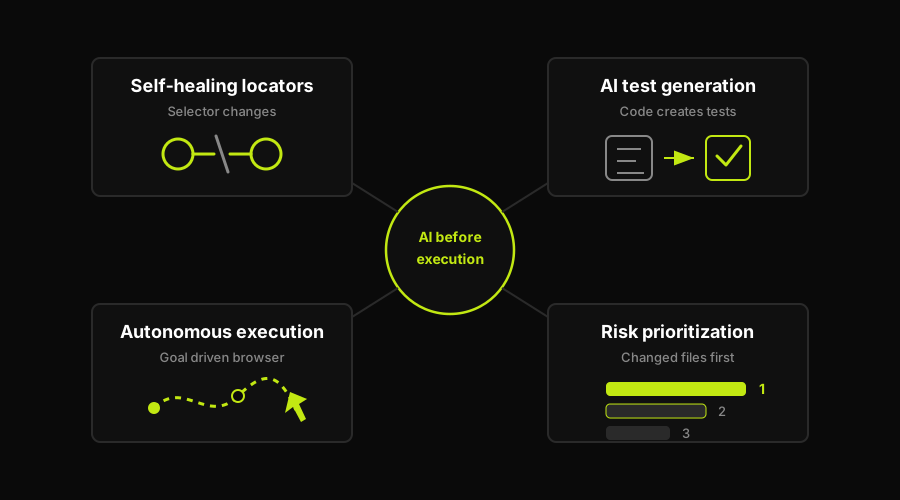
The four capabilities that define the category, each operating upstream of test execution.
Self-healing vs regeneration: the distinction that matters
Self-healing is not a single thing. There is a spectrum, and where a tool sits on that spectrum determines whether you are actually reducing maintenance debt or just deferring it.
At one end is locator-level self-healing. The test breaks because a data-cy attribute was renamed or a CSS class changed. The self-healing layer detects the failure, looks for the best matching element, updates the locator, and marks the test as healed. The test is alive again.
That is genuinely useful. Failed tests that stop running are invisible. A test that heals and keeps running at least stays in the suite.
The problem is subtler. The self-healing layer does not know what the test was supposed to verify about the user's experience. It knows that this element was previously at this position with this role, and it found something close enough. It made a guess. The test now runs, but it may be asserting against a different element than intended. The test has been kept alive, but its understanding of the UI is now inferred rather than derived. You have patched the locator, not the knowledge.
Behavior-generated regeneration works from the other direction. Instead of detecting a break and guessing a fix, it starts from the intended behavior (the code, the routes, the user flows) and re-derives the test case from that source. There is no selector to patch because the test was never based on a fragile selector. There is no guess because the generation always traces back to the source of truth.
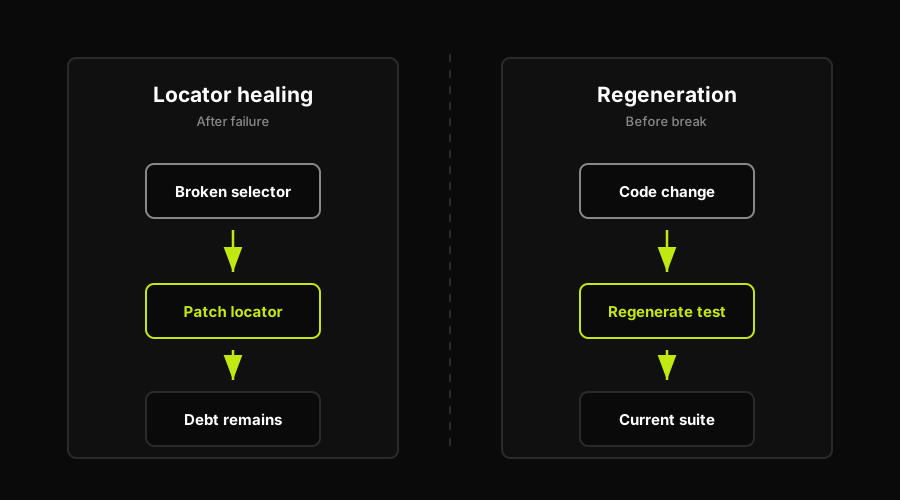
Patching covers a broken selector after the fact; regeneration re-derives the test from source so the break never becomes debt.
How Autonoma makes intelligent test automation codebase-first
This is where Autonoma sits on that spectrum. Our Diffs Agent watches every PR for code changes and re-derives the affected test cases from the updated codebase. The test is not healed after the break; it is updated before the break becomes a failure. The source of truth is the code itself, not a recorded click path or a fragile locator chain. This is what autonomous test generation looks like when it is codebase-first rather than selector-first.
The distinction matters practically for teams shipping fast. Locator-level self-healing reduces flaky-test noise. Regeneration eliminates the class of maintenance work that accumulates every sprint. The first is a quality-of-life improvement. The second is a structural change in how much your test suite costs to own.
Where intelligent test automation helps (and where it does not)
The most useful thing about defining a category precisely is that you can also say where it does not apply. Intelligent test automation is not the right answer for every team or every codebase.
Where it genuinely helps:
High-churn UIs are the clearest case. If your frontend is changing every sprint, locator-level self-healing is at minimum a noise reducer. Behavior-generated regeneration is a structural fix. Either way, AI-assisted maintenance pays off faster when the UI changes often.
Large regression suites that run too slowly benefit from risk-based prioritization. If you have 2,000 tests and a 40-minute CI run, routing the right 200 tests to run on every PR and deferring the rest to nightly is a real time savings. The AI prioritization layer earns its keep.
Teams without dedicated QA are the ICP that intelligent test automation was built for. If developers are writing tests between feature work, reducing the authoring and maintenance burden per test directly increases the share of the codebase that gets covered. AI test generation means tests happen; without it, they often do not.
Where it is overkill or does not help:
A small static site with ten pages and no dynamic state is not a good candidate. The maintenance overhead of a traditional scripted test is low because the UI rarely changes. Adding an AI layer adds complexity with no return.
One-off scripts and internal tooling often do not benefit from a test suite at all, let alone an intelligent one. Simpler deterministic checks (a health endpoint, a data validation script) are cheaper and more reliable.
Teams where the bottleneck is not test maintenance but test design should invest in strategy first. Intelligent test automation makes your existing test approach faster and cheaper to maintain; it does not replace the judgment about what to test.
For teams evaluating the broader landscape of AI approaches to testing, ai-for-qa covers the practitioner cut and the tool options in that space. If you are focused specifically on AI end-to-end testing, AI e2e testing goes deeper on that layer.
FAQ
Intelligent test automation is test automation that uses AI to author, maintain, or prioritize tests, not just to execute pre-written scripts. The defining capabilities are: self-healing locators, AI test generation, autonomous execution, and risk-based prioritization. The term is often used loosely as a marketing label, but in precise technical usage it refers to AI involvement upstream of execution, not just AI dashboards or reporting layers.
Regular test automation executes scripts a human wrote. If the UI changes, a human updates the script. Intelligent test automation adds AI at the authoring and maintenance stages: tests are generated from code or behavior specifications, selectors are healed or regenerated automatically, and the system decides which tests are relevant for a given change. The practical difference is maintenance cost: regular automation accumulates technical debt every time the UI evolves; intelligent automation reduces or eliminates that debt.
Self-healing test automation detects when a test fails due to a UI change (a renamed selector, a moved element) and attempts to fix the locator automatically so the test continues running. Most self-healing implementations work at the locator level: they find the best-matching element and update the reference. More advanced regeneration approaches re-derive the entire test from the intended behavior, so the locator never becomes stale in the first place.
Yes, but the quality and completeness depend heavily on what the AI uses as its source of truth. AI that generates tests from recorded clicks produces tests that are only as good as the recorded session. AI that generates tests from the codebase (routes, components, user flows) produces tests grounded in what the application actually does. The codebase-first approach also keeps tests maintainable as the code changes, because the source of truth updates alongside the code.
For teams with high-churn UIs, large regression suites, or limited QA capacity, yes. The ROI comes from reduced maintenance time per test and increased coverage per engineer-hour. For small static projects or one-off tooling, the complexity overhead outweighs the benefit. The honest framing: intelligent test automation multiplies the leverage of whatever testing investment you already have. If that investment is near zero, start with strategy before adding AI.


