

A software testing strategy is the decision framework that determines which tests get written and why. It is not the list of test types that dominates search results for software testing strategies: unit, integration, system, and acceptance testing describe what gets tested, while a strategy describes the principle that decides scope, priority, and effort across all of them. There are seven named, classical approaches to that principle: analytical, model-based, methodical, process-compliant, reactive, consultative, and regression-averse.
Someone above you asked for a test strategy document. You went looking for what one actually looks like, and every result on page one gave you the same thing: a list of test types. Unit testing, integration testing, system testing, acceptance testing, sometimes with a paragraph on the testing pyramid bolted on. None of it told you what a strategy is, because none of it is a strategy. It's a glossary.
This is written for the QA lead, QA manager, or engineering manager who owns quality without a dedicated QA function, at a company past the earliest stage: a real suite, real CI, a real release cadence. If you have no tests at all, the problem is different and earlier than what's covered here. If your problem is that you don't trust the tests your AI coding tool wrote, that's a different, adjacent problem too. This one is about allocation: given a fixed amount of review capacity, which of the seven classical approaches decides what gets tested first.
The seven named approaches
Every real test strategy is a version of one of these seven, first cataloged in classical software testing literature and still the cleanest taxonomy available. None of them is intrinsically better than another. Each optimizes for a different scarce resource, and picking one is a bet about which resource you have the least of.
Analytical
An analytical strategy derives what gets tested from a chosen factor, most often risk. You rank the ways the system can fail by likelihood and impact, then spend testing effort against that ranking instead of against the org chart or the feature list. A twelve-person fintech engineering team with one QA lead runs an analytical strategy by necessity: they can't test everything, so they test the payment flow and the auth flow first, because that's where a bug costs the most.
Model-based
A model-based strategy derives tests from an explicit model of the system: a state machine, a user-flow graph, a statistical usage profile built from real traffic. The model, not a person's judgment on any given day, tells you which paths matter and which combinations are worth covering. A team with a genuinely graph-shaped product, a checkout flow with a dozen branching states, gets more from formalizing that graph and generating paths from it than from writing cases one at a time.
Methodical
A methodical strategy applies a fixed, predetermined set of test conditions every release, drawn from a standard checklist or a quality-characteristic list: performance, security, usability, and so on. It doesn't derive scope from risk or from a model. It derives scope from consistency, the same checks every time, so nothing standard gets skipped under deadline pressure. A team shipping a mature product with low structural risk but high scrutiny on consistency leans methodical.
Process-compliant
A process-compliant strategy, also called standard-compliant, derives its tests from an external standard: IEC 62304 for medical device software, DO-178C for avionics, PCI-DSS for payment handling, or an internal SDLC standard a larger org imposes on every team it runs. The standard specifies what must be tested and often how it must be documented. A team building a payment processor doesn't choose this strategy so much as inherit it from an auditor.
Reactive
A reactive strategy designs tests in response to the running system rather than planning them in advance. Exploratory testing and error guessing live here: a tester interacts with the built product, follows what looks suspicious, and generates test ideas from what they find rather than from a spec written before the system existed. A small team shipping fast, with a working build available before anyone had time to plan test cases, ends up here whether they meant to or not.
Consultative
A consultative strategy has its scope and coverage dictated by stakeholders outside the test team: developers flagging the areas they're least confident in, business stakeholders defining what "done" means for a launch, a customer with a contractual acceptance list. The test team doesn't choose the priorities. It executes someone else's. An agency team building against a client's fixed acceptance checklist is running a consultative strategy, whether or not anyone calls it that.
Regression-averse
A regression-averse strategy invests heavily in preventing regressions: large automated regression suites, extensive reuse of existing test cases across releases, a bias toward "did we break anything that used to work" over "did we ship the new thing correctly." A team with a large, stable, widely-used product, where a regression is more costly than a missing new feature, runs this by default, often without naming it.
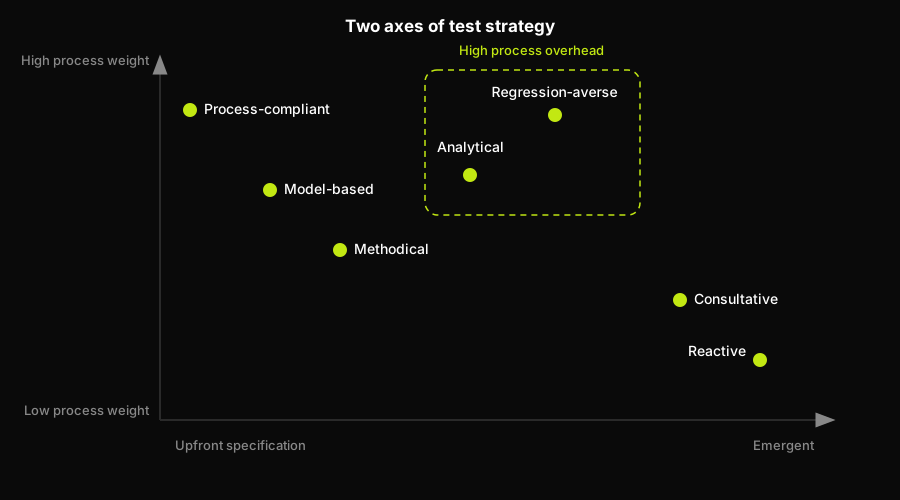
Process-compliant and model-based sit furthest toward upfront specification; reactive sits furthest toward emergent. Analytical and regression-averse land in the upper-middle, where both approaches carry real process overhead despite deriving scope differently.
The verdict table
Here's what changes once a generator, not a person, can produce the eleventh test case as cheaply as the first.
| Approach | What it optimizes for | Verdict for AI-authored suites | Why |
|---|---|---|---|
| Analytical | Coverage weighted by risk analysis | Holds up | Selection is everything once authoring is free |
| Model-based | Coverage derived from a system model | Needs revision | The model can now be inferred from code |
| Methodical | Consistent checklist run every release | Collapsed | Merges with process-compliant; truth source shifts |
| Process-compliant | Compliance with an external standard | Collapsed | Merges with methodical; truth source shifts |
| Reactive | Bugs found by exploring the running system | Holds up | Explores exactly where the spec stays silent |
| Consultative | Scope set by outside stakeholders | Holds up | Scope owner is unchanged by who authors tests |
| Regression-averse | Preventing regressions via large reused suites | Needs revision | Goal stays; hand-built suite maintenance does not |
Consultative doesn't belong in the disagreements above for a reason: it's an org-process choice about who decides scope, and whether a generator or a person writes the resulting tests doesn't change who's in the room making that call. The honest verdict is "unaffected," not "AI-proofed."
Why cheap authoring changes the ranking
A test strategy allocates a scarce resource. That resource used to be the time it took to write a test. Increasingly, it's the attention it takes to review one.
That shift is the entire reason the table above skews toward analytical. When authoring approaches zero cost, the question stops being "can we afford to write this test" and becomes "is this test worth the reviewer's time to read." Methodical and process-compliant, both built around who has the authority to write the checklist, converge once a generator reads the same specification either way. Reactive keeps its value precisely because it's the one approach a generator structurally cannot imitate: a generator extrapolates from what already exists, and exploratory testing pays off exactly where the specification is silent. This is a different shift than shift-left testing, which moved testing earlier in the pipeline. This one moves who is authoring the tests once they exist, not when they run.
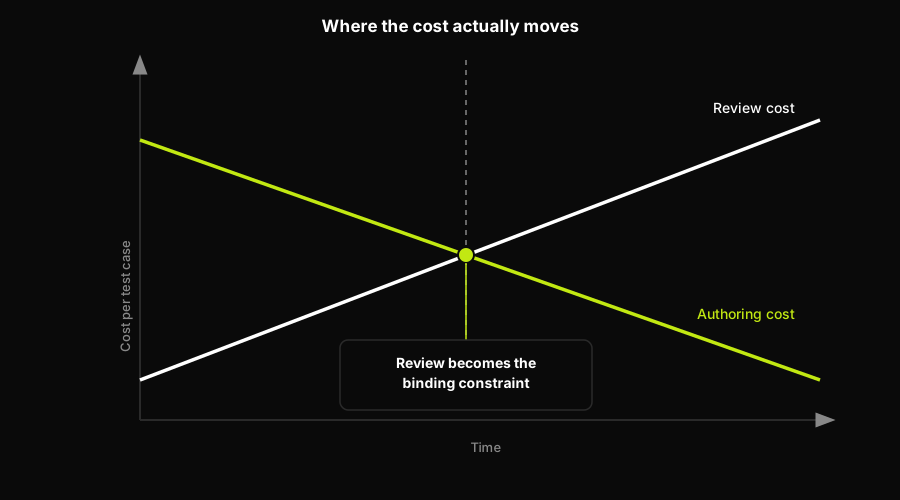
Authoring cost per test case keeps falling as generation improves. Review cost per test case keeps rising because suite size grows faster than review capacity. Past the crossover, review is the resource the strategy has to budget for.
Concretely: a suite that used to top out around forty end-to-end tests, because that's roughly what one engineer could hand-write and maintain alongside their actual job, can run several times that scope for a comparable level of ongoing effort once something else absorbs the maintenance. What doesn't get easier is the reviewer's ability to read several times as many results in the same afternoon. A test strategy that only ever had to answer "what do we have time to write" now has to answer "what deserves someone's attention when it fails," which is a harder and more valuable question than the one it replaced.
None of this means the strategy document gets rewritten from scratch. It means each section gets revisited with the new constraint in mind: what analytical scoring looks like when part of the analysis itself can be generated, what regression-averse investment means when the regression suite maintains itself, what process-compliant documentation requires when the evidence trail is machine-produced. Working through that section by section, rather than in the abstract, is worth its own treatment, and our companion piece on AI test strategy covers it in full.
How Autonoma changes the scope calculation
The template every strategy guide inherits says "pick the critical paths" as if that were obviously the right amount of coverage. It was the right amount for a world where writing the twentieth end-to-end flow cost a week of an engineer's time, weighed against the value of testing a path nobody had complained about yet. Under that constraint, narrow scope wasn't a preference. It was survival.
We built Autonoma because that constraint isn't fixed, it's just where most teams happen to be standing. It reads your codebase directly, plans test cases from the routes and flows that actually exist, and runs them against a preview environment on every pull request. The part that matters for the scope calculation is what happens after the first pass: our Diffs Agent re-reads every diff and adds, deprecates, or updates test cases as the code changes, so the twentieth flow doesn't carry the same standing maintenance cost a hand-authored one does. That maintenance loop is also why a broader footprint doesn't have to mean a proportionally larger review queue: the Diffs Agent flags what actually changed on a given PR rather than re-litigating the whole suite, so the review burden tracks the size of the diff, not the size of the strategy.
Autonoma does not replace a strategy. It changes what the strategy can afford. The selection question, which paths are worth testing, doesn't go away. It gets harder and more valuable, because the cost of guessing wrong about scope moves from wasted authoring weeks to wasted review attention. A generated suite nobody scoped carefully still has to be read by someone, and reading is the resource that didn't get cheaper. Getting that read decision wrong twice, approving a broad scope nobody actually reviews and narrowing scope nobody ever revisits, costs more than picking either extreme once and living with it. The operational side of running that coverage on an AI-forward team, day to day, is covered in E2E testing strategy for AI teams.
Choosing yours
If you have no QA function, start narrow and analytical: rank by risk, test the paths where a bug is expensive, and defer the regression-averse instinct until you have a suite worth protecting. Building broad regression coverage before you have anything worth being averse to losing spends effort on the wrong constraint. The failure mode to watch for isn't testing too little; it's spending the first real testing budget on a broad regression suite that protects features nobody has broken yet, instead of the handful of flows where a bug would actually cost you a customer.
If you have one QA lead, analytical stays primary, but add reactive as a deliberate second pass rather than an accident of running out of time. Block time after the planned coverage lands to explore the areas the plan didn't anticipate, because that's the one class of bug a plan structurally cannot catch. In practice that looks like a fixed block every release cycle where the explicit goal is to go looking for trouble rather than confirm what was already specified, logged separately from the planned suite so the two don't get conflated at retro time.
If you have a full QA team, analytical and regression-averse both belong, and model-based earns its added complexity wherever your flows are actually graph-shaped, a checkout with a dozen branching states, not wherever a diagram would simply look good in a deck. The mistake tends to run the other direction here: teams with the headcount to build an elaborate state-machine model for every flow, including the ones that never change and rarely break, end up spending model-based effort on parts of the product that would have been fine with a simple analytical pass.
If you operate in a regulated environment, process-compliant is not optional. It's the floor, and analytical selection operates inside whatever room the standard leaves open. The standard tells you what has to be tested and documented; it rarely tells you in what order, which is exactly where a risk-based pass inside the mandated scope earns its place.
Most teams are not cleanly one of these four. They're an analytical core with a regression-averse layer bolted on after the first bad incident, and a consultative override whenever a large customer's contract demands a specific checklist. That's normal. A pattern we see often, though: a strategy that was clearly analytical when the document was first written slides into process-compliant within a year, one security audit and one compliance checklist at a time, without anyone deciding to make that trade. The audit isn't wrong to demand its checklist. Nobody sits down afterward and decides the risk-based scoring underneath no longer matters, either. It just stops happening, because the checklist ate the calendar. The strategy document doesn't need to pick one approach and defend it forever; it needs to say, in writing, which approach is primary for which class of change, and how often that gets revisited, so the choice is a decision instead of an accident nobody remembers making.
For the actual strategy document this produces, the test strategy document template article has the filled-in example. If what you were actually asked for is the release-level document rather than the strategy, test plan template has a ready-to-fill version of that instead. If you're not sure which of the two you were asked for in the first place, test strategy vs test plan draws the line between them before you write either. And if the analytical approach above is the one you're building around, the risk-based testing scoring framework turns "rank by risk" into something more specific than a mood.
Test strategies rarely fail because a team picked the wrong one of the seven. They fail because nobody wrote down which one they picked, so the choice quietly drifts every time someone new joins or a deadline gets tight. None of the seven approaches is obsolete, and none of them was ever a checkbox you mark once. A test strategy is a living answer to "given what we can't test, what matters most," and cheap authoring changes the shape of what you can't test without changing the question itself. Write down which of the seven you're actually running, say why out loud, and revisit it the next time your authoring cost drops again, because it will. When you're ready to see what a broader analytical scope actually costs to run day to day, Autonoma is built to make that a review decision instead of an authoring one.
Frequently Asked Questions
A software testing strategy is the decision framework that determines which tests get written and why: what gets priority, what gets skipped, and what principle decides between them. It is not the same as a list of test types (unit, integration, system, acceptance), which describes what gets tested rather than the reasoning behind the choice. Classical testing literature names seven approaches to that reasoning: analytical, model-based, methodical, process-compliant, reactive, consultative, and regression-averse.
There are seven classical approaches to test strategy: analytical (scope driven by risk analysis), model-based (scope derived from a system model like a state machine or user-flow graph), methodical (a fixed checklist run every release), process-compliant (scope dictated by an external standard), reactive (tests designed in response to the running system, including exploratory testing), consultative (scope set by stakeholders outside the test team), and regression-averse (heavy investment in preventing regressions). Most real teams run a blend, with one approach dominant.
A test strategy is the high-level set of principles that decides what gets tested and why. A test plan is the specific, executable document for one release or feature that says who tests what, when, and in what environment. The strategy answers 'what kind of testing do we do and why'; the plan answers 'what are we testing this sprint, on this build.' A single strategy can outlive dozens of plans without changing.
In organizations with a QA function, a QA lead or QA manager usually drafts the test strategy, informed by engineering leadership and, under a consultative strategy, by stakeholders outside the test team entirely. In organizations with no dedicated QA function, the engineering manager who owns quality by default is usually the one who ends up writing it, whether or not anyone gave them the title.
A test strategy should treat AI-generated tests as a change to the cost side of the equation, not a replacement for the strategy itself. When authoring and maintaining test cases gets cheaper, the approaches built around scarce authoring time, methodical and process-compliant, converge, while risk-based selection becomes more important, not less, because someone still has to decide what's worth generating and reviewing. The strategy document should say explicitly how AI-authored and AI-maintained tests get reviewed, not just how they get written.
Yes, and that gap is the concrete problem it was built for. Whichever of the seven approaches you run, the suite tends to stop at whatever one engineer can hand-write and keep passing, so the flows ranked third through tenth on your risk list stay uncovered even though the strategy says they matter. Autonoma removes both halves of that ceiling: our Planner agent reads your codebase and derives the end-to-end cases your routes and flows imply, including the database state each one needs, then runs them against a preview environment on every pull request. Our Diffs Agent re-reads each code diff and adds, updates, or retires cases, so the suite tracks the product instead of decaying between releases. It still doesn't decide which risks matter, that's your analytical pass. What it ends is authoring capacity quietly setting your scope.


