

Staging environment hubspot integrations expose a structural problem: HubSpot sandbox environments do not mirror production. Stripe test mode does not mirror production. Segment dev sources do not mirror production. The staging environment problem for a no-QA team is not a missing tool. It is a missing layer that contains the canonical third-party data flow without leaking prod data.
We built PreviewKit so a small team can spin up an environment that runs against canonical recorded third-party flows, not against vendor sandboxes that drift from production. Every pull request gets an isolated environment with the data layer baked in. No QA hire required. No shared staging bottleneck. No "works in sandbox, breaks in prod" surprises.
Why HubSpot sandbox is structurally broken as staging
A team we spoke with recently had built a CRM sync feature that pushed deal stage updates from their SaaS into HubSpot. The integration worked perfectly in their sandbox. They shipped it. Production started throwing 400 errors within the hour.
The root cause: a custom object they used in production had never been created in the sandbox. The sandbox had different property availability. A deal-stage workflow that fires in production never fired in sandbox because the trigger condition referenced a property that simply did not exist in the sandbox schema.
This is not an edge case. It is the structural reality of HubSpot sandbox. Custom objects do not auto-sync from production to sandbox when you create them. Property availability differs between the two environments. Workflows behave differently because they reference different schema states. The sandbox was designed to let you test HubSpot-native configuration changes: email templates, workflow logic, field mappings. It was not designed to mirror your production data flow.
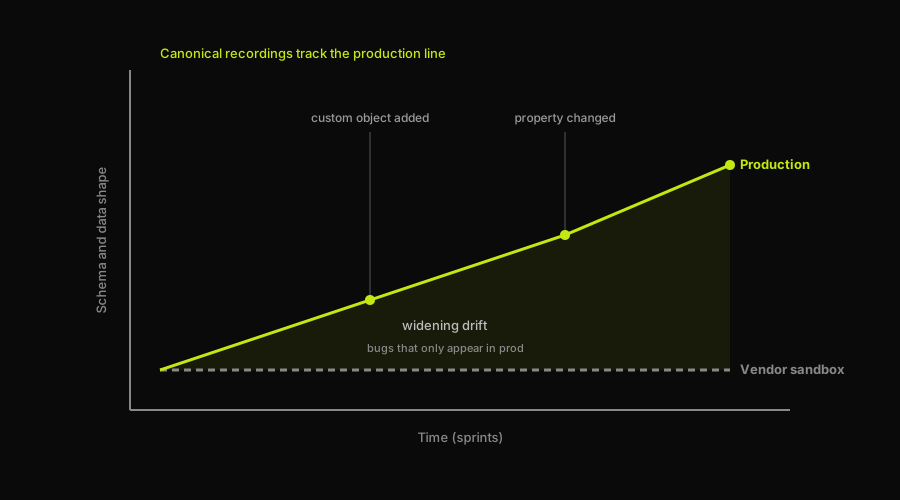
Sandbox schema drifts from production over time; canonical snapshots track it.
The team described it to us bluntly: "we don't have any QA, so we tested in sandbox, it looked fine, and we hear about it real quick when something is actually wrong." That feedback loop, discovering integration failures from production errors, is the default state for most seed-to-Series A teams using vendor sandboxes as a proxy for staging.
The deeper issue is that HubSpot sandbox gives you a structurally different schema than production. Your test surface is not production-like. It is a vendor-managed approximation that drifts from production the moment you customize your CRM.
The pattern repeats for Stripe, Segment, and other third-party SaaS
HubSpot is the most common case we hear, but the pattern is identical across every third-party SaaS your application integrates with.
Stripe test mode exists to verify that your checkout flow calls the right Stripe API methods and handles the right response codes. It does not mirror your production customer state: no real subscriptions, no real payment methods, no real upgrade/downgrade history. A billing feature that works in Stripe test mode can still fail in production when it encounters an edge case in a customer's actual subscription state.
Segment dev sources capture the event schema you intend to send. They do not replay what your production event stream actually looks like: the event ordering, the property cardinality, the volume patterns that stress-test your downstream pipelines. A feature that sends clean events in dev can still trigger downstream failures in production from unexpected ordering or volume.
The common thread: vendor sandboxes exist to test the vendor's API surface. They do not exist to mirror your production data flow. That distinction matters enormously for a team without a QA function. There is no one running manual verification in production-shaped conditions before each release. The sandbox is the only pre-prod check, and it is not checking what the team thinks it is checking.
The 4 broken patterns small teams try first
When teams recognize this problem, they cycle through four approaches before landing on a sustainable one.
| Pattern | What teams hope for | What actually happens |
|---|---|---|
| Mock the third-party in staging | Stable, fast, no sandbox drift | Mocks drift from vendor API immediately; teams stop updating them |
| Use prod with a staging flag | Real data, real responses | Staging traffic creates real objects, triggers real webhooks, leaks prod data |
| Skip staging, ship to prod | Faster iteration | "local to prod" feedback loop: bugs surface in production only |
| Manual end-to-end before each release | Catches integration bugs | Does not scale past 2-3 engineers; blocks shipping velocity |
The mock approach sounds reasonable on paper. Write a mock HubSpot server, control the responses, eliminate flakiness from sandbox drift. The problem is that mocks require maintenance. When HubSpot adds a property or changes a response shape, the mock silently diverges. The team's test suite passes against a mock that no longer reflects reality. Teams universally stop updating mocks within a few sprints.
Using production with a staging flag is the most dangerous pattern. Staging traffic writes real HubSpot contacts, creates real Stripe charges in test mode but using real webhooks, fires real Segment events into production pipelines. The data pollution is hard to clean up, and there is a real risk of triggering billing or notification workflows against actual customers.
Skipping staging entirely (shipping directly from local or from a shared dev environment to production) is the pattern we hear most often from early-stage teams. "Local to prod," as one engineer described it. It works until it doesn't. The feedback loop is brutal: you find out something broke when a customer emails or when Sentry fires. For more on the tradeoffs of this pattern, the post on shipping without a staging environment covers the risk surface in detail.
Manual end-to-end testing before releases buys time but cannot scale. Two or three engineers can run through critical flows for a few minutes before each deploy. But as the surface area grows and deploy frequency increases, the manual check becomes the bottleneck. Teams either cut corners or slow down.
None of these four patterns solves the root problem: a missing layer that contains the canonical third-party data flow in an isolated, production-like form.
The per-PR canonical-data pattern
The pattern that works is a per-PR preview environment backed by canonical recorded third-party flows.
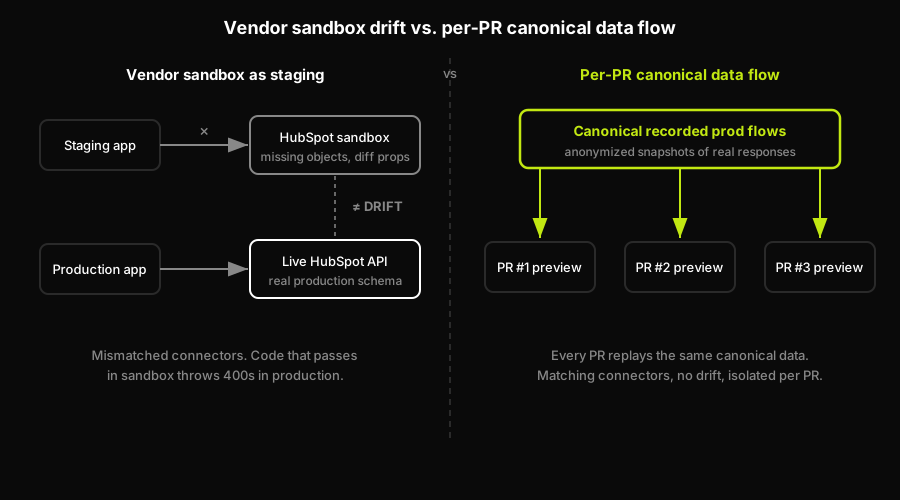
Vendor sandboxes drift from prod; canonical recordings keep every PR pod in sync.
The setup has three parts. First, record the third-party API responses your application actually receives in production (anonymized to strip any PII). These recordings become the canonical data layer. Second, provision an isolated environment per pull request. Each PR gets its own database, its own environment variables, its own application stack. Third, wire the third-party integration layer to replay the canonical recordings instead of calling the live vendor API.
The result: every pull request runs against a staging surface that reflects the actual structure of your production HubSpot data, your production Stripe subscription state, your production Segment event patterns. Not against a sandbox that drifts. Not against production with a flag that leaks data. Against a stable, canonical, anonymized representation of what production actually looks like.
This solves the structural problem. The sandbox drift issue disappears because the canonical recordings are fixed snapshots of real production API responses. The prod data leak issue disappears because the recordings are anonymized and the environment is isolated. The scaling issue disappears because provisioning is automated per PR.
The catch: building this infrastructure yourself takes weeks. Recording layer, replay server, per-PR provisioning, database isolation, teardown automation. Teams that do it describe it as a significant investment. That is what PreviewKit abstracts away.
HubSpot sandbox doesn't mirror prod. Talk to us about a per-PR preview environment with canonical third-party data flows. Grab 20 min with a founder
How Autonoma + PreviewKit solves the third-party data problem
The problem this article has documented is structural. Vendor sandboxes are not designed to mirror production data flows. Homegrown mocks drift. Prod flags leak data. Manual testing does not scale. Small teams without a QA function carry this structural gap into every release.
Autonoma's PreviewKit addresses this at the infrastructure layer, not the application layer. When a pull request opens, PreviewKit provisions an isolated per-PR preview environment: full application stack, isolated database seeded via the Environment Factory SDK using factory.up(), and a third-party data flow layer that replays canonical recorded responses instead of calling the live vendor API. When the PR closes, factory.down() tears the namespace down. No manual cleanup, no state leakage between PRs, no coordination overhead.
The four-stage pipeline handles the integration verification automatically: environment provisioning, canonical data injection, Autonoma's E2E test agents running against the live preview URL, and a PR comment artifact showing the test outcome. The HubSpot integration your team just shipped gets exercised against the real property schema, the real custom object structure, the real workflow trigger conditions, because the canonical recordings reflect what production actually sends and receives. Not what the sandbox approximates.
This is the layer that small teams cannot build in a sprint. We built it so a team of three engineers gets the same pre-merge confidence as a team with a dedicated QA function, without the headcount. The per-PR preview environment is the substrate. The canonical third-party data flow is what makes it production-like. Autonoma's testing agents are what make it actionable on every PR, not just before a quarterly release.
For teams already running preview environments on ephemeral environments or curious how the full environment lifecycle compares across providers, how Autonoma's preview environments work covers the control plane in detail.
Where this pattern fits
This pattern (PreviewKit + canonical recorded flows) is built for seed-to-Series A engineering teams that ship to production without a dedicated QA function. If you have 3 to 20 engineers, you integrate with one or more third-party SaaS APIs, and your current pre-prod check is either manual or vendor sandbox, this is the layer you are missing.
It also complements teams that already operate a full mirrored staging cluster. If you have a dedicated ops engineer maintaining a production replica with a live HubSpot sandbox wired to a staging CRM account with matching schema, you start from a different point: that full mirror delivers production-like confidence, and it carries a real cost and maintenance overhead that grows with scale. The canonical-data per-PR pattern is the lighter-weight path to the same pre-merge confidence, so you can run it on every pull request without standing up and babysitting a second production. Teams running a full mirror often adopt it for fast inner-loop checks and reserve the mirror for the cases that truly need it.
The signal that you need this layer: you have merged something that worked in sandbox and broke in production at least once in the last quarter. If that sentence describes your team, the vendor sandbox is not working as a staging proxy. The canonical-data per-PR pattern is.
No. HubSpot sandbox environments do not mirror production. Custom objects do not auto-sync from production to sandbox when you create them. Property availability differs between the two environments. Workflows behave differently because they reference different schema states. The sandbox was designed to let you test HubSpot-native configuration changes (email templates, workflow logic, field mappings) without touching live CRM data. It was not designed to mirror your production data flow or the third-party integration state your SaaS application depends on.
The pattern that works for small teams is a per-PR preview environment that runs canonical recorded third-party flows instead of live sandbox API calls. Your application spins up in an isolated environment per pull request, and the HubSpot integration layer replays recorded production-shaped responses rather than calling the sandbox API. This gives you a stable, consistent test surface that reflects how your application actually behaves in production, without leaking real customer data or hitting the structural schema differences that make HubSpot sandbox unreliable as a staging proxy.
The alternative is a per-PR preview environment with canonical recorded third-party flows. Instead of calling HubSpot sandbox (which drifts from production schema), the preview environment replays recorded production-shaped API responses that are stable, schema-accurate, and isolated per pull request. Autonoma's PreviewKit provides this substrate: it provisions a per-PR environment with an isolated database and third-party data flows baked in, so every pull request gets a consistent staging surface without the structural drift that sandbox environments introduce.
You can, but you almost certainly should not. Testing against a real third-party SaaS API in staging means your staging traffic creates real objects (contacts, payments, events) in vendor systems, which pollutes analytics, triggers real webhooks, and potentially incurs real costs. The pattern that works is canonical recorded flows: record the third-party API responses your application actually receives in production (anonymized), replay those recordings in your per-PR preview environment, and test your application's behavior against stable, realistic responses. You get production fidelity without the side effects.
A per-PR preview environment is an isolated, full-stack deployment of your application that is provisioned automatically when a pull request opens and torn down when it closes. Each PR gets its own URL, its own database, its own environment variables, and (in the PreviewKit pattern) its own set of canonical third-party data flows. This means every pull request can be reviewed against a live, production-like environment without interfering with other open PRs or with the main staging environment. Per-PR environments eliminate the shared-staging coordination problem and give reviewers a consistent, reproducible artifact to evaluate alongside the code diff.


