

API testing tools verify a service at the request/response boundary instead of through a browser, and they split into five categories: interactive clients for exploring and documenting endpoints, code-first frameworks for asserting behavior in CI, contract testing for multi-service compatibility, schema-driven fuzzing for edge cases a human wouldn't write, and load-shaped tools for latency under volume. Which category you need depends on who runs the check and when, not which tool ranks first on a listicle.
Every "best AI testing tools" roundup published in the last year has the same blind spot. Open ten of them and count how many mention a request header, an OpenAPI schema, or a status code. Most land at zero. They compare browser automation and self-healing selectors, then call it "testing tools," as if a backend didn't exist.
If your team ships a service with no UI, or a UI that's a thin client over an API doing the real work, those roundups have nothing for you. This one does. It's for QA leads, QA managers, and engineering managers who inherited quality ownership without a QA function, at a company with a real suite and release cadence, deciding where API coverage fits next to everything already in CI. It is not for a pre-seed team standing up its first tests, and it is not about whether AI-generated tests are trustworthy. What follows is the pick: five categories, what each verifies, and how to choose between them.
Five categories of API testing tools, not one ranking
API testing tools don't compete on a single axis the way browser frameworks do, so ranking them 1-10 hides more than it shows. The better question is what each one verifies and who runs it.
Interactive clients and collections: Postman, Bruno, Insomnia
Interactive clients (Postman, Bruno, Insomnia) let a human explore an API by hand and save the request as a named collection. Postman serializes to a documented Collection Format v2.1 JSON schema that CI can replay without the GUI; Bruno stores the same idea as plain .bru files that diff like code in the repo.
Code-first API test automation tools: REST Assured, Karate, SuperTest
Code-first frameworks (REST Assured, Karate, SuperTest) let an engineer assert behavior on every pull request, no clicking required. REST Assured's given().when().then() syntax reads like a spec; Karate lets a non-Java engineer write a full test as a Gherkin-flavored .feature file; SuperTest wraps Node's HTTP client in chainable assertions inside whatever runner you already use.
Contract testing: Pact
Contract testing (Pact) solves what neither of the above touches: multiple consumers built by different teams sharing one API. A consumer defines the interactions it depends on; Pact writes them to a pact file (JSON) the provider verifies against, typically via a shared Pact Broker, so neither side runs the other's suite.
Schema-driven fuzzing: Schemathesis
Schema-driven fuzzing (Schemathesis) assumes the spec already exists: point it at an OpenAPI or GraphQL schema and it uses Hypothesis, Python's property-based testing library, to generate malformed and boundary inputs, then checks the response against what the schema promised.
Load-shaped checks: k6
Load-shaped checks (k6) verify whether an API still behaves correctly once many requests hit it at once. k6 scripts are JavaScript run by a Go binary and assert with check(); the difference is volume, not syntax. Load and performance tooling gets dedicated treatment in our guide to performance testing tools.
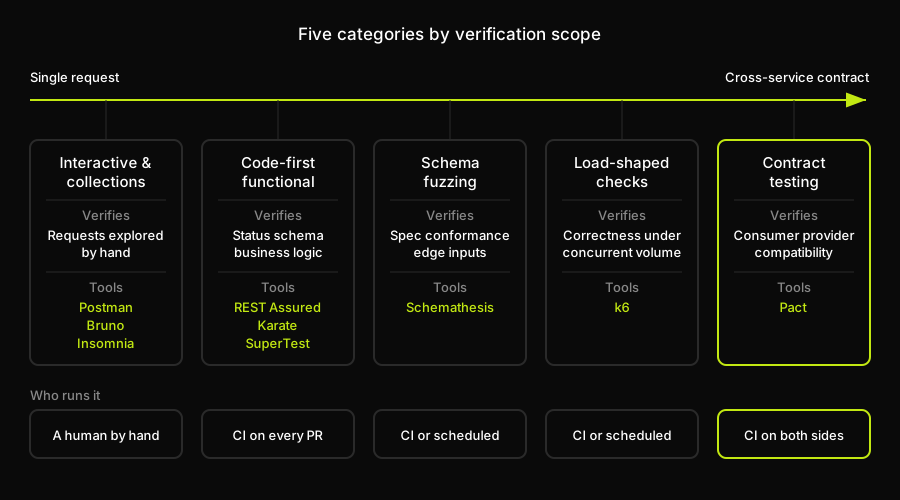
Read the axis before the tool names: scope widens from one request a person sends by hand to a contract two teams have to agree on, and the category you need is the one whose scope matches the check you are trying to write.
Side by side, here are the five categories of API testing tools, what each one verifies, and when to reach for it:
| Category | Tools | What it verifies | Code required | Best when |
|---|---|---|---|---|
| Interactive & collections | Postman, Bruno, Insomnia | Manual request/response behavior | None | Exploring or documenting an API |
| Code-first functional | REST Assured, Karate, SuperTest | Status, schema, business logic | Yes | CI-run regression on every PR |
| Contract testing | Pact | Consumer-provider compatibility | Yes | Independent teams share one API |
| Schema fuzzing | Schemathesis | Schema conformance, edge inputs | Minimal, config only | An OpenAPI spec already exists |
| Load-shaped checks | k6 | Latency and correctness under load | Yes | Capacity planning, not correctness alone |
Which API testing tools are open source?
Every category has at least one openly licensed option. Interactive clients are the only category with a closed-source leader: Postman's client is closed commercial software, though its Collection Format v2.1 is a published JSON schema, so a Postman collection stays portable to other tools. Bruno (MIT) and Insomnia's repository (Apache 2.0) are open too. REST Assured is Apache 2.0; Karate, SuperTest, Schemathesis, and Pact are MIT; k6 is AGPL 3.0, maintained under Grafana.
A runnable API test automation starter
The code-first category plugs directly into a pull request gate with nothing extra to license or stand up: an Express app with three routes and a SuperTest suite asserting status code, response shape, and one negative case per route, using Node's built-in node:test runner.
The manifest: an ESM project whose test script calls the built-in runner:
The app under test: a health check, a lookup by ID that can 404, and a create endpoint that can 400 on a bad payload:
And the suite itself, five assertions covering both success and failure paths:
Run npm install, then npm test. Every assertion here checks something a browser-driven test would need a running frontend and a network wait to exercise indirectly; here it's a function call.
Why API tests should carry the most assertions
This is where the roundup becomes a strategy decision: API tests are the cheapest assertions your team will ever own, and a well-shaped strategy pushes as much verification down to this layer as the API surface allows.
Cheapest is a claim about mechanism, not a borrowed statistic. An API assertion calls a function and reads a value: no browser, no selector to resolve. It fails for one reason, instead of the dozen reasons a UI test can fail. Interfaces also change slower than UIs: a route's contract is a promise to every consumer, while a button's class name is an implementation detail nobody outside the frontend team depended on.
Push volume to the layer where a failure is unambiguous, freeing review attention for end-to-end tests where a failure could mean five different things. That's the case for weighting a strategy toward API coverage: every correct API-layer assertion is one less ambiguous failure competing for attention in review. For prioritizing endpoints, see our API testing strategy post; for the AI side, see AI-driven backend API testing.
None of that means API tests are the only layer worth funding, only that the marginal assertion belongs there first. The next question is what's left once you've pushed everything downward the API surface allows, and where a product like ours sits relative to that remaining layer.
How Autonoma sits above the API layer
Everything above this line is a real recommendation stack for a real gap: API testing is invisible in nearly every "AI testing tools" comparison published this year. That gap is exactly what this article filled, and the six tools above fill it well enough that recommending them beats recommending ourselves for it.
We built Autonoma for the layer directly above: read your codebase, generate end-to-end tests from the routes and flows that exist in it, and run those against a live preview environment on every pull request, with a Diffs Agent that keeps the suite aligned as the code changes. That's the behavior a user actually experiences once your API responses get rendered, clicked through, and acted on in a browser, and it's the half a passing API suite can't see. Wire up the request and response surface with one of the five categories above, then point Autonoma at the flows that only exist once a real session is running in front of a screen.
Map it to the categories above and the split is clean. Postman, REST Assured, Karate, SuperTest, Pact, and Schemathesis each own a piece of the request/response surface; none of them render a page or click a button. Autonoma's generated tests run against a live preview environment created for that pull request, the same request/response layer this article covers, consumed by a browser instead of an assertion library.
What API tests cannot tell you
A clean API response doesn't guarantee a clean experience. The response might be exactly correct and the page that renders it might still be broken: a loading state that never resolves, a client-side redirect that drops a query parameter, a form that submits the right payload but never re-enables its button. None of the five categories above can see that, because none of them render anything. That's not a knock on any of them; it's a description of where their contract ends.
Take a password reset. The API layer can assert that a request endpoint returns 200 with a token, and that a confirmation endpoint returns 200 given a valid token and 400 given an expired one. Every one of those checks can pass while the reset flow itself is unusable end to end, if the confirmation email never renders the right link, if the form doesn't clear a cached session, or if a redirect after success drops the user on an error page instead of the login screen. The API was never wrong. The experience built on top of it was.
The same failure mode shows up around checkout. An order-creation endpoint can return 201 with a valid order ID every time, and a payment-confirmation endpoint can return 200 with the right status field, while the checkout page still fails silently: a client-side validation library that blocks submission on a field the API never required, a webhook race where the confirmation page renders before the payment provider's callback lands, a cart that doesn't clear after a successful order and lets someone pay twice. Each is a real production bug a green API suite will never surface, because none of them touch a request or a response; they live entirely in what the browser does with a response it already received correctly.
This matters most for the exact reader this article was written for: someone who was asked to write down a testing approach and needs the document to hold up under a follow-up question. "We have API coverage" answers one part of "how do you test." It does not answer what happens when a user actually completes checkout, resets a password, or hits an error state mid-flow, because those are properties of a rendered session, not a response body. A strategy document that stops at the API layer looks complete and isn't; the honest version says which layer covers which failure mode and why.
A useful heuristic for drawing that line yourself: if a scenario can be verified without loading a page, ask whether it should live at the API layer first, since it will be cheaper to run and cheaper to review there. Reserve a browser-driven check for the moment a scenario stops being about a single response and starts being about a sequence a user actually lives through, one screen leading to the next with state carried between them. Most teams get this backwards by default, writing a browser test first because that's the layer that's visible, then discovering months later that half those tests were only ever checking something the API layer could have caught in milliseconds.
That heuristic also explains why API suites tend to stay healthier over time than UI suites of the same age. A route rarely changes shape without every consumer needing to know, so the assertion that pins its behavior rarely goes stale on its own. A UI selector can change the moment a designer ships a new component, with no external party needing to agree first. Neither category is exempt from maintenance, but one earns its keep for longer before someone has to go back and touch it.
Write that boundary into the document itself: which layer owns which failure mode, and why. That's the sentence a security questionnaire or a board deck is actually asking for, and it holds up under a follow-up question in a way a bare list of tool names never will. Whichever categories you adopt from the table above, this is the layer that earns your engineers' trust fastest, because a failure here is never ambiguous about what broke.
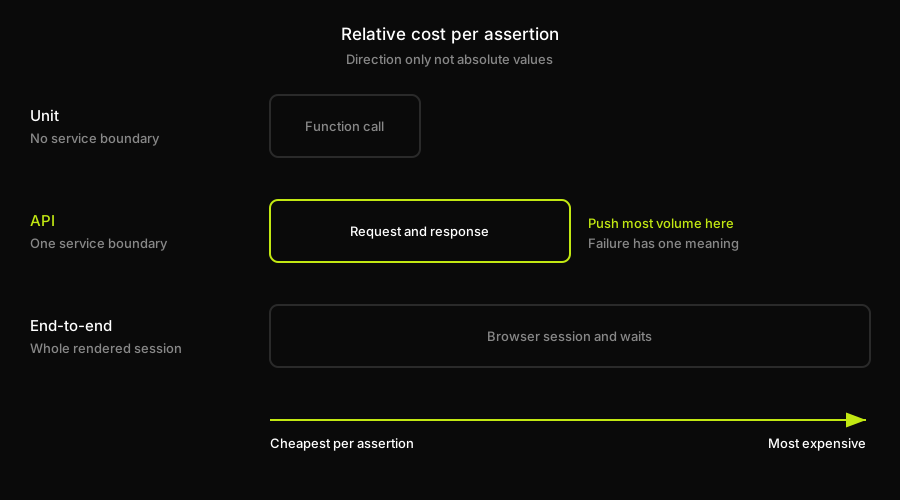
The bars show direction, not measured figures: cost per assertion rises with the number of moving parts a single check has to cross, which is why the API layer is where most of the volume belongs and the browser layer is where it has to be spent deliberately.
That's also the boundary this whole roundup has been drawing around. Get the API layer right with the tool that matches how your team works, whether that's a Postman collection your whole team can read, a REST Assured suite living next to your Java service, or a Pact contract between two teams that don't sit in the same repo. None of that requires standardizing on a single tool company-wide; the five categories above coexist inside one strategy without contradicting each other. For further reading on the open-source side of that decision, our broader roundup of open-source test automation tools, our dedicated look at open source performance testing tools, and our guide to testing APIs from inside Playwright all cover adjacent ground worth cross-checking before you commit to a stack. Then let something else own the layer where a browser session is the only way to observe the failure. That's not a gap in this list. It's the line the list was always meant to draw, and it's the same line Autonoma was built to sit on the other side of.
Frequently Asked Questions
API testing tools verify a service at the request and response boundary rather than through its UI. They fall into five categories: interactive clients for manual exploration (Postman, Bruno, Insomnia), code-first frameworks for CI-run assertions (REST Assured, Karate, SuperTest), contract testing for multi-team API compatibility (Pact), schema-driven fuzzing for edge cases (Schemathesis), and load-shaped checks for behavior under volume (k6).
There isn't one best tool because the category depends on who runs the check. A team documenting an API by hand is better served by Postman or Bruno. A team asserting business logic on every pull request is better served by REST Assured, Karate, or SuperTest. A team split across multiple services benefits most from Pact's contract testing. Pick by category first, then by tool.
They solve different problems. Postman is an interactive client: you build a request by hand, save it as a collection, and replay it, with or without writing code. REST Assured is a Java library meant to run inside an automated suite with no manual step. Teams that need both usually start with Postman collections for exploration and migrate the assertions that matter into a code-first suite once they need CI enforcement.
Every category has at least one openly licensed option. Bruno, Karate, SuperTest, Schemathesis, and Pact are all MIT. REST Assured is Apache 2.0. k6 is AGPL 3.0, maintained under Grafana. Insomnia's repository is Apache 2.0. Postman is the exception: its client is closed commercial software, though its Collection Format v2.1 is a published JSON schema, so collections built in it stay portable to other tools.
Contract testing verifies that a service (the provider) still honors the interactions a dependent service (the consumer) expects, without running both services together. Pact is the common tool: the consumer records its expected interactions as a pact file, typically shared through a Pact Broker, and the provider verifies its real behavior against that file. It catches breaking changes between teams that don't share a codebase or a deploy schedule.
No. API tests verify what a service returns; they cannot verify what a user actually experiences once that response is rendered, clicked through, and acted on in a browser. A well-shaped strategy pushes as much verification as possible down to the API layer because it's cheaper and more stable, then reserves end-to-end tests for the flows, like checkout or a multi-step form, that only exist once a real session is running.
The half a green API suite cannot see: what the user actually gets once that response is rendered. A 200 with a correct JSON body still ships a broken checkout if the button stays disabled, the redirect drops a query parameter, or the success state never renders. Autonoma works that layer. It reads your codebase, generates end-to-end tests from the routes and flows that exist in it, and runs them against a live preview environment on every pull request, with a Diffs Agent that adds and retires cases as the code changes rather than leaving a stale suite behind. It is not a request builder or a contract testing tool, so keep Pact, REST Assured, or Schemathesis for the service boundary. Pairing them is the point: the API layer proves the contract holds, the browser layer proves the feature works, and a strategy that only does the first is the common way a fully green pipeline still ships a broken flow.


