

Manual QA vs AI testing is not a replacement story. Manual QA wins on exploratory testing, UX nuance, and business judgment cases where a human needs to decide whether behavior is correct. AI testing wins on breadth, repeatability, and regression coverage at scale. The mistake teams make: assuming AI test generation eliminates the need for independent verification. Green tests mean consistency, not correctness.
The question engineering leads are actually asking right now is not "manual or AI?" It's something quieter: "Why are our QA engineers still finding things that our AI-generated tests completely missed?"
If you're shipping AI-generated code at speed and leaning on AI-generated tests for confidence, you may have built a loop where the same system that writes the code also writes the verification. No independent source of truth. Everything passes. Something still breaks in production. This post is for engineering leads and QA leads on teams in that position. The manual vs automated testing cost breakdown covers the cost side; this post is the capability split.
What AI Testing Is Genuinely Better At
The honest case for AI testing is not that it replaces judgment. It's that it eliminates the grunt work at a scale no human team can match.
Breadth is the real win. A team of three QA engineers cannot manually cover 200 user flows before every deploy. AI testing can. It doesn't get tired, it doesn't skip the boring flows, and it doesn't forget to test the edge case it tested last sprint. Regression coverage that would take days of manual work runs in minutes. That's not a marginal improvement. It changes what "covered" means.
Repeatability and speed round out the picture. Human testers bring subjectivity to what counts as a pass. One tester flags a slightly misaligned element; another ignores it. AI testing runs the same verification the same way every time, which is exactly the property you want from a regression suite. And continuous deployment pipelines cannot wait for a human QA cycle. Every PR can trigger a full regression pass in CI, and the feedback loop closes before code lands on main.
Where AI testing is genuinely weaker: anything that requires deciding whether a behavior is correct from a business perspective, anything exploratory where you don't know what you're looking for yet, and anything that requires noticing that something feels wrong even though it technically passed.
What Still Needs Human Judgment
The flows AI testing misses are not random. They cluster around a few categories that share a common trait: the expected outcome is not fully specified in code.
Business logic is the clearest example. When a discount should apply, when a refund is valid, when an account status should block an action: these rules live in product decisions, not just code paths. AI test generation reads the codebase and generates tests that verify the code behaves consistently with itself. It does not know whether the rule is right. A QA engineer who understands the business can catch a checkout that applies a discount incorrectly even if the code does exactly what the developer intended.
Teams working with us surface this pattern regularly. The framing we hear: "Our QA engineers are still finding things." Not because AI testing is broken. Because the things being found require someone to say "that's not how it should work," not just "that's not how it works." We've written more about this specific failure mode in why AI misses business-logic bugs.
Exploratory testing and UX nuance are the second and third categories. Good exploratory testing is deliberate investigation without a predefined path. A skilled human tester approaches a new feature with skepticism and a mental model of how real users behave, not how developers expect them to behave. They try combinations no one thought to specify and notice when a flow works correctly but feels wrong. UX nuance goes further: whether an error message is intelligible, whether a form feels broken even if it submits correctly, whether the loading state is long enough to make a user think it crashed. A test can assert that a button is clickable. It cannot assert that the button is where a user would expect to find it, or that the feedback after clicking it is reassuring rather than confusing.
A second signal we see in teams: "We turned on AI testing, our pass rate went up, and then a customer found something in the first week." The issue is usually not coverage gaps in the happy path. It's that no one tested the unhappy path from a user's perspective. AI testing covers what was coded, not what was missed from the user's mental model.
Autonoma belongs in the repeatable E2E breadth layer: running known flows against preview environments so regressions do not depend on manual repetition. Manual QA keeps the judgment layer for business logic, exploratory testing, and UX calls where someone still has to decide whether the behavior is right.
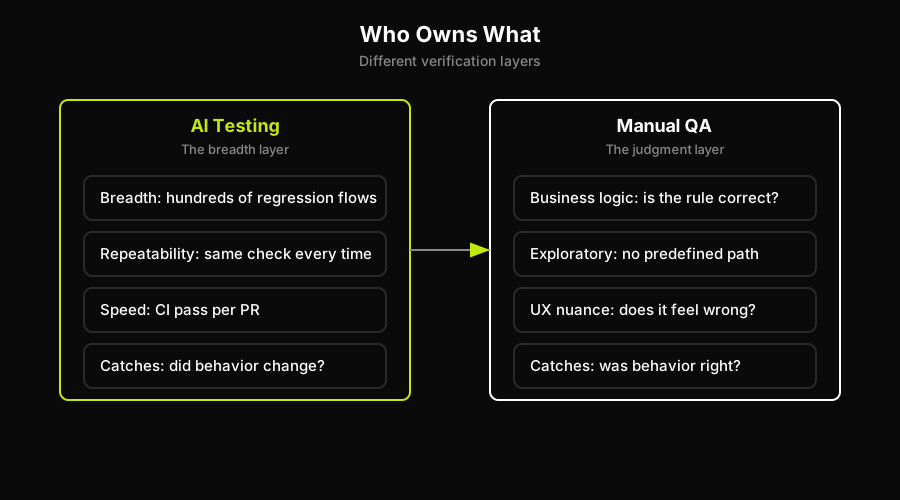
AI covers breadth; manual QA keeps the judgment layer.
The Mistake: Treating AI Generation as a QA Replacement
The failure mode has a specific shape. It's not "AI testing is unreliable." It's the self-verification loop.
When your AI coding assistant generates a feature, and then generates tests for that feature, those tests verify that the feature is consistent with itself. The same assumptions that went into the code go into the tests. If a business rule was misunderstood, the tests reflect the misunderstanding. Everything is green. The misunderstanding ships.
This is the AI test theater pattern: a test suite that was never capable of catching the bugs you actually ship is not a safety net. It's a confidence signal with no underlying signal. Green means consistent. Not correct. Independent verification is only trustworthy when it's independent of the thing being verified.
This is where Autonoma should be evaluated: not as a replacement for judgment, but as the managed breadth layer that runs independent E2E checks on every preview. The point is to remove regression maintenance from QA while preserving the human layer for business logic and UX calls.
How Autonoma Blends AI Breadth with Independent Verification
The answer to the manual-vs-AI question is not a choice between them. It's a sequencing question: what does each layer own, and where does independence live? The answer we built toward at Autonoma starts with that exact constraint.
The pattern teams run into: AI writes the code, AI writes the tests, the tests pass, and something breaks in production. The tests were consistent with the code. They just weren't independent of it.
We built Autonoma to address the independence problem at the AI testing layer. Our approach uses four agents working from your codebase and managed preview runtime, not from the developer's session or the coding assistant's context.
Planner reads your codebase: routes, components, user flows, state transitions. It plans test cases based on what the application does structurally, not based on what a developer said it was supposed to do. It also handles database state setup for each test scenario, generating the endpoints needed to put the app in the right state before a test runs. Executor runs those test cases against a live preview environment, with verification layers at every step to ensure consistent, observable results. Reviewer evaluates each run and classifies what it finds: a real bug, an agent error, or a test/plan mismatch. Diffs Agent analyzes each PR, adds and deprecates test cases, and keeps the suite aligned as the code changes.
The independence matters here. Our agents are generating tests from the codebase as a spec, not from the same session that generated the feature. That's not the same as a human QA engineer reading the business requirement, but it's a meaningfully different signal than a coding assistant verifying its own output.
For the cases that need human judgment: exploratory testing, business-logic checks, UX review. That layer stays human. Our role is to take the breadth layer off QA engineers' plates entirely so they can focus there. A QA engineer who isn't spending three days a week maintaining a regression suite can spend those three days doing the exploratory and business-logic work that actually requires their expertise.
The Blended Model in Practice
The answer to the manual-vs-AI question is not a choice between them. It's a sequencing question: what does each layer own, and where does independence live?
AI testing owns the breadth layer. Every regression, every known flow, every path that was working last week and should still be working: that's AI's job. Running it continuously, in CI, before every merge. No human time spent on flows that haven't changed. Managed preview environments run each test in an isolated context, keeping execution independent from the code author's local environment.
Human judgment owns the cases where the spec is ambiguous, where the business rule is the question, and where something needs a second set of eyes that isn't looking through the same lens as the code author. That's not a small category, but it's a focused one. QA engineers who are no longer writing and maintaining regression scripts have more capacity for exploratory testing, business-logic checks, and UX review. These are exactly the cases where human judgment is irreplaceable.
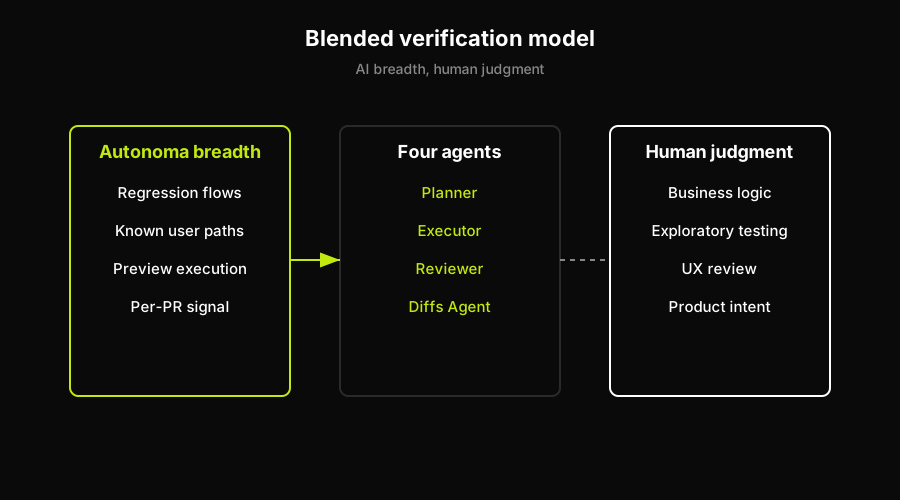
Autonoma owns regression breadth; QA keeps the judgment layer.
The key shift is where QA engineers spend their time. Before: a large share of QA capacity goes to writing regression tests, debugging selector failures, updating test scripts after UI changes. After: that time moves to the high-judgment work that AI cannot do. Exploratory testing sessions on new features. Business-logic review against product requirements. User-perspective testing of edge cases that no automated system would know to check.
Independence is the constraint that runs through both layers. In practice, that is the operating model Autonoma is built for: every PR gets an automated E2E breadth layer from agents that did not author the feature, and QA keeps the high-judgment review that no regression system should pretend to replace. The question is not how to eliminate manual QA. It's how to make sure the verification at each layer is genuinely independent of what it's verifying. That shift in framing, from "replace manual QA" to "keep each layer independent," is what separates teams that ship confidently from teams that ship and hope.
FAQ
No. AI testing replaces the breadth layer: regression coverage, known flows, continuous verification in CI. It does not replace human judgment on business logic, exploratory testing, or UX evaluation. Teams that treat AI testing as a full QA replacement typically discover the gap when something breaks in production that passed every test.
Manual QA is better at business logic validation (deciding whether a rule is correct, not just whether the code is consistent), exploratory testing (finding failure modes that weren't anticipated), and UX judgment (noticing when something feels wrong even if it technically passes). These all require a human who understands intent, not just behavior.
AI testing is better at breadth, repeatability, and speed. It can cover hundreds of regression flows before every deploy, run the same verification the same way every time, and fit inside CI/CD pipelines without blocking deployment velocity. These are exactly the things human QA teams cannot do at scale without significant headcount.
Rarely, and only indirectly. AI testing can find inconsistencies in behavior (something changed from last run). It cannot determine whether the behavior was correct to begin with. Business-logic bugs, where the code does what the developer intended but the intent was wrong, require an external reference point. That's a human judgment call.
Yes, but their role shifts. With AI testing handling regression coverage automatically, QA engineers stop spending time writing and maintaining test scripts. That time moves to exploratory testing, business-logic review, and the edge cases that require human judgment. Teams that use AI testing well typically find their QA engineers more effective, not redundant.


