

Most teams don't set out to adopt an application platform. They set out to fix one specific thing: a pull request that looks fine, deploys fine, and then three days later someone discovers the checkout flow was broken the entire time, because nobody actually opened the preview URL and looked.
Northflank can fix that. It can also fix your production deploys, your background jobs, your managed Postgres, and a chunk of your CI/CD pipeline while it's at it. Whether your team wanted all of that, or just wanted previews that work, is a different question, and it's the one this comparison is actually trying to answer.
Autonoma's managed preview-environment product, PreviewKit, is built for the latter case: teams that need a trustworthy per-PR environment without adopting a new platform for production deployment.
What Northflank Is
Northflank is a full application platform. You can build container images from source, deploy services and background jobs, run managed Postgres and Redis, autoscale workloads, and wire up CI/CD, all from one control plane. It supports self-hosting and bring-your-own-cloud (BYOC) deployments, so teams with data residency or compliance requirements can run the platform on their own infrastructure rather than a shared multi-tenant cloud.
Preview environments are one capability inside that platform, not a standalone product. A preview typically spins up as a step in the same pipeline that builds and deploys production: open a pull request, Northflank builds the image, and an environment comes up alongside whatever other services the pipeline already touches. Templates and GitOps-style configuration make that repeatable across services once it's set up.
Where the Full-Platform Model Shines
Give Northflank its due. For a team already running production workloads on Northflank, previews are close to free conceptually: they inherit the same project structure, the same resource quotas, and the same deploy templates that already exist for production. There's no second platform to operate, no second vendor relationship, and no separate mental model for "how previews work" versus "how everything else works."
That consolidation is a genuine advantage for teams standardizing infrastructure. One platform means one place to manage secrets, one billing relationship, one support channel, and one set of GitOps templates that cover build, deploy, run, and preview in the same syntax. If self-hosting or BYOC matters, because of data residency, cost control at scale, or simply not wanting workloads on someone else's shared cloud, Northflank's model supports that in a way a narrower, hosted-only preview product typically doesn't.
Northflank Preview Environments and the Data Layer
Here's where the calculation changes for a team that only wants previews. Adopting Northflank purely to get preview environments means adopting its deploy model, its project structure, its templating syntax, and its resource-quota system, even if you have no interest in running production there. That's a real learning curve and a real migration cost, not a checkbox.
But the more specific gap, the one most preview-environment comparisons skip entirely, is the database. On Northflank, a preview typically gets a new database service alongside the rest of the environment. Seed jobs exist, but they're opt-in configuration: something a team writes, wires into the pipeline, and maintains, not something that happens automatically when a PR opens. Skip that step, which teams often do under deadline pressure, and the preview boots against an empty schema.
An empty database hides exactly the bugs that matter: pagination behavior at row 10,001, N+1 queries that only show up with realistic volume, and authorization rules that pass trivially when there's only one row to check. The alternative, pointing every preview at a shared staging database, trades that problem for a different one: previews that collide, tests that flake because another PR just wrote to the same row, and a "which environment actually has clean data right now" guessing game every sprint.
The same gap shows up in testing. Northflank will give a pull request a live, reachable environment. Whether anything runs against that environment, and whether a reviewer sees the result before merging, is a separate pipeline step someone has to build and keep working. A preview with no tests running against it isn't a verified environment. It's a deploy with a URL.
That is the boundary PreviewKit is designed around: each pull request gets isolated data and web-first end-to-end testing as part of the managed preview workflow, rather than leaving both as pipeline work for the team to assemble.
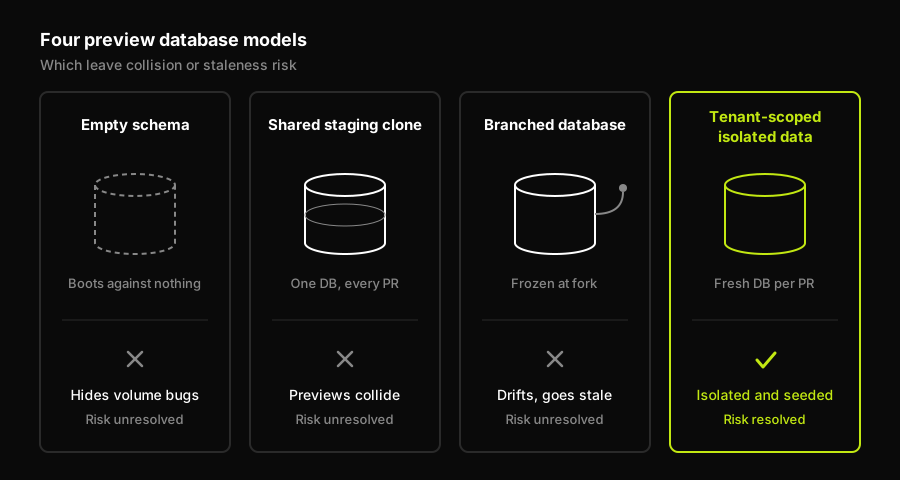
Northflank gets you a database service per environment. Which of these four models it behaves like depends entirely on whether someone wired up seeding.
| Dimension | Northflank | PreviewKit |
|---|---|---|
| Model | Full app platform, previews included | Managed, previews only |
| Data layer | Seed job optional, opt-in | Isolated DB per PR, by default |
| Testing | Bring your own runner | E2E tests run automatically |
| Setup effort | Migrate deploys onto platform | Connect codebase, low setup |
| Self-host / BYOC | Yes, Northflank cloud or BYOC | Managed (runtime is open source) |
| Pricing model | Usage-based, per compute-hour | Managed plan, no infra billing |
How PreviewKit Closes the Gap
The pain this article has been describing isn't that Northflank is a bad platform. It's genuinely capable at the thing it's built for: running production and preview workloads under one deploy model. The gap is that "the environment exists" and "the environment is trustworthy" are two different claims, and a general-purpose application platform is optimized for the first one.
Autonoma built PreviewKit specifically to close that second gap, without asking a team to adopt a whole platform to get there. Connect your codebase, and PreviewKit provisions a full-stack preview per pull request, backend, isolated database, and supporting services, then verifies it before a human opens the PR. A Planner agent reads the actual code (routes, components, the flows the code implies) and plans test cases, including the database state each scenario needs, generating the endpoints required to put that database in the right shape automatically, not as a seed script someone maintains by hand. An Executor agent drives those tests against the live preview. A Reviewer agent classifies each result: a real bug, an agent error, or a mismatch between the test and the current plan, so a merge decision doesn't come down to someone eyeballing a flaky run. A Diffs Agent runs on every PR and updates, adds, or deprecates test cases based on what the code diff actually changed, so the suite doesn't quietly drift out of sync with the app.
Every one of those agents includes verification layers at each step, so results stay consistent rather than depending on whichever path an agent happened to take that run. The net effect: the two things Northflank leaves as follow-up projects, isolated realistic data and automatic test verification, are the default behavior instead of the opt-in configuration.
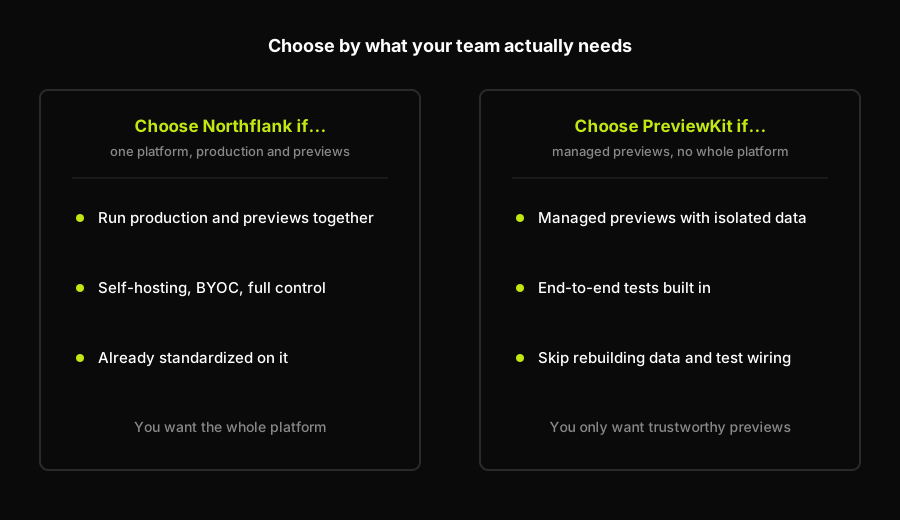
Neither side wins by default. Pick Northflank if you want one platform for production and previews. Pick PreviewKit if previews with isolated data and tests are all you actually need.
Choose Northflank if...
Northflank is the right call if your team already runs production on it, or is planning to, and wants previews to inherit that same project structure with no second platform to operate. It's also the stronger fit if self-hosting or BYOC is a hard requirement, if your infrastructure team wants one GitOps syntax across build, deploy, run, and preview, or if the breadth of a full application platform, jobs, managed databases, autoscaling, CI/CD, is something you need anyway and previews are just one more capability you get along the way.
Choose PreviewKit if...
PreviewKit is the better fit if previews are the specific problem you're solving, and you'd rather not migrate deploys onto a new platform to get them. It's the right call if the data layer and test verification are the parts you keep rebuilding by hand: another seed script per service, another flaky shared staging environment, another postmortem where "the preview looked fine" turns out to be the root cause. It trades some of Northflank's platform breadth for a narrower, managed product where isolated data and passing tests are the default per PR, not a configuration project. That is its deliberate scope: PreviewKit is a managed preview environment, not a replacement for a full production application platform.
A Trust Note
We build PreviewKit, so weigh the above accordingly. We tried to describe Northflank the way a fair engineer evaluating it would: a genuinely capable full application platform where previews are a real, if secondary, feature, and the right call for teams that want one platform for production and previews together. Where that's true, we said so directly, not as a hedge.
The data-layer gap described here isn't specific to Northflank. It shows up across most platforms in this category, which is exactly why we built PreviewKit to sit on that specific ground rather than trying to out-platform the platforms. That's our bias, named plainly.
For the wider landscape beyond this single comparison, see our roundup of ephemeral environment platforms, and how PreviewKit compares to other managed options in PreviewKit vs Uffizzi, PreviewKit vs Qovery, PreviewKit vs Release, and PreviewKit vs Signadot.
Whether the right answer for your team is Northflank, PreviewKit, or something else on that list, the question worth asking before either adoption is the one this whole platform category tends to skip: who owns the data inside the preview, and who verifies it works, once the environment is up.
Frequently Asked Questions
Not by default. Northflank provisions a new database service alongside each preview environment, but seeding it with realistic data is an opt-in job a team configures and maintains, not automatic behavior out of the box.
No. Northflank gives a pull request a live, reachable environment, but running a test suite against it and surfacing results to reviewers before merge is a separate pipeline step your team builds and maintains.
Yes. Northflank supports bring-your-own-cloud and self-hosted deployments in addition to its managed cloud, which matters for teams with data residency or compliance requirements around where preview and production workloads run.
It depends on what you're solving for. If your team already runs production on Northflank and wants previews on the same platform, Northflank is a reasonable choice. If previews are the specific problem, and you'd rather not adopt a full application platform to get isolated data and automated testing, PreviewKit is built for exactly that gap.
Beyond the usage-based compute pricing, the cost is migrating your deploy process onto Northflank's project and template model, learning its GitOps syntax, and still building your own database seeding and test-running pipeline on top, since neither is automatic.


